SUBSCRIBE TO OUR FREE NEWSLETTER
Daily news & progressive opinion—funded by the people, not the corporations—delivered straight to your inbox.
5
#000000
#FFFFFF
To donate by check, phone, or other method, see our More Ways to Give page.
Daily news & progressive opinion—funded by the people, not the corporations—delivered straight to your inbox.
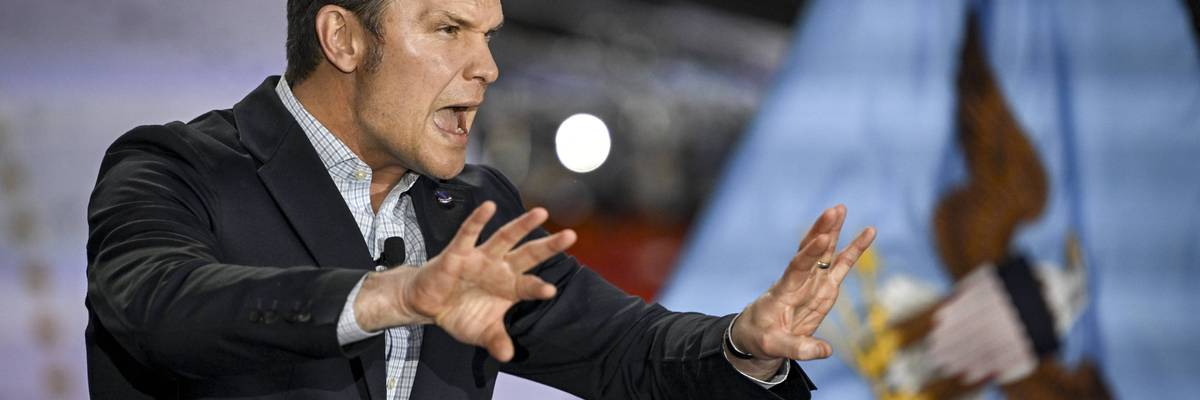
United States Secretary of War Pete Hegseth speaks during a visit to Sierra Space in Louisville, Colorado on Monday, February 23, 2026.
Politically, war and militarism are taken utterly for granted, but the “creation of peace” is controversial. Why?
“In the 21st century, the United States has spent almost $8 trillion on foreign wars, with nearly 5 million lives lost.”
And we’re only a quarter of the way into the century. Are we aiming for 20 million dead civilians by 2100? Here’s a recent Truth Social post from the current president: “For Iran, the Clock is Ticking, and they better get moving, FAST, or there won’t be anything left of them.”
There’s a moral insanity to these words, hiding behind a ho-hum collective shrug. People either brush it off as “just talk” or, even more ominously, nod their heads and smile in agreement. Yeah, he’s keeping us safe. War, the planet’s great, lethal abstraction, is necessary. It keeps us safe. It eliminates evil. Yada, yada. No matter it does none of those things—indeed, does just the opposite. Public acceptance of the inevitability and necessity of war has been expanding throughout my lifetime.
The quote at the top of the column, tossing out a few incomprehensible statistics, is one of the findings included in the 2025 bill presented before Congress to establish a Department of Peacebuilding, introduced by Rep. Ilhan Omar (D-Minn.). It’s the most recent in a long, long line of bills and proposals over the years, meant to establish peace—whatever that is—as a matter of national significance and responsibility. No such bill has ever been passed; all have remained marginal... and no doubt cynically dismissed.
Probably the only way to gain political traction is to focus on peace not as political or ideological, but as structurally logical. Peacebuilding works!
Politically, war and militarism, as well as armed policing and the prison-industrial complex—all of which are funded annually by multitrillions of dollars of the federal and other public budgets—are taken utterly for granted. But the “creation of peace” is controversial. Why?
Of all the questions buzzing around in my mind, this is perhaps the largest—and most predatory. Here are some more findings from the 2025 Department of Peacebuilding bill:
And on and on. The bill also notes:
The preamble of the Earth Charter provides, "To move forward we must recognize that in the midst of a magnificent diversity of cultures and life forms we are one human family and one Earth community with a common destiny. We must join together to bring forth a sustainable global society founded on respect for nature, universal human rights, economic justice, and a culture of peace.”
Which country would you rather live in? That country or this one, as summed up by “Secretary of War” Pete Hegseth:
America, regardless of what so-called international institutions say, is unleashing the most lethal and precise air power campaign in history. B-2s, fighters, drones, missiles, and of course classified effects. All on our terms with maximum authorities. No stupid rules of engagement, no nation-building quagmire, no democracy building exercise, no politically correct wars. We fight to win, and we don't waste time or lives.
Can peacebuilding even be acknowledged as legitimate in such a culture? The ever-present necessity of war not only unites the nation state—it’s us vs. the bad guys, the commies, the terrorists, or whoever—it provides moral protection for those who have already committed or supported murder of “the other,” including the murder of children. Including genocide. The vet suicide rate is an example of what happens when this moral protection vanishes.
What a complex reality faced by those of us who believe—with all our hearts—in the recognition and establishment of peacebuilding at the national level. Probably the only way to gain political traction is to focus on peace not as political or ideological, but as structurally logical. Peacebuilding works! Restorative Justice is certainly one example: creating a structure of healing for people harmed by a crime, rather than simply hunting down and punishing the “offender,” changing nothing.
Of course, another problem faced by peacebuilders is that the current violence-based, non-functional system is lucrative for investors—in weaponry, prisons, etc. How dare those peaceniks challenge this!
All we can do is refuse to give up—and refuse to look at “peace” as an us-vs.-them problem, easy (and tempting) as that is to do. The powerful will, and should, also benefit from peacebuilding, though not perhaps in a way they can understand. Power comes with connection, not domination.
Note: I’ll continue to address this issue and, indeed, continue writing my column, even though this is the last one being syndicated by the Chicago Tribune, after 27 years.
Dear Common Dreams reader, It’s been nearly 30 years since I co-founded Common Dreams with my late wife, Lina Newhouser. We had the radical notion that journalism should serve the public good, not corporate profits. It was clear to us from the outset what it would take to build such a project. No paid advertisements. No corporate sponsors. No millionaire publisher telling us what to think or do. Many people said we wouldn't last a year, but we proved those doubters wrong. Together with a tremendous team of journalists and dedicated staff, we built an independent media outlet free from the constraints of profits and corporate control. Our mission has always been simple: To inform. To inspire. To ignite change for the common good. Building Common Dreams was not easy. Our survival was never guaranteed. When you take on the most powerful forces—Wall Street greed, fossil fuel industry destruction, Big Tech lobbyists, and uber-rich oligarchs who have spent billions upon billions rigging the economy and democracy in their favor—the only bulwark you have is supporters who believe in your work. But here’s the urgent message from me today. It's never been this bad out there. And it's never been this hard to keep us going. At the very moment Common Dreams is most needed, the threats we face are intensifying. We need your support now more than ever. We don't accept corporate advertising and never will. We don't have a paywall because we don't think people should be blocked from critical news based on their ability to pay. Everything we do is funded by the donations of readers like you. When everyone does the little they can afford, we are strong. But if that support retreats or dries up, so do we. Will you donate now to make sure Common Dreams not only survives but thrives? —Craig Brown, Co-founder |
“In the 21st century, the United States has spent almost $8 trillion on foreign wars, with nearly 5 million lives lost.”
And we’re only a quarter of the way into the century. Are we aiming for 20 million dead civilians by 2100? Here’s a recent Truth Social post from the current president: “For Iran, the Clock is Ticking, and they better get moving, FAST, or there won’t be anything left of them.”
There’s a moral insanity to these words, hiding behind a ho-hum collective shrug. People either brush it off as “just talk” or, even more ominously, nod their heads and smile in agreement. Yeah, he’s keeping us safe. War, the planet’s great, lethal abstraction, is necessary. It keeps us safe. It eliminates evil. Yada, yada. No matter it does none of those things—indeed, does just the opposite. Public acceptance of the inevitability and necessity of war has been expanding throughout my lifetime.
The quote at the top of the column, tossing out a few incomprehensible statistics, is one of the findings included in the 2025 bill presented before Congress to establish a Department of Peacebuilding, introduced by Rep. Ilhan Omar (D-Minn.). It’s the most recent in a long, long line of bills and proposals over the years, meant to establish peace—whatever that is—as a matter of national significance and responsibility. No such bill has ever been passed; all have remained marginal... and no doubt cynically dismissed.
Probably the only way to gain political traction is to focus on peace not as political or ideological, but as structurally logical. Peacebuilding works!
Politically, war and militarism, as well as armed policing and the prison-industrial complex—all of which are funded annually by multitrillions of dollars of the federal and other public budgets—are taken utterly for granted. But the “creation of peace” is controversial. Why?
Of all the questions buzzing around in my mind, this is perhaps the largest—and most predatory. Here are some more findings from the 2025 Department of Peacebuilding bill:
And on and on. The bill also notes:
The preamble of the Earth Charter provides, "To move forward we must recognize that in the midst of a magnificent diversity of cultures and life forms we are one human family and one Earth community with a common destiny. We must join together to bring forth a sustainable global society founded on respect for nature, universal human rights, economic justice, and a culture of peace.”
Which country would you rather live in? That country or this one, as summed up by “Secretary of War” Pete Hegseth:
America, regardless of what so-called international institutions say, is unleashing the most lethal and precise air power campaign in history. B-2s, fighters, drones, missiles, and of course classified effects. All on our terms with maximum authorities. No stupid rules of engagement, no nation-building quagmire, no democracy building exercise, no politically correct wars. We fight to win, and we don't waste time or lives.
Can peacebuilding even be acknowledged as legitimate in such a culture? The ever-present necessity of war not only unites the nation state—it’s us vs. the bad guys, the commies, the terrorists, or whoever—it provides moral protection for those who have already committed or supported murder of “the other,” including the murder of children. Including genocide. The vet suicide rate is an example of what happens when this moral protection vanishes.
What a complex reality faced by those of us who believe—with all our hearts—in the recognition and establishment of peacebuilding at the national level. Probably the only way to gain political traction is to focus on peace not as political or ideological, but as structurally logical. Peacebuilding works! Restorative Justice is certainly one example: creating a structure of healing for people harmed by a crime, rather than simply hunting down and punishing the “offender,” changing nothing.
Of course, another problem faced by peacebuilders is that the current violence-based, non-functional system is lucrative for investors—in weaponry, prisons, etc. How dare those peaceniks challenge this!
All we can do is refuse to give up—and refuse to look at “peace” as an us-vs.-them problem, easy (and tempting) as that is to do. The powerful will, and should, also benefit from peacebuilding, though not perhaps in a way they can understand. Power comes with connection, not domination.
Note: I’ll continue to address this issue and, indeed, continue writing my column, even though this is the last one being syndicated by the Chicago Tribune, after 27 years.
“In the 21st century, the United States has spent almost $8 trillion on foreign wars, with nearly 5 million lives lost.”
And we’re only a quarter of the way into the century. Are we aiming for 20 million dead civilians by 2100? Here’s a recent Truth Social post from the current president: “For Iran, the Clock is Ticking, and they better get moving, FAST, or there won’t be anything left of them.”
There’s a moral insanity to these words, hiding behind a ho-hum collective shrug. People either brush it off as “just talk” or, even more ominously, nod their heads and smile in agreement. Yeah, he’s keeping us safe. War, the planet’s great, lethal abstraction, is necessary. It keeps us safe. It eliminates evil. Yada, yada. No matter it does none of those things—indeed, does just the opposite. Public acceptance of the inevitability and necessity of war has been expanding throughout my lifetime.
The quote at the top of the column, tossing out a few incomprehensible statistics, is one of the findings included in the 2025 bill presented before Congress to establish a Department of Peacebuilding, introduced by Rep. Ilhan Omar (D-Minn.). It’s the most recent in a long, long line of bills and proposals over the years, meant to establish peace—whatever that is—as a matter of national significance and responsibility. No such bill has ever been passed; all have remained marginal... and no doubt cynically dismissed.
Probably the only way to gain political traction is to focus on peace not as political or ideological, but as structurally logical. Peacebuilding works!
Politically, war and militarism, as well as armed policing and the prison-industrial complex—all of which are funded annually by multitrillions of dollars of the federal and other public budgets—are taken utterly for granted. But the “creation of peace” is controversial. Why?
Of all the questions buzzing around in my mind, this is perhaps the largest—and most predatory. Here are some more findings from the 2025 Department of Peacebuilding bill:
And on and on. The bill also notes:
The preamble of the Earth Charter provides, "To move forward we must recognize that in the midst of a magnificent diversity of cultures and life forms we are one human family and one Earth community with a common destiny. We must join together to bring forth a sustainable global society founded on respect for nature, universal human rights, economic justice, and a culture of peace.”
Which country would you rather live in? That country or this one, as summed up by “Secretary of War” Pete Hegseth:
America, regardless of what so-called international institutions say, is unleashing the most lethal and precise air power campaign in history. B-2s, fighters, drones, missiles, and of course classified effects. All on our terms with maximum authorities. No stupid rules of engagement, no nation-building quagmire, no democracy building exercise, no politically correct wars. We fight to win, and we don't waste time or lives.
Can peacebuilding even be acknowledged as legitimate in such a culture? The ever-present necessity of war not only unites the nation state—it’s us vs. the bad guys, the commies, the terrorists, or whoever—it provides moral protection for those who have already committed or supported murder of “the other,” including the murder of children. Including genocide. The vet suicide rate is an example of what happens when this moral protection vanishes.
What a complex reality faced by those of us who believe—with all our hearts—in the recognition and establishment of peacebuilding at the national level. Probably the only way to gain political traction is to focus on peace not as political or ideological, but as structurally logical. Peacebuilding works! Restorative Justice is certainly one example: creating a structure of healing for people harmed by a crime, rather than simply hunting down and punishing the “offender,” changing nothing.
Of course, another problem faced by peacebuilders is that the current violence-based, non-functional system is lucrative for investors—in weaponry, prisons, etc. How dare those peaceniks challenge this!
All we can do is refuse to give up—and refuse to look at “peace” as an us-vs.-them problem, easy (and tempting) as that is to do. The powerful will, and should, also benefit from peacebuilding, though not perhaps in a way they can understand. Power comes with connection, not domination.
Note: I’ll continue to address this issue and, indeed, continue writing my column, even though this is the last one being syndicated by the Chicago Tribune, after 27 years.