SUBSCRIBE TO OUR FREE NEWSLETTER
Daily news & progressive opinion—funded by the people, not the corporations—delivered straight to your inbox.
5
#000000
#FFFFFF
To donate by check, phone, or other method, see our More Ways to Give page.
Daily news & progressive opinion—funded by the people, not the corporations—delivered straight to your inbox.
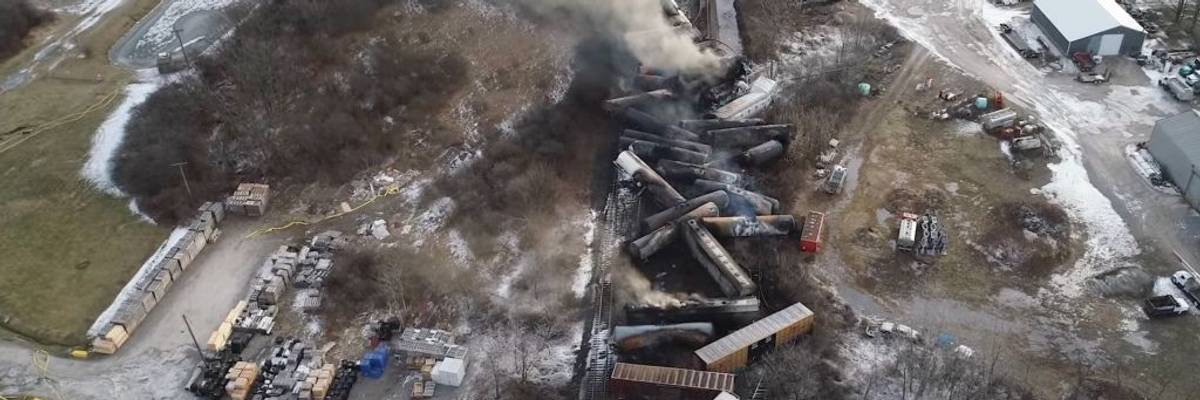
About 50 Norfolk Southern freight train cars derailed on the night of Feb. 3 in East Palestine, a town of 4,800 residents near the Ohio-Pennsylvania border, due to a mechanical problem on an axle of one of the vehicles.
It should be no surprise that corporate greed is making life dangerous for ever greater numbers of people.
I’m not surprised that migrant children who have been coming into the United States from Latin America without their parents, fleeing violence and poverty, have ended up in some of the most punishing jobs in the country.
And I’m not surprised that a train carrying dangerous chemicals derailed, causing a toxic plume that is sickening people in Ohio.
In fact, I’m not surprised that corporate greed is making life dangerous for ever greater numbers of people.
I saw it when I was secretary of labor in the early 1990s, overseeing enforcing the nation’s labor laws.
The department had only 1,100 inspectors responsible for the health and safety of 130 million workers, including any children who might be working illegally in dangerous conditions. And not even the biggest penalty we could impose was high enough to deter companies that treated such fines as costs of doing business.
The Labor Department is still woefully understaffed, and penalties are still too low. Every time the department’s budget is up for review, members of Congress — mostly (but not entirely) Republicans — refuse to appropriate enough funds for inspectors or to increase penalties.
So of course migrant children coming into the United States, fleeing violence and poverty, have ended up in dangerous jobs.
In Delaware, Mississippi, and North Carolina, young children are working in slaughterhouses. In Michigan, young children are making auto parts used by Ford and General Motors. In Virginia, girls as young as 13 are washing hotel sheets. In Florida and Tennessee, 12-year-olds are doing roofing jobs. In South Dakota, children are sawing planks of wood on overnight shifts.
It’s a throwback to the late 19th century, when children were drafted into dangerous work.
On Monday, the Department of Labor announced new steps to stop exploitative child labor. Biden officials say they’ll ask Congress to increase funding for inspectors and to increase monetary penalties.
Just as Republican tax cuts for big corporations and the wealthy have not trickled down, Republican regulatory cuts have not benefited most people.
But on the basis of my experience, I know that industry lobbyists will fight these steps tooth and nail. And most Republicans (along with some Democrats) will do their bidding, because many of these companies finance their campaigns.
The problem extends far beyond child labor.
On February 3, a freight train carrying hazardous materials derailed in East Palestine, Ohio. The result was a massive fire with plumes of black smoke, an evacuation order, and worries about the impact on the environment and public health.
Amid mounting criticism that Biden did not personally visit East Palestine, Donald Trump showed up. He handed out branded water bottles and bragged afterward about the “incredible reach” of his visit in the media and online.
Yet Trump oversaw a major rollback of rail-safety regulations after the rail industry delivered more than $6 million to GOP campaigns. Backed by Senate Republicans, the Trump administration rescinded part of an Obama rule requiring railroads to have better brakes, and it killed requirements that rail cars carrying hazardous flammable materials be equipped with electronic braking systems.
Norfolk Southern had once touted electronic braking systems, but the company’s lobbyists pressed for the rule’s repeal, telling regulators it would “impose tremendous costs without providing offsetting safety benefits.” The argument prevailed with Trump officials. (The Biden administration has not moved to reinstate the brake rule or expand the kinds of trains subjected to tougher safety regulations.)
Ever since Ronald Reagan decried government regulation as strangling the economy, Republicans have resisted all efforts to constrain corporate greed through health, safety, environmental, and labor protections. In Congress, they’ve starved agencies of funds they need to enforce regulations or kept penalties so low that regulations don’t deter corporate misconduct.
When they control the White House, they rescind tougher rules put in place by previous Democratic administrations and staff regulatory agencies and departments with industry stooges — foxes guarding henhouses — to ensure that proposed regulations are slowed and that enforcement is hobbled.
Their argument is always the same: Regulations stifle growth and jobs.
But just as Republican tax cuts for big corporations and the wealthy have not trickled down, Republican regulatory cuts have not benefited most people. Big companies and their major shareholders enjoy larger profits, but average working people bear the costs and risks. Citizens in places like East Palestine, Ohio, become sickened by toxic plumes. Children fleeing violence and poverty in Latin America become injured on jobs they should never have been offered.
Capitalism needs regulation if it is to serve the public. Greed requires guardrails if it is to stay on track.
Dear Common Dreams reader, It’s been nearly 30 years since I co-founded Common Dreams with my late wife, Lina Newhouser. We had the radical notion that journalism should serve the public good, not corporate profits. It was clear to us from the outset what it would take to build such a project. No paid advertisements. No corporate sponsors. No millionaire publisher telling us what to think or do. Many people said we wouldn't last a year, but we proved those doubters wrong. Together with a tremendous team of journalists and dedicated staff, we built an independent media outlet free from the constraints of profits and corporate control. Our mission has always been simple: To inform. To inspire. To ignite change for the common good. Building Common Dreams was not easy. Our survival was never guaranteed. When you take on the most powerful forces—Wall Street greed, fossil fuel industry destruction, Big Tech lobbyists, and uber-rich oligarchs who have spent billions upon billions rigging the economy and democracy in their favor—the only bulwark you have is supporters who believe in your work. But here’s the urgent message from me today. It's never been this bad out there. And it's never been this hard to keep us going. At the very moment Common Dreams is most needed, the threats we face are intensifying. We need your support now more than ever. We don't accept corporate advertising and never will. We don't have a paywall because we don't think people should be blocked from critical news based on their ability to pay. Everything we do is funded by the donations of readers like you. When everyone does the little they can afford, we are strong. But if that support retreats or dries up, so do we. Will you donate now to make sure Common Dreams not only survives but thrives? —Craig Brown, Co-founder |
I’m not surprised that migrant children who have been coming into the United States from Latin America without their parents, fleeing violence and poverty, have ended up in some of the most punishing jobs in the country.
And I’m not surprised that a train carrying dangerous chemicals derailed, causing a toxic plume that is sickening people in Ohio.
In fact, I’m not surprised that corporate greed is making life dangerous for ever greater numbers of people.
I saw it when I was secretary of labor in the early 1990s, overseeing enforcing the nation’s labor laws.
The department had only 1,100 inspectors responsible for the health and safety of 130 million workers, including any children who might be working illegally in dangerous conditions. And not even the biggest penalty we could impose was high enough to deter companies that treated such fines as costs of doing business.
The Labor Department is still woefully understaffed, and penalties are still too low. Every time the department’s budget is up for review, members of Congress — mostly (but not entirely) Republicans — refuse to appropriate enough funds for inspectors or to increase penalties.
So of course migrant children coming into the United States, fleeing violence and poverty, have ended up in dangerous jobs.
In Delaware, Mississippi, and North Carolina, young children are working in slaughterhouses. In Michigan, young children are making auto parts used by Ford and General Motors. In Virginia, girls as young as 13 are washing hotel sheets. In Florida and Tennessee, 12-year-olds are doing roofing jobs. In South Dakota, children are sawing planks of wood on overnight shifts.
It’s a throwback to the late 19th century, when children were drafted into dangerous work.
On Monday, the Department of Labor announced new steps to stop exploitative child labor. Biden officials say they’ll ask Congress to increase funding for inspectors and to increase monetary penalties.
Just as Republican tax cuts for big corporations and the wealthy have not trickled down, Republican regulatory cuts have not benefited most people.
But on the basis of my experience, I know that industry lobbyists will fight these steps tooth and nail. And most Republicans (along with some Democrats) will do their bidding, because many of these companies finance their campaigns.
The problem extends far beyond child labor.
On February 3, a freight train carrying hazardous materials derailed in East Palestine, Ohio. The result was a massive fire with plumes of black smoke, an evacuation order, and worries about the impact on the environment and public health.
Amid mounting criticism that Biden did not personally visit East Palestine, Donald Trump showed up. He handed out branded water bottles and bragged afterward about the “incredible reach” of his visit in the media and online.
Yet Trump oversaw a major rollback of rail-safety regulations after the rail industry delivered more than $6 million to GOP campaigns. Backed by Senate Republicans, the Trump administration rescinded part of an Obama rule requiring railroads to have better brakes, and it killed requirements that rail cars carrying hazardous flammable materials be equipped with electronic braking systems.
Norfolk Southern had once touted electronic braking systems, but the company’s lobbyists pressed for the rule’s repeal, telling regulators it would “impose tremendous costs without providing offsetting safety benefits.” The argument prevailed with Trump officials. (The Biden administration has not moved to reinstate the brake rule or expand the kinds of trains subjected to tougher safety regulations.)
Ever since Ronald Reagan decried government regulation as strangling the economy, Republicans have resisted all efforts to constrain corporate greed through health, safety, environmental, and labor protections. In Congress, they’ve starved agencies of funds they need to enforce regulations or kept penalties so low that regulations don’t deter corporate misconduct.
When they control the White House, they rescind tougher rules put in place by previous Democratic administrations and staff regulatory agencies and departments with industry stooges — foxes guarding henhouses — to ensure that proposed regulations are slowed and that enforcement is hobbled.
Their argument is always the same: Regulations stifle growth and jobs.
But just as Republican tax cuts for big corporations and the wealthy have not trickled down, Republican regulatory cuts have not benefited most people. Big companies and their major shareholders enjoy larger profits, but average working people bear the costs and risks. Citizens in places like East Palestine, Ohio, become sickened by toxic plumes. Children fleeing violence and poverty in Latin America become injured on jobs they should never have been offered.
Capitalism needs regulation if it is to serve the public. Greed requires guardrails if it is to stay on track.
I’m not surprised that migrant children who have been coming into the United States from Latin America without their parents, fleeing violence and poverty, have ended up in some of the most punishing jobs in the country.
And I’m not surprised that a train carrying dangerous chemicals derailed, causing a toxic plume that is sickening people in Ohio.
In fact, I’m not surprised that corporate greed is making life dangerous for ever greater numbers of people.
I saw it when I was secretary of labor in the early 1990s, overseeing enforcing the nation’s labor laws.
The department had only 1,100 inspectors responsible for the health and safety of 130 million workers, including any children who might be working illegally in dangerous conditions. And not even the biggest penalty we could impose was high enough to deter companies that treated such fines as costs of doing business.
The Labor Department is still woefully understaffed, and penalties are still too low. Every time the department’s budget is up for review, members of Congress — mostly (but not entirely) Republicans — refuse to appropriate enough funds for inspectors or to increase penalties.
So of course migrant children coming into the United States, fleeing violence and poverty, have ended up in dangerous jobs.
In Delaware, Mississippi, and North Carolina, young children are working in slaughterhouses. In Michigan, young children are making auto parts used by Ford and General Motors. In Virginia, girls as young as 13 are washing hotel sheets. In Florida and Tennessee, 12-year-olds are doing roofing jobs. In South Dakota, children are sawing planks of wood on overnight shifts.
It’s a throwback to the late 19th century, when children were drafted into dangerous work.
On Monday, the Department of Labor announced new steps to stop exploitative child labor. Biden officials say they’ll ask Congress to increase funding for inspectors and to increase monetary penalties.
Just as Republican tax cuts for big corporations and the wealthy have not trickled down, Republican regulatory cuts have not benefited most people.
But on the basis of my experience, I know that industry lobbyists will fight these steps tooth and nail. And most Republicans (along with some Democrats) will do their bidding, because many of these companies finance their campaigns.
The problem extends far beyond child labor.
On February 3, a freight train carrying hazardous materials derailed in East Palestine, Ohio. The result was a massive fire with plumes of black smoke, an evacuation order, and worries about the impact on the environment and public health.
Amid mounting criticism that Biden did not personally visit East Palestine, Donald Trump showed up. He handed out branded water bottles and bragged afterward about the “incredible reach” of his visit in the media and online.
Yet Trump oversaw a major rollback of rail-safety regulations after the rail industry delivered more than $6 million to GOP campaigns. Backed by Senate Republicans, the Trump administration rescinded part of an Obama rule requiring railroads to have better brakes, and it killed requirements that rail cars carrying hazardous flammable materials be equipped with electronic braking systems.
Norfolk Southern had once touted electronic braking systems, but the company’s lobbyists pressed for the rule’s repeal, telling regulators it would “impose tremendous costs without providing offsetting safety benefits.” The argument prevailed with Trump officials. (The Biden administration has not moved to reinstate the brake rule or expand the kinds of trains subjected to tougher safety regulations.)
Ever since Ronald Reagan decried government regulation as strangling the economy, Republicans have resisted all efforts to constrain corporate greed through health, safety, environmental, and labor protections. In Congress, they’ve starved agencies of funds they need to enforce regulations or kept penalties so low that regulations don’t deter corporate misconduct.
When they control the White House, they rescind tougher rules put in place by previous Democratic administrations and staff regulatory agencies and departments with industry stooges — foxes guarding henhouses — to ensure that proposed regulations are slowed and that enforcement is hobbled.
Their argument is always the same: Regulations stifle growth and jobs.
But just as Republican tax cuts for big corporations and the wealthy have not trickled down, Republican regulatory cuts have not benefited most people. Big companies and their major shareholders enjoy larger profits, but average working people bear the costs and risks. Citizens in places like East Palestine, Ohio, become sickened by toxic plumes. Children fleeing violence and poverty in Latin America become injured on jobs they should never have been offered.
Capitalism needs regulation if it is to serve the public. Greed requires guardrails if it is to stay on track.