
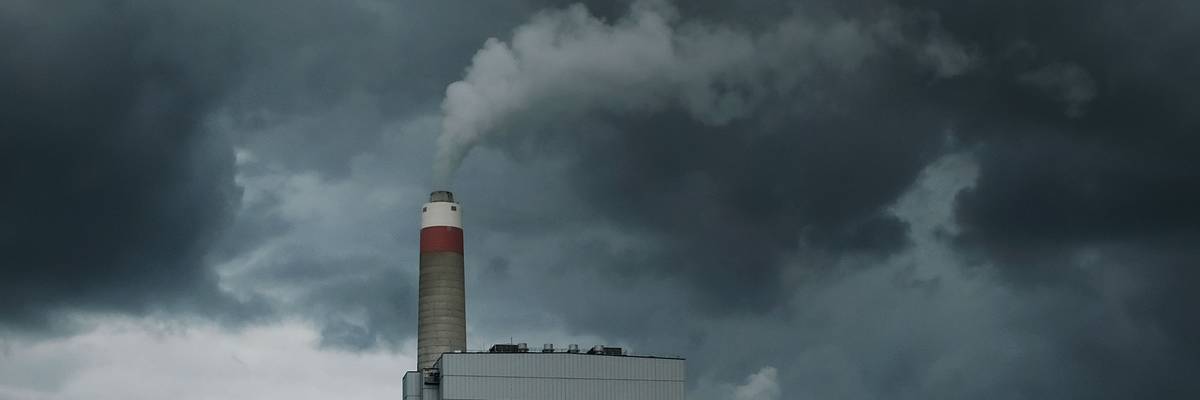
The Longview Power Plant, a coal-fired plant, stands on August 21, 2018 in Maidsville, West Virginia.
The Fight Over Worst-Case Climate Scenarios Reveals a Science Communication Failure
When articles imply a scientific model was wrong when it was merely updated to reflect new data, they sow unfounded distrust in science and create space for climate disinformation.
After a new scientific paper advanced a climate modeling framework that replaced an old extreme climate scenario with a less severe one, President Donald Trump posted to social media that climate scientists had admitted to being “WRONG! WRONG! WRONG!” But it wasn’t a science mistake. It was a communication one.
Climate scenarios are not predictions. They are tools to understand how the climate would respond to different human actions, from rapid emissions cuts to current policies to backsliding into more fossil fuels. The most extreme widely-used pathway, called RCP8.5, studied a world with no climate policy and exceptionally high fossil fuel use through the rest of the century. Though always meant as an unlikely outlier, RCP8.5 has become far less plausible after a decade of accelerated clean energy deployment, to the point that this new paper proposed replacing it in future research. That should have been a climate win: Humans avoided the worst pathway and scientists revised models accordingly.
That this story could be so easily recast as scientific failure should be a wake-up call for science communicators. For years, journalists have favored alarm over nuance and problems over solutions, leaving the public poorly equipped to understand how uncertainty works or how climate action has improved future prospects. Without that context, every averted disaster can be mistaken for proof that the danger was made up at the outset.
Contrary to the president’s post, this pathway revision did not originate at the Intergovernmental Panel on Climate Change (IPCC). It came from the Coupled Model Intercomparison Project (CMIP), which convened an international group of scientists to devise an updated set of climate scenarios for future study. The group didn’t just toss RCP8.5. It published a new framework that removes implausible outliers at both extremes, includes more pathways where the world uses carbon removal technologies, and centers human emissions decisions more explicitly. In a news release, the IPCC clarified that CMIP is not under their umbrella, though the research will likely appear among the tens of thousands of studies analyzed for the IPCC’s next major report.
RCP8.5 is not wrong science. Rather, science provided a map of perilous futures, people changed course, and the map refreshed accordingly.
Yet in addition to Trump, the New York Post and Daily Caller falsely presented this shift as an IPCC scandal. The New York Times and Washington Post also implied in their headlines that scientists got something wrong. These framings defy the logic of climate scenarios. Scenarios are not future predictions. Rather, they consider several possible human actions and study how the climate system would respond to each.
The uncertainty in these scenarios is a feature, not a bug. To scientists, uncertainty does not mean knowing or not knowing, but rather how well something is known. In the case of a climate model, scientists know pumping more greenhouse gases into the atmosphere will warm the planet, but they cannot know exactly how much humans will emit; how strongly clouds, water vapor, surface reflectivity, and other feedbacks will amplify or dampen additional warming; or how oceans, forests, permafrost, and other natural systems will absorb or release carbon as the planet changes. Knowing this, scientists use ranges, error bars, assumptions, and confidence levels to communicate what a model can and can’t assert.
Like scientists, journalists seek the truth. However, journalists must hit far shorter word counts with far tighter deadlines. As such, they prefer hard facts and snappy quotes from authorities to convey information. They may see “uncertainty” as describing something unknown and thus irrelevant, not realizing how this thought process diverges from scientists'. Editors even less familiar with the topic may use the most conflict-charged framing or the scariest number in a range when they write headlines, favoring clicks over accuracy.
Typically, these issues are not nefarious. But when articles imply a scientific model was wrong when it was merely updated to reflect new data, they sow unfounded distrust in science and create space for climate disinformation.
In this case, changed human behavior is the new data point. When the Paris Agreement was signed in 2015, the world was projected to warm by nearly 4°C, not much better than the RCP8.5 nightmare scenario. Today, based only on current policies, that projection is down to 2.6°C. While that trajectory still presents major cause for concern, these improvements are substantial, drastically reducing the risk of reaching several tipping points this century including East Antarctic glacier collapse, northern permafrost collapse, and a West African monsoon shift.
If journalists want audiences to trust science, they must tell the whole story: the danger, the uncertainty, the progress, and the paths forward.
That progress comes largely from the fact that solar costs have fallen about 90%, onshore wind about 70%, and batteries by more than 90% in the last decade, now routinely besting fossil fuels on price. Several other clean technologies have emerged and scaled, many businesses have adopted more sustainable practices, and thousands of climate policies have been enacted globally. With these achievements, what was once a plausible outlier in RCP8.5 no longer makes sense as the upper bound for climate scenarios.
Had Americans encountered frequent climate solutions reporting over the past decade, scientists setting aside RCP8.5 would have made complete sense. Yet solutions journalism remains a growing but still niche practice. Many editors worry solutions stories could look like advocacy, garner less readership, or fail to qualify as news. Evidence demonstrates the opposite: Audiences view, share, and trust solutions stories more than problem stories, and climate solutions stories specifically increase readers’ self-efficacy relative to problem-oriented alternatives.
Journalists play an essential role in showing which solutions are driving progress, where they fall short, and how best practices can be replicated. Without that news, audiences are more likely to believe climate deniers were right than understand that substantial climate progress has been happening for years, just without the sustained attention it merited.
None of this reduces the urgency of climate change. A 2.6°C world would still be incredibly costly, unjust, and catastrophic. But urgency without context leaves communities unable to assess risk and recognize which actions work. RCP8.5 is not wrong science. Rather, science provided a map of perilous futures, people changed course, and the map refreshed accordingly.
If journalists want audiences to trust science, they must tell the whole story: the danger, the uncertainty, the progress, and the paths forward. Otherwise, every hard-earned climate win risks being twisted into a scandal.
We are at a crossroads
This country and this world are at a monumental crossroads. In a few short weeks, US voters will have an opportunity to beat back the forces of fascism and confront the billionaires who are rigging the economy, our media system, and our democracy, making it increasingly impossible for ordinary people to get by. We’re not just talking about the election. We’re talking about what must be done once these fascist elements are vanquished from power. We need a bolder set of solutions than what either major party has so far been willing to offer and a working-class movement ready to fight like hell for it. Trump didn't emerge from nowhere. The conditions that fueled MAGA authoritarianism were created by decades of radical neoliberal economic policies and a corrupt political system dominated by corporate interests. They slashed taxes on the super-rich, promising that the benefits would trickle down. They said giveaways to the corporate titans would make life more affordable for the rest of us. It was all bullshit. And when a bitter, betrayed populace searches for someone to blame, right-wing demagogues have little trouble finding scapegoats. People know when they're being lied to, but you won't hear any of this from the corporate media. Only independent journalism—powered and funded by people who believe in building a better world—can deliver truly trustworthy daily news. Our Fall Campaign is underway, and we need your help. To power our newsroom through the rest of the year, we need to raise $125,000 by midnight on October 31. So if you share our vision, please contribute whatever you can to sustain our work. |
After a new scientific paper advanced a climate modeling framework that replaced an old extreme climate scenario with a less severe one, President Donald Trump posted to social media that climate scientists had admitted to being “WRONG! WRONG! WRONG!” But it wasn’t a science mistake. It was a communication one.
Climate scenarios are not predictions. They are tools to understand how the climate would respond to different human actions, from rapid emissions cuts to current policies to backsliding into more fossil fuels. The most extreme widely-used pathway, called RCP8.5, studied a world with no climate policy and exceptionally high fossil fuel use through the rest of the century. Though always meant as an unlikely outlier, RCP8.5 has become far less plausible after a decade of accelerated clean energy deployment, to the point that this new paper proposed replacing it in future research. That should have been a climate win: Humans avoided the worst pathway and scientists revised models accordingly.
That this story could be so easily recast as scientific failure should be a wake-up call for science communicators. For years, journalists have favored alarm over nuance and problems over solutions, leaving the public poorly equipped to understand how uncertainty works or how climate action has improved future prospects. Without that context, every averted disaster can be mistaken for proof that the danger was made up at the outset.
Contrary to the president’s post, this pathway revision did not originate at the Intergovernmental Panel on Climate Change (IPCC). It came from the Coupled Model Intercomparison Project (CMIP), which convened an international group of scientists to devise an updated set of climate scenarios for future study. The group didn’t just toss RCP8.5. It published a new framework that removes implausible outliers at both extremes, includes more pathways where the world uses carbon removal technologies, and centers human emissions decisions more explicitly. In a news release, the IPCC clarified that CMIP is not under their umbrella, though the research will likely appear among the tens of thousands of studies analyzed for the IPCC’s next major report.
RCP8.5 is not wrong science. Rather, science provided a map of perilous futures, people changed course, and the map refreshed accordingly.
Yet in addition to Trump, the New York Post and Daily Caller falsely presented this shift as an IPCC scandal. The New York Times and Washington Post also implied in their headlines that scientists got something wrong. These framings defy the logic of climate scenarios. Scenarios are not future predictions. Rather, they consider several possible human actions and study how the climate system would respond to each.
The uncertainty in these scenarios is a feature, not a bug. To scientists, uncertainty does not mean knowing or not knowing, but rather how well something is known. In the case of a climate model, scientists know pumping more greenhouse gases into the atmosphere will warm the planet, but they cannot know exactly how much humans will emit; how strongly clouds, water vapor, surface reflectivity, and other feedbacks will amplify or dampen additional warming; or how oceans, forests, permafrost, and other natural systems will absorb or release carbon as the planet changes. Knowing this, scientists use ranges, error bars, assumptions, and confidence levels to communicate what a model can and can’t assert.
Like scientists, journalists seek the truth. However, journalists must hit far shorter word counts with far tighter deadlines. As such, they prefer hard facts and snappy quotes from authorities to convey information. They may see “uncertainty” as describing something unknown and thus irrelevant, not realizing how this thought process diverges from scientists'. Editors even less familiar with the topic may use the most conflict-charged framing or the scariest number in a range when they write headlines, favoring clicks over accuracy.
Typically, these issues are not nefarious. But when articles imply a scientific model was wrong when it was merely updated to reflect new data, they sow unfounded distrust in science and create space for climate disinformation.
In this case, changed human behavior is the new data point. When the Paris Agreement was signed in 2015, the world was projected to warm by nearly 4°C, not much better than the RCP8.5 nightmare scenario. Today, based only on current policies, that projection is down to 2.6°C. While that trajectory still presents major cause for concern, these improvements are substantial, drastically reducing the risk of reaching several tipping points this century including East Antarctic glacier collapse, northern permafrost collapse, and a West African monsoon shift.
If journalists want audiences to trust science, they must tell the whole story: the danger, the uncertainty, the progress, and the paths forward.
That progress comes largely from the fact that solar costs have fallen about 90%, onshore wind about 70%, and batteries by more than 90% in the last decade, now routinely besting fossil fuels on price. Several other clean technologies have emerged and scaled, many businesses have adopted more sustainable practices, and thousands of climate policies have been enacted globally. With these achievements, what was once a plausible outlier in RCP8.5 no longer makes sense as the upper bound for climate scenarios.
Had Americans encountered frequent climate solutions reporting over the past decade, scientists setting aside RCP8.5 would have made complete sense. Yet solutions journalism remains a growing but still niche practice. Many editors worry solutions stories could look like advocacy, garner less readership, or fail to qualify as news. Evidence demonstrates the opposite: Audiences view, share, and trust solutions stories more than problem stories, and climate solutions stories specifically increase readers’ self-efficacy relative to problem-oriented alternatives.
Journalists play an essential role in showing which solutions are driving progress, where they fall short, and how best practices can be replicated. Without that news, audiences are more likely to believe climate deniers were right than understand that substantial climate progress has been happening for years, just without the sustained attention it merited.
None of this reduces the urgency of climate change. A 2.6°C world would still be incredibly costly, unjust, and catastrophic. But urgency without context leaves communities unable to assess risk and recognize which actions work. RCP8.5 is not wrong science. Rather, science provided a map of perilous futures, people changed course, and the map refreshed accordingly.
If journalists want audiences to trust science, they must tell the whole story: the danger, the uncertainty, the progress, and the paths forward. Otherwise, every hard-earned climate win risks being twisted into a scandal.
- 2100, and the Fundamental Fallacy of Climate Change Predictions ›
- On the Brink: Planet Near Irreversible Point of Global Warming ›
- The Black Hole of Depressions: Doing Nothing About Climate Emergency Could Cost More Than All the Wealth in the World ›
- 'Existential' Risk of Climate Crisis Could Lead to Civilizational Collapse by 2050, Warns Report ›
- 10 Worst-Case Climate Predictions If Global Temperatures Rise Above 1.5 Degrees Celsius ›
- Scientists Say 'Catastrophic' Climate Scenarios--Including Human Extinction--Demand Further Study ›
After a new scientific paper advanced a climate modeling framework that replaced an old extreme climate scenario with a less severe one, President Donald Trump posted to social media that climate scientists had admitted to being “WRONG! WRONG! WRONG!” But it wasn’t a science mistake. It was a communication one.
Climate scenarios are not predictions. They are tools to understand how the climate would respond to different human actions, from rapid emissions cuts to current policies to backsliding into more fossil fuels. The most extreme widely-used pathway, called RCP8.5, studied a world with no climate policy and exceptionally high fossil fuel use through the rest of the century. Though always meant as an unlikely outlier, RCP8.5 has become far less plausible after a decade of accelerated clean energy deployment, to the point that this new paper proposed replacing it in future research. That should have been a climate win: Humans avoided the worst pathway and scientists revised models accordingly.
That this story could be so easily recast as scientific failure should be a wake-up call for science communicators. For years, journalists have favored alarm over nuance and problems over solutions, leaving the public poorly equipped to understand how uncertainty works or how climate action has improved future prospects. Without that context, every averted disaster can be mistaken for proof that the danger was made up at the outset.
Contrary to the president’s post, this pathway revision did not originate at the Intergovernmental Panel on Climate Change (IPCC). It came from the Coupled Model Intercomparison Project (CMIP), which convened an international group of scientists to devise an updated set of climate scenarios for future study. The group didn’t just toss RCP8.5. It published a new framework that removes implausible outliers at both extremes, includes more pathways where the world uses carbon removal technologies, and centers human emissions decisions more explicitly. In a news release, the IPCC clarified that CMIP is not under their umbrella, though the research will likely appear among the tens of thousands of studies analyzed for the IPCC’s next major report.
RCP8.5 is not wrong science. Rather, science provided a map of perilous futures, people changed course, and the map refreshed accordingly.
Yet in addition to Trump, the New York Post and Daily Caller falsely presented this shift as an IPCC scandal. The New York Times and Washington Post also implied in their headlines that scientists got something wrong. These framings defy the logic of climate scenarios. Scenarios are not future predictions. Rather, they consider several possible human actions and study how the climate system would respond to each.
The uncertainty in these scenarios is a feature, not a bug. To scientists, uncertainty does not mean knowing or not knowing, but rather how well something is known. In the case of a climate model, scientists know pumping more greenhouse gases into the atmosphere will warm the planet, but they cannot know exactly how much humans will emit; how strongly clouds, water vapor, surface reflectivity, and other feedbacks will amplify or dampen additional warming; or how oceans, forests, permafrost, and other natural systems will absorb or release carbon as the planet changes. Knowing this, scientists use ranges, error bars, assumptions, and confidence levels to communicate what a model can and can’t assert.
Like scientists, journalists seek the truth. However, journalists must hit far shorter word counts with far tighter deadlines. As such, they prefer hard facts and snappy quotes from authorities to convey information. They may see “uncertainty” as describing something unknown and thus irrelevant, not realizing how this thought process diverges from scientists'. Editors even less familiar with the topic may use the most conflict-charged framing or the scariest number in a range when they write headlines, favoring clicks over accuracy.
Typically, these issues are not nefarious. But when articles imply a scientific model was wrong when it was merely updated to reflect new data, they sow unfounded distrust in science and create space for climate disinformation.
In this case, changed human behavior is the new data point. When the Paris Agreement was signed in 2015, the world was projected to warm by nearly 4°C, not much better than the RCP8.5 nightmare scenario. Today, based only on current policies, that projection is down to 2.6°C. While that trajectory still presents major cause for concern, these improvements are substantial, drastically reducing the risk of reaching several tipping points this century including East Antarctic glacier collapse, northern permafrost collapse, and a West African monsoon shift.
If journalists want audiences to trust science, they must tell the whole story: the danger, the uncertainty, the progress, and the paths forward.
That progress comes largely from the fact that solar costs have fallen about 90%, onshore wind about 70%, and batteries by more than 90% in the last decade, now routinely besting fossil fuels on price. Several other clean technologies have emerged and scaled, many businesses have adopted more sustainable practices, and thousands of climate policies have been enacted globally. With these achievements, what was once a plausible outlier in RCP8.5 no longer makes sense as the upper bound for climate scenarios.
Had Americans encountered frequent climate solutions reporting over the past decade, scientists setting aside RCP8.5 would have made complete sense. Yet solutions journalism remains a growing but still niche practice. Many editors worry solutions stories could look like advocacy, garner less readership, or fail to qualify as news. Evidence demonstrates the opposite: Audiences view, share, and trust solutions stories more than problem stories, and climate solutions stories specifically increase readers’ self-efficacy relative to problem-oriented alternatives.
Journalists play an essential role in showing which solutions are driving progress, where they fall short, and how best practices can be replicated. Without that news, audiences are more likely to believe climate deniers were right than understand that substantial climate progress has been happening for years, just without the sustained attention it merited.
None of this reduces the urgency of climate change. A 2.6°C world would still be incredibly costly, unjust, and catastrophic. But urgency without context leaves communities unable to assess risk and recognize which actions work. RCP8.5 is not wrong science. Rather, science provided a map of perilous futures, people changed course, and the map refreshed accordingly.
If journalists want audiences to trust science, they must tell the whole story: the danger, the uncertainty, the progress, and the paths forward. Otherwise, every hard-earned climate win risks being twisted into a scandal.
- 2100, and the Fundamental Fallacy of Climate Change Predictions ›
- On the Brink: Planet Near Irreversible Point of Global Warming ›
- The Black Hole of Depressions: Doing Nothing About Climate Emergency Could Cost More Than All the Wealth in the World ›
- 'Existential' Risk of Climate Crisis Could Lead to Civilizational Collapse by 2050, Warns Report ›
- 10 Worst-Case Climate Predictions If Global Temperatures Rise Above 1.5 Degrees Celsius ›
- Scientists Say 'Catastrophic' Climate Scenarios--Including Human Extinction--Demand Further Study ›