SUBSCRIBE TO OUR FREE NEWSLETTER
Daily news & progressive opinion—funded by the people, not the corporations—delivered straight to your inbox.
5
#000000
#FFFFFF
To donate by check, phone, or other method, see our More Ways to Give page.
Daily news & progressive opinion—funded by the people, not the corporations—delivered straight to your inbox.
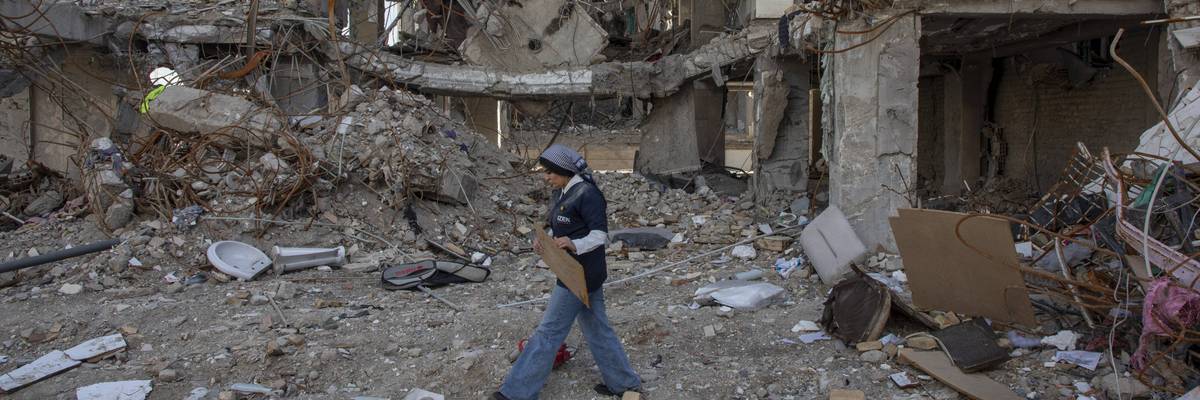
A woman walks among buildings destroyed in a joint attack by Israel and the United States on April 6, 2026, in Tehran, Iran.
In Iran as in Laos, you cannot claim to negotiate in good faith while destroying civilian life. And you cannot escape the long shadow of toxins and explosives that outlive every justification offered in their name.
April brings back a memory I cannot shake: the 1973 Pii Mai, or Lao New Year, bombing in Laos. This year, that memory unfolds against the backdrop of the US’ war in Iran that is repeating history—killing civilians, destroying homes and infrastructure, and setting the stage for suffering that will last generations. The war in Iran has already claimed over 1,500 civilian lives, including 217 children.
Like the US war in Vietnam, this new war has regional ramifications. In Southeast Asia, the conflict did not stay within Vietnam—it spilled into Laos and Cambodia, devastating communities that had little say in the war itself. Today, the consequences of the war in Iran are already crossing borders. In places like Lebanon, families are being pushed from their homes as violence escalates and instability spreads, echoing the same kind of regional unraveling we saw decades ago.
Once again, we are confronted with the consequences of sidelining diplomacy and the rules-based order.
As a US Air Force veteran, I’ve witnessed firsthand the devastating human cost of bombing strikes, both at the moment and in the decades to come. From December 1966 to December 1968, I was assigned to the 56th Air Commando Wing at air bases in Thailand, where our primary mission was to interdict the flow of personnel and supplies along the “Ho Chi Minh Trail” through Laos. As a 26-year-old newly promoted captain, I was shocked to discover that nearly all of our missions involved flying over Laos, where we dropped over 2.5 million tons of ordnance over nine years—580,000 bombing runs in total.
A new year should bring hope, but when war arrives, it replaces hope with memory—and its shadow has a way of returning, year after year, long after the headlines fade.
Some of those strikes took place during Pii Mai 1973—just as we recently witnessed US bombing during Nowruz, the Persian New Year.
Today, as the United States wages war in Iran while diplomacy is said to continue, I recognize a familiar contradiction. We are told negotiations are ongoing. We are told peace and safety are the goal. Yet bombs continue to fall, and civilians continue to die.
I have seen where that leads.
Even as negotiations to end the conflict moved forward—including the talks that led to the Paris Peace Accords—the bombing did not stop. In April 1973, after those agreements were signed, US aircraft continued striking Laos, justified as leverage—pressure deemed necessary to secure peace.
On April 16, 1973, the last day of the Lao New Year, American B-52 bombers and F-111 fighters struck the village of Tha Vieng, near the Plain of Jars in Xieng Khouang province, after it was reportedly occupied by North Vietnamese forces. US officials described the operation as a response to a “major violation of the ceasefire.”
President Richard Nixon warned Hanoi to comply—or face consequences. Those repercussions included renewed bombing in the neutral country of Laos during what should have been its most festive and peaceful celebration.
That is not diplomacy but destruction wearing the mask of strategy.
I returned to Laos in 2023, decades after the war, and for the first time I was part of the solution. I didn’t see “targets” anymore—I saw what was left behind. I walked through villages where the war never truly ended, where farmers still dig into soil that can explode beneath their hands, and where families continue to lose children long after the last airstrike. Many of the bombs that were dropped failed to detonate on impact, leaving behind a deadly legacy of unexploded ordnance covering about one-third of the country.
In one remote village, I helped detonate two cluster munitions near a home under construction. That family can now live without fear, but countless others cannot. With roughly 10% of the contamination cleared, the war is not past—it is ongoing, just out of sight.
And then there are the poisons—the part of war that doesn’t explode, but seeps.
Toxic exposure and unexploded ordnance do not just end when the fighting stops—they create multigenerational harm for both civilians and those sent to fight. The US Department of Veterans Affairs now recognizes 19 cancers and other serious conditions as linked to Agent Orange exposure, along with more than 20 conditions tied to burn pits and other toxic exposures from the Gulf War and post-9/11 conflicts. As of 2024, 6.5 million veterans or their dependents were receiving $163.1 billion in disability benefits.
Those numbers are evidence that war reaches far beyond the battlefield. The true costs of war are delayed, dispersed, and often denied until they can no longer be ignored.
And still, we repeat the pattern.
We are told that bombing Iran strengthens our negotiating position. That it brings adversaries to the table. These are the same arguments made during Southeast Asia—arguments that left behind unexploded bombs in Laos and dioxins embedded in human bodies for generations.
If I have learned anything, it is this: You cannot bomb your way to peace. You cannot claim to negotiate in good faith while destroying civilian life. And you cannot escape the long shadow of toxins and explosives that outlive every justification offered in their name.
For me, Laos is not just a part of my history. It is a warning written into the Earth and into the bodies of those still living with what was done there.
I remember what Pii Mai was meant to be—joyful, cleansing, a turning of the page. We are now bombing through another New Year, just as we did in 1973. Today it is Nowruz. Different place, same justification, same consequences. A new year should bring hope, but when war arrives, it replaces hope with memory—and its shadow has a way of returning, year after year, long after the headlines fade.
The question is whether we are willing to listen—or, are we destined to relive it.
Dear Common Dreams reader, It’s been nearly 30 years since I co-founded Common Dreams with my late wife, Lina Newhouser. We had the radical notion that journalism should serve the public good, not corporate profits. It was clear to us from the outset what it would take to build such a project. No paid advertisements. No corporate sponsors. No millionaire publisher telling us what to think or do. Many people said we wouldn't last a year, but we proved those doubters wrong. Together with a tremendous team of journalists and dedicated staff, we built an independent media outlet free from the constraints of profits and corporate control. Our mission has always been simple: To inform. To inspire. To ignite change for the common good. Building Common Dreams was not easy. Our survival was never guaranteed. When you take on the most powerful forces—Wall Street greed, fossil fuel industry destruction, Big Tech lobbyists, and uber-rich oligarchs who have spent billions upon billions rigging the economy and democracy in their favor—the only bulwark you have is supporters who believe in your work. But here’s the urgent message from me today. It's never been this bad out there. And it's never been this hard to keep us going. At the very moment Common Dreams is most needed, the threats we face are intensifying. We need your support now more than ever. We don't accept corporate advertising and never will. We don't have a paywall because we don't think people should be blocked from critical news based on their ability to pay. Everything we do is funded by the donations of readers like you. When everyone does the little they can afford, we are strong. But if that support retreats or dries up, so do we. Will you donate now to make sure Common Dreams not only survives but thrives? —Craig Brown, Co-founder |
April brings back a memory I cannot shake: the 1973 Pii Mai, or Lao New Year, bombing in Laos. This year, that memory unfolds against the backdrop of the US’ war in Iran that is repeating history—killing civilians, destroying homes and infrastructure, and setting the stage for suffering that will last generations. The war in Iran has already claimed over 1,500 civilian lives, including 217 children.
Like the US war in Vietnam, this new war has regional ramifications. In Southeast Asia, the conflict did not stay within Vietnam—it spilled into Laos and Cambodia, devastating communities that had little say in the war itself. Today, the consequences of the war in Iran are already crossing borders. In places like Lebanon, families are being pushed from their homes as violence escalates and instability spreads, echoing the same kind of regional unraveling we saw decades ago.
Once again, we are confronted with the consequences of sidelining diplomacy and the rules-based order.
As a US Air Force veteran, I’ve witnessed firsthand the devastating human cost of bombing strikes, both at the moment and in the decades to come. From December 1966 to December 1968, I was assigned to the 56th Air Commando Wing at air bases in Thailand, where our primary mission was to interdict the flow of personnel and supplies along the “Ho Chi Minh Trail” through Laos. As a 26-year-old newly promoted captain, I was shocked to discover that nearly all of our missions involved flying over Laos, where we dropped over 2.5 million tons of ordnance over nine years—580,000 bombing runs in total.
A new year should bring hope, but when war arrives, it replaces hope with memory—and its shadow has a way of returning, year after year, long after the headlines fade.
Some of those strikes took place during Pii Mai 1973—just as we recently witnessed US bombing during Nowruz, the Persian New Year.
Today, as the United States wages war in Iran while diplomacy is said to continue, I recognize a familiar contradiction. We are told negotiations are ongoing. We are told peace and safety are the goal. Yet bombs continue to fall, and civilians continue to die.
I have seen where that leads.
Even as negotiations to end the conflict moved forward—including the talks that led to the Paris Peace Accords—the bombing did not stop. In April 1973, after those agreements were signed, US aircraft continued striking Laos, justified as leverage—pressure deemed necessary to secure peace.
On April 16, 1973, the last day of the Lao New Year, American B-52 bombers and F-111 fighters struck the village of Tha Vieng, near the Plain of Jars in Xieng Khouang province, after it was reportedly occupied by North Vietnamese forces. US officials described the operation as a response to a “major violation of the ceasefire.”
President Richard Nixon warned Hanoi to comply—or face consequences. Those repercussions included renewed bombing in the neutral country of Laos during what should have been its most festive and peaceful celebration.
That is not diplomacy but destruction wearing the mask of strategy.
I returned to Laos in 2023, decades after the war, and for the first time I was part of the solution. I didn’t see “targets” anymore—I saw what was left behind. I walked through villages where the war never truly ended, where farmers still dig into soil that can explode beneath their hands, and where families continue to lose children long after the last airstrike. Many of the bombs that were dropped failed to detonate on impact, leaving behind a deadly legacy of unexploded ordnance covering about one-third of the country.
In one remote village, I helped detonate two cluster munitions near a home under construction. That family can now live without fear, but countless others cannot. With roughly 10% of the contamination cleared, the war is not past—it is ongoing, just out of sight.
And then there are the poisons—the part of war that doesn’t explode, but seeps.
Toxic exposure and unexploded ordnance do not just end when the fighting stops—they create multigenerational harm for both civilians and those sent to fight. The US Department of Veterans Affairs now recognizes 19 cancers and other serious conditions as linked to Agent Orange exposure, along with more than 20 conditions tied to burn pits and other toxic exposures from the Gulf War and post-9/11 conflicts. As of 2024, 6.5 million veterans or their dependents were receiving $163.1 billion in disability benefits.
Those numbers are evidence that war reaches far beyond the battlefield. The true costs of war are delayed, dispersed, and often denied until they can no longer be ignored.
And still, we repeat the pattern.
We are told that bombing Iran strengthens our negotiating position. That it brings adversaries to the table. These are the same arguments made during Southeast Asia—arguments that left behind unexploded bombs in Laos and dioxins embedded in human bodies for generations.
If I have learned anything, it is this: You cannot bomb your way to peace. You cannot claim to negotiate in good faith while destroying civilian life. And you cannot escape the long shadow of toxins and explosives that outlive every justification offered in their name.
For me, Laos is not just a part of my history. It is a warning written into the Earth and into the bodies of those still living with what was done there.
I remember what Pii Mai was meant to be—joyful, cleansing, a turning of the page. We are now bombing through another New Year, just as we did in 1973. Today it is Nowruz. Different place, same justification, same consequences. A new year should bring hope, but when war arrives, it replaces hope with memory—and its shadow has a way of returning, year after year, long after the headlines fade.
The question is whether we are willing to listen—or, are we destined to relive it.
April brings back a memory I cannot shake: the 1973 Pii Mai, or Lao New Year, bombing in Laos. This year, that memory unfolds against the backdrop of the US’ war in Iran that is repeating history—killing civilians, destroying homes and infrastructure, and setting the stage for suffering that will last generations. The war in Iran has already claimed over 1,500 civilian lives, including 217 children.
Like the US war in Vietnam, this new war has regional ramifications. In Southeast Asia, the conflict did not stay within Vietnam—it spilled into Laos and Cambodia, devastating communities that had little say in the war itself. Today, the consequences of the war in Iran are already crossing borders. In places like Lebanon, families are being pushed from their homes as violence escalates and instability spreads, echoing the same kind of regional unraveling we saw decades ago.
Once again, we are confronted with the consequences of sidelining diplomacy and the rules-based order.
As a US Air Force veteran, I’ve witnessed firsthand the devastating human cost of bombing strikes, both at the moment and in the decades to come. From December 1966 to December 1968, I was assigned to the 56th Air Commando Wing at air bases in Thailand, where our primary mission was to interdict the flow of personnel and supplies along the “Ho Chi Minh Trail” through Laos. As a 26-year-old newly promoted captain, I was shocked to discover that nearly all of our missions involved flying over Laos, where we dropped over 2.5 million tons of ordnance over nine years—580,000 bombing runs in total.
A new year should bring hope, but when war arrives, it replaces hope with memory—and its shadow has a way of returning, year after year, long after the headlines fade.
Some of those strikes took place during Pii Mai 1973—just as we recently witnessed US bombing during Nowruz, the Persian New Year.
Today, as the United States wages war in Iran while diplomacy is said to continue, I recognize a familiar contradiction. We are told negotiations are ongoing. We are told peace and safety are the goal. Yet bombs continue to fall, and civilians continue to die.
I have seen where that leads.
Even as negotiations to end the conflict moved forward—including the talks that led to the Paris Peace Accords—the bombing did not stop. In April 1973, after those agreements were signed, US aircraft continued striking Laos, justified as leverage—pressure deemed necessary to secure peace.
On April 16, 1973, the last day of the Lao New Year, American B-52 bombers and F-111 fighters struck the village of Tha Vieng, near the Plain of Jars in Xieng Khouang province, after it was reportedly occupied by North Vietnamese forces. US officials described the operation as a response to a “major violation of the ceasefire.”
President Richard Nixon warned Hanoi to comply—or face consequences. Those repercussions included renewed bombing in the neutral country of Laos during what should have been its most festive and peaceful celebration.
That is not diplomacy but destruction wearing the mask of strategy.
I returned to Laos in 2023, decades after the war, and for the first time I was part of the solution. I didn’t see “targets” anymore—I saw what was left behind. I walked through villages where the war never truly ended, where farmers still dig into soil that can explode beneath their hands, and where families continue to lose children long after the last airstrike. Many of the bombs that were dropped failed to detonate on impact, leaving behind a deadly legacy of unexploded ordnance covering about one-third of the country.
In one remote village, I helped detonate two cluster munitions near a home under construction. That family can now live without fear, but countless others cannot. With roughly 10% of the contamination cleared, the war is not past—it is ongoing, just out of sight.
And then there are the poisons—the part of war that doesn’t explode, but seeps.
Toxic exposure and unexploded ordnance do not just end when the fighting stops—they create multigenerational harm for both civilians and those sent to fight. The US Department of Veterans Affairs now recognizes 19 cancers and other serious conditions as linked to Agent Orange exposure, along with more than 20 conditions tied to burn pits and other toxic exposures from the Gulf War and post-9/11 conflicts. As of 2024, 6.5 million veterans or their dependents were receiving $163.1 billion in disability benefits.
Those numbers are evidence that war reaches far beyond the battlefield. The true costs of war are delayed, dispersed, and often denied until they can no longer be ignored.
And still, we repeat the pattern.
We are told that bombing Iran strengthens our negotiating position. That it brings adversaries to the table. These are the same arguments made during Southeast Asia—arguments that left behind unexploded bombs in Laos and dioxins embedded in human bodies for generations.
If I have learned anything, it is this: You cannot bomb your way to peace. You cannot claim to negotiate in good faith while destroying civilian life. And you cannot escape the long shadow of toxins and explosives that outlive every justification offered in their name.
For me, Laos is not just a part of my history. It is a warning written into the Earth and into the bodies of those still living with what was done there.
I remember what Pii Mai was meant to be—joyful, cleansing, a turning of the page. We are now bombing through another New Year, just as we did in 1973. Today it is Nowruz. Different place, same justification, same consequences. A new year should bring hope, but when war arrives, it replaces hope with memory—and its shadow has a way of returning, year after year, long after the headlines fade.
The question is whether we are willing to listen—or, are we destined to relive it.