SUBSCRIBE TO OUR FREE NEWSLETTER
Daily news & progressive opinion—funded by the people, not the corporations—delivered straight to your inbox.
5
#000000
#FFFFFF
To donate by check, phone, or other method, see our More Ways to Give page.
Daily news & progressive opinion—funded by the people, not the corporations—delivered straight to your inbox.
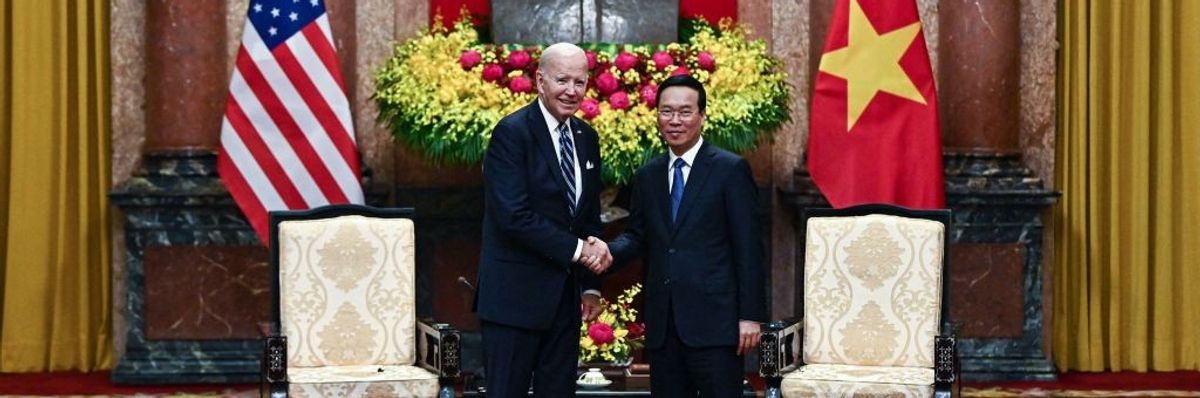
Vietnam’s President Vo Van Thuong (R) shakes hands with U.S. President Joe Biden during a meeting at the Presidential Palace in Hanoi on September 11, 2023.
No matter how many lies it tells or how many people it kills, being the United States government means never having to say you’re sorry.
When President Joe Biden flew out of Hanoi last week, he was leaving a country where U.S. warfare caused roughly 3.8 million Vietnamese deaths. But, like every other president since the Vietnam War, he gave no sign of remorse. In fact, Biden led up to his visit by presiding over a White House ceremony that glorified the war as a noble effort.
Presenting the Medal of Honor to former Army pilot Larry L. Taylor for bravery during combat, Biden praised the veteran with effusive accolades for risking his life in Vietnam to rescue fellow soldiers from “the enemy.” But that heroism was 55 years ago. Why present the medal on national television just days before traveling to Vietnam?
The timing reaffirmed the shameless pride in the U.S. war on Vietnam that one president after another has tried to render as history. You might think that—after killing such a vast number of people in a war of aggression based on continuous deceptions—some humility and even penance would be in order.
The pretenses that falsify the past are foreshadowing excuses for future warfare.
But no. As George Orwell put it, “Who controls the past controls the future: who controls the present controls the past.” And a government that intends to continue its might-makes-right use of military power needs leaders who do their best to distort history with foggy rhetoric and purposeful omissions. Lies and evasions about past wars are prefigurative for future wars.
And so, at a press conference in Hanoi, the closest Biden came to acknowledging the slaughter and devastation inflicted on Vietnam by the U.S. military was this sentence: “I’m incredibly proud of how our nations and our people have built trust and understanding over the decades and worked to repair the painful legacy the war left on both our nations.”
In the process, Biden was pretending an equivalency of suffering and culpability for both countries—a popular pretense for commanders in chief ever since the first new one after the Vietnam War ended.
Two months into his presidency in early 1977, Jimmy Carter was asked at a news conference if he felt “any moral obligation to help rebuild that country.” Carter replied firmly:
Well, the destruction was mutual. You know, we went to Vietnam without any desire to capture territory or to impose American will on other people. We went there to defend the freedom of the South Vietnamese. And I don’t feel that we ought to apologize or to castigate ourselves or to assume the status of culpability.
And, Carter added, “I don’t feel that we owe a debt, nor that we should be forced to pay reparations at all.”
In other words, no matter how many lies it tells or how many people it kills, being the United States government means never having to say you’re sorry.
When President George H.W. Bush celebrated the U.S. victory in the 1991 Gulf War, he proclaimed: “By God, we’ve kicked the Vietnam syndrome once and for all.” Bush meant that the triumphant killing of Iraqi people—estimated at 100,000 in six weeks—had ushered in American euphoria about military action that promised to wipe away hesitation to launch future wars.
From Carter to Biden, presidents have never come anywhere near providing an honest account of the Vietnam War. None could imagine engaging in the kind of candor that Pentagon Papers whistleblower Daniel Ellsberg provided when he said, “It wasn’t that we were on the wrong side. We were the wrong side.”
Mainstream political discourse has paid scant attention to the deaths and injuries of Vietnamese people. Likewise the horrendous ecological damage and effects of poisons from the Pentagon’s arsenal have gotten very short shrift in U.S. media and politics.
Does such history really matter now? Absolutely. Efforts to portray the U.S. government’s military actions as well-meaning and virtuous are incessant. The pretenses that falsify the past are foreshadowing excuses for future warfare.
Telling central truths about the Vietnam War is a basic threat to the U.S. war machine. No wonder the leaders of the warfare state would rather keep pretending.
Dear Common Dreams reader, It’s been nearly 30 years since I co-founded Common Dreams with my late wife, Lina Newhouser. We had the radical notion that journalism should serve the public good, not corporate profits. It was clear to us from the outset what it would take to build such a project. No paid advertisements. No corporate sponsors. No millionaire publisher telling us what to think or do. Many people said we wouldn't last a year, but we proved those doubters wrong. Together with a tremendous team of journalists and dedicated staff, we built an independent media outlet free from the constraints of profits and corporate control. Our mission has always been simple: To inform. To inspire. To ignite change for the common good. Building Common Dreams was not easy. Our survival was never guaranteed. When you take on the most powerful forces—Wall Street greed, fossil fuel industry destruction, Big Tech lobbyists, and uber-rich oligarchs who have spent billions upon billions rigging the economy and democracy in their favor—the only bulwark you have is supporters who believe in your work. But here’s the urgent message from me today. It's never been this bad out there. And it's never been this hard to keep us going. At the very moment Common Dreams is most needed, the threats we face are intensifying. We need your support now more than ever. We don't accept corporate advertising and never will. We don't have a paywall because we don't think people should be blocked from critical news based on their ability to pay. Everything we do is funded by the donations of readers like you. When everyone does the little they can afford, we are strong. But if that support retreats or dries up, so do we. Will you donate now to make sure Common Dreams not only survives but thrives? —Craig Brown, Co-founder |
Norman Solomon is the national director of RootsAction.org and executive director of the Institute for Public Accuracy. The paperback edition of his latest book, War Made Invisible: How America Hides the Human Toll of Its Military Machine, includes an afterword about the Gaza war.
When President Joe Biden flew out of Hanoi last week, he was leaving a country where U.S. warfare caused roughly 3.8 million Vietnamese deaths. But, like every other president since the Vietnam War, he gave no sign of remorse. In fact, Biden led up to his visit by presiding over a White House ceremony that glorified the war as a noble effort.
Presenting the Medal of Honor to former Army pilot Larry L. Taylor for bravery during combat, Biden praised the veteran with effusive accolades for risking his life in Vietnam to rescue fellow soldiers from “the enemy.” But that heroism was 55 years ago. Why present the medal on national television just days before traveling to Vietnam?
The timing reaffirmed the shameless pride in the U.S. war on Vietnam that one president after another has tried to render as history. You might think that—after killing such a vast number of people in a war of aggression based on continuous deceptions—some humility and even penance would be in order.
The pretenses that falsify the past are foreshadowing excuses for future warfare.
But no. As George Orwell put it, “Who controls the past controls the future: who controls the present controls the past.” And a government that intends to continue its might-makes-right use of military power needs leaders who do their best to distort history with foggy rhetoric and purposeful omissions. Lies and evasions about past wars are prefigurative for future wars.
And so, at a press conference in Hanoi, the closest Biden came to acknowledging the slaughter and devastation inflicted on Vietnam by the U.S. military was this sentence: “I’m incredibly proud of how our nations and our people have built trust and understanding over the decades and worked to repair the painful legacy the war left on both our nations.”
In the process, Biden was pretending an equivalency of suffering and culpability for both countries—a popular pretense for commanders in chief ever since the first new one after the Vietnam War ended.
Two months into his presidency in early 1977, Jimmy Carter was asked at a news conference if he felt “any moral obligation to help rebuild that country.” Carter replied firmly:
Well, the destruction was mutual. You know, we went to Vietnam without any desire to capture territory or to impose American will on other people. We went there to defend the freedom of the South Vietnamese. And I don’t feel that we ought to apologize or to castigate ourselves or to assume the status of culpability.
And, Carter added, “I don’t feel that we owe a debt, nor that we should be forced to pay reparations at all.”
In other words, no matter how many lies it tells or how many people it kills, being the United States government means never having to say you’re sorry.
When President George H.W. Bush celebrated the U.S. victory in the 1991 Gulf War, he proclaimed: “By God, we’ve kicked the Vietnam syndrome once and for all.” Bush meant that the triumphant killing of Iraqi people—estimated at 100,000 in six weeks—had ushered in American euphoria about military action that promised to wipe away hesitation to launch future wars.
From Carter to Biden, presidents have never come anywhere near providing an honest account of the Vietnam War. None could imagine engaging in the kind of candor that Pentagon Papers whistleblower Daniel Ellsberg provided when he said, “It wasn’t that we were on the wrong side. We were the wrong side.”
Mainstream political discourse has paid scant attention to the deaths and injuries of Vietnamese people. Likewise the horrendous ecological damage and effects of poisons from the Pentagon’s arsenal have gotten very short shrift in U.S. media and politics.
Does such history really matter now? Absolutely. Efforts to portray the U.S. government’s military actions as well-meaning and virtuous are incessant. The pretenses that falsify the past are foreshadowing excuses for future warfare.
Telling central truths about the Vietnam War is a basic threat to the U.S. war machine. No wonder the leaders of the warfare state would rather keep pretending.
Norman Solomon is the national director of RootsAction.org and executive director of the Institute for Public Accuracy. The paperback edition of his latest book, War Made Invisible: How America Hides the Human Toll of Its Military Machine, includes an afterword about the Gaza war.
When President Joe Biden flew out of Hanoi last week, he was leaving a country where U.S. warfare caused roughly 3.8 million Vietnamese deaths. But, like every other president since the Vietnam War, he gave no sign of remorse. In fact, Biden led up to his visit by presiding over a White House ceremony that glorified the war as a noble effort.
Presenting the Medal of Honor to former Army pilot Larry L. Taylor for bravery during combat, Biden praised the veteran with effusive accolades for risking his life in Vietnam to rescue fellow soldiers from “the enemy.” But that heroism was 55 years ago. Why present the medal on national television just days before traveling to Vietnam?
The timing reaffirmed the shameless pride in the U.S. war on Vietnam that one president after another has tried to render as history. You might think that—after killing such a vast number of people in a war of aggression based on continuous deceptions—some humility and even penance would be in order.
The pretenses that falsify the past are foreshadowing excuses for future warfare.
But no. As George Orwell put it, “Who controls the past controls the future: who controls the present controls the past.” And a government that intends to continue its might-makes-right use of military power needs leaders who do their best to distort history with foggy rhetoric and purposeful omissions. Lies and evasions about past wars are prefigurative for future wars.
And so, at a press conference in Hanoi, the closest Biden came to acknowledging the slaughter and devastation inflicted on Vietnam by the U.S. military was this sentence: “I’m incredibly proud of how our nations and our people have built trust and understanding over the decades and worked to repair the painful legacy the war left on both our nations.”
In the process, Biden was pretending an equivalency of suffering and culpability for both countries—a popular pretense for commanders in chief ever since the first new one after the Vietnam War ended.
Two months into his presidency in early 1977, Jimmy Carter was asked at a news conference if he felt “any moral obligation to help rebuild that country.” Carter replied firmly:
Well, the destruction was mutual. You know, we went to Vietnam without any desire to capture territory or to impose American will on other people. We went there to defend the freedom of the South Vietnamese. And I don’t feel that we ought to apologize or to castigate ourselves or to assume the status of culpability.
And, Carter added, “I don’t feel that we owe a debt, nor that we should be forced to pay reparations at all.”
In other words, no matter how many lies it tells or how many people it kills, being the United States government means never having to say you’re sorry.
When President George H.W. Bush celebrated the U.S. victory in the 1991 Gulf War, he proclaimed: “By God, we’ve kicked the Vietnam syndrome once and for all.” Bush meant that the triumphant killing of Iraqi people—estimated at 100,000 in six weeks—had ushered in American euphoria about military action that promised to wipe away hesitation to launch future wars.
From Carter to Biden, presidents have never come anywhere near providing an honest account of the Vietnam War. None could imagine engaging in the kind of candor that Pentagon Papers whistleblower Daniel Ellsberg provided when he said, “It wasn’t that we were on the wrong side. We were the wrong side.”
Mainstream political discourse has paid scant attention to the deaths and injuries of Vietnamese people. Likewise the horrendous ecological damage and effects of poisons from the Pentagon’s arsenal have gotten very short shrift in U.S. media and politics.
Does such history really matter now? Absolutely. Efforts to portray the U.S. government’s military actions as well-meaning and virtuous are incessant. The pretenses that falsify the past are foreshadowing excuses for future warfare.
Telling central truths about the Vietnam War is a basic threat to the U.S. war machine. No wonder the leaders of the warfare state would rather keep pretending.