

SUBSCRIBE TO OUR FREE NEWSLETTER
Daily news & progressive opinion—funded by the people, not the corporations—delivered straight to your inbox.
5
#000000
#FFFFFF
To donate by check, phone, or other method, see our More Ways to Give page.
Daily news & progressive opinion—funded by the people, not the corporations—delivered straight to your inbox.

No matter how many lies it tells or how many people it kills, being the United States government means never having to say you’re sorry.
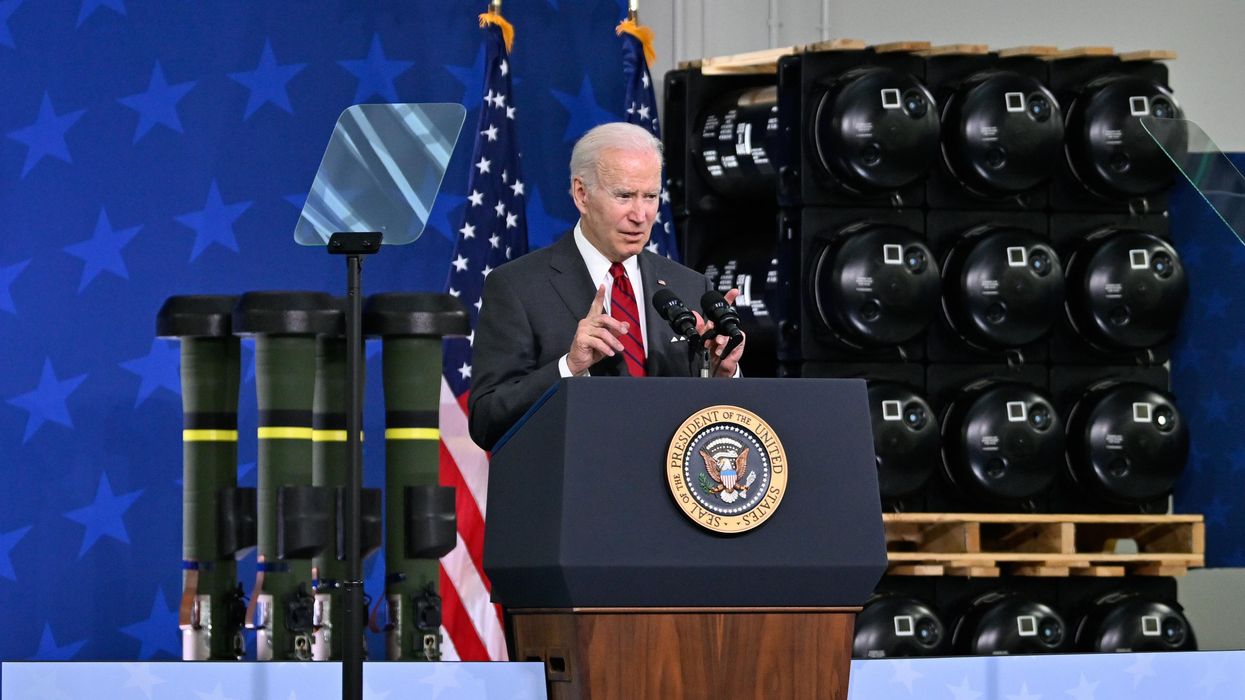
When President Joe Biden flew out of Hanoi last week, he was leaving a country where U.S. warfare caused roughly 3.8 million Vietnamese deaths. But, like every other president since the Vietnam War, he gave no sign of remorse. In fact, Biden led up to his visit by presiding over a White House ceremony that glorified the war as a noble effort.
Presenting the Medal of Honor to former Army pilot Larry L. Taylor for bravery during combat, Biden praised the veteran with effusive accolades for risking his life in Vietnam to rescue fellow soldiers from “the enemy.” But that heroism was 55 years ago. Why present the medal on national television just days before traveling to Vietnam?
The timing reaffirmed the shameless pride in the U.S. war on Vietnam that one president after another has tried to render as history. You might think that—after killing such a vast number of people in a war of aggression based on continuous deceptions—some humility and even penance would be in order.
The pretenses that falsify the past are foreshadowing excuses for future warfare.
But no. As George Orwell put it, “Who controls the past controls the future: who controls the present controls the past.” And a government that intends to continue its might-makes-right use of military power needs leaders who do their best to distort history with foggy rhetoric and purposeful omissions. Lies and evasions about past wars are prefigurative for future wars.
And so, at a press conference in Hanoi, the closest Biden came to acknowledging the slaughter and devastation inflicted on Vietnam by the U.S. military was this sentence: “I’m incredibly proud of how our nations and our people have built trust and understanding over the decades and worked to repair the painful legacy the war left on both our nations.”
In the process, Biden was pretending an equivalency of suffering and culpability for both countries—a popular pretense for commanders in chief ever since the first new one after the Vietnam War ended.
Two months into his presidency in early 1977, Jimmy Carter was asked at a news conference if he felt “any moral obligation to help rebuild that country.” Carter replied firmly:
Well, the destruction was mutual. You know, we went to Vietnam without any desire to capture territory or to impose American will on other people. We went there to defend the freedom of the South Vietnamese. And I don’t feel that we ought to apologize or to castigate ourselves or to assume the status of culpability.
And, Carter added, “I don’t feel that we owe a debt, nor that we should be forced to pay reparations at all.”
In other words, no matter how many lies it tells or how many people it kills, being the United States government means never having to say you’re sorry.
When President George H.W. Bush celebrated the U.S. victory in the 1991 Gulf War, he proclaimed: “By God, we’ve kicked the Vietnam syndrome once and for all.” Bush meant that the triumphant killing of Iraqi people—estimated at 100,000 in six weeks—had ushered in American euphoria about military action that promised to wipe away hesitation to launch future wars.
From Carter to Biden, presidents have never come anywhere near providing an honest account of the Vietnam War. None could imagine engaging in the kind of candor that Pentagon Papers whistleblower Daniel Ellsberg provided when he said, “It wasn’t that we were on the wrong side. We were the wrong side.”
Mainstream political discourse has paid scant attention to the deaths and injuries of Vietnamese people. Likewise the horrendous ecological damage and effects of poisons from the Pentagon’s arsenal have gotten very short shrift in U.S. media and politics.
Does such history really matter now? Absolutely. Efforts to portray the U.S. government’s military actions as well-meaning and virtuous are incessant. The pretenses that falsify the past are foreshadowing excuses for future warfare.
Telling central truths about the Vietnam War is a basic threat to the U.S. war machine. No wonder the leaders of the warfare state would rather keep pretending.

One of the reasons that Russian media has been completely blocked in the West, along with the unprecedented control and censorship over the Ukraine war narrative, is the fact that western governments simply do not want their public to know that the world is vastly changing.
'Let the war go on with all of its horrors, with all the destruction of Ukraine, and let's let it go on until we get what we want.'
Ignorance might be bliss, arguably in some situations, but not in this case. Here, ignorance can be catastrophic as western audiences are denied access to information about a critical situation that is affecting them in profound ways and will most certainly impact the world's geopolitics for generations to come.
The growing inflation, an imminent global recession, a festering refugee crisis, a deepening food shortage crisis and much more are the kinds of challenges that require open and transparent discussions regarding the situation in Ukraine, the NATO-Russia rivalry and the responsibility of the West in the ongoing war.
To discuss these issues, along with the missing context of the Russia-Ukraine war, we spoke with Professor Noam Chomsky, believed to be the greatest living intellectual of our time.
Chomsky told us that it "should be clear that the (Russian) invasion of Ukraine has no (moral) justification." He compared it to the US invasion of Iraq, seeing it as an example of "supreme international crime." With this moral question settled, Chomsky believes that the main 'background' of this war, a factor that is missing in mainstream media coverage, is "NATO expansion."
"This is not just my opinion," said Chomsky, "it is the opinion of every high-level US official in the diplomatic services who has any familiarity with Russia and Eastern Europe. This goes back to George Kennan and, in the 1990s, Reagan's ambassador Jack Matlock, including the current director of the CIA; in fact, just everybody who knows anything has been warning Washington that it is reckless and provocative to ignore Russia's very clear and explicit red lines. That goes way before (Vladimir) Putin, it has nothing to do with him; (Mikhail) Gorbachev, all said the same thing. Ukraine and Georgia cannot join NATO, this is the geostrategic heartland of Russia."
Though various US administrations acknowledged and, to some extent, respected the Russian red lines, the Bill Clinton Administration did not. According to Chomsky, "George H. W. Bush ... made an explicit promise to Gorbachev that NATO would not expand beyond East Germany, perfectly explicit. You can look up the documents. It's very clear. Bush lived up to it. But when Clinton came along, he started violating it. And he gave reasons. He explained that he had to do it for domestic political reasons. He had to get the Polish vote, the ethnic vote. So, he would let the so-called Visegrad countries into NATO. Russia accepted it, didn't like it but accepted it."
"The second George Bush," Chomsky argued, "just threw the door wide open. In fact, even invited Ukraine to join over, despite the objections of everyone in the top diplomatic service, apart from his own little clique, Cheney, Rumsfeld (among others). But France and Germany vetoed it."
However, that was hardly the end of the discussion. Ukraine's NATO membership remained on the agenda because of intense pressures from Washington.
"Starting in 2014, after the Maidan uprising, the United States began openly, not secretly, moving to integrate Ukraine into the NATO military command, sending heavy armaments and joining military exercises, military training and it was not a secret. They boasted about it," Chomsky said.
What is interesting is that current Ukrainian President Volodymyr Zelensky "was elected on a peace platform, to implement what was called Minsk Two, some kind of autonomy for the eastern region. He tried to implement it. He was warned by right-wing militias that if he persisted, they'd kill him. Well, he didn't get any support from the United States. If the United States had supported him, he could have continued, we might have avoided all of this. The United States was committed to the integration of Ukraine within NATO."
The Joe Biden Administration carried on with the policy of NATO expansion. "Just before the invasion," said Chomsky, "Biden ... produced a joint statement ... calling for expanding these efforts of integration. That's part of what was called an 'enhanced program' leading to the mission of NATO. In November, it was moved forward to a charter, signed by the Secretary of State."
Soon after the war, "the United States Department acknowledged that they had not taken Russian security concerns into consideration in any discussions with Russia. The question of NATO, they would not discuss. Well, all of that is provocation. Not a justification but a provocation and it's quite interesting that in American discourse, it is almost obligatory to refer to the invasion as the 'unprovoked invasion of Ukraine'. Look it up on Google, you will find hundreds of thousands of hits."
Chomsky continued, "Of course, it was provoked. Otherwise, they wouldn't refer to it all the time as an unprovoked invasion. By now, censorship in the United States has reached such a level beyond anything in my lifetime. Such a level that you are not permitted to read the Russian position. Literally. Americans are not allowed to know what the Russians are saying. Except, selected things. So, if Putin makes a speech to Russians with all kinds of outlandish claims about Peter the Great and so on, then, you see it on the front pages. If the Russians make an offer for a negotiation, you can't find it. That's suppressed. You're not allowed to know what they are saying. I have never seen a level of censorship like this."
Regarding his views of the possible future scenarios, Chomsky said that "the war will end, either through diplomacy or not. That's just logic. Well, if diplomacy has a meaning, it means both sides can tolerate it. They don't like it, but they can tolerate it. They don't get anything they want, they get something. That's diplomacy. If you reject diplomacy, you are saying: 'Let the war go on with all of its horrors, with all the destruction of Ukraine, and let's let it go on until we get what we want.'"
By 'we,' Chomsky was referring to Washington, which simply wants to "harm Russia so severely that it will never be able to undertake actions like this again. Well, what does that mean? It's impossible to achieve. So, it means, let's continue the war until Ukraine is devastated. That's US policy."
Most of this is not obvious to western audiences simply because rational voices are "not allowed to talk" and because "rationality is not permitted. This is a level of hysteria that I have never seen, even during the Second World War, which I am old enough to remember very well."
While an alternative understanding of the devastating war in Ukraine is disallowed, the West continues to offer no serious answers or achievable goals, leaving Ukraine devastated and the root causes of the problem in place. "That's US policy," indeed.
David Barsamian: Let's head into the most obvious nightmare of this moment, the war in Ukraine and its effects globally. But first a little background. Let's start with President George H.W. Bush's assurance to then-Soviet leader Mikhail Gorbachev that NATO would not move "one inch to the east"--and that pledge has been verified. My question to you is, why didn't Gorbachev get that in writing?
If you imagine some extraterrestrials, if they existed, they'd think we were all totally insane. And they'd be right.
Noam Chomsky: He accepted a gentleman's agreement, which is not that uncommon in diplomacy. Shake-of-the-hand. Furthermore, having it on paper would have made no difference whatsoever. Treaties that are on paper are torn up all the time. What matters is good faith. And in fact, H.W. Bush, the first Bush, did honor the agreement explicitly. He even moved toward instituting a partnership in peace, which would accommodate the countries of Eurasia. NATO wouldn't be disbanded but would be marginalized. Countries like Tajikistan, for example, could join without formally being part of NATO. And Gorbachev approved of that. It would have been a step toward creating what he called a common European home with no military alliances.
Clinton in his first couple of years also adhered to it. What the specialists say is that by about 1994, Clinton started to, as they put it, talk from both sides of his mouth. To the Russians he was saying: Yes, we're going to adhere to the agreement. To the Polish community in the United States and other ethnic minorities, he was saying: Don't worry, we'll incorporate you within NATO. By about 1996-97, Clinton said this pretty explicitly to his friend Russian President Boris Yeltsin, whom he had helped win the 1996 election. He told Yeltsin: Don't push too hard on this NATO business. We're going to expand but I need it because of the ethnic vote in the United States.
In 1997, Clinton invited the so-called Visegrad countries--Hungary, Czechoslovakia, Romania--to join NATO. The Russians didn't like it but didn't make much of a fuss. Then the Baltic nations joined, again the same thing. In 2008, the second Bush, who was quite different from the first, invited Georgia and Ukraine into NATO. Every U.S. diplomat understood very well that Georgia and Ukraine were red lines for Russia. They'll tolerate the expansion elsewhere, but these are in their geostrategic heartland and they're not going to tolerate expansion there. To continue with the story, the Maidan uprising took place in 2014, expelling the pro-Russian president and Ukraine moved toward the West.
From 2014, the U.S. and NATO began to pour arms into Ukraine--advanced weapons, military training, joint military exercises, moves to integrate Ukraine into the NATO military command. There's no secret about this. It was quite open. Recently, the Secretary General of NATO, Jens Stoltenberg, bragged about it. He said: This is what we were doing since 2014. Well, of course, this is very consciously, highly provocative. They knew that they were encroaching on what every Russian leader regarded as an intolerable move. France and Germany vetoed it in 2008, but under U.S. pressure, it was kept on the agenda. And NATO, meaning the United States, moved to accelerate the de facto integration of Ukraine into the NATO military command.
In 2019, Volodymyr Zelensky was elected with an overwhelming majority--I think about 70% of the vote--on a peace platform, a plan to implement peace with Eastern Ukraine and Russia, to settle the problem. He began to move forward on it and, in fact, tried to go to the Donbas, the Russian-oriented eastern region, to implement what's called the Minsk II agreement. It would have meant a kind of federalization of Ukraine with a degree of autonomy for the Donbas, which is what they wanted. Something like Switzerland or Belgium. He was blocked by right-wing militias which threatened to murder him if he persisted with his effort.
Well, he's a courageous man. He could have gone forward if he had had any backing from the United States. The U.S. refused. No backing, nothing, which meant he was left to hang out to dry and had to back off. The U.S. was intent on this policy of integrating Ukraine step by step into the NATO military command. That accelerated further when President Biden was elected. In September 2021, you could read it on the White House website. It wasn't reported but, of course, the Russians knew it. Biden announced a program, a joint statement to accelerate the process of military training, military exercises, more weapons as part of what his administration called an "enhanced program" of preparation for NATO membership.
It accelerated further in November. This was all before the invasion. Secretary of State Antony Blinken signed what was called a charter, which essentially formalized and extended this arrangement. A spokesman for the State Department conceded that before the invasion, the U.S. refused to discuss any Russian security concerns. All of this is part of the background.
On February 24th, Putin invaded, a criminal invasion. These serious provocations provide no justification for it. If Putin had been a statesman, what he would have done is something quite different. He would have gone back to French President Emmanuel Macron, grasped his tentative proposals, and moved to try to reach an accommodation with Europe, to take steps toward a European common home.
The U.S., of course, has always been opposed to that. This goes way back in Cold War history to French President de Gaulle's initiatives to establish an independent Europe. In his phrase "from the Atlantic to the Urals," integrating Russia with the West, which was a very natural accommodation for trade reasons and, obviously, security reasons as well. So, had there been any statesmen within Putin's narrow circle, they would have grasped Macron's initiatives and experimented to see whether, in fact, they could integrate with Europe and avert the crisis. Instead, what he chose was a policy which, from the Russian point of view, was total imbecility. Apart from the criminality of the invasion, he chose a policy that drove Europe deep into the pocket of the United States. In fact, it is even inducing Sweden and Finland to join NATO--the worst possible outcome from the Russian point of view, quite apart from the criminality of the invasion, and the very serious losses that Russia is suffering because of that.
So, criminality and stupidity on the Kremlin side, severe provocation on the U.S. side. That's the background that has led to this. Can we try to bring this horror to an end? Or should we try to perpetuate it? Those are the choices.
There's only one way to bring it to an end. That's diplomacy. Now, diplomacy, by definition, means both sides accept it. They don't like it, but they accept it as the least bad option. It would offer Putin some kind of escape hatch. That's one possibility. The other is just to drag it out and see how much everybody will suffer, how many Ukrainians will die, how much Russia will suffer, how many millions of people will starve to death in Asia and Africa, how much we'll proceed toward heating the environment to the point where there will be no possibility for a livable human existence. Those are the options. Well, with near 100% unanimity, the United States and most of Europe want to pick the no-diplomacy option. It's explicit. We have to keep going to hurt Russia.
You can read columns in the New York Times, the London Financial Times, all over Europe. A common refrain is: we've got to make sure that Russia suffers. It doesn't matter what happens to Ukraine or anyone else. Of course, this gamble assumes that if Putin is pushed to the limit, with no escape, forced to admit defeat, he'll accept that and not use the weapons he has to devastate Ukraine.
There are a lot of things that Russia hasn't done. Western analysts are rather surprised by it. Namely, they've not attacked the supply lines from Poland that are pouring weapons into Ukraine. They certainly could do it. That would very soon bring them into direct confrontation with NATO, meaning the U.S. Where it goes from there, you can guess. Anyone who's ever looked at war games knows where it'll go--up the escalatory ladder toward terminal nuclear war.
So, those are the games we're playing with the lives of Ukrainians, Asians, and Africans, the future of civilization, in order to weaken Russia, to make sure that they suffer enough. Well, if you want to play that game, be honest about it. There's no moral basis for it. In fact, it's morally horrendous. And the people who are standing on a high horse about how we're upholding principle are moral imbeciles when you think about what's involved.
Barsamian: In the media, and among the political class in the United States, and probably in Europe, there's much moral outrage about Russian barbarity, war crimes, and atrocities. No doubt they are occurring as they do in every war. Don't you find that moral outrage a bit selective though?
Chomsky: The moral outrage is quite in place. There should be moral outrage. But you go to the Global South, they just can't believe what they're seeing. They condemn the war, of course. It's a deplorable crime of aggression. Then they look at the West and say: What are you guys talking about? This is what you do to us all the time.
It's kind of astonishing to see the difference in commentary. So, you read the New York Times and their big thinker, Thomas Friedman. He wrote a column a couple of weeks ago in which he just threw up his hands in despair. He said: What can we do? How can we live in a world that has a war criminal? We've never experienced this since Hitler. There's a war criminal in Russia. We're at a loss as to how to act. We've never imagined the idea that there could be a war criminal anywhere.
When people in the Global South hear this, they don't know whether to crack up in laughter or ridicule. We have war criminals walking all over Washington. Actually, we know how to deal with our war criminals. In fact, it happened on the twentieth anniversary of the invasion of Afghanistan. Remember, this was an entirely unprovoked invasion, strongly opposed by world opinion. There was an interview with the perpetrator, George W. Bush, who then went on to invade Iraq, a major war criminal, in the style section of the Washington Post--an interview with, as they described it, this lovable goofy grandpa who was playing with his grandchildren, making jokes, showing off the portraits he painted of famous people he'd met. Just a beautiful, friendly environment.
So, we know how to deal with war criminals. Thomas Friedman is wrong. We deal with them very well.
Or take probably the major war criminal of the modern period, Henry Kissinger. We deal with him not only politely, but with great admiration. This is the man after all who transmitted the order to the Air Force, saying that there should be massive bombing of Cambodia--"anything that flies on anything that moves" was his phrase. I don't know of a comparable example in the archival record of a call for mass genocide. And it was implemented with very intensive bombing of Cambodia. We don't know much about it because we don't investigate our own crimes. But Taylor Owen and Ben Kiernan, serious historians of Cambodia, have described it. Then there's our role in overthrowing Salvador Allende's government in Chile and instituting a vicious dictatorship there, and on and on. So, we do know how to deal with our war criminals.
Still, Thomas Friedman can't imagine that there's anything like Ukraine. Nor was there any commentary on what he wrote, which means it was regarded as quite reasonable. You can hardly use the word selectivity. It's beyond astonishing. So, yes, the moral outrage is perfectly in place. It's good that Americans are finally beginning to show some outrage about major war crimes committed by someone else.
Barsamian: I've got a little puzzle for you. It's in two parts. Russia's military is inept and incompetent. Its soldiers have very low morale and are poorly led. Its economy ranks with Italy's and Spain's. That's one part. The other part is Russia is a military colossus that threatens to overwhelm us. So, we need more weapons. Let's expand NATO. How do you reconcile those two contradictory thoughts?
Chomsky: Those two thoughts are standard in the entire West. I just had a long interview in Sweden about their plans to join NATO. I pointed out that Swedish leaders have two contradictory ideas, the two you mentioned. One, gloating over the fact that Russia has proven itself to be a paper tiger that can't conquer cities a couple of miles from its border defended by a mostly citizens' army. So, they're completely militarily incompetent. The other thought is: they're poised to conquer the West and destroy us.
George Orwell had a name for that. He called it doublethink, the capacity to have two contradictory ideas in your mind and believe both of them. Orwell mistakenly thought that was something you could only have in the ultra-totalitarian state he was satirizing in 1984. He was wrong. You can have it in free democratic societies. We're seeing a dramatic example of it right now. Incidentally, this is not the first time.
Such doublethink is, for instance, characteristic of Cold War thinking. You go way back to the major Cold War document of those years, NSC-68 in 1950. Look at it carefully and it showed that Europe alone, quite apart from the United States, was militarily on a par with Russia. But of course, we still had to have a huge rearmament program to counter the Kremlin design for world conquest.
That's one document and it was a conscious approach. Dean Acheson, one of the authors, later said that it's necessary to be "clearer than truth," his phrase, in order to bludgeon the mass mind of government. We want to drive through this huge military budget, so we have to be "clearer than truth" by concocting a slave state that's about to conquer the world. Such thinking runs right through the Cold War. I could give you many other examples, but we're seeing it again now quite dramatically. And the way you put it is exactly correct: these two ideas are consuming the West.
Barsamian: It's also interesting that diplomat George Kennan foresaw the danger of NATO moving its borders east in a very prescient op-ed he wrote that appeared in The New York Times in 1997.
Chomsky: Kennan had also been opposed to NSC-68. In fact, he had been the director of the State Department Policy Planning Staff. He was kicked out and replaced by Paul Nitze. He was regarded as too soft for such a hard world. He was a hawk, radically anticommunist, pretty brutal himself with regard to U.S. positions, but he realized that military confrontation with Russia made no sense.
Russia, he thought, would ultimately collapse from internal contradictions, which turned out to be correct. But he was considered a dove all the way through. In 1952, he was in favor of the unification of Germany outside the NATO military alliance. That was actually Soviet ruler Joseph Stalin's proposal as well. Kennan was ambassador to the Soviet Union and a Russia specialist.
Stalin's initiative. Kennan's proposal. Some Europeans supported it. It would have ended the Cold War. It would have meant a neutralized Germany, non-militarized and not part of any military bloc. It was almost totally ignored in Washington.
There was one foreign policy specialist, a respected one, James Warburg, who wrote a book about it. It's worth reading. It's called Germany: Key to Peace. In it, he urged that this idea be taken seriously. He was disregarded, ignored, ridiculed. I mentioned it a couple of times and was ridiculed as a lunatic, too. How could you believe Stalin? Well, the archives came out. Turns out he was apparently serious. You now read the leading Cold War historians, people like Melvin Leffler, and they recognize that there was a real opportunity for a peaceful settlement at the time, which was dismissed in favor of militarization, of a huge expansion of the military budget.
Now, let's go to the Kennedy administration. When John Kennedy came into office, Nikita Khrushchev, leading Russia at the time, made a very important offer to carry out large-scale mutual reductions in offensive military weapons, which would have meant a sharp relaxation of tensions. The United States was far ahead militarily then. Khrushchev wanted to move toward economic development in Russia and understood that this was impossible in the context of a military confrontation with a far richer adversary. So, he first made that offer to President Dwight Eisenhower, who paid no attention. It was then offered to Kennedy and his administration responded with the largest peacetime buildup of military force in history--even though they knew that the United States was already far ahead.
The U.S. concocted a "missile gap." Russia was about to overwhelm us with its advantage in missiles. Well, when the missile gap was exposed, it turned out to be in favor of the U.S. Russia had maybe four missiles exposed on an airbase somewhere.
You can go on and on like this. The security of the population is simply not a concern for policymakers. Security for the privileged, the rich, the corporate sector, arms manufacturers, yes, but not the rest of us. This doublethink is constant, sometimes conscious, sometimes not. It's just what Orwell described, hyper-totalitarianism in a free society.
Barsamian: In an article in Truthout, you quote Eisenhower's 1953 "Cross of Iron" speech. What did you find of interest there?
Chomsky: You should read it and you'll see why it's interesting. It's the best speech he ever made. This was 1953 when he was just taking office. Basically, what he pointed out was that militarization was a tremendous attack on our own society. He--or whoever wrote the speech--put it pretty eloquently. One jet plane means this many fewer schools and hospitals. Every time we're building up our military budget, we're attacking ourselves.
He spelled it out in some detail, calling for a decline in the military budget. He had a pretty awful record himself, but in this respect he was right on target. And those words should be emblazoned in everyone's memory. Recently, in fact, Biden proposed a huge military budget. Congress expanded it even beyond his wishes, which represents a major attack on our society, exactly as Eisenhower explained so many years ago.
The excuse: the claim that we have to defend ourselves from this paper tiger, so militarily incompetent it can't move a couple of miles beyond its border without collapse. So, with a monstrous military budget, we have to severely harm ourselves and endanger the world, wasting enormous resources that will be necessary if we're going to deal with the severe existential crises we face. Meanwhile, we pour taxpayer funds into the pockets of the fossil-fuel producers so that they can continue to destroy the world as quickly as possible. That's what we're witnessing with the vast expansion of both fossil-fuel production and military expenditures. There are people who are happy about this. Go to the executive offices of Lockheed Martin, ExxonMobil, they're ecstatic. It's a bonanza for them. They're even being given credit for it. Now, they're being lauded for saving civilization by destroying the possibility for life on Earth. Forget the Global South. If you imagine some extraterrestrials, if they existed, they'd think we were all totally insane. And they'd be right.

The big question in the media today is, "Will Afghanistan again become a 'breeding ground' for terrorists who may again attack America?" It's the wrong question.
We've all heard that question asked, in a dozen variations, probably a hundred times in the past few months in the media. And it's not just the wrong question: it strengthens the GOP frame that lets George W. Bush off the hook for many of his worst failures and crimes.
Afghanistan had little to nothing to do with 9/11.
It's time to put this tired and deceptive canard to bed. The 9/11 attacks were not planned, hatched, developed, funded, practiced, expanded, worked out or otherwise devised in Afghanistan. That country and its leadership in 2001, in fact, had pretty much nothing whatsoever to do with 9/11.
But wasn't Bin Laden running a "terror training camp" in Afghanistan? Yes, he was, but, again, it had little to nothing to do specifically with 9/11. It was more like the backwoods training camps that various US rightwing militias run, teaching low-level soldier-wannabee grunts (with the money to pay) how to use weapons and get into physical shape.
But an operation as detailed, well-funded and sophisticated as 9/11 had nothing to do with those yahoos. Bin Laden, who we generously funded during the Reagan administration to help evict the Soviets from Afghanistan, was running Al Qaeda at the time, and while he wrote the checks to pay for 9/11, the actual planning and management of the operation was done out of Pakistan and Germany by Khalid Sheik Mohammed.
Even the 9/11 Commission Report notes that one of the German plotters, Zakariya Essabar, became the courier to update Bin Laden that the attack was imminent. "Shortly before the 9/11 attacks, he would travel [from Germany] to Afghanistan to communicate the dates for the attacks to al Qaeda leadership" notes the Commission report on page 165.
From Germany, the plotters moved to Florida, where they organized the final plans and Mohammed Ata and others trained and received their pilots' licenses. Of the 19 hijackers, 15 were Saudi citizens, 2 were citizens of the UAE (that funded Jared Kushner), and one each were from Egypt and Lebanon. None were Afghans.
Further, none of the money came from the government of Afghanistan or Afghan nationals; Bin Laden had a substantial family fortune, and the Reagan administration had given him additional millions of dollars. And, increasingly, it appears that some of the funding may have come from Bin Laden's native Saudi Arabia. Afghanistan had nothing to do with it.
But doesn't Afghanistan hate America?
But, the "Afghan connection" press will ask, didn't "they" hit us on 9/11 because the Taliban hated American "values"?
First, the Taliban had nothing to do with 9/11 other than tolerating Bin Laden's presence in their country, something for which some corrupt officials were apparently well compensated. They really didn't care much at all about "American values" as long as we stayed the hell away from their country.
They'd just driven out the Soviets, and done so to the British, Greeks, Mongols and Persians in the centuries before that. They just wanted to be left alone. (This is the big battle between the Taliban and ISIS-K right now: the former wants to run Afghanistan while the latter wants to become a regional/international caliphate.)
It was all about sacred Saudi soil!
Bin Laden, though, was upset with the United States in September of 2001; it was because we were defiling the holy land of his home country, Saudi Arabia, a leftover from pappy Bush's "little war" in Iraq.
GHW Bush had put US soldiers on the ground in Saudi Arabia for the first time in generations to stage the invasion of Iraq, and those soldiers stayed long after pappy Bush's 3-day war was long over.
That infidel men, US soldiers who were Christian or Jewish were watching porn and drinking alcohol on holy Saudi soil was intolerable to Bin Laden and his fellow fundamentalists. And the fact that "loose" American women were also there, showing their elbows and driving cars in clear violation of Saudi law and customs, was doubly infuriating.
As early as 1998, Bin Laden threatened to strike America if we didn't withdraw Bush's troops and stop "defiling" Bin Laden's native holy land, Saudi Arabia. On September 2, 1996, he publicly threatened to "launch a guerrilla war against American forces and expel the infidels from the Arabian Peninsula."
As he told a reporter for The Guardian in 1998: "We believe that we are men, Muslim men, committed to defend the grandest house in the universe. The Holy [Saudi] Kaaba [land] is an honour to die and defend. So this is our aim--to liberate the lands of Islam from the sinners."
In a "letter to America," Bin Laden wrote: "Your forces occupy our countries; you spread your military bases throughout them; you corrupt our lands, and you besiege our sanctities, to protect the security of the Jews and to ensure the continuity of your pillage of our treasures."
This was, he said repeatedly, the reason why he ordered America struck in what we now refer to as the 9/11 attacks. He wanted us to remove daddy Bush's troops from the Bin Sultan Air Force Base in Saudi Arabia.
George W. Bush gave Bin Laden what he wanted.
As a result, Bush Jr. withdrew US those troops soon after 9/11: he was no dummy. Again, it had nothing to do with Afghanistan.
George W. Bush was warned multiple times that 9/11 was coming. Richard Clark told me, live on the air, that he told Condi Rice; he also said that he knew Al Gore had told Cheney and Bill Clinton had told Bush that Bin Laden was coming after us if we didn't pull out of Saudi Arabia.
Bush put Cheney in charge of a task force to follow up on the warnings, but Cheney was so busy planning his attack on Iraq and dividing up its oil fields among international buyers in anticipation of that 2003 invasion and oil-well-theft that his Al Qaeda task force never met until late August of 2001--and then did nothing.
But after 9/11 Bush and Cheney had to do something!
America had suffered a big bloody nose, an attack even more audacious than Pearl Harbor, and admitting that they'd ignored the intelligence warnings--particularly at a time a majority of Americans had doubts about the legitimacy of Bush's Supreme Court-appointed presidency itself--would have been politically disastrous.
And Bush and Cheney were seriously interested in getting re-elected in 2004, and Bush had told his biographer, Mickey Herskowitz, back in 1999 that being a wartime president with an active war going on at the time was the very, very best way to get re-elected.
Afghanistan was, at that time, the second poorest country in the world, with an average per-person income of around $2 per day. Their entire GDP was less than $2 billion a year. Their army was a joke, their air force almost non-existent, and their alliances were frazzled; in short, they were a sitting duck for a US president looking to make a name for himself on the cheap.
Which is exactly what Bush did. He sold us the fiction that 9/11 was planned and executed out of Afghanistan (much easier than attacking Hamburg, Germany or Venice, Florida), lied that it was funded by Afghans (much easier than biting the Saudi hand that fed the Bush family and Al Qaeda), and said that a revenge strike there by the world's largest military force would satisfy America's need for "closure."
Bush and Cheney ignored (indeed, they actively ridiculed) the threat Bin Laden presented to the US; then, after 9/11, they directed blame away from their friends in Saudi Arabia and toward the dysfunctional Taliban government of Afghanistan.
That Afghan Taliban government, hit hard with our initial bombing, then offered to arrest Bin Laden and turn him over to a third country for prosecution but, as The Washington Post's 9/15 headline noted, "Bush Rejects Taliban Offer On Bin Laden."
George W. Bush and Dick Cheney wanted a war and they got it.
For Bush it ended speculation about his Supreme Court-assisted illegitimate claim to the White House. For Cheney it meant hundreds of billions in no-bid contracts for his failing Haliburton company, which he had formerly led and was heavily invested in.
The war was over in less than three weeks when the Kabul government fell, and then began a 20+ year occupation that's just now coming to an end, another important distinction almost never mentioned in the media.
It's time to end the fiction that poverty-ridden failed states run by throwbacks to Bronze Age versions of modern religions were or are the source of well-funded and sophisticated attacks on fully developed countries like the United States.
It all goes back to Pappy Bush's "Gulf War"
Had George HW Bush not lied us into the first Gulf War as a failed 1992 re-election stunt (there were no babies being thrown from incubators: that was a lie told to Congress by a daughter of the Kuwaiti royal family at the suggestion of a US PR firm) and stationed US troops in Saudi Arabia to prosecute his "little war" (much like Reagan's "little war" in Grenada) Bin Laden never would have had the least concern with us.
It's said that nations that don't learn from history are doomed to repeat it.
We should have learned from LBJ lying us into Vietnam that false wars and long occupations never work out well. Hell, we should have learned that from the Mexican American War and the Spanish American War, both also conflicts American presidents lied us into.
But we hadn't learned any of that as of 9/11, and news coverage today suggests we still haven't learned the clear lessons of our own history.
As a result, the reputations of George W. Bush and Dick Cheney are enjoying a revival and those two and their defense contractor friends are laughing all the way to the bank.
Our media need to start asking the right questions:
How did Bush and Cheney get away with lying us into a war and 20-year occupation with Afghanistan--and nearly that long in Iraq--without political or historic consequences?
Why did the Bush, Obama and Trump administrations, all knowing these occupations were a lost cause and a waste of American blood and treasure, not get us out before now?
And what can we do in the Middle East and elsewhere around the world, if that is our goal, to promote peace, modernity and democratic values without using warplanes, drones, soldiers and bombs?
This article, which appears here with permission, was first published on The Hartmann Report.
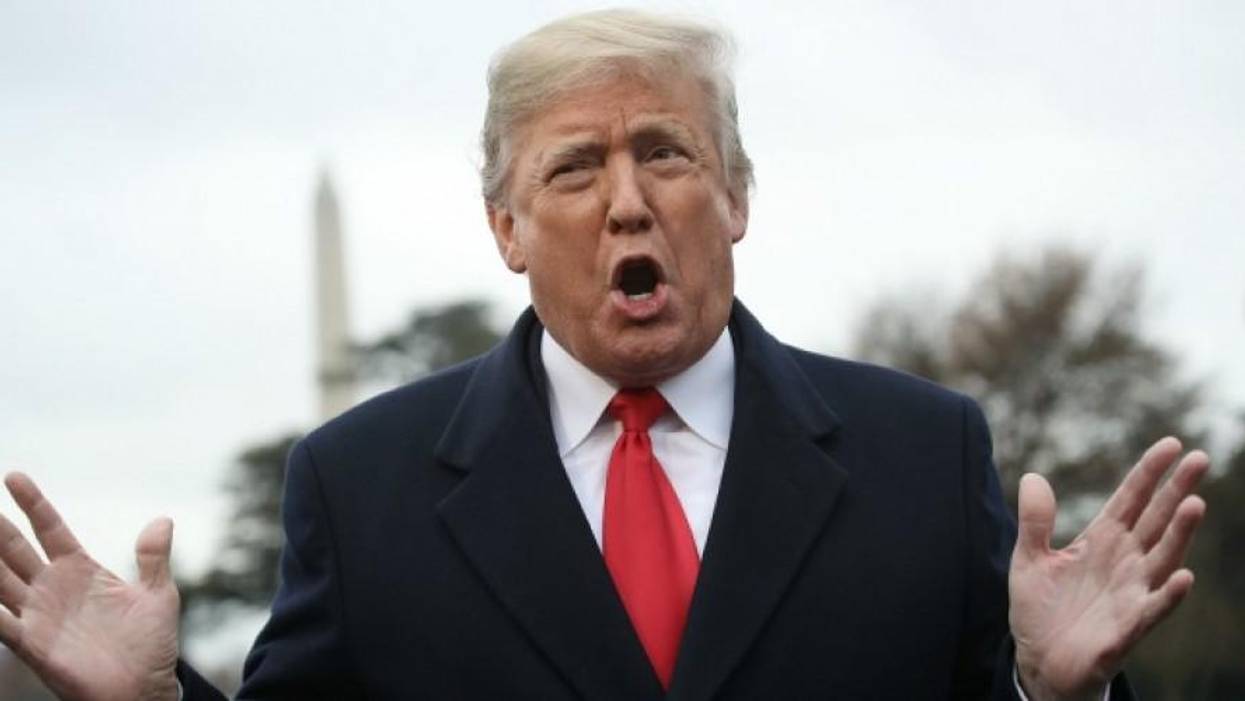
The Biden administration on Thursday laid it right out in the open.
It's time to seriously discuss a 60-year problem we've had with treasonous and illegitimate Republican presidents.
When Trump 2016 campaign chairman Paul Manafort was passing secret polling information about swing states like Michigan, Wisconsin, and Pennsylvania to Konstantin Kilimnik, as is laid out in the Mueller Report, it was part of a very specific and successful effort on the part of Russian Intelligence to help put Trump in office.
This was the data they would have used to have troll accounts and ads target individuals in those states via social media, particularly Facebook, to both suppress the vote for Clinton and encourage voters to show up for Trump and other down-ticket Republicans.
This is not the first time a Republican candidate for president has committed treason to get into the White House. In fact, it's been the norm since 1968, and therefore it's time to seriously discuss a 60-year problem we've had with treasonous and illegitimate Republican presidents.
America must stop giving criminal Republican presidents a pass. Every GOP president since Dwight Eisenhower used treason or deception to come to office (or inherited office from one who did), and it needs to end. It's a truly astonishing and horrifying story.
It started in 1968, when President Lyndon Johnson was desperately trying to end the Vietnam War. It had turned into both a personal and political nightmare for him, and his vice president, Hubert Humphrey, was running for president in the election that year against a "reinvented" Richard Nixon.
Johnson spent most of late 1967 and early 1968 working back-channels to North and South Vietnam, and by the summer of 1968 had a tentative agreement from both for what promised to be a lasting peace deal they'd both sign that fall.
But Richard Nixon knew that if he could block that peace deal, it would kill Humphrey's chances of winning the 1968 election. So Nixon sent envoys from his campaign to talk to South Vietnamese leaders to encourage them not to attend upcoming peace talks in Paris.
Nixon promised South Vietnam's corrupt politicians that he'd give them a richer deal when he was president than LBJ could give them then.
The FBI had been wiretapping Nixon's people and told LBJ about his effort to prolong the Vietnam War. Thus, just three days before the 1968 election, Johnson phoned the Republican Senate leader, Everett Dirksen, (you can listen to the entire conversation here):
President Johnson: Some of our folks, including some of the old China lobby, are going to the Vietnamese embassy and saying please notify the [South Vietnamese] president that if he'll hold out 'til November 2nd they could get a better deal. Now, I'm reading their hand. I don't want to get this in the campaign. And they oughtn't to be doin' this, Everett. This is treason.
Sen. Dirksen: I know.
Those tapes were only released by the LBJ library in the past decade, and that's Richard Nixon who Lyndon Johnson was accusing of treason.
At that point, for President Johnson, it was no longer about getting Humphrey elected. By then Nixon's plan had already worked and Humphrey was being wiped out in the polls.
Instead, Johnson was desperately trying to salvage the peace talks to stop the death and carnage as soon as possible. He literally couldn't sleep.
In a phone call to Nixon himself just before the election, LBJ begged him to stop sabotaging the peace process, noting that he was almost certainly going to win the election and inherit the war anyway. Instead, Nixon publicly said LBJ's efforts were "in shambles."
But South Vietnam had taken Nixon's deal and boycotted the peace talks, the war continued, and Nixon won the White House thanks to it.
An additional 22,000 American soldiers, and over an additional million Vietnamese, died because of Nixon's 1968 treason, and he left it to Gerald Ford to end the war and evacuate the American soldiers.
Nixon was never held to account for it, and when the LBJ library released the tapes and documentation it was barely noticed by the American press.
Gerald Ford, who succeeded Nixon, was never elected to the White House (he was appointed to replace VP Spiro Agnew, after Agnew was indicted for decades of taking bribes), and thus would never have been president had it not been for Richard Nixon's treason. He pardoned Nixon.
Next up was Ronald Reagan.
During the Carter/Reagan election battle of 1980, then-President Carter had reached a deal with newly elected Iranian President Abdolhassan Bani-Sadr to release the 52 hostages held by students at the American Embassy in Tehran.
Bani-Sadr was a moderate and, as he explained in an editorial for The Christian Science Monitor, successfully ran for president on the popular position of releasing the hostages:
I openly opposed the hostage-taking throughout the election campaign. ...I won the election with over 76% of the vote. ...Other candidates also were openly against hostage-taking, and overall, 96% of votes in that election were given to candidates who were against it [hostage-taking].
Carter was confident that with Bani-Sadr's help, he could end the embarrassing hostage crisis that had been a thorn in his political side ever since it began in November of 1979.
But behind Carter's back, the Reagan campaign worked out a deal with the leader of Iran's radical faction--Supreme Leader Ayatollah Khomeini--to keep the hostages in captivity until after the 1980 presidential election. Khomeini needed spare parts for American weapons systems the Shah had purchased for Iran, and Reagan was happy to promise them.
This was the second act of treason by a Republican wanting to become president.
The Reagan campaign's secret negotiations with Khomeini--the so-called "October Surprise"-- sabotaged President Carter's and Iranian President Bani-Sadr's attempts to free the hostages. As President Bani-Sadr told The Christian Science Monitor in March of 2013:
"After arriving in France [in 1981], I told a BBC reporter that I had left Iran to expose the symbiotic relationship between Khomeinism and Reaganism.
"Ayatollah Khomeini and Ronald Reagan had organized a clandestine negotiation, later known as the 'October Surprise,' which prevented the attempts by myself and then-U.S. President Jimmy Carter to free the hostages before the 1980 U.S. presidential election took place. The fact that they were not released tipped the results of the election in favor of Reagan."
And Reagan's treason--just like Nixon's treason--worked perfectly.
The Iran hostage crisis continued and torpedoed Jimmy Carter's re-election hopes. And the same day Reagan took the oath of office--to the minute, as Reagan put his hand on the bible, by way of Iran's acknowledging the deal--the American hostages in Iran were released.
Keeping his side of the deal, Reagan began selling the Iranians weapons and spare parts in 1981, and continued until he was busted for it in 1986, producing the so-called "Iran-Contra" scandal.
But, like Nixon, Reagan was never held to account for the criminal and treasonous actions that brought him to office.
After Reagan--Bush senior was elected--but like Jerry Ford--Bush was really only president because he served as vice president under Reagan. And, of course, the naked racism of his Willie Horton ads helped keep him in office.
The criminal investigation into Iran-Contra came to a head with independent prosecutor Lawrence Walsh subpoenaing President George H.W. Bush after having already obtained convictions for Weinberger, Ollie North and others. Bush's attorney general, Bill Barr, suggested he pardon them all to kill the investigation, which Bush did. The screaming headline across the New York Times front page on December 25, 1992, said it all:
THE PARDONS; BUSH PARDONS 6 IN IRAN AFFAIR, ABORTING A WEINBERGER TRIAL; PROSECUTOR ASSAILS 'COVER-UP'
And if the October Surprise hadn't hoodwinked voters in 1980, you can bet Bush senior would never have been elected in 1988. That's four illegitimate Republican presidents.
Which brings us to George W. Bush, the man who was given the White House by five right-wing justices on the Supreme Court.
In the Bush v. Gore Supreme Court decision in 2000 that stopped the Florida recount--and thus handed George W. Bush the presidency--Justice Antonin Scalia wrote in his opinion:
The counting of votes... does in my view threaten irreparable harm to petitioner [George W. Bush], and to the country, by casting a cloud upon what he [Bush] claims to be the legitimacy of his election.
Apparently, denying the presidency to Al Gore, the guy who actually won the most votes in Florida, did not constitute "irreparable harm" to Scalia or the media.
And apparently it wasn't important that Scalia's son worked for a law firm that was defending George W. Bush before the high court (with no Scalia recusal).
Just like it wasn't important to mention that Justice Clarence Thomas's wife worked on the Bush transition team--before the Supreme Court shut down the count in Florida--and was busy accepting resumes from people who would serve in the Bush White House if her husband stopped the recount in Florida... which he did. (No Thomas recusal, either.)
More than a year after the election a consortium of newspapers including The Washington Post, The New York Times, and USA Today did their own recount of the vote in Florida--manually counting every vote in a process that took almost a year--and concluded that Al Gore did indeed win the presidency in 2000.
As the November 12th, 2001 article in The New York Times read:
If all the ballots had been reviewed under any of seven single standards and combined with the results of an examination of overvotes, Mr. Gore would have won.
That little bit of info was slipped into the seventeenth paragraph of the Times story so that it would attract as little attention as possible because the 9/11 attacks had happened just weeks earlier and journalists feared that burdening Americans with the plain truth that George W. Bush actually lost the election would further hurt a nation already in crisis.
To compound the crime, Bush could only have gotten as close to Gore in the election as he did because his brother, Florida Gov. Jeb Bush, had ordered his Secretary of State, Kathrine Harris, to purge at least 57,000 mostly-Black voters from the state's voter rolls just before the election.
So, for the third time in four decades, Republicans took the White House under illegitimate electoral circumstances. Even President Carter was shocked by the brazenness of that one. And Jeb Bush and the GOP were never held to account for that crime against democracy.*
Most recently, in 2016, Trump ally Kris Kobach and Republican secretaries of state across the nation used Interstate Crosscheck to purge millions of legitimate voters--most people of color--from the voting rolls just in time for the Clinton-Trump election.
Meanwhile, Russian oligarchs or the Russian state, and possibly pro-Trump groups or nations in the Middle East, are alleged to have funded a widespread program to flood social media with pro-Trump, anti-Clinton messages from accounts posing as Americans, as documented by Robert Mueller's investigation.
One can only wonder how much better off America would be if six Republican presidents hadn't stolen or inherited a stolen White House and used it to put right-wing cranks on the Supreme Court and other federal benches.
And on top of that, we learned today that Republican campaign data on the 2016 election, including which states needed a little help via phony influencers on Facebook and other social media, was not only given to Konstantin Kilimnik by Paul Manafort, but Kilimnik transferred it to Russian intelligence.
Donald Trump still lost the national vote by nearly three million votes, but came to power through an electoral college designed to keep slavery safe in colonial America.
One can only wonder how much better off America would be if six Republican presidents hadn't stolen or inherited a stolen White House and used it to put right-wing cranks on the Supreme Court and other federal benches.
Now, finally, there may be an opportunity for some accountability for another criminal Republican president.
The depth and breadth of Trump's involvement in the January 6th attempt to destroy our form of government and replace it with single-party strongman rule is becoming more and more obvious. As a result, the pressure is building to hold him and many of those in his administration to account.
America has ignored GOP crimes to seize and hold the White House long enough. It's time, at long last, to put this one in prison.
This piece initially appeared on The Hartmann Report.

Thirty years ago, when the United States launched Operation Desert Storm against Iraq, I was a member of the Gulf Peace Team. We were 73 people from fifteen different countries, aged 22 to 76, living in a tent camp close to Iraq's border with Saudi Arabia, along the road to Mecca.
We aimed to nonviolently interpose ourselves between the warring parties. Soldiers are called upon to risk their lives for a cause they may not know much about. Why not ask peace activists to take risks on behalf of preventing and opposing wars?
So we witnessed the dismal onset of the air war at 3:00 a.m. on January 17, 1991, huddled under blankets, hearing distant explosions and watching anxiously as war planes flew overhead. With so many fighter jets crossing the skies, we wondered if there would be anything left of Baghdad.
Ten days later, Iraqi authorities told us we must pack up, readying for a morning departure to Baghdad. Not all of us could agree on how to respond. Adhering to basic principles, twelve peace team members resolved to sit in a circle, holding signs saying "We choose to stay."
Buses arrived the next morning, along with two Iraqi civilians and two soldiers. Tarak, a civilian, was in charge, under orders to follow a timetable for the evacuation. Looking at the circle of twelve, Tarak seemed a bit baffled. He walked over to where I stood. "Excuse me, Ms. Kathy," he asked, "but what am I to do?"
"No one in that circle means you any harm," I assured him. "And no one wishes to disrespect you, but they won't be able board the bus on their own. It's a matter of conscience."
Tarak nodded and then motioned to the other Iraqis who followed him as he approached Jeremy Hartigan, the tallest person sitting in the circle. Jeremy, an elderly UK lawyer and also a Buddhist, was chanting a prayer as he sat with his sign.
Tarak bent over Jeremy, kissed him on the forehead, and said, "Baghdad!" Then he pointed to the bus.
Next, he, the other civilian and two Iraqi soldiers carefully hoisted Jeremy, still in his cross-legged position, and carried him to the top step of the bus. Gently placing him down, Tarak then asked, "Mister, you okay?!" And in this manner they proceeded to evacuate the remaining eleven people in the circle.
On February 13, 1991, two 2,000 lb. U.S. laser guided missiles killed 400 civilians, mostly women and children.
Another evacuation was happening as Iraqi forces, many of them young conscripts, hungry, disheveled and unarmed, poured out of Kuwait along a major highway, later called "the Highway of Death."
Boxed in by U.S. forces, many Iraqis abandoned their vehicles and ran away from what had become a huge and very dangerous traffic jam. Iraqis attempting to surrender were stuck in a long line of Iraqi military vehicles. They were systematically slaughtered.
"It was like shooting fish in a barrel," said one U.S. pilot of the air attack. Another called it "a turkey shoot."
Days earlier, on February 24th, the United States Army forces buried scores of living Iraqi soldiers in trenches. According to The New York Times, Army officials said "the Iraqi soldiers who died remained in their trenches as plow-equipped tanks dumped tons of earth and sand onto them, filling the trenches to ensure that they could not be used as cover from which to fire on allied units that were poised to pour through the gaps."
Shortly after viewing photos of gruesome carnage caused by the ground and air attacks, President George H.W. Bush called for a cessation of hostilities on February 27th, 1991. An official cease fire was signed on March 4.
It's ironic that in October of 1990, Bush had asserted that the U.S. would never stand by and let a larger country swallow a smaller country. His country had just invaded Grenada and Panama, and as President Bush spoke, the U.S. military pre-positioned at three Saudi ports hundreds of ships, thousands of aircraft, and millions of tons of equipment and fuel in preparation to invade Iraq.
Noam Chomsky notes that there were diplomatic alternatives to the bloodletting and destruction visited upon Iraq by Operation Desert Storm. Iraqi diplomats had submitted an alternative plan which was suppressed in the mainstream media and flatly rejected by the U.S.
The U.S. State Department, along with Margaret Thatcher's government in the United Kingdom, were hell-bent on moving ahead with their war plans. "This was no time to go wobbly," U.K. Prime Minister Margaret Thatcher famously warned Bush.
The resolve to attack and punish Iraqis never ceased.
After the "success" of Operation Desert Storm, the bombing war turned into an economic war, which lasted through 2003. As early as 1995, United Nations documents clarified that the economic war, waged through continued imposition of U.N. economic sanctions against Iraq, was far more brutal than even the worst of the 1991 aerial and ground war attacks.
In 1995, two Food and Agriculture Organization scientists estimated that more than half a million Iraqi children under age five had likely died due to economic sanctions.
In February, 1998, while visiting a hospital in Baghdad, I watched two friends from the United Kingdom trying to absorb the horror of seeing children being starved to death because of policy decisions made by governments in the UK and the U.S. Martin Thomas, himself a nurse, looked at mothers sitting cross legged, holding their limp and dying infants, in a ward where helpless doctors and nurses tried to treat many dozens of children.
"I think I understand," said Thomas. "It's a death row for infants." Milan Rai, now editor of Peace News and then the coordinator of a U.K. campaign to defy the economic sanctions, knelt next to one of the mothers. Rai's own child was close in age to the toddler the mother cradled. "I'm sorry," Rai murmured. "I'm so very sorry."
Those six words whispered by Milan Rai, are, I believe, incalculably important.
If only people in the U.S. and the UK could take those words to heart, undertaking to finally pressure their governments to echo these words and themselves say, "We're sorry. We're so very sorry."
We're sorry for slaughtering hundreds of thousands of your children through economic sanctions and then expecting you to thank us for liberating you.
We're sorry for coldly viewing your land as a "target rich environment" and then systematically destroying your electrical facilities, sewage and sanitation plants, roads, bridges, infrastructure, health care, education, and livelihood. We're sorry for believing we somehow had a right to the oil in your land, and we're sorry many of us lived so well because we were consuming your precious and irreplaceable resources at cut rate prices.
We're sorry for slaughtering hundreds of thousands of your children through economic sanctions and then expecting you to thank us for liberating you. We're sorry for wrongfully accusing you of harboring weapons of mass destruction while we looked the other way as Israel acquired thermonuclear weapons.
We're sorry for again traumatizing your children through the 2003 Shock and Awe bombing, filling your broken down hospitals with maimed and bereaved survivors of the vicious bombing and then causing enormous wreckage through our inept and criminal occupation of your land.
We're sorry. We're so very sorry. And we want to pay reparations.
From March 5 - 8, Pope Francis will visit Iraq. Security concerns are high, and I won't begin to second guess the itinerary that has been developed. But knowing of his eloquent and authentic plea to end wars and stop the pernicious weapons trade, I wish he could kneel and kiss the ground at the Ameriyah shelter in Baghdad.
There, on February 13, 1991, two 2,000 lb. U.S. laser guided missiles killed 400 civilians, mostly women and children. Another 200 were severely wounded. I wish President Joe Biden could meet the Pope there and ask him to hear his confession.
I wish people around the world could be represented by the Pope as a symbol of unity expressing collective sorrow for making war after hideous war, in Iraq, against people who meant us no harm.
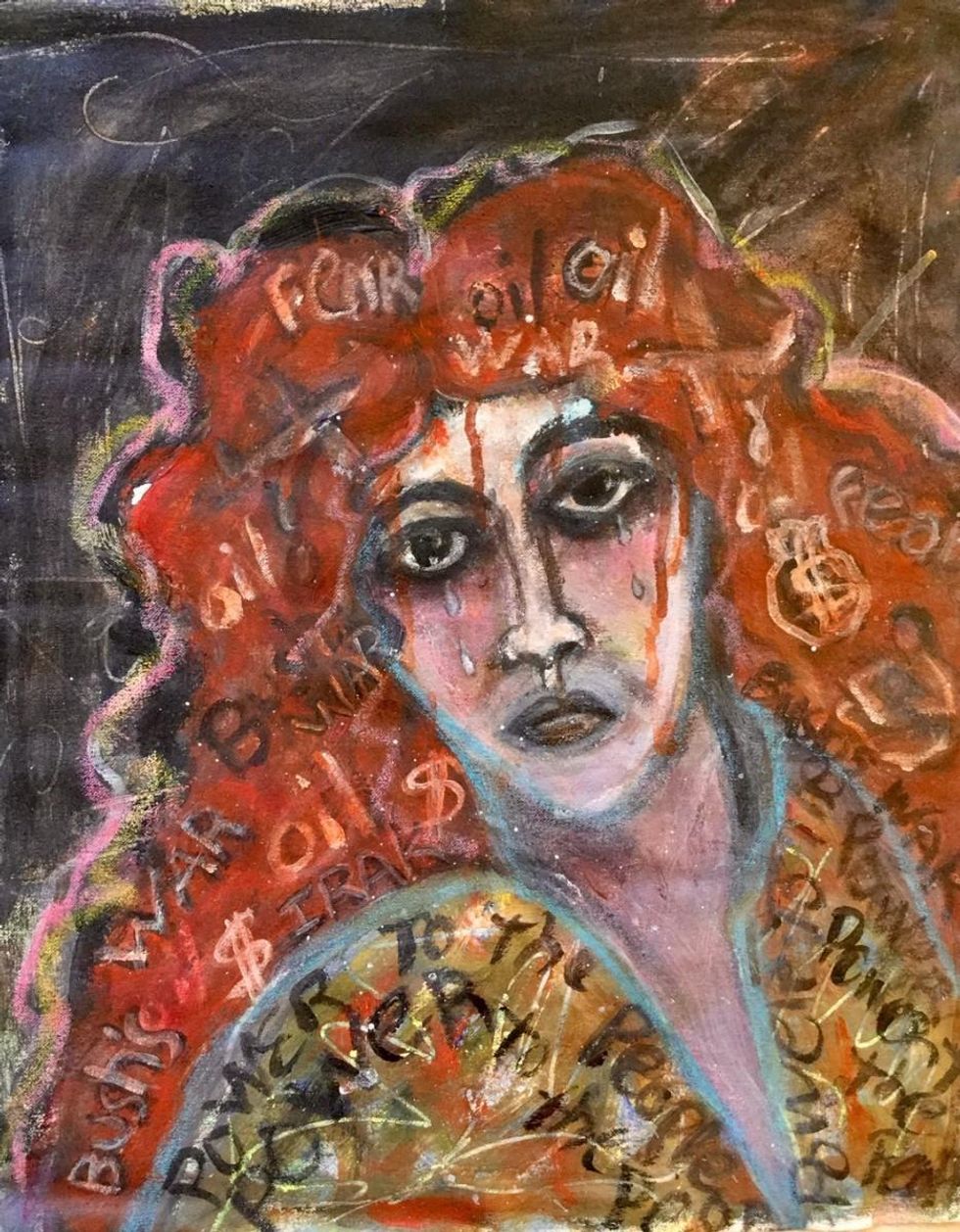
A version of this article first appeared at The Progressive.org

"This is a different kind of war, which we will wage aggressively and methodically to disrupt and destroy terrorist activity," President George W. Bush announced a little more than two weeks after the 9/11 attacks. "Some victories will be won outside of public view, in tragedies avoided and threats eliminated. Other victories will be clear to all."
This year will mark the 20th anniversary of the war on terror, including America's undeclared conflict in Afghanistan. After that war's original moniker, Operation Infinite Justice, was nixed for offending Muslim sensibilities, the Pentagon rebranded it Operation Enduring Freedom. Despite neither a clear victory, nor the slightest evidence that enduring freedom had ever been imposed on that country, "U.S. combat operations in Afghanistan ended," according to the Defense Department, in 2014. In reality, that combat simply continued under a new name, Operation Freedom's Sentinel, and grinds on to this very day.
Like the 2003 invasion of Iraq, known as Operation Iraqi Freedom, Enduring Freedom and Freedom's Sentinel failed to live up to their names. Nor did any of the monikers slapped on America's post-9/11 wars ever catch the public imagination; the battlefields spread from Afghanistan and Iraq to Yemen, Somalia, the Philippines, Libya, Syria, Niger, Burkina Faso, and beyond -- at a price tag north of $6.4 trillion and a human toll that includes at least 335,000 civilians killed and at least 37 million displaced from their homes. Meanwhile, those long promised clear victories never materialized even as the number of terrorist groups around the world proliferated.
Last month, America's top general offered an assessment of the Afghan War that was as apt as it was bleak. "We believe that after two decades of consistent effort, we've achieved a modicum of success," said Chairman of the Joint Chiefs of Staff General Mark Milley. "I would also argue over the last five to seven years at a minimum, we have been in a condition of strategic stalemate." Milley's soundbites provided appellations far more apt than those the Pentagon dreamt up over the years. Had the Defense Department opened the post-9/11 wars with names like Operation Modicum of Success or Operation Strategic Stalemate, Americans would at least have had a realistic idea of what to expect in the ensuing decades as three presidents waged undeclared wars without achieving victories anywhere across the Greater Middle East or Africa.
What the future will bring in terms of this country's many armed conflicts is murkier than ever as the Trump administration pursues an array of 11th-hour efforts interpreted as last-minute attempts to make good on pledges to end this country's "endless wars" or simply as sour-grapes shots at upending, undermining, and sabotaging the "deep state" (the CIA in particular), while handcuffing or kneecapping the incoming Biden administration's future foreign policy. As it happens, however, President Trump's flailing final gambits, while by no means ending America's wars, provide the Biden administration with a unique opportunity to put those conflicts in the history books, should the president-elect choose to take advantage of the inadvertent gift his predecessor provided.
The Third President Not to End the War on Terror
For four years, the Trump administration has waged a multifront war, not only in Afghanistan, Iraq, Somalia, Syria, and elsewhere around the globe, but with the Pentagon as well. Donald Trump entered the White House vowing to stop America's ceaseless foreign interventions and repeatedly teased ending those "endless wars." He didn't. Instead, he and his administration continued to wage America's many conflicts, surged troops into Afghanistan and Syria, and threatened nuclear strikes against enemies and allies alike.
When the president finally began making halting gestures toward curtailing the country's endless conflicts and attempted to draw down troops in various war zones, the Pentagon and State Department slow walked, slow rolled, and stymied their commander-in-chief, deceiving him, for example, when it came to something as basic as the actual number of U.S. troops in Syria. Even after striking a 2020 deal with the Taliban to settle the Afghan War and ordering significant troop withdrawals from that country and others as he became a lame-duck president, he failed to halt a single armed intervention that he had inherited.
Far from ending endless wars, President Trump escalated the most endless of them: the conflicts in Afghanistan and Somalia where America has been intermittently involved since the 1970s and 1990s, respectively. Air strikes in Somalia have, for instance, skyrocketed under the Trump administration. From 2007 to 2017, the U.S. military conducted 42 declared air attacks in that country. Under President Trump, 37 strikes were conducted in 2017, 48 in 2018, and 63 in 2019. Last year, U.S. Africa Command (AFRICOM) acknowledged 53 air strikes in Somalia, more than during the 16 years of the administrations of George W. Bush and Barack Obama.
The reasons for that increase remain shrouded in secrecy. In March 2017, however, President Trump reportedly designated parts of Somalia as "areas of active hostilities," while removing Obama-era rules requiring that there be near certainty that airstrikes will not injure or kill noncombatants. Although the White House refuses to explicitly confirm or deny that this ever happened, retired Brigadier General Donald Bolduc, who headed Special Operations Command Africa at the time, told the Intercept that the "burden of proof as to who could be targeted and for what reason changed dramatically." That change, he noted, led AFRICOM to conduct strikes that previously would not have been carried out.
The uptick in airstrikes has been disastrous for civilians. While Africa Command recently acknowledged five deaths of noncombatants in Somalia from all such airstrikes, an investigation by Amnesty International found that, in just nine of them, 21 civilians were killed and 11 others injured. According to the U.K.-based monitoring group Airwars, evidence suggests that as many as 13 Somali civilians have been killed by U.S. strikes in 2020 alone, and Trump's recent decision to withdraw U.S. forces from there will not end those air attacks, much less America's war, according to the Pentagon. "While a change in force posture, this action is not a change in U.S. policy," reads a Defense Department statement that followed Trump's withdrawal order. "The U.S. will retain the capability to conduct targeted counterterrorism operations in Somalia and collect early warnings and indicators regarding threats to the homeland."
The war in Afghanistan has followed a similar trajectory under President Trump. Far from deescalating the conflict as it negotiated a peace deal with the Taliban and pursued troop drawdowns, the administration ramped up the war on multiple fronts, initially deploying more troops and increasing its use of U.S. air power. As in Somalia, civilians suffered mightily, according to a recent report by Neta Crawford of Brown University's Costs of War project.
During its first year in office, the Trump administration relaxed the rules of engagement and escalated the air war in an effort to gain leverage at the bargaining table. "From 2017 through 2019, civilian deaths due to U.S. and allied forces' air strikes in Afghanistan dramatically increased," wrote Crawford. "In 2019, airstrikes killed 700 civilians -- more civilians than in any other year since the beginning of the war in 2001 and 2002." After the U.S. and the Taliban reached a tentative peace agreement last February, U.S. air strikes declined, but never completely ceased. As recently as last month, the U.S. reportedly conducted one in Afghanistan that resulted in civilian casualties.
As those civilian deaths from air power were spiking, an elite CIA-trained Afghan paramilitary unit known as 01, in partnership with U.S. Special Operations forces, was involved in what Andrew Quilty, writing at the Intercept, termed "a campaign of terror against civilians," including a "string of massacres, executions, mutilation, forced disappearances, attacks on medical facilities, and air strikes targeting structures known to house civilians." In all, the unit killed at least 51 civilians in Afghanistan's Wardak province between December 2018 and December 2019. As Akhtar Mohammad Tahiri, the head of Wardak's provincial council, told Quilty, the Americans "step on all the rules of war, human rights, all the things they said they'd bring to Afghanistan." They are, he said, "conducting themselves as terrorists. They show terror and violence and think they'll bring control this way."
President Biden's Choice
"We are not a people of perpetual war -- it is the antithesis of everything for which we stand and for which our ancestors fought," Acting Secretary of Defense Christopher Miller wrote as part of a two-page memo to Defense Department employees last November, adding, "All wars must end." His predecessor, Mark Esper, was reportedly fired, at least in part, for resisting President Trump's efforts to remove troops from Afghanistan. Yet neither Miller nor Trump turned out to be committed to actually ending America's wars.
After losing his bid for reelection in November, the president did issue a series of orders drawing down some troops from Afghanistan, Iraq, and Syria. Virtually all military personnel are to be withdrawn from Somalia. There, however, according to the Pentagon, some or all of those forces will simply be "repositioned from Somalia into neighboring countries in order to allow cross-border operations," not to speak of continuing "targeted counterterrorism operations" in that country. This suggests that the long-running U.S. air war will continue uninterrupted.
The same goes for the other war zones where American troops are slated to remain and no cessation of air strikes has been announced. "You're still going to have the ability to do the missions that we've been doing," a senior Pentagon official said last month regarding Afghanistan. Miller echoed this during a recent trip to that country when he said: "I especially want to see and hear the plan for our continued air support role." Ironically enough, Miller's all-wars-must-end November memo actually championed a forever-war mindset by insisting on the necessity of "finishing the war that al-Qaida brought to our shores in 2001."
In classic the-U.S.-has-finally-turned-the-corner fashion, Miller asserted that America is "on the verge of defeating al-Qaida and its associates" and "must avoid our past strategic error of failing to see the fight through to the finish." To anyone who might have thought he was signaling that the war on terror was coming to a close, Miller offered a message that couldn't have been more succinct: "This war isn't over."
At the same time, Miller and several other post-election Trump political appointees, including his chief of staff Kash Patel and Acting Under Secretary of Defense for Intelligence Ezra Cohen-Watnick, have sought to make significant last-minute policy changes at the Pentagon, rankling members of the national security establishment. Last month, for example, Trump administration officials delivered to the Joint Chiefs of Staff a proposal to decouple the leadership of the National Security Agency and U.S. Cyber Command. Miller also sent a letter to CIA Director Gina Haspel informing her that a longstanding arrangement in which the Pentagon offered support to the Agency is in jeopardy.
News reports indicated that the Department of Defense is reviewing its support for the CIA. The reason, former and current administration and military officials told Defense One, was to determine whether Special Operations forces should be diverted from the Agency's counterterrorism operations to missions "related to competition with Russia and China." The New York Times suggested, however, that the true purpose could be to "make it difficult" for the CIA to conduct operations in Afghanistan.
The troop drawdowns and eleventh-hour policy changes have been cast by pundits and national security establishment boosters as the spiteful final acts of a lame-duck president. Whatever they may be, they also represent a genuine opportunity for a president-elect who has voiced support for a shift in national security policy. "Biden will end the forever wars in Afghanistan and the Middle East, which have cost us untold blood and treasure" reads the plan for "Leading the Democratic World" at JoeBiden.com. There, too, in the fine print, however, lurk a set of Miller-esque fight-to-the-finish loopholes, as the italicized words in this sentence suggest: "Biden will bring the vast majority of our troops home from Afghanistan and narrowly focus our mission on al-Qaeda and ISIS."
Under an agreement the Trump administration struck with Taliban negotiators last year, the United States promised to remove all remaining troops from Afghanistan by May 1, 2021, if that group upholds its commitments. Were the Biden team to take advantage of both the Trump administration's withdrawal pact and its last-ditch effort to handcuff the CIA, a significant part of the American war there would simply expire later this spring. While this would undoubtedly elicit anguished howls from supporters of that failed war, President Biden could defer to Congress's constitutionally assigned war powers, leaving it to the legislative branch to either declare war in that country after all these years or simply allow the conflict to end.
He could also use the bully pulpit of the presidency to call for sunsetting the 2001 Authorization for Use of Military Force, or AUMF, a 60-word resolution passed by Congress three days after the September 11th attacks, which has been used to justify 20 years of war against groups like the Islamic State that didn't even exist on 9/11. He could do the same with the 2002 Iraq Authorization for Use of Military Force, which authorized the war against Saddam Hussein's regime in Iraq, but was nonetheless cited last year in the Trump administration's justification for the drone assassination of Iranian Major General Qasem Suleimani.
Almost two decades after President George W. Bush launched "a different kind of war"; more than a decade after President Barack Obama entered the White House promising to avoid "stupid wars" (while promising to win the "right war" in Afghanistan); six months after President Trump committed to "ending the era of endless wars," President-elect Biden enters the White House with an opportunity to begin to make good on his own pledge to "end the forever wars in Afghanistan and the Middle East."
As President Bush put it in 2001: "Some victories will be won outside of public view, in tragedies avoided and threats eliminated." America's twenty-first-century wars have, instead, been tragedies for millions and have led to a proliferation of threats that damaged the United States in fundamental ways. President-elect Biden has recognized this, noting that "staying entrenched in unwinnable conflicts only drains our capacity to lead on other issues that require our attention, and it prevents us from rebuilding the other instruments of American power."
Failed forever wars are, however, also a Joe Biden legacy. As a senator, he voted for that 2001 AUMF, the 2002 AUMF, and then seconded a president who expanded America's overseas interventions -- and nothing in his personal history suggests that he will take the bold actions necessary to follow through on putting an end to America's overseas conflicts. "It's long past time we end the forever wars," he announced in 2019. As it happens, on entering the Oval Office he will be faced with a monumental choice: to be either the first U.S. president of this century not to double down on doomed overseas conflicts or the fourth to find failure in wars that can never be won.
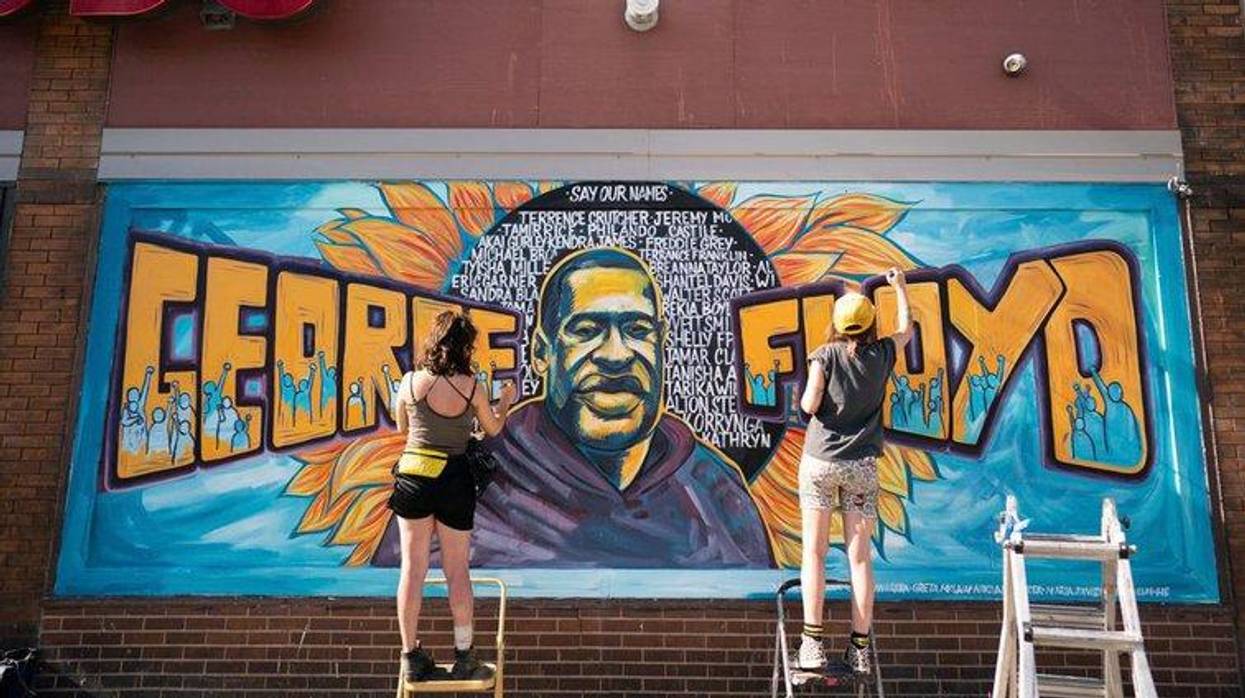
Conventional wisdom tells us lynchings in the US are a historical phenomenon. George Floyd's murder graphically demonstrates they are not.
For many, the word 'lynching' conjures up images of an angry mob throwing a rope over a branch and hastily dispatching its victim before the authorities can intervene. But as anyone who has taken more than a cursory glance at the history of white US 'mob justice' will know, lynchings in post-slavery/Reconstruction America were anything but. They were protracted, brutal affairs overwhelmingly committed against black men as calculated acts of intimidation and fear.
What happened to George Floyd was nothing less than a public lynching. Unfortunately, the list of similarities does not end there.
Like countless lynching victims before him, George Floyd's death occurred in full public view.
Like countless lynching victims before him, George Floyd's death was captured on film
Like countless lynching victims before him, George Floyd pleaded with his executioners: for water, for air, for mercy.
Like countless lynchers before, murder suspect Derek Chauvin looks calmly into the lens of the camera, with the self-assurance of someone who has done this before and will do it again, with impunity.
Like countless lynchers before, Derek Chauvin was surrounded by those who believe they too are above the law.
And just like the communities the victims back then came from, few have any faith lasting justice will ever be forthcoming.
Of course, there will be those who insist this is an exaggeration. An over-dramatisation of what actually happened. That tracing a thread from the US's bloody past of conquest, genocide, slavery, and state sanctioned Jim Crow discrimination, through to present day deaths in police custody, mass incarceration and systemic socio-economic discrimination and segregation, is unfair. That it fails to consider the 'arc of progress'; of the civil rights movement and the first ever African American President.
In one respect they are right. From such a low and brutal historical bar, 'progress' of the kind mentioned has indeed been made. Unfortunately, 'arcs of progress' are rarely one-way streets. Sometimes they regress. And that ultimately is the reality of the post-civil-rights era we now inhabit.
There is no single point of regression but arguably a key turning point can be traced back to Ronald Reagan's presidency. It was here US law enforcement militarisation began in earnest, with its specialist weapons and hard-line policing.
Under Bush Senior the pace quickened when, as historian Pankaj Mishra described, 'the removal of all restraints on American global power were realised' and with it the 'old legal and moral barriers were dismantled at home.'
As working-class terms and conditions came under attack, racism provided far too valuable a tool for elites that required a divided working class: Mexicans, Muslims, blacks, immigration--these were the cause of declining living standards, not the rapacious greed of the 1%.
In other words, US political elites no longer needed to win the 'hearts and minds' of the mainly black and brown developing world. The Soviet Union's defeat removed the necessity of an ideological duel that required the ending of Jim Crow and the embracing of black civil rights. For how do you convince people of colour across the developing world that your system of political-economy is superior to that of your Soviet opponents? A creed, that no matter how flawed in retrospect, claimed to represent 'anti-imperialism' and 'equality for all'? In contrast your own system was busy brutalising, 'red-lining' and segregating the very people you were trying to win over abroad? Black civil rights and the 'war on poverty' was therefore the price the US's ruling elites had to pay to compete for global superiority.
But that changed with the collapse of the Soviet Union. Now workers across the western world faced a resurgent free-market capitalism, attacking hard won social protections, won in the post-war period. But for black workers there was an extra sting in the tail of this regression. Anti-racist progress was also being driven back too. As working-class terms and conditions came under attack, racism provided far too valuable a tool for elites that required a divided working class: Mexicans, Muslims, blacks, immigration--these were the cause of declining living standards, not the rapacious greed of the 1%. Backed by right-wing media and centuries of ingrained racism, the dog whistles and worse were dusted down.
This complete reversal of the 'war on poverty' welfare programmes and erosion of workers' rights was always going to fall disproportionately hard on Black America. Just as millions were beginning to haul themselves up, the rug was once again being pulled from underneath them. Affirmative action withered under conservative onslaught. Federal and state programmes to improve housing, education were slashed.
But by the mid 1990s it wasn't just the US right that was busy regressing the 'arc of progress' when it came to race justice. Now liberal America joined the throng, declaring a post-racist society and deregulating financial and labour markets yet further. It was to this backdrop President Clinton dismantled 'welfare as we know it' and the notion of the 'deserving and undeserving poor' was introduced. But if there are those who no longer deserve welfare support, the question surely arises as to what you do with this 'undeserving' contingent?
The answer soon became apparent: a burgeoning and profitable prison industrial complex. In 1970 there were 300,000 prisoners in the US. By 2001 that had expanded to 2.1 million -- the majority black, brown and poor. To be sure Clinton didn't just inherit Republican policies of harsh policing and punishment -- he expanded on them, introducing in 1994 the most draconian crime bill in US history.
Under Bush Jnr, the regression continued. His administrations' response to Hurricane Katrina laid bare once again the systemic structural racism at the heart of US society. Old style Jim Crow segregation had been abolished to now be replaced by sharply defined zones of prosperity and destitution. Like Covid-19, a disease that of itself isn't racist yet nonetheless highlights perfectly the disease of racism, Katrina shone a spotlight on deep US structural racism. Whether living in poorer, more flood prone housing or shot dead as 'looters' whilst attempting to survive amidst a shocking paucity of state and federal aid, African Americans fared badly.
Even under Obama drone killings reached an all-time high. Libya was decimated. Yemen and Somalia despoiled. Whilst mass deportations, that even Trump has been unable to match, took place on his watch. Meanwhile domestic economic policy was dominated by austerity, ruining the lives of millions, especially African Americans, already struggling after decades of neoliberal deregulation and civil-rights regression.
With Obama that was all meant to change. As one critical observer noted, the first African American president, "Embodied neoliberal chic at its most seductive. Obama managed to restore the self-image of American elites in politics, business and the media that had been much battered during the final years of the Bush presidency. It was in effect the updated narrative of American exceptionalism." But this was an exceptionalism that was becoming an increasingly hard sell after almost a decade of foreign aggression and torture in the name of the 'war on terror'. A war which had fallen disproportionately on people of colour.
And yet even under Obama drone killings reached an all-time high. Libya was decimated. Yemen and Somalia despoiled. Whilst mass deportations, that even Trump has been unable to match, took place on his watch. Meanwhile domestic economic policy was dominated by austerity, ruining the lives of millions, especially African Americans, already struggling after decades of neoliberal deregulation and civil-rights regression.
And so, we come full-circle to Trump, George Floyd and all the other countless acts of violence, murder and economic racial injustice that is now hardwired deep into US society. When seen in the context of post-civil-rights history, Trump's election and the elites he represents, makes much more sense. Although he has played on the underlying hatreds that having an African American in the Whitehouse brought to the fore in US society, he is simply one in a long line of US administrations that have played their part in the social, economic and racist mess the US is now in.
Like any society, including our own, where the accumulation of wealth and power has been inextricably linked to the notion of racial hierarchies, structural racism will run deep. Whether George Floyd's 'lynching', COVID-19 and BME deaths or toxic debates on immigration that have at their core a racist world view--acknowledging the existence and origins of this pernicious and malign force, is surely the first step we must take to defeat it.

"I'll never apologize for the United States of America, ever; I don't care what the facts are," said Vice President George H. W. Bush after the US Navy shot down Iran Air Flight 655 in 1988, killing 290 innocent people, including 66 children.
It's too early to tell whether or not Iran shot down Ukraine International Airlines Flight 752 shortly after the Boeing 737-8KV took off in Tehran on Wednesday, killing all 176 people on board. One thing seems almost certain--if Iran did shoot down the plane, it was by accident. Canadian Prime Minister Justin Trudeau and Boris Johnson, his British counterpart, both claim to have intelligence and other evidence that Flight 752 was hit by one or more surface-to-air missiles, while US President Donald Trump opined that "somebody could have made a mistake on the other side." It's practically impossible to imagine a scenario in which Iran would intentionally target a Ukrainian commercial flight; fortunately, cool heads seem to be prevailing ahead of investigations of the incident.
'I'll Never Apologize for the United States of America'
For many Iranians, the Tehran tragedy brought back painful memories of a similar incident from more than 30 years ago during a period of similarly heightened tensions between the United States and Iran. On July 3, 1988 the US guided missile destroyer USS Vincennes shot down Iran Air Flight 655, an Airbus A300 flying in Iranian airspace and carrying 290 civilians from Tehran to Dubai via Bandar Abbas, killing all aboard. The victims included people from six countries, including 66 children. The US maintains this was an accident, while Iran accused the US of an intentional act of state terrorism.
According to the official US account, the Vincennes' crew misidentified the civilian airliner, claiming its flight profile was similar to that of the US-made F-14 Tomcat fighters sold to the Imperial Iranian Air Force during the last years of Shah Mohammad Reza Pahlavi's dictatorship. The latter years of the Iraq-Iran war--which began in 1980 after the US encouraged Iraqi dictator Saddam Hussein to invade his much larger neighbor -- saw periodic skirmishes between US and Iranian forces in the Persian Gulf and Strait of Hormuz. On the morning of July 3 a US helicopter came under small arms fire from Iranian patrol boats; the Vincennes gave chase into Iranian waters, where it fired two surface-to-air missiles at the doomed airliner.
Serious questions were raised by the US account of the incident. First, the Vincennes' Aegis Combat System, a state-of-the-art computer and radar tracking and guidance system, indicated the plane was climbing and not descending as an attacking F-14 would. Second, Flight 655 was transmitting the correct transponder "squawk" code for a commercial airliner, while maintaining radio communication in English with nearby air traffic controllers. Third, Iran argued that even if the plane had been a fighter jet, the US had no right to shoot it down, as it was in Iranian airspace and its flight path couldn't possibly indicate an attack profile as it was climbing when attacked.
The Reagan administration told lie after lie about the incident. It claimed the Vincennes was in international waters at the time of the attack It was not. It said the ship acted in self defense against the "descending" plane; Flight 455 was climbing when it was shot down. It also claimed the flight had strayed from its usual route. It did not. It told the United Nations that the Vincennes was rushing to defend merchant shipping from Iranian attack, a complete fabrication.
President Ronald Reagan swiftly apologized to Iran for the incident, while Vice President George H.W. Bush--who was running for president that year--shocked the world with his response to his country's mass killing of 290 innocent civilians. "I'll never apologize for the United States of America, ever," he said on August 5. "I don't care what the facts are."
A subsequent Pentagon investigation concluded that Flight 655 "was on a normal commercial air flight plan profile, in the assigned airway, squawking Mode III (civilian), on a continuous ascent in altitude from take-off at Bandar Abbas to shoot-down." In 1996, the United States agreed to pay over $60 million, or just over $213,000 per passenger, to families of Iran Air Flight 655 victims, without admitting any legal liability.
For the sailors of the USS Vincennes, praise, not punishment, was the order of the day. All received combat action ribbons, while the ship's air warfare coordinator was awarded a commendation medal for the "heroic achievement" of "quickly and precisely completing the firing procedure" that shot down Flight 655. Captain Will Rogers III was honored with the Legion of Merit for his "outstanding service."
'A Bus with 73 Dogs'
While Iran Air Flight 655 was almost certainly a tragic accident, an earlier attack on a commercial airliner closer to home bears much more sinister US fingerprints.
On the balmy afternoon of October 6, 1976, Cubana de Aviacion Flight 455, a DC-8 carrying 73 passengers, many of them teenage members of Cuba's junior Olympic fencing team, took off from Barbados bound for Jamaica. The plane made a brief stop in Trinidad and Tobago, where two anti-Fidel Castro terrorists planted a pair of bombs, cleverly hidden inside a camera and a tube of toothpaste, aboard the plane. They exploded shortly after takeoff, blasting a hole in the plane and sparking a fire as it plunged into the sea. There were no survivors of what was, until September 11, 2001, the worst-ever act of airborne terrorism in the Western Hemisphere.
Shortly after the attack, one of the terrorists, Hernan Ricardo, phoned Orlando Bosch, a CIA-backed, Miami-based Cuban exile militant who, along with fellow anti-Castro terrorist and longtime CIA agent Luis Posada Carriles, planned the bombing. "A bus with 73 dogs went off a cliff," Ricardo told Bosch. "All got killed."
The CIA, under its new director at the time--none other than George H. W. Bush--knew as early as June 1976 that Cuban exiles were plotting to blow up a Cubana airliner, but did not warn Havana. Ricardo and his accomplice Freddy Lugo were arrested in Trinidad and Tobago. They confessed to the bombing and fingered Bosch and Posada Carriles as the masterminds of the attack. The four men were jailed in Venezuela but Bosch and Posada Carriles escaped. They eventually made their way back to Florida, where they were welcomed as heroes--the city of Miami even declared an official Orlando Bosch Day--and protected by Bush, who was now president. This, despite the Justice Department calling Posada Carriles, the hemisphere's most wanted terrorist, "an unrepentant criminal and admitted mastermind of terrorist plots and attacks."
Bosch and Posada Carriles lived out the rest of their lives in sunny South Florida while relatives of Flight 455 victims waited for justice that was never delivered. Posada Carriles pursued a successful art career while Bosch made frequent media appearances, always insisting that "there were no innocents on that plane." Roseanne Nenninger Persaud of Guyana, whose 19-year-old brother Raymond died on Flight 455, told the New York Times in 2006 that the perpetrators of the bombing should be "treated like [Osama] bin Laden."
"If this were a plane full of Americans, it would have been a different story," she said.
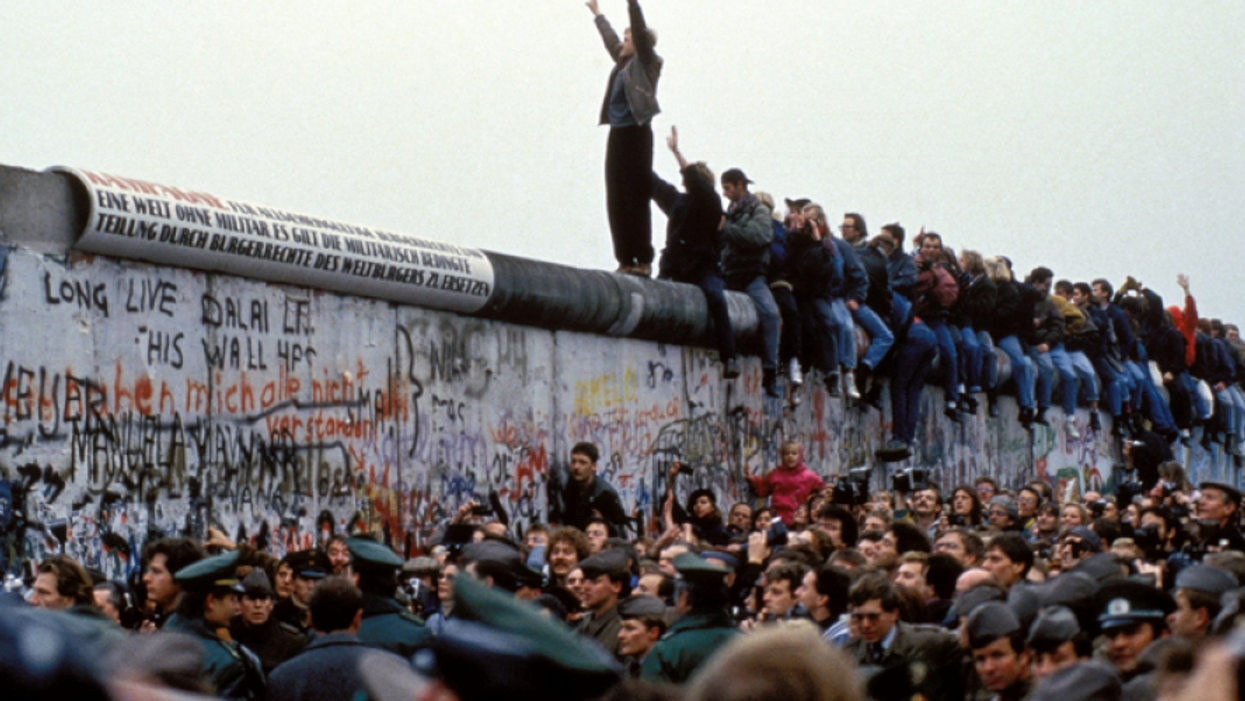
Some anniversaries are less about the past than the future. So it should be with November 9, 1989. In case you've long forgotten, that was the day when East and West Germans began nonviolently dismantling the Berlin Wall, an entirely unpredicted, almost unimaginable ending to the long-entrenched Cold War. Think of it as the triumph of idealistic hope over everything that then passed for hard-nosed "realism." After all, Western intelligence services, academic Kremlinologists, and the American national security establishment had always blithely assumed that the Cold War would essentially go on forever--unless the absolute malevolence of Soviet Communism led to the ultimate mayhem of nuclear Armageddon. For almost half a century, only readily dismissed peaceniks insisted that, in the nuclear age, war and endless preparations for more of it were not the answer. When the Berlin Wall came down, such idealists were proven right, even if their triumph was still ignored.
Yet war-as-the-answer reasserted itself with remarkable rapidity. Within weeks of the Wall being breached by hope--in an era that saw savage conflicts in Central America, the Philippines, and South Africa transformed by a global wave of nonviolent resolution--the United States launched Operation Just Cause, the invasion of Panama by a combat force of more than 27,000 troops. The stated purpose of that act of war was the arrest of Panama's tinhorn dictator Manuel Noriega, who had initially come to power as a CIA asset. That invasion's only real importance was as a demonstration that, even with global peace being hailed, the world's last remaining superpower remained as committed as ever to the hegemony of violent force.
Who Ended the Cold War?
While President George H.W. Bush rushed to claim credit for ending the Cold War, the Soviet Union's Mikhail Gorbachev was the lynchpin of that historic conclusion. It was he who, in the dramatic autumn of 1989, repeatedly ordered Communist forces to remain in their barracks while throngs of freedom-chanters poured into the streets of multiple cities behind the Iron Curtain. Instead of blindly striking out (as the leaders of crumbling empires often had), Gorbachev allowed democratic demands to echo through the Soviet empire--ultimately even in Russia itself.
Yet the American imagination was soon overtaken by the smug fantasy that the U.S. had "won" the Cold War and that it was now a power beyond all imagining. Never mind that, in 1987, when President Ronald Reagan issued his famed demand in then still-divided Berlin, "Mister Gorbachev, tear down this wall," the Soviet leader was already starting to do precisely that.
As the wall came down, the red-scare horrors that had disturbed American dreams for three generations seemed to dissolve overnight, leaving official Washington basking in triumphalism. The U.S. then wrapped itself in a self-aggrandizing mantle of virtue and power that effectively blinded this country's political leadership to the ways the Cold War's end had left them mired in an outmoded, ever more dangerous version of militarism.
After Panama, the self-styled "indispensable nation" would show itself to be hell-bent on unbridled--and profoundly self-destructive--belligerence. Deprived of an existential enemy, Pentagon budgets would decline oh-so-modestly (though without a "peace dividend" in sight) but soon return to Cold War levels. A bristling nuclear arsenal would be maintained as a "hedge" against the comeback of Soviet-style communism. Such thinking would, in the end, only empower Moscow's hawks, smoothing the way for the future rise of an ex-KGB agent named Vladimir Putin. Such hyper-defensive anticipation would prove to be, as one wag put it, the insurance policy that started the fire.
Even as the disintegration of the once-demonized USSR was firmly underway, culminating in the final lowering of the hammer-and-sickle flag from the Kremlin on Christmas Day 1991, the United States was launching what would prove to be a never-ending and disastrous sequence of unnecessary Middle Eastern wars. They began with Operation Desert Storm, George H.W. Bush's assault on Saddam Hussein's Iraq in 1990. In American memory, that campaign, which crushed the Iraqi autocrat's army and forced it out of Kuwait, would be a techno-war made in heaven with fewer than 200 U.S. combat deaths.
That memory, however, fits poorly with what was actually happening that year. An internationally mounted sanctions regime had already been on the verge of thwarting Hussein without the U.S.-led invasion--and, of course, what Bush the father began, Bush the son would, with his 2003 shock-and-awe recapitulation, turn into the permanent bedrock of American politics.
As the 30th anniversary of the end of the Cold War approaches, it should be obvious that there's been a refusal in the United States to reckon with a decades-long set of conflagrations in the Greater Middle East as the inevitable consequence of that first American invasion in 1990. Above all, Desert Storm, with its monumental victory parade in Washington D.C., brought the Pentagon's Cold War raison d'etre back from the brink of obsolescence. That campaign and what followed in its wake guaranteed that violence would continue to occupy the heartlands of the U.S. economy, its politics, and its culture. In the process, the world-historic aspirations kindled by the miracle of the Berlin Wall's dismantling would be thoroughly dashed. No wonder, so many years later, we hardly remember that November of hope--or the anniversary that goes with it.
Out of the Memory Hole
By revisiting its astonishing promise as the anniversary approaches, however, and by seeing it more fully in light of what made it so surprising, perhaps something of that vanished positive energy can still be retrieved. So let me call to mind the events of various earlier Novembers that make the point. What follows is a decade-by-decade retracing of the way the war machine trundled through recent history--and through the American psyche--until it was finally halted in a battle-scarred, divided city in the middle of Europe, stopped by an urge for peace that refused to be denied.
Let's start with November 1939, only weeks after the German invasion of Poland that began what would become World War II. A global struggle between good and evil was just then kicking into gear. Unlike the previous Great War of 1914-1918, which was fought for mere empire, Hitler's war was understood in distinctly Manichaean terms as both apocalyptic and transcendent. After all, the moral depravity of the Nazi project had already been laid bare when Jewish synagogues, businesses, and homes everywhere in Germany were subject to the savagery of Kristallnacht, or "the night of broken glass." That ignition of what became an anti-Jewish genocide took place, as it happened, on November 9, 1938.
The good-versus-evil absolutism of World War II stamped the American imagination so profoundly that a self-righteous moral dualism survived not only into the Cold War but into Washington's twenty-first-century war on terror. In such contests against enemies defined as devils, Americans could adopt the kinds of ends-justify-the-means strategies called for by "realism." When you are fighting along what might be thought of as an axis of evil, anything goes--from deceit and torture to the routine sacrifice of civilians, whose deaths in America's post-9/11 wars have approached a total of half a million. Through it all, we were assured of one certain thing: that God was on our side. ("God is not neutral," as George W. Bush put it just days after the 9/11 attacks.)
From Genocide to Omnicide
But what if God could not protect us? That was the out-of-the-blue question posed near the start of all this--not in August 1945 when the U.S. dropped its "victory weapon" on two cities in Japan, but in August 1949 when the Soviet Union acquired an atomic bomb, too. By that November, the American people were already in the grip of an unprecedented nuclear paranoia, which prompted President Harry Truman to override leading atomic scientists and order the development of what one called a "genocidal weapon," the even more powerful hydrogen bomb. Then came the manic build-up of the U.S. nuclear arsenal to proportions suitable less for genocide than for "omnicide." Such weapons mushroomed (if you'll excuse the word in a potentially mushroom-clouded world) from fewer than 200 in 1950 to nearly 20,000 a decade later. Of course, that escalation, in turn, drove Moscow forward in a desperate effort to keep up, leading to an unhinged arms race that turned the suicide of the human species into a present danger, one measured by the Doomsday Clock, of the Bulletin of the Atomic Scientists, which was set at two minutes to midnight in 1953--and then again in 2019, all these Novembers later.
Now, let's flash forward another decade to November 1959 when the mortal danger of human self-extinction finally became openly understood, as Soviet leader Nikita Khrushchev began issuing blatant threats of nuclear war over--you guessed it--Berlin. Because part of that city, far inside Communist East Germany, was still occupied by American, French, and British forces, it amounted to a tear in what was then called the Iron Curtain, separating the Soviet empire from Western Europe. With thousands fleeing through that tear to the so-called Free World, the Soviets became increasingly intent on shutting the escape hatch, threatening to use the Red Army to drive the Allies out of Berlin. That brought the possibility of a nuclear conflict to the fore.
Ultimately, the Communists would adopt a quite different strategy when, in 1961, they built that infamous wall, a concrete curtain across the city. At the time, Berliners sometimes referred to it, with a certain irony, as the "Peace Wall" because, by blocking escape from the East, it made the dreaded war between the two Cold War superpowers unnecessary. Yet within a year the unleashed prospect of such a potentially civilization-ending conflict had hopscotched the globe to Communist Cuba. The Cuban Missile Crisis of 1962 caused the world to shudder as incipient nuclear war between Washington and Moscow suddenly loomed. That moment, just before Khrushchev and American President John F. Kennedy stepped back from doomsday, might have changed something; a relieved world's shock of recognition, that is, might have thrown the classic wooden shoe of sabotage into the purring engine of "realism." No such luck, however, as the malevolent power of the war state simply motored on--in the case of the United States directly into Vietnam.
By November 1969, President Richard Nixon's cynical continuation of the Vietnam War for his own political purposes had already driven the liberal-conservative divide over that misbegotten conflict into the permanent structure of American politics. The ubiquitous "POW/MIA: You Are Not Forgotten" flag survives today as an icon of Nixon's manipulations. Still waving over ball parks, post offices, town halls, and VFW posts across the nation, that sad black banner now flies as a symbol of red state/blue state antagonism--and as a lasting reminder of how we Americans can make prisoners of ourselves.
By 1979, with the Vietnam War in the past, President Jimmy Carter showed how irresistible November's tide--the inexorable surge toward war--truly was. It was in November of that year that militant Iranian students overran the American embassy in Tehran, taking sixty-six Americans hostage--the event that was credited with stymying the formerly peace-minded president. In reality, though, Carter had already initiated the historic anti-Soviet arms build-up for which President Ronald Reagan would later be credited.
Then, of course, Carter would ominously foreshadow America's future reversals in the deserts of the Levant with a failed rescue of those hostages. Most momentously, however, he would essentially license future Middle East defeats with what came to be known as the Carter Doctrine--the formally declared principle that the Persian Gulf (and its oil) were "vital interests" of this country, worthy of defense "by any means necessary, including military force." (And of course, his CIA would lead us into America's first Afghan War, still in a sense going on some 40 years later.)
Retrieving Hope?
Decade by decade, the evidence of an unstoppable martial dynamic only seemed to accumulate. In that milestone month of November 1989, Washington's national security "realists" were still stuck in the groove of such worst-case thinking. That they were wrong, that they would be stunned by the fall of the Berlin Wall and the subsequent implosion of the Soviet Union, should mandate thoughtful observance of this coming 30th anniversary.
During the late 1980s, a complex set of antiwar and antinuclear countercurrents seemed to come out of nowhere. Each of them should have been impossible. The ruthlessly totalitarian Soviet system should not have produced in Mikhail Gorbachev a humane statesman who sacrificed empire and his own career for the sake of peace. The most hawkish American president in history, Ronald Reagan, should not have responded to Gorbachev by working to end the arms race with him--but he did.
Pressuring those two leaders to pursue that course--indeed, forcing them to--was an international grassroots movement demanding an end to apocalyptic terror. People wanted peace so much, as President Dwight D. Eisenhower had predicted in 1959, that, miracle of all miracles, governments got out of their way and let them have it. With the breaching of the Berlin Wall that November 9th--a transformation accomplished by ordinary citizens, not soldiers--the political realm of the possible was substantially broadened, not only to include prospective future detente among warring nations, but an eventual elimination of nuclear weapons themselves.
Yet, in November 2019, all of that seems lost. A new Cold War is underway, with East-West hostilities quickening; a new arms race has begun, especially as the United States renounces Reagan-Gorbachev arms-control agreements for the sake of a trillion-plus dollar "modernization" of its nuclear arsenal. Across the globe, democracy is in retreat, driven by pressures from both populist nationalism and predatory capitalism. Even in America, democracy seems imperiled. And all of this naturally prompts the shudder-inducing question: Were the worst-case realists right all along?
This November anniversary of the dismantling of the Berlin Wall should offer an occasion to say no to that. The Wall's demise stopped in its tracks the demonic dynamic set in motion on the very same date in 1938 by that Kristallnacht. If idealistic hope could so triumph once, it can so triumph again, no matter what the die-hard realists of our moment may believe. I've referred to that November in Berlin as a miracle, but that is wrong. The most dangerous face-off in history ended not because of the gods or good fortune, but because of the actions and efforts of human beings. Across two generations, countless men and women--from anonymous community activists and union organizers to unsung military officials, scientists, and even world leaders--overcame the seemingly endless escalations of nuclear-armed animus to make brave choices for peace and against a war of annihilation, for life and against death, for the future and against the doom-laden past.
It can happen again. It must.