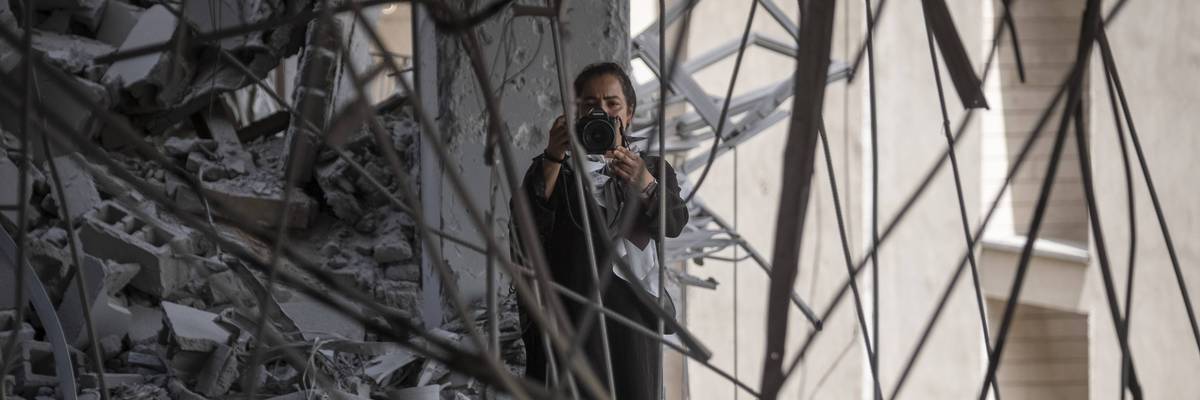
Bearing Witness in the Age of Generative AI
Pushing back against the assault on verifiable reality is a crucial undertaking in the pursuit of justice.
The advent of generative AI has made it even harder to distinguish between what’s real and what isn’t, and also easy to claim what is real is fake. This threatens to undermine the very idea of "evidence," which traditionally has been used to enforce accountability, by fracturing shared, verifiable reality.
For example, in Iran authorities attempted to dismiss protest footage as edited or artificially manufactured after AI was used to enhance long-distance footage of someone confronting the military, effectively turning this doubt into a propaganda weapon. Doubt was also a feature in the aftermath of the recent bombing of a girls' school which killed 168 people—mostly children—in Minab, Iran. And in the midst of an already distorted information ecosystem, methods developed to detect AI fakes are now being weaponized to falsely discredit authentic evidence.
This affirms that the emergence of generative AI is not simply a technological issue, but is creating a visual evidence problem. The consequences are already being felt not only by those chronicling and exposing injustice.
Historically, visual media has been an important tool to document injustice. In South Africa, for instance, a generation of photographers used the camera to challenge the prevailing power structures of apartheid. By exposing the apartheid’s injustices and delegitimizing the system, as well as documenting resistance and everyday life, photographers had a huge impact on the liberation struggle in South Africa. So much so, that the camera would be “seen as an instrument of insurrection” by the apartheid regime, resulting in a ban on foreign journalists and documentary photography.
What would have happened if the apartheid regime had claimed that photographs like Nzima’s were faked or AI generated? Would this have created doubt for the audiences who saw it, impacting international support for South Africa’s liberation struggle?
Although they were not the sole targets of apartheid repression, those photographing or filming were often targeted by the regime. Security forces regularly exposed films, confiscated equipment, conducted raids, and banned publications, as well as people. For example, photographer Sam Nzima was harassed by police and placed under house arrest for months following the publication of his iconic photo of the dying 13-year-old Hector Pieterson who was shot by police during the youth uprising on June 16, 1976. The photo not only fueled the liberation movement within South Africa, but also galvanized stronger international condemnation of apartheid. Apartheid Minister Stoffel Botha even referred to those documenting what was unfolding in the country as "media terrorists."
While there have been attempts to deny or downplay apartheid, including from the now late last apartheid president F. W. de Klerk, systemic denial has not been possible owing to the evidence available. This underscores the role of documentation in defending truth, even if incomplete.
What would have happened if the apartheid regime had claimed that photographs like Nzima’s were faked or AI generated? Would this have created doubt for the audiences who saw it, impacting international support for South Africa’s liberation struggle? Today these questions are not rhetorical, owing to the emergence of generative AI.
To be sure for most of the world, the saying, “The camera never lies” has never been true. Visual media was vital to the Nazi regime's propaganda efforts. Before that, it played “a critical role in propagating colonialist myths about Africa,” with colonial states using photographic imagery to cement white supremacy. It would also become a tool for apartheid in South Africa, used to not only legitimize and validate itself, but to also attempt to shape global perceptions of what was happening in the country.
But the story did not end there. Visual media would also become a tool for liberation movements in South Africa and beyond, because documentation impacts how the world is perceived, meaning is made, and reality is verified.
For example, Human Rights Watch recently used geolocated images to verify the Israeli military’s unlawful use of white phosphorus, a highly reactive chemical which ignites when exposed to oxygen, in residential areas in Lebanon. This offers a pathway for accountability in the future. Similarly, the Syrian Archive, which tracks and preserves videos of war crimes in Syria, has used documentation to pursue accountability for the deadly use of chemical weapons in the country.
Documentation is critical in the pursuit of justice, as well as the need to preserve the past to confirm reality. Not only for these worthy ideals, but also so that those who are left to pick up the pieces know that their experiences of injustices are documented, even in the face of denial and propaganda aimed at persuading people otherwise.
Of course the risks and harms are heightened in conflict situations, which does not need to be inevitable. For example, Meta’s Oversight Board recently called for new rules on how deceptive AI content is managed by the platform to enable users to distinguish between what is real and fake. This follows Meta’s failure to appropriately designate an AI-generated video that purported to show significant damage caused by Iranian soldiers in Haifa, Israel. While the board’s recommendations are not binding, should Meta fail to urgently implement these, it will be yet another example of a platform knowing how to address harms but failing to do so. This must change.
To this end, pushing back against the assault on verifiable reality is a crucial undertaking. This includes protecting people's ability to safely document and preserve their documentation; accessible and effective detection tools, alongside transparency for AI-generated content; and democratic policies, laws, and regulations that center human rights considerations.
As history has repeatedly shown us, secrecy is a shield that protects injustice and emboldens bad actors. So, bearing witness, exposing truth, and insisting on justice remains as important now as it was for South Africa’s liberation movement and beyond— even in the age of generative AI.
We are at a crossroads
This country and this world are at a monumental crossroads. In a few short weeks, US voters will have an opportunity to beat back the forces of fascism and confront the billionaires who are rigging the economy, our media system, and our democracy, making it increasingly impossible for ordinary people to get by. We’re not just talking about the election. We’re talking about what must be done once these fascist elements are vanquished from power. We need a bolder set of solutions than what either major party has so far been willing to offer and a working-class movement ready to fight like hell for it. Trump didn't emerge from nowhere. The conditions that fueled MAGA authoritarianism were created by decades of radical neoliberal economic policies and a corrupt political system dominated by corporate interests. They slashed taxes on the super-rich, promising that the benefits would trickle down. They said giveaways to the corporate titans would make life more affordable for the rest of us. It was all bullshit. And when a bitter, betrayed populace searches for someone to blame, right-wing demagogues have little trouble finding scapegoats. People know when they're being lied to, but you won't hear any of this from the corporate media. Only independent journalism—powered and funded by people who believe in building a better world—can deliver truly trustworthy daily news. Our Fall Campaign is underway, and we need your help. To power our newsroom through the rest of the year, we need to raise $125,000 by midnight on October 31. So if you share our vision, please contribute whatever you can to sustain our work. |
The advent of generative AI has made it even harder to distinguish between what’s real and what isn’t, and also easy to claim what is real is fake. This threatens to undermine the very idea of "evidence," which traditionally has been used to enforce accountability, by fracturing shared, verifiable reality.
For example, in Iran authorities attempted to dismiss protest footage as edited or artificially manufactured after AI was used to enhance long-distance footage of someone confronting the military, effectively turning this doubt into a propaganda weapon. Doubt was also a feature in the aftermath of the recent bombing of a girls' school which killed 168 people—mostly children—in Minab, Iran. And in the midst of an already distorted information ecosystem, methods developed to detect AI fakes are now being weaponized to falsely discredit authentic evidence.
This affirms that the emergence of generative AI is not simply a technological issue, but is creating a visual evidence problem. The consequences are already being felt not only by those chronicling and exposing injustice.
Historically, visual media has been an important tool to document injustice. In South Africa, for instance, a generation of photographers used the camera to challenge the prevailing power structures of apartheid. By exposing the apartheid’s injustices and delegitimizing the system, as well as documenting resistance and everyday life, photographers had a huge impact on the liberation struggle in South Africa. So much so, that the camera would be “seen as an instrument of insurrection” by the apartheid regime, resulting in a ban on foreign journalists and documentary photography.
What would have happened if the apartheid regime had claimed that photographs like Nzima’s were faked or AI generated? Would this have created doubt for the audiences who saw it, impacting international support for South Africa’s liberation struggle?
Although they were not the sole targets of apartheid repression, those photographing or filming were often targeted by the regime. Security forces regularly exposed films, confiscated equipment, conducted raids, and banned publications, as well as people. For example, photographer Sam Nzima was harassed by police and placed under house arrest for months following the publication of his iconic photo of the dying 13-year-old Hector Pieterson who was shot by police during the youth uprising on June 16, 1976. The photo not only fueled the liberation movement within South Africa, but also galvanized stronger international condemnation of apartheid. Apartheid Minister Stoffel Botha even referred to those documenting what was unfolding in the country as "media terrorists."
While there have been attempts to deny or downplay apartheid, including from the now late last apartheid president F. W. de Klerk, systemic denial has not been possible owing to the evidence available. This underscores the role of documentation in defending truth, even if incomplete.
What would have happened if the apartheid regime had claimed that photographs like Nzima’s were faked or AI generated? Would this have created doubt for the audiences who saw it, impacting international support for South Africa’s liberation struggle? Today these questions are not rhetorical, owing to the emergence of generative AI.
To be sure for most of the world, the saying, “The camera never lies” has never been true. Visual media was vital to the Nazi regime's propaganda efforts. Before that, it played “a critical role in propagating colonialist myths about Africa,” with colonial states using photographic imagery to cement white supremacy. It would also become a tool for apartheid in South Africa, used to not only legitimize and validate itself, but to also attempt to shape global perceptions of what was happening in the country.
But the story did not end there. Visual media would also become a tool for liberation movements in South Africa and beyond, because documentation impacts how the world is perceived, meaning is made, and reality is verified.
For example, Human Rights Watch recently used geolocated images to verify the Israeli military’s unlawful use of white phosphorus, a highly reactive chemical which ignites when exposed to oxygen, in residential areas in Lebanon. This offers a pathway for accountability in the future. Similarly, the Syrian Archive, which tracks and preserves videos of war crimes in Syria, has used documentation to pursue accountability for the deadly use of chemical weapons in the country.
Documentation is critical in the pursuit of justice, as well as the need to preserve the past to confirm reality. Not only for these worthy ideals, but also so that those who are left to pick up the pieces know that their experiences of injustices are documented, even in the face of denial and propaganda aimed at persuading people otherwise.
Of course the risks and harms are heightened in conflict situations, which does not need to be inevitable. For example, Meta’s Oversight Board recently called for new rules on how deceptive AI content is managed by the platform to enable users to distinguish between what is real and fake. This follows Meta’s failure to appropriately designate an AI-generated video that purported to show significant damage caused by Iranian soldiers in Haifa, Israel. While the board’s recommendations are not binding, should Meta fail to urgently implement these, it will be yet another example of a platform knowing how to address harms but failing to do so. This must change.
To this end, pushing back against the assault on verifiable reality is a crucial undertaking. This includes protecting people's ability to safely document and preserve their documentation; accessible and effective detection tools, alongside transparency for AI-generated content; and democratic policies, laws, and regulations that center human rights considerations.
As history has repeatedly shown us, secrecy is a shield that protects injustice and emboldens bad actors. So, bearing witness, exposing truth, and insisting on justice remains as important now as it was for South Africa’s liberation movement and beyond— even in the age of generative AI.
- If This Is Artificial Intelligence, Let’s Go With Real Stupidity ›
- Experts Demand 'Pause' on Spread of Artificial Intelligence Until Regulations Imposed ›
- Experts Urge Action to Mitigate 'Risk of Extinction From AI' ›
- Bearing Witness to the Costs of War ›
- Bearing Witness at ICE, One Wednesday at a Time ›
The advent of generative AI has made it even harder to distinguish between what’s real and what isn’t, and also easy to claim what is real is fake. This threatens to undermine the very idea of "evidence," which traditionally has been used to enforce accountability, by fracturing shared, verifiable reality.
For example, in Iran authorities attempted to dismiss protest footage as edited or artificially manufactured after AI was used to enhance long-distance footage of someone confronting the military, effectively turning this doubt into a propaganda weapon. Doubt was also a feature in the aftermath of the recent bombing of a girls' school which killed 168 people—mostly children—in Minab, Iran. And in the midst of an already distorted information ecosystem, methods developed to detect AI fakes are now being weaponized to falsely discredit authentic evidence.
This affirms that the emergence of generative AI is not simply a technological issue, but is creating a visual evidence problem. The consequences are already being felt not only by those chronicling and exposing injustice.
Historically, visual media has been an important tool to document injustice. In South Africa, for instance, a generation of photographers used the camera to challenge the prevailing power structures of apartheid. By exposing the apartheid’s injustices and delegitimizing the system, as well as documenting resistance and everyday life, photographers had a huge impact on the liberation struggle in South Africa. So much so, that the camera would be “seen as an instrument of insurrection” by the apartheid regime, resulting in a ban on foreign journalists and documentary photography.
What would have happened if the apartheid regime had claimed that photographs like Nzima’s were faked or AI generated? Would this have created doubt for the audiences who saw it, impacting international support for South Africa’s liberation struggle?
Although they were not the sole targets of apartheid repression, those photographing or filming were often targeted by the regime. Security forces regularly exposed films, confiscated equipment, conducted raids, and banned publications, as well as people. For example, photographer Sam Nzima was harassed by police and placed under house arrest for months following the publication of his iconic photo of the dying 13-year-old Hector Pieterson who was shot by police during the youth uprising on June 16, 1976. The photo not only fueled the liberation movement within South Africa, but also galvanized stronger international condemnation of apartheid. Apartheid Minister Stoffel Botha even referred to those documenting what was unfolding in the country as "media terrorists."
While there have been attempts to deny or downplay apartheid, including from the now late last apartheid president F. W. de Klerk, systemic denial has not been possible owing to the evidence available. This underscores the role of documentation in defending truth, even if incomplete.
What would have happened if the apartheid regime had claimed that photographs like Nzima’s were faked or AI generated? Would this have created doubt for the audiences who saw it, impacting international support for South Africa’s liberation struggle? Today these questions are not rhetorical, owing to the emergence of generative AI.
To be sure for most of the world, the saying, “The camera never lies” has never been true. Visual media was vital to the Nazi regime's propaganda efforts. Before that, it played “a critical role in propagating colonialist myths about Africa,” with colonial states using photographic imagery to cement white supremacy. It would also become a tool for apartheid in South Africa, used to not only legitimize and validate itself, but to also attempt to shape global perceptions of what was happening in the country.
But the story did not end there. Visual media would also become a tool for liberation movements in South Africa and beyond, because documentation impacts how the world is perceived, meaning is made, and reality is verified.
For example, Human Rights Watch recently used geolocated images to verify the Israeli military’s unlawful use of white phosphorus, a highly reactive chemical which ignites when exposed to oxygen, in residential areas in Lebanon. This offers a pathway for accountability in the future. Similarly, the Syrian Archive, which tracks and preserves videos of war crimes in Syria, has used documentation to pursue accountability for the deadly use of chemical weapons in the country.
Documentation is critical in the pursuit of justice, as well as the need to preserve the past to confirm reality. Not only for these worthy ideals, but also so that those who are left to pick up the pieces know that their experiences of injustices are documented, even in the face of denial and propaganda aimed at persuading people otherwise.
Of course the risks and harms are heightened in conflict situations, which does not need to be inevitable. For example, Meta’s Oversight Board recently called for new rules on how deceptive AI content is managed by the platform to enable users to distinguish between what is real and fake. This follows Meta’s failure to appropriately designate an AI-generated video that purported to show significant damage caused by Iranian soldiers in Haifa, Israel. While the board’s recommendations are not binding, should Meta fail to urgently implement these, it will be yet another example of a platform knowing how to address harms but failing to do so. This must change.
To this end, pushing back against the assault on verifiable reality is a crucial undertaking. This includes protecting people's ability to safely document and preserve their documentation; accessible and effective detection tools, alongside transparency for AI-generated content; and democratic policies, laws, and regulations that center human rights considerations.
As history has repeatedly shown us, secrecy is a shield that protects injustice and emboldens bad actors. So, bearing witness, exposing truth, and insisting on justice remains as important now as it was for South Africa’s liberation movement and beyond— even in the age of generative AI.
- If This Is Artificial Intelligence, Let’s Go With Real Stupidity ›
- Experts Demand 'Pause' on Spread of Artificial Intelligence Until Regulations Imposed ›
- Experts Urge Action to Mitigate 'Risk of Extinction From AI' ›
- Bearing Witness to the Costs of War ›
- Bearing Witness at ICE, One Wednesday at a Time ›