SUBSCRIBE TO OUR FREE NEWSLETTER
Daily news & progressive opinion—funded by the people, not the corporations—delivered straight to your inbox.
5
#000000
#FFFFFF
To donate by check, phone, or other method, see our More Ways to Give page.

While stopping evictions is the PAH’s [Platform for People Affected by Mortgages, or Plataforma de Afectados por la Hipoteca] most well-known activity, the movement only began to use civil disobedience as a tactic of resistance out of necessity. Foreclosure processes tend to move slowly and a series of other problems must be resolved before eviction is imminent. At some point, people in the assembly started getting eviction notices, but the first ones to receive them didn’t feel the strength to try and resist the police kicking them out. In 2010, PAH Barcelona was approached by a man named Lluís who had just received a date for eviction from his house in La Bisbal del Penedès. He was desperate, claiming that he’d rather fill his house with butane canisters and blow it up, than to hand it over to the bank. At the PAH, they quickly understood the need for an alternative solution.
The platform’s founders realized that at some point they would have to resort to direct action to stop evictions, but they didn’t think they’d be capable of it... until they were forced to. To stop Lluís’ eviction, they armed themselves with a strong narrative, echoing the legal and ethical arguments against eviction, and an energetic communication campaign that included signs, banners, and media coverage. Moreover, the entire action was recorded.
They knew they had to avoid violence, and when the judicial delegation arrived, the activists did not physically engage them, but simply blocked the entrance to the house, tried to talk them out of evicting Lluís and refused to move. There was little the two police officers could do, and the eviction was postponed. Two days later, the PAH released the video of the demonstration, providing proof of what would later become one of the movement’s slogans: “Sí se puede!”
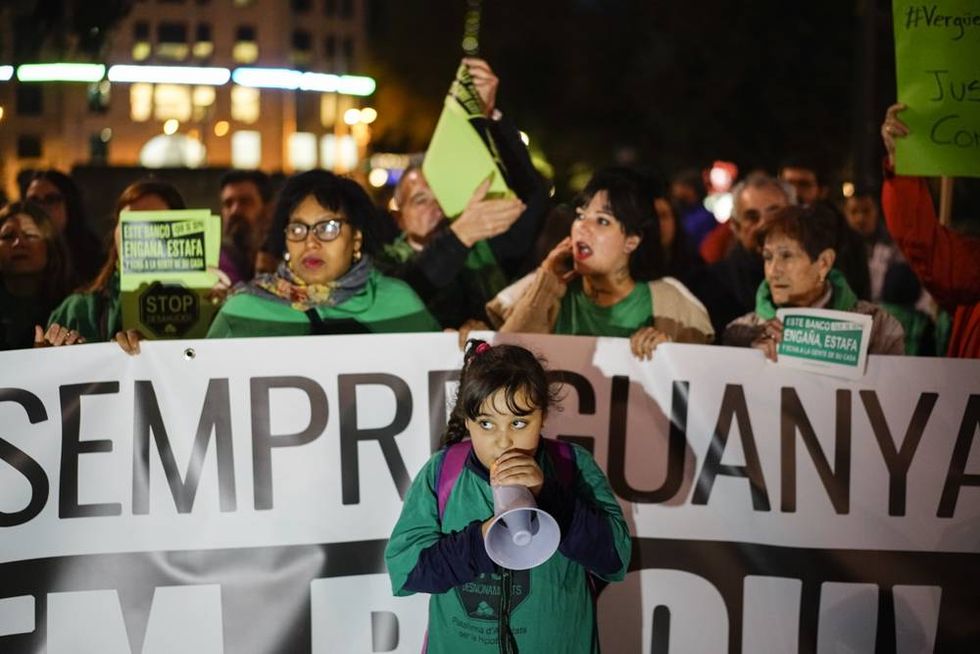 Members of PAH hold a protest. (Photo by PAH-Barcelona)
Civil disobedience as a tactic to stop evictions became part of the PAH’s regular activity. “What we have to do to stop evictions has become so normalized that when we talk about it at the assembly, we don’t speak in terms of ‘we’re engaging in civil disobedience,’ although that is what we do, and perhaps we should reflect more on that,” ponders Berni from PAHC Bages. “The PAH emerged at a time when thousands of evictions for mortgage defaults were taking place and the issue affected a lot of people who thought they were middle class; in the public discourse, everyone saw that this was something dramatic and unfair,” recalls Emma from PAHC Sabadell. “The fact that in this context, a group of people spoke out to draw attention to this injustice and engaged in nonviolent but active civil disobedience led to the success of the PAH model and its acceptance within society,” she concludes.
“The experience of protesting inside a bank with fifty people is really fulfilling, it takes away your fear and it empowers you.”
To ensure that the platform’s civil disobedience continues to be successful, it’s vitally important for it to preserve that legitimacy. That means being able to justify each and every action as legitimate. Although it will sometimes react to emergency situations, the PAH only takes action on evictions affecting people already involved in the platform. At their assemblies, PAH groups make it clear that they’re not an eviction prevention service, but that they work on the basis of mutual support and only try to block evictions when the people being evicted do not have proper alternative housing.
Beyond the general idea behind these actions—to resist peacefully at the entrance to the building to prevent the judicial delegation from entering—they must be carefully planned and roles must be assigned to make sure everything runs smoothly. If there are minors in the family’s care, a solution must be found to ensure that they aren’t in the house at the time when the eviction is scheduled. It’s very important to support the family, who might be out on the street with their compas, or prefer to resist from inside their home. It’s also very important to remember that the action revolves around their interests and they must be kept informed of what’s happening and able to make decisions when necessary.
Outside, the aim is to keep people’s spirits up while they wait for the judicial delegation to arrive, which might take the whole morning. It’s important to have people to energize the protest in creative ways and give directions. Although people can move around, someone must be responsible for making sure that the door is always protected.
It’s also important to decide in advance how to communicate the purpose and legitimacy of the action to the public, and who will be in charge of communicating with the authorities and the media, rather than leaving it to be decided on the spot.
It’s also helpful to consider preparing the affected person how to deal with the press, if necessary. The movement’s social media presence and its relationship with the media are also very important, as these are tools that can be used to amplify the PAH’s demands and reinforce its legitimacy.
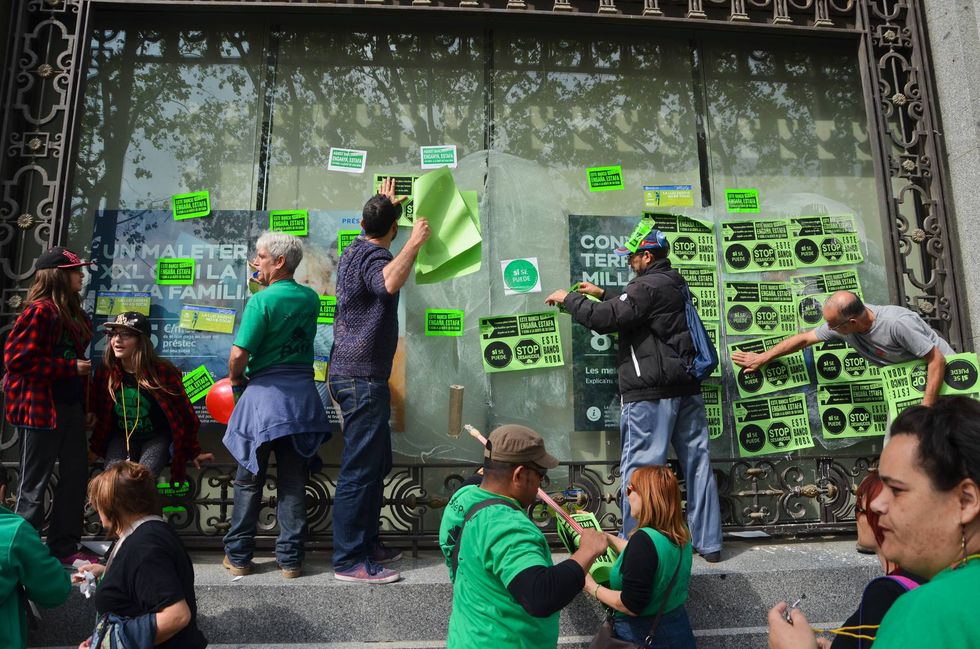 Members of PAH-Barcelona stick flyers on a bank window. (Photo by PAH-Barcelona)
The PAH has an extensive repertoire of actions that goes far beyond stopping evictions. In fact, stopping an eviction is not usually the final solution, but a postponement that should make it possible to find a more permanent answer to the problem. This might require action against financial institutions, public authorities or water, electricity, and gas companies. Besides taking action in support of specific cases, big demonstrations can be called to target the institutions responsible for the problems faced by many families.
“I remember the first time we occupied a bank, back in 2010 or 2011. We occupied Caixa Catalunya and the riot police came to kick us out; that was ecstasy, a real high, and then the fear disappeared,” says Delia from PAH Barcelona. “The experience of protesting inside a bank with fifty people is really fulfilling, it takes away your fear and it empowers you.” Many people emphasize the strength of collective action; sometimes the mere act of covering a bank with posters condemning its actions is very powerful. “Wallpapering is a high, an outlet for your rage; you can take out all the hatred you’ve built up inside and stick it all over the institution,” says Juan Luis from PAH Torrevieja.
That’s where the festive tone and creativity of the PAH’s actions come in. Even if you’re protesting against a very difficult issue, you have to make room for joy. If you occupy a bank, you can use the leaflets that are there for anyone to take as confetti and play music or put up balloons and banners. “It wiped away my fear of the bank when I saw how all the employees could leave and the office would be left alone, occupied by activists,” says Juan Luis. The PAH manages to paralyze the bank’s activity without confronting anyone or even directly hindering its work. The movement’s actions are simply intended to make its presence felt because the bank is unwilling to continue its activity in these conditions.
Of course, everyone experiences these actions in their own way and that’s why some groups in Madrid organize what they call “fear workshops.” “These are workshops for people to learn how to act during an action: how to avoid losing their temper or falling for police provocation, how to rely on colleagues. In short, how to overcome yourself so that you can go to the protest, even if you’re afraid, because nothing is going to happen to you in 90 percent of the cases,” explains Alejandra from PAVPS [Platform for People Affected by Public and Social Housing], Madrid.
It’s also important to think about how to look after people in these protests. This can be done, for example, by warning when there’s a possibility that the police show up and recommending that people in an irregular administrative situation stay away to avoid unnecessary risks. “Besides that, they tell you how to act or how to hold onto another person so that they don’t hurt you if they’re trying to remove you by force,” adds Francisco from PAH Barcelona.
This excerpt is adapted from Yes, It’s Possible! A Handbook for Building Power by João França and The Platform for People Affected by Mortgages, published by Common Notions. Copyright (c) 2026 Common Notions. All rights reserved. Do not republish.
While stopping evictions is the PAH’s [Platform for People Affected by Mortgages, or Plataforma de Afectados por la Hipoteca] most well-known activity, the movement only began to use civil disobedience as a tactic of resistance out of necessity. Foreclosure processes tend to move slowly and a series of other problems must be resolved before eviction is imminent. At some point, people in the assembly started getting eviction notices, but the first ones to receive them didn’t feel the strength to try and resist the police kicking them out. In 2010, PAH Barcelona was approached by a man named Lluís who had just received a date for eviction from his house in La Bisbal del Penedès. He was desperate, claiming that he’d rather fill his house with butane canisters and blow it up, than to hand it over to the bank. At the PAH, they quickly understood the need for an alternative solution.
The platform’s founders realized that at some point they would have to resort to direct action to stop evictions, but they didn’t think they’d be capable of it... until they were forced to. To stop Lluís’ eviction, they armed themselves with a strong narrative, echoing the legal and ethical arguments against eviction, and an energetic communication campaign that included signs, banners, and media coverage. Moreover, the entire action was recorded.
They knew they had to avoid violence, and when the judicial delegation arrived, the activists did not physically engage them, but simply blocked the entrance to the house, tried to talk them out of evicting Lluís and refused to move. There was little the two police officers could do, and the eviction was postponed. Two days later, the PAH released the video of the demonstration, providing proof of what would later become one of the movement’s slogans: “Sí se puede!”
Members of PAH hold a protest. (Photo by PAH-Barcelona)
Civil disobedience as a tactic to stop evictions became part of the PAH’s regular activity. “What we have to do to stop evictions has become so normalized that when we talk about it at the assembly, we don’t speak in terms of ‘we’re engaging in civil disobedience,’ although that is what we do, and perhaps we should reflect more on that,” ponders Berni from PAHC Bages. “The PAH emerged at a time when thousands of evictions for mortgage defaults were taking place and the issue affected a lot of people who thought they were middle class; in the public discourse, everyone saw that this was something dramatic and unfair,” recalls Emma from PAHC Sabadell. “The fact that in this context, a group of people spoke out to draw attention to this injustice and engaged in nonviolent but active civil disobedience led to the success of the PAH model and its acceptance within society,” she concludes.
“The experience of protesting inside a bank with fifty people is really fulfilling, it takes away your fear and it empowers you.”
To ensure that the platform’s civil disobedience continues to be successful, it’s vitally important for it to preserve that legitimacy. That means being able to justify each and every action as legitimate. Although it will sometimes react to emergency situations, the PAH only takes action on evictions affecting people already involved in the platform. At their assemblies, PAH groups make it clear that they’re not an eviction prevention service, but that they work on the basis of mutual support and only try to block evictions when the people being evicted do not have proper alternative housing.
Beyond the general idea behind these actions—to resist peacefully at the entrance to the building to prevent the judicial delegation from entering—they must be carefully planned and roles must be assigned to make sure everything runs smoothly. If there are minors in the family’s care, a solution must be found to ensure that they aren’t in the house at the time when the eviction is scheduled. It’s very important to support the family, who might be out on the street with their compas, or prefer to resist from inside their home. It’s also very important to remember that the action revolves around their interests and they must be kept informed of what’s happening and able to make decisions when necessary.
Outside, the aim is to keep people’s spirits up while they wait for the judicial delegation to arrive, which might take the whole morning. It’s important to have people to energize the protest in creative ways and give directions. Although people can move around, someone must be responsible for making sure that the door is always protected.
It’s also important to decide in advance how to communicate the purpose and legitimacy of the action to the public, and who will be in charge of communicating with the authorities and the media, rather than leaving it to be decided on the spot.
It’s also helpful to consider preparing the affected person how to deal with the press, if necessary. The movement’s social media presence and its relationship with the media are also very important, as these are tools that can be used to amplify the PAH’s demands and reinforce its legitimacy.
Members of PAH-Barcelona stick flyers on a bank window. (Photo by PAH-Barcelona)
The PAH has an extensive repertoire of actions that goes far beyond stopping evictions. In fact, stopping an eviction is not usually the final solution, but a postponement that should make it possible to find a more permanent answer to the problem. This might require action against financial institutions, public authorities or water, electricity, and gas companies. Besides taking action in support of specific cases, big demonstrations can be called to target the institutions responsible for the problems faced by many families.
“I remember the first time we occupied a bank, back in 2010 or 2011. We occupied Caixa Catalunya and the riot police came to kick us out; that was ecstasy, a real high, and then the fear disappeared,” says Delia from PAH Barcelona. “The experience of protesting inside a bank with fifty people is really fulfilling, it takes away your fear and it empowers you.” Many people emphasize the strength of collective action; sometimes the mere act of covering a bank with posters condemning its actions is very powerful. “Wallpapering is a high, an outlet for your rage; you can take out all the hatred you’ve built up inside and stick it all over the institution,” says Juan Luis from PAH Torrevieja.
That’s where the festive tone and creativity of the PAH’s actions come in. Even if you’re protesting against a very difficult issue, you have to make room for joy. If you occupy a bank, you can use the leaflets that are there for anyone to take as confetti and play music or put up balloons and banners. “It wiped away my fear of the bank when I saw how all the employees could leave and the office would be left alone, occupied by activists,” says Juan Luis. The PAH manages to paralyze the bank’s activity without confronting anyone or even directly hindering its work. The movement’s actions are simply intended to make its presence felt because the bank is unwilling to continue its activity in these conditions.
Of course, everyone experiences these actions in their own way and that’s why some groups in Madrid organize what they call “fear workshops.” “These are workshops for people to learn how to act during an action: how to avoid losing their temper or falling for police provocation, how to rely on colleagues. In short, how to overcome yourself so that you can go to the protest, even if you’re afraid, because nothing is going to happen to you in 90 percent of the cases,” explains Alejandra from PAVPS [Platform for People Affected by Public and Social Housing], Madrid.
It’s also important to think about how to look after people in these protests. This can be done, for example, by warning when there’s a possibility that the police show up and recommending that people in an irregular administrative situation stay away to avoid unnecessary risks. “Besides that, they tell you how to act or how to hold onto another person so that they don’t hurt you if they’re trying to remove you by force,” adds Francisco from PAH Barcelona.
This excerpt is adapted from Yes, It’s Possible! A Handbook for Building Power by João França and The Platform for People Affected by Mortgages, published by Common Notions. Copyright (c) 2026 Common Notions. All rights reserved. Do not republish.
While stopping evictions is the PAH’s [Platform for People Affected by Mortgages, or Plataforma de Afectados por la Hipoteca] most well-known activity, the movement only began to use civil disobedience as a tactic of resistance out of necessity. Foreclosure processes tend to move slowly and a series of other problems must be resolved before eviction is imminent. At some point, people in the assembly started getting eviction notices, but the first ones to receive them didn’t feel the strength to try and resist the police kicking them out. In 2010, PAH Barcelona was approached by a man named Lluís who had just received a date for eviction from his house in La Bisbal del Penedès. He was desperate, claiming that he’d rather fill his house with butane canisters and blow it up, than to hand it over to the bank. At the PAH, they quickly understood the need for an alternative solution.
The platform’s founders realized that at some point they would have to resort to direct action to stop evictions, but they didn’t think they’d be capable of it... until they were forced to. To stop Lluís’ eviction, they armed themselves with a strong narrative, echoing the legal and ethical arguments against eviction, and an energetic communication campaign that included signs, banners, and media coverage. Moreover, the entire action was recorded.
They knew they had to avoid violence, and when the judicial delegation arrived, the activists did not physically engage them, but simply blocked the entrance to the house, tried to talk them out of evicting Lluís and refused to move. There was little the two police officers could do, and the eviction was postponed. Two days later, the PAH released the video of the demonstration, providing proof of what would later become one of the movement’s slogans: “Sí se puede!”
Members of PAH hold a protest. (Photo by PAH-Barcelona)
Civil disobedience as a tactic to stop evictions became part of the PAH’s regular activity. “What we have to do to stop evictions has become so normalized that when we talk about it at the assembly, we don’t speak in terms of ‘we’re engaging in civil disobedience,’ although that is what we do, and perhaps we should reflect more on that,” ponders Berni from PAHC Bages. “The PAH emerged at a time when thousands of evictions for mortgage defaults were taking place and the issue affected a lot of people who thought they were middle class; in the public discourse, everyone saw that this was something dramatic and unfair,” recalls Emma from PAHC Sabadell. “The fact that in this context, a group of people spoke out to draw attention to this injustice and engaged in nonviolent but active civil disobedience led to the success of the PAH model and its acceptance within society,” she concludes.
“The experience of protesting inside a bank with fifty people is really fulfilling, it takes away your fear and it empowers you.”
To ensure that the platform’s civil disobedience continues to be successful, it’s vitally important for it to preserve that legitimacy. That means being able to justify each and every action as legitimate. Although it will sometimes react to emergency situations, the PAH only takes action on evictions affecting people already involved in the platform. At their assemblies, PAH groups make it clear that they’re not an eviction prevention service, but that they work on the basis of mutual support and only try to block evictions when the people being evicted do not have proper alternative housing.
Beyond the general idea behind these actions—to resist peacefully at the entrance to the building to prevent the judicial delegation from entering—they must be carefully planned and roles must be assigned to make sure everything runs smoothly. If there are minors in the family’s care, a solution must be found to ensure that they aren’t in the house at the time when the eviction is scheduled. It’s very important to support the family, who might be out on the street with their compas, or prefer to resist from inside their home. It’s also very important to remember that the action revolves around their interests and they must be kept informed of what’s happening and able to make decisions when necessary.
Outside, the aim is to keep people’s spirits up while they wait for the judicial delegation to arrive, which might take the whole morning. It’s important to have people to energize the protest in creative ways and give directions. Although people can move around, someone must be responsible for making sure that the door is always protected.
It’s also important to decide in advance how to communicate the purpose and legitimacy of the action to the public, and who will be in charge of communicating with the authorities and the media, rather than leaving it to be decided on the spot.
It’s also helpful to consider preparing the affected person how to deal with the press, if necessary. The movement’s social media presence and its relationship with the media are also very important, as these are tools that can be used to amplify the PAH’s demands and reinforce its legitimacy.
Members of PAH-Barcelona stick flyers on a bank window. (Photo by PAH-Barcelona)
The PAH has an extensive repertoire of actions that goes far beyond stopping evictions. In fact, stopping an eviction is not usually the final solution, but a postponement that should make it possible to find a more permanent answer to the problem. This might require action against financial institutions, public authorities or water, electricity, and gas companies. Besides taking action in support of specific cases, big demonstrations can be called to target the institutions responsible for the problems faced by many families.
“I remember the first time we occupied a bank, back in 2010 or 2011. We occupied Caixa Catalunya and the riot police came to kick us out; that was ecstasy, a real high, and then the fear disappeared,” says Delia from PAH Barcelona. “The experience of protesting inside a bank with fifty people is really fulfilling, it takes away your fear and it empowers you.” Many people emphasize the strength of collective action; sometimes the mere act of covering a bank with posters condemning its actions is very powerful. “Wallpapering is a high, an outlet for your rage; you can take out all the hatred you’ve built up inside and stick it all over the institution,” says Juan Luis from PAH Torrevieja.
That’s where the festive tone and creativity of the PAH’s actions come in. Even if you’re protesting against a very difficult issue, you have to make room for joy. If you occupy a bank, you can use the leaflets that are there for anyone to take as confetti and play music or put up balloons and banners. “It wiped away my fear of the bank when I saw how all the employees could leave and the office would be left alone, occupied by activists,” says Juan Luis. The PAH manages to paralyze the bank’s activity without confronting anyone or even directly hindering its work. The movement’s actions are simply intended to make its presence felt because the bank is unwilling to continue its activity in these conditions.
Of course, everyone experiences these actions in their own way and that’s why some groups in Madrid organize what they call “fear workshops.” “These are workshops for people to learn how to act during an action: how to avoid losing their temper or falling for police provocation, how to rely on colleagues. In short, how to overcome yourself so that you can go to the protest, even if you’re afraid, because nothing is going to happen to you in 90 percent of the cases,” explains Alejandra from PAVPS [Platform for People Affected by Public and Social Housing], Madrid.
It’s also important to think about how to look after people in these protests. This can be done, for example, by warning when there’s a possibility that the police show up and recommending that people in an irregular administrative situation stay away to avoid unnecessary risks. “Besides that, they tell you how to act or how to hold onto another person so that they don’t hurt you if they’re trying to remove you by force,” adds Francisco from PAH Barcelona.
This excerpt is adapted from Yes, It’s Possible! A Handbook for Building Power by João França and The Platform for People Affected by Mortgages, published by Common Notions. Copyright (c) 2026 Common Notions. All rights reserved. Do not republish.