

SUBSCRIBE TO OUR FREE NEWSLETTER
Daily news & progressive opinion—funded by the people, not the corporations—delivered straight to your inbox.
5
#000000
#FFFFFF
To donate by check, phone, or other method, see our More Ways to Give page.
Daily news & progressive opinion—funded by the people, not the corporations—delivered straight to your inbox.
Kaitlin Sopoci-Belknap, National Field Organizing Director, (707) 362-0626, info@movetoamend.org
With yesterday's vote in the state house, Vermont is now the first state to call for an amendment to abolish the doctrine known as "Corporate Personhood" which gives corporations constitutional rights meant to protect people.
Hawaii and New Mexico have passed resolutions against the Citizens United v. FEC ruling by the Supreme Court, but the Vermont resolution goes beyond simply overturning that case and aims to remove corporations from the constitution altogether and make clear that money is not speech and that campaign spending and political contributions can be regulated by government.
Support for the resolution in the state legislature comes from a mandate set forth by Vermont's citizens. Last month 65 town meetings passed similar resolutions, calling on the legislators in the state to stand up and urging Congress to send an amendment to the states for ratification.
"Americans of all political persuasions are tired of the big money in politics and tired of corporations running the country," said David Cobb, spokesperson for the Move to Amend coalition, a grassroots national organization spearheading resolution efforts across the country. "We salute the good people of Vermont for standing up first to make clear that an amendment that addresses this issue at its core is what's needed now."
While Vermont is the first state to clearly call for an end to corporate constitutional rights, this is far from the first resolution passed. Nearly half of the states have seen passage of resolutions at the local level through city and county councils, and a handful of cities have also passed measures using the initiative process. This week Salt Lake City, Utah became the latest city to join the effort when Move to Amend volunteers turned in 11,400 signatures collected in 60 days to qualify a resolution for the ballot in their town.
"Communities across the country are standing up to show their outrage and to demand that their legislators pass an amendment to overrule the Court," stated Kaitlin Sopoci-Belknap, National Field Organizing Director for Move to Amend. "We recognize that an amendment is a big task, but Move to Amend's volunteers are ready to rise to the challenge."
MovetoAmend.org is a coalition supported by hundreds of organizations and tens of thousands of individuals dedicated to ending the illegitimate legal doctrines that prevent the American people from governing ourselves.
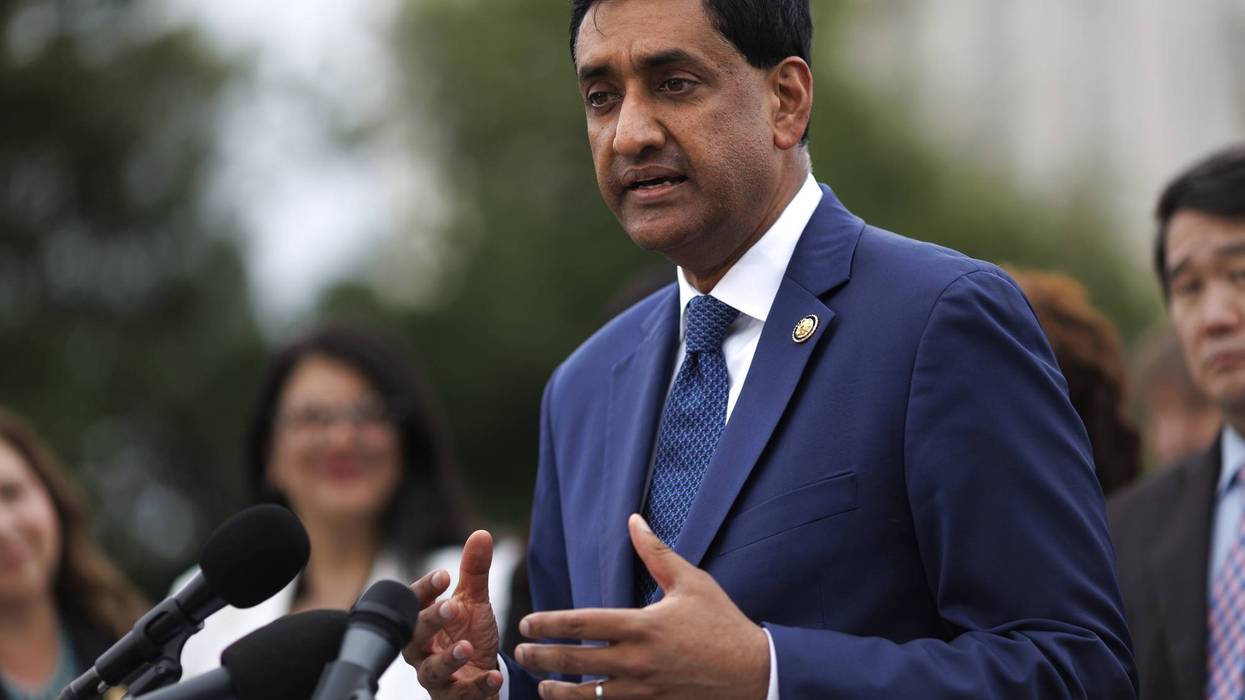
"The next Democratic White House does not need a court reform commission like some college seminar," said the California Democrat.
With a right-wing supermajority controlling the US Supreme Court, and the recent ruling in Louisiana v. Callais yet again displaying the court's "war on constitutional democracy," as one legal expert put it, US Rep. Ro Khanna is pushing for Democrats to move with just as much certainty as the far-right justices as soon as the party is able to reform the court.
In a social media post Tuesday morning, Khanna (D-Calif.) suggested the Democratic Party has all the information it needs to take decisive action to rein in the court as soon as it controls the White House once again—instead of simply "exploring" the possibility of judicial reform.
"The next Democratic White House does not need a court reform commission like some college seminar," said Khanna, who has been named a potential 2028 presidential contender. "We need action. We need term limits for justices. We need to expand this morally bankrupt court from nine to 13."
Khanna is among the progressive lawmakers who have previously expressed support for replacing Supreme Court justices' lifetime appointments with term limits and for expanding the court, which polls have found the majority of Americans support.
The congressman's comments came three days after House Minority Leader Hakeem Jeffries (D-NY) was interviewed by Ali Velshi on MS NOW about the Democratic Party's plans to reform the federal government, should it retake the US House of Representatives and Senate after the November midterm elections and the White House in 2028.
Jeffries called for "nationwide judicial reform," without mentioning specific actions the party should take to reform the court following multiple corruption and ethics scandals involving right-wing Justices Clarence Thomas and Samuel Alito as well as rulings like Callais, which eviscerated Section 2 of the Voting Rights Act and cleared the way for Republican legislatures to redraw congressional maps and eliminate the electoral power of Black communities in the South and across the country.
The ruling of the supposedly nonpartisan high court appeared timed to allow the GOP to redraw districts before the midterms, maximizing their chances of winning seats.
"We are going to have to explore massive judicial reform, state by state and at the federal level, and everything should be on the table, as far as I'm concerned," said Jeffries.
Democrat Judicial Takeover?!
Hakeem Jeffries just proposed a left-wing takeover of the U.S. court system NATIONWIDE if Democrats regain power:
"We're going to have to explore judicial 'reform' state by state and at the federal level...everything should be on the table as far as… pic.twitter.com/yUBN2Wy9Zu
— Conservative Brief (@ConservBrief) May 11, 2026
Ahead of the Callais ruling late last month, the Brennan Center for Justice published a report on several actions Congress could take "to fix the Supreme Court," which currently "wields vast power with minimal accountability" and has the confidence of less than a quarter of Americans, according to polling. Lawmakers, said the group, should take actions including:
Advocacy groups including Demand Justice have called for expanding the court from nine to 13 seats, a move that the group says is "straightforward, constitutional, and grounded in history," with Congress having changed the number of justices that sit on the court six times in the past. A number of Democratic lawmakers have expressed support for court expansion, and former President Joe Biden convened a commission to study reforms in 2021.
At The Guardian on Tuesday, Austin Sarat, a professor of jurisprudence and political science at Amherst College, recalled the historian Henry Steele Commager's 1943 warning that the Supreme Court "had never been a friend to US democracy, and it never would be."
"For anyone committed to the advancement of majority rule, he added, judicial review 'is wrong in theory and dangerous in practice,'" wrote Sarat, who said the Callais ruling put the danger Commager warned of "on full display"—as have a number of rulings since the court allowed unlimited corporate spending on elections in 2010 with its Citizens United ruling.
"Commager would not have been surprised by what has unfolded since 2010, but he would have warned Americans against despair," wrote Sarat. "He would want us to get busy trying to save what is left of our democracy by using our votes and our voices. There is no time to waste."

"It’s not a big deal," Landry said after casually announcing that legally cast ballots were "discarded" after he suspended elections.
Louisiana's Republican Gov. Jeff Landry is facing criticism over his blasé admission that tens of thousands of Louisianans would have their legally cast ballots thrown out after he suspended the state's primary elections.
Landry signed an executive order suspending the state's May 16 and June 27 primaries immediately after the US Supreme Court’s landmark decision in late April, which held that the state’s maps guaranteeing districts representing the state's Black residents constituted “an unconstitutional racial gerrymander."
The ruling in Louisiana v. Callais effectively destroyed Section 2 of the 1965 Voting Rights Act and set the stage for the GOP to draw new districts that could totally wipe out the electoral power of Louisiana's Black population, which makes up about one-third of the state, and do the same across the country.
Declaring a "state of emergency," the governor announced that elections were suspended just as early voting was set to begin, leading many to conclude that the right-wing high court's ruling was timed to allow Republicans to maximize their power as they enter this year's midterms.
In an interview with "60 Minutes" on Sunday night, Landry was asked by anchor Cecilia Vega about the unprecedented decision to suspend the election and what would happen to the roughly 45,000 mail ballots cast before the order went into effect.
Landry contended that he had no choice but to suspend the elections because "we don't have a map that our voters can vote on" as a result of the court's ruling.
Vega noted that during times of much greater strife, including "during the Civil War, during two world wars, elections still went on."
"We'll have an election, and we're actually going to have an election on Election Day," Landry responded, in an apparent shot at those who cast their votes early.
"But voting was already happening," Vega said. "More than 45,000 ballots have been returned. What happens to those?"
Landry said, "Those ballots are discarded, and those voters will vote again in November." (Notably, Landry's order does not delay primary elections until November, but until July 15 or whenever the legislature enacts new maps.)
Vega responded with incredulity at the governor's casual acknowledgment that the state would simply throw out tens of thousands of legally cast votes.
“You say that like it’s not a big deal,” she said.
“Well, it’s not a big deal,” Landry responded. “It’s not my fault. If anyone has a grievance, take it to the United States Supreme Court.”
The voting rights-focused news outlet Democracy Docket responded to Landry on social media: "It is a big deal to the 45,000 voters whose ballots you trashed. It’s also your fault."
They echoed the words of Rep. Cleo Fields (D-La.), whose majority Black 6th congressional district in Baton Rouge is expected to be chopped up by the GOP, and who has joined a lawsuit with other candidates hoping to stop Landry's suspension of elections.
“The Supreme Court ruled that the map that you created, that this legislature created, and this governor signed, was illegal,” Fields said to Landry on Monday. "The Supreme Court did not say, ‘Throw away those ballots.’"
The decision to suspend Louisiana’s primary comes amid a multi-pronged assault on voting rights coming from the administration of President Donald Trump, who has himself repeatedly floated the idea of canceling elections and praised Landry for “moving so quickly” to block his constituents from voting.
But many were particularly shocked at Landry's apparent ho-hum attitude toward mass disenfranchisement.
Civil rights attorney and public defender Scott Hechinger marveled at the “governor of Louisiana throwing out 45,000 votes with a smug smirk and a chuckle.”
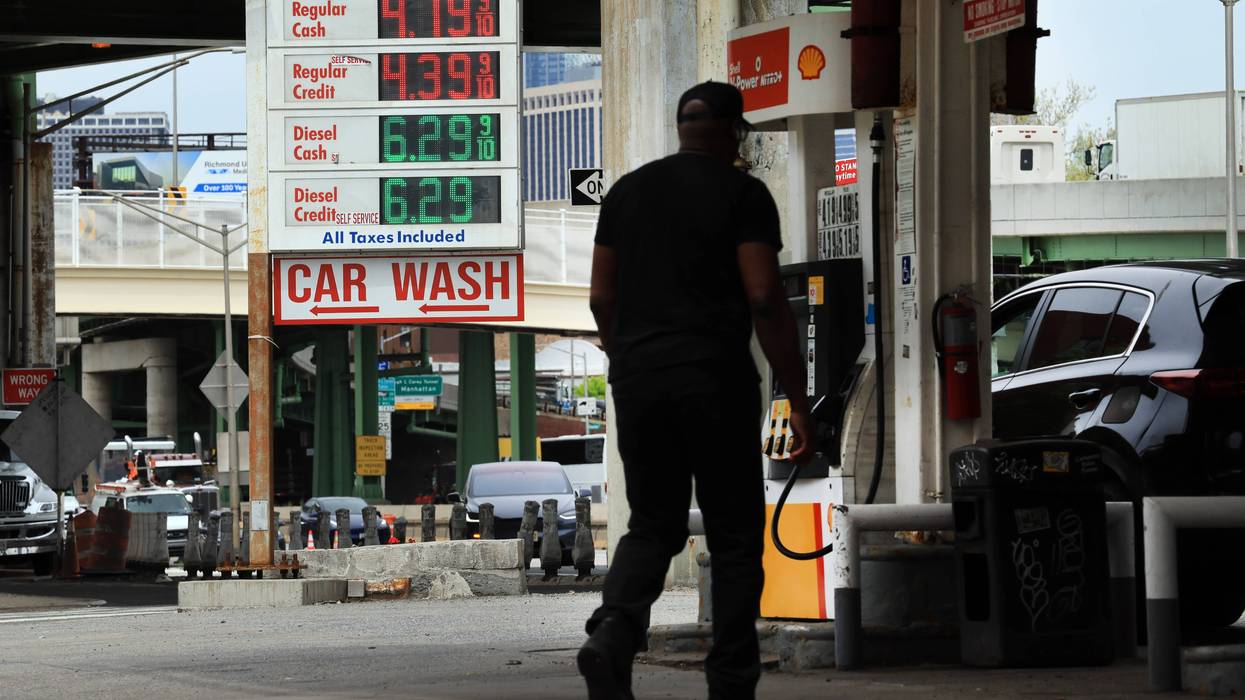
"Trump is more focused on finishing his billion-dollar ballroom than lowering prices for American families," said one critic.
Federal data released Tuesday showed US inflation rising to the highest level it's been since May 2023, as President Donald Trump's Iran War has led to increases in the costs of both energy and food.
The latest Consumer Price Index (CPI) released by the US Bureau of Labor Statistics finds that prices in April posted a year-over-year increase of 3.8%, above economists' expectations of a 3.7% increase, driven by energy prices that surged nearly 18% from April 2025.
The price of groceries also notched significant increases during the month, the report notes.
"Five of the six major grocery store food group indexes increased in April," says the report. "The index for meats, poultry, fish, and eggs increased 1.3% over the month as the index for beef rose 2.7%. The fruits and vegetables index increased 1.8% in April and the nonalcoholic beverages index rose 1.1%. The index for dairy and related products increased 0.8% over the month and the index for cereals and bakery products rose 0.1% in April."
Economists said the new CPI report showed significant trouble ahead for American consumers, who last month registered record-low sentiment in the University of Michigan’s Surveys of Consumers, driven in large part by anxiety over price increases caused by the Iran war.
Joseph Brusuelas, chief economist at RSM, told The Wall Street Journal that "the American economy has entered a new chapter where inflation appears to have stepped up," and predicted that "median American families are going to find it very challenging to adjust going into the second half of the year."
Heather Long, chief economist at Navy Federal Credit Union, observed that the cost of living in April rose above average monthly wage gains, meaning US consumers are no longer just treading water but falling behind.
"Inflation is now eating up all wage gains for the first time in about three years," she wrote. "This is painful for Americans and a true financial squeeze."
University of Michigan economist Justin Wolfers highlighted just how much the latest CPI report exposes the false promises President Donald Trump made during the 2024 presidential campaign.
"Trump campaigned on bringing down the cost of living 'starting on day one,'" he wrote, "and then: started a trade war; deported much of the farm workforce, bombed Iran, allowed healthcare subsidies to expire, cut food assistance, ran an interest-rate boosting deficit, and attacked Fed independence."
Rep. Brendan Boyle (D-Pa.) similarly ripped Trump's economic mismanagement in the wake of the CPI report.
"From his tariff taxes to his disastrous war in Iran, President Trump is making life even harder for American families," said Boyle. "Today’s inflation data confirms what everyone can see: costs are out of control, and President Trump is responsible."
The latest CPI data comes as a poll from CNN released Tuesday shows a record-high 70% of Americans disapprove of Trump's handling of the economy, with 75% of US voters saying the president's unprovoked war of choice with Iran has had a negative effect on their financial situations.
Trump's approval on the economy was a strength throughout his first term, even as polls showed him to be otherwise unpopular. As noted by CNN senior political reporter Aaron Blake, Trump's disapproval on the economy "never even reached 50% in his first term," but has now been at over 60% for the last year.
Alex Jacquez, chief of policy and advocacy at Groundwork Collaborative, said in a statement that "Trump chose to reignite inflation with his illegal and reckless war in Iran, and more than two months in, there’s no offramp in sight."
"Every day the war continues, prices climb higher and will stay there for months after it ends," said Jacquez. "As Americans continue to rank cost of living and inflation as their most important issues, Trump is more focused on finishing his billion-dollar ballroom than lowering prices for American families.”