

SUBSCRIBE TO OUR FREE NEWSLETTER
Daily news & progressive opinion—funded by the people, not the corporations—delivered straight to your inbox.
5
#000000
#FFFFFF
To donate by check, phone, or other method, see our More Ways to Give page.
Daily news & progressive opinion—funded by the people, not the corporations—delivered straight to your inbox.

Today's argument in Citizens United v. FEC suggests that the Roberts
Court is poised to sweep aside century-old restraints on corporate
domination of the political marketplace--unless the wisdom of the
Court's newest member proves persuasive when the decision is ultimately
written.
As Justice Sotomayor listened to some of her colleagues encourage
Ted Olson's argument for overruling key Supreme Court precedents
preventing the use of corporate general treasury funds in elections,
she intervened to ask a pointed question of Olson: "Are you giving up
on your earlier arguments that there are narrower, nonconstitutional
grounds for deciding your case"? And Mr. Olson had to say "no." This
question by the newest Justice was a pointed reminder that if
overruling key precedents is a form of judicial activism, doing so when
there clearly are more narrow, statutory grounds for deciding the case
is a truly extreme example of judicial activism.
As explained in a blog post
by Demos' Democracy Program Director Brenda Wright, the two key
precedents the Court appears intent on overturning--Austin v. Michigan
Chamber of Commerce and McConnell v. FEC--affirmed that Congress and
the states may require corporate political speech to be funded by
donations from persons who agree with the corporation's message rather
than by corporate general treasury funds that were not accumulated for
political purposes. A majority of the current Court, however, appears
ready to hold that corporations must enjoy an unfettered right to
dominate electoral politics by using their huge corporate general
treasury funds in electoral campaigns--regardless of the political
views of shareholders.
"The general treasury funds of large for-profit corporations
entirely dwarf the resources available for political expenditures from
individual citizens, and thus will provide a virtually irresistible
target for political actors clawing for advantage in federal elections
if Austin and McConnell are overruled," said Wright. "Democracy should
not be a wholly owned corporate subsidiary, but today's argument
suggests that is where the Roberts Court may be headed."
Jeff Milchen, the co-founder of the American Independent Business
Alliance, reacted to Justice Scalia's repeated questions about
protecting the rights of small businesses: "For ten years, I've spoken
with dozens of business owners every week and often discuss their
concerns with government policy. Not once has an owner raised concern
about restrictions on their ability to make political contributions.
For Justice Scalia to invoke concern for small business owners to
advance his agenda of expanding the power of giant corporations simply
is laughable."
Demos joined with the American Independent Business Alliance, a
non-profit organization helping communities design and implement
programs to support independent locally-owned businesses, to file a
friend-of-the-court brief arguing that elevating corporations to the
status of citizens has no constitutional basis and would harm not only
citizens, but America's small businesses.
The amicus brief on behalf of American Independent Business Alliance
was prepared by attorneys with Demos, a national, non-partisan
organization that works to ensure broad political participation and a
vibrant democracy; and by Daniel Greenwood, a professor at Hofstra
University School of Law who has written extensively about the
intersection of corporate law and democracy.
For more information, visit www.demos.org or www.amiba.net.
Demos is a think tank that powers the movement for a just, inclusive, multiracial democracy. Through cutting-edge policy research, inspiring litigation, and deep relationships with grassroots organizations, Demos champions solutions that will create a democracy and economy rooted in racial equity.

"Lindsey Graham will forever be remembered as an enabler of a regime that has murdered people, destroyed democratic norms, and caused irreparable harm to this county. What a horrific legacy," said one critic.
Sen. Lindsey Graham, one of the most relentless proponents for using US military force overseas, died on Saturday night at the age of 71.
In a statement posted on Graham's (R-SC) social media account, the senator's office said that he "passed away from a brief and sudden illness."
"Sen. Graham's family appreciates prayers at this time," the office added, "and asks for privacy during this incredibly difficult period."
During his life, Graham advocated either starting or getting involved in multiple wars across the world, and he was reportedly instrumental in convincing President Donald Trump to launch an illegal attack on Iran without any authorization from the US Congress.
Although Graham was once a Trump critic—he infamously declared in 2016 that the Republican Party would get "destroyed" if it made the former Celebrity Apprentice host its presidential nominee—the South Carolina Republican grew to become one of the president's staunchest allies.
Some critics of Graham reacted to his death by rehashing what they considered to be his least admirable traits.
David Dayen, executive editor of The American Prospect, remarked that Graham "never met a war he didn't want to send your kids to."
Alejandra Caraballo, clinical instructor at the Harvard Law School Cyberlaw Clinic, also reflected on Graham's lifetime of war mongering.
"You can say a lot about Lindsey Graham," Caraballo wrote, "but at least he got to see the thing he most wanted before he died, bombing school children in Iran."
Princeton historian Kevin Kruse predicted that Graham would leave behind a decidedly poor legacy.
"When Lindsey Graham appears in a history book," wrote Kruse, "it'll be his prediction in 2016 that the Republican Party would be destroyed for supporting Donald Trump and then a few lines about how he proved it by becoming Trump's toady. That's pretty much it. That's his legacy. Pathetic lickspittle."
Steve Schmidt, a former Republican strategist who left the party due to its embrace of Trump, wrote that Graham was "a simple, tragic man" who "lacked a moral core."
"The great empty spaces of his life were filled with an insatiable need for 'relevance,'" Schmidt observed. "He found it as a cast member in the most malignant reality show ever made."
Kenneth Roth, former executive director of Human Rights Watch, had a similar analysis of Graham's character.
"Lindsey Graham supported the International Criminal Court when it charged [Russian President Vladimir] Putin but turned on it when it charged [Israeli Prime Minister] Netanyahu," wrote Roth. "Principled, he wasn't."
Nicholas Grossman, professor of international relations at the University of Illinois, wrote that Graham "spent the last decade of his life in public service... trying hard to be remembered as an enemy of the Constitution who worked to destroy American democracy."
Grossman added that Graham "exhibited occasional signs that he knew why that was bad but kept doing it anyway."
Ruth Zakarin, CEO of the Massachusetts Coalition to Prevent Gun Violence, offered a grim assessment of the late senator.
"Lindsey Graham will forever be remembered as an enabler of a regime that has murdered people, destroyed democratic norms, and caused irreparable harm to this county," wrote Zakarin. "What a horrific legacy."

"Trump has turned Venezuela into an effective US colony," said one critic.
Some critics of the Trump administration are reacting with horror to revelations that US Secretary of State Marco Rubio has been serving as the de facto ruler of Venezuela.
According to a Saturday report in The New York Times, Rubio for the last several months has been acting informally as the "viceroy" of Venezuela ever since its recognized president, Nicolás Maduro, was abducted by the American military in January and brought to the US to face charges related to "narco-terrorism."
The Times' sources revealed that Rubio "effectively controls Venezuela’s finances, the distribution of its natural resources, and its government" and "is deeply involved in the country’s day-to-day operations," while maintaining regular contact with acting Venezuelan President Delcy Rodríguez.
Under current arrangements, the US Treasury Department takes in revenue from Venezuela's exports, including its petroleum, and then disperses the money back to the country through its private banks with strict conditions set by Rubio over what it can be spent on.
In explaining the system, the Times likened it to "parents handing out allowances to children," adding that it gives Rubio "immense leverage over... Rodríguez, who depends on the money to pay workers and prop up the national currency."
Elizabeth Saunders, professor of political science at Columbia University, described Rubio's power over Venezuela as "insane," as well as "derelict, unconscionable, and impeachable."
"The secretary of state's time is scarce, valuable, and not outsourcable," Saunders emphasized.
Orlando J. Pérez, professor of Political Science at the University of North Texas at Dallas, said the Times report made a mockery of Rubio's professed claims to want to bring democracy back to Venezuela.
"It appears Rubio has transformed from democracy promotion warrior," Pérez commented, "to transactional realpolitik operative!"
Kenneth Roth, former executive director at Human Rights Watch, wrote that US control over Venezuela appeared similar to the kind of imperial power wielded by European nations in the 19th Century.
"Trump has turned Venezuela into an effective US colony," said Roth, "with Marco Rubio as the viceroy and Washington controlling the country’s oil revenue and dictating major foreign and domestic policies. Democracy has been relegated to the distant future."
Bradley Simpson, historian at the University of Connecticut, also saw the current US arrangement with Venezuela as a return to overt imperialism.
"We are literally back in the Dollar Diplomacy days of the 1910s," Simpson wrote, "when the United States invaded countries and took over their financial systems and ran them as effective colonies. Flagrantly illegal, enormously corrupt. Where is the organization of American states or UN in denouncing this?"
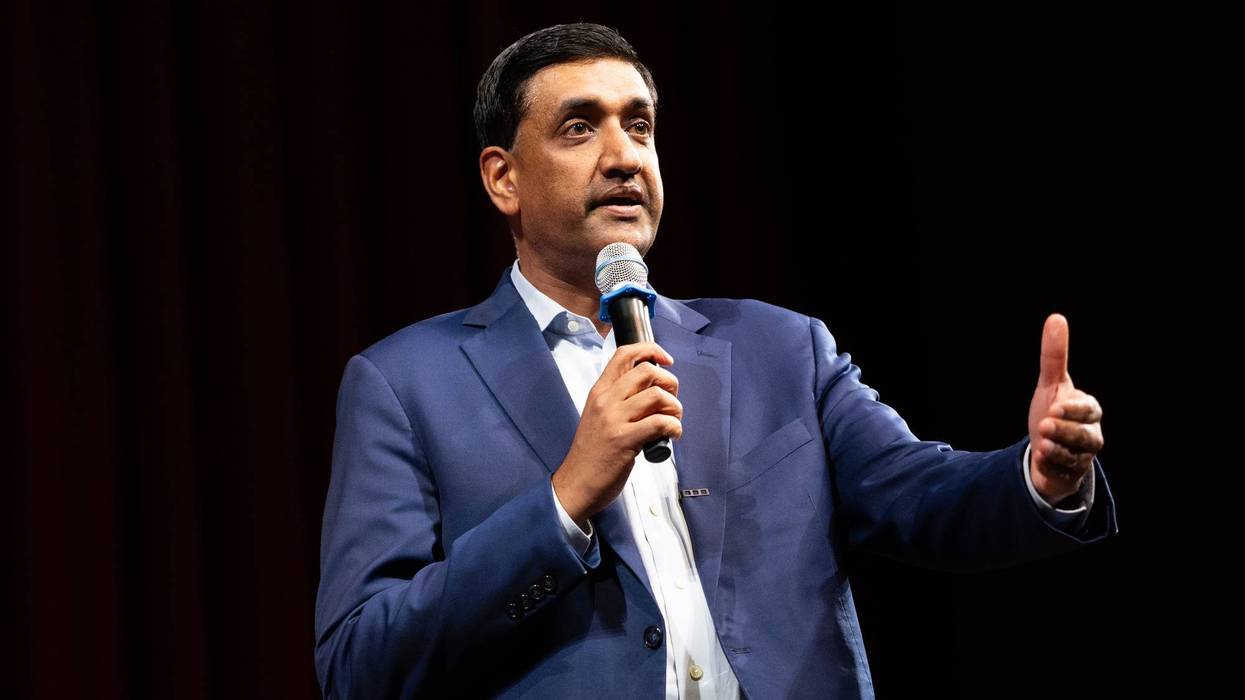
"These hoodlums come in with machine guns—M4, an American-made machine gun—and they detain us. They block off the road."
Rep. Ro Khanna this week was detained by a group of Israeli settlers whom he described as "hoodlums... with machine guns" while making a visit to a Palestinian village in the occupied West Bank.
In an interview with Reuters published on Saturday, Khanna (D-Calif.) said he and his tour group were surrounded by armed settlers as they were traveling through the West Bank on Wednesday.
"We were at a village that Israeli settlers had destroyed, they had destroyed the school, they had destroyed that village, and we were just looking at it," said Khanna. "And these hoodlums come in with machine guns—M4, an American-made machine gun—and they detain us. They block off the road."
The California Democrat said that the settlers called in members of the Israel Defense Forces (IDF) to help them deal with him and his group.
"The IDF is on their side," Khanna remarked, "not on the side of the Americans."
Cameron Kasky, an aide to Khanna, told Reuters that the group was held for over an hour before officials whom he believed to be police intervened and secured their release.
The IDF told Reuters that both military troops and police officers dispersed the settlers who had set up a roadblock near the small Palestinian village of Khirbet Zanuta.
Khanna wasn't the only American to have a run-in with Israeli settlers this week, as CNN reported that four settlers attacked groups of journalists, including CNN reporters and crew, who were traveling through an area north of the Palestinian city of Ramallah on Saturday.
As the journalists were driving, four settlers blocked off the road with their cars and began attacking the reporters' vehicles with wooden clubs and metal rods.
"The settlers then began to jump on the vehicle behind CNN's—carrying another group of journalists—and smashed the windshield of that vehicle," the network reported. "Another group of settlers tried to block a separate exit route before chasing the journalists towards the town of Sinjil."
Israeli police arrived on the scene and arrested four settlers who were allegedly responsible for the attacks, CNN reported.
"The Israel Police and the IDF view any manifestation of violence or causing damage to property very seriously," the Israeli officers said after the arrests, "especially when it concerns media personnel performing their work."
Israeli settlers for years have carried out violent attacks on Palestinians living in the West Bank, and witnesses have regularly described IDF soldiers at the scene either standing by as the attacks occur or even actively helping the attackers.
In an interview with CNN on Tuesday, Israeli Prime Minister Benjamin Netanyahu said that claims about settler violence have been "blown up beyond belief," describing attacks as being carried out by a small number of "juvenile delinquents."