SUBSCRIBE TO OUR FREE NEWSLETTER
Daily news & progressive opinion—funded by the people, not the corporations—delivered straight to your inbox.
5
#000000
#FFFFFF
To donate by check, phone, or other method, see our More Ways to Give page.
Daily news & progressive opinion—funded by the people, not the corporations—delivered straight to your inbox.
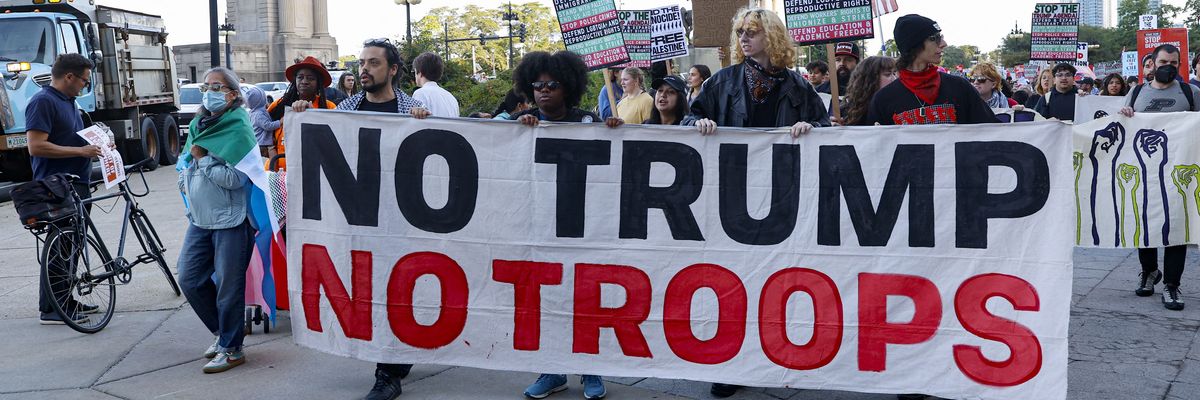
People march behind a 'No Trump, No Troops' banner during a demonstration against US Immigration and Customs Enforcement (ICE) and planned deployment of National Guard troops in Chicago, Illinois, on September 9, 2025.
"Ultimately, this court must conclude that defendants'... perceptions are not reliable," wrote Judge April Perry.
A federal judge on Friday night released her full opinion justifying an earlier decision to block President Donald Trump from deploying Texas National Guard troops in Chicago, and she even went so far as to question his administration's grasp on reality.
In her ruling, Judge April Perry began by citing a lengthy quote from the Federalist Papers in which Alexander Hamilton addressed concerns that a tyrannical US president would use a militia from one state to invade and occupy another state.
After giving the matter brief consideration, Hamilton dismissed fears about a would-be tyrant carrying out such a scheme on the grounds that "it is impossible to believe that they would employ such preposterous means to accomplish their designs."
And yet, Perry noted, this exact scenario is one that the state of Illinois and the city of Chicago claim is happening right now, as they argue that "National Guard troops from both Illinois and Texas have been deployed to Illinois because the president of the United States wants to punish state elected officials whose policies are different from his own."
Perry went on to consider circumstances in which the president may federalize the National Guard, and concluded that the administration's case for sending the National Guard to Chicago did not meet any of them.
Perry noted that the president may federalize the National Guard if "there is a rebellion or danger of a rebellion against the authority" of the US government, but she argued there has historically been a "very high threshold for deployment" that is not justified by current circumstances.
"In the late 1800s and early 1900s, 'rebellion' was understood to mean a deliberate, organized resistance, openly and avowedly opposing the laws and authority of the government as a whole by means of armed opposition and violence," she explained. "As an example, during the late 1800s, after the close of the Civil War, the Supreme Court and several statutes referred to the Civil War as constituting a 'rebellion.'"
She then found that the administration itself has not claimed any Civil War-like rebellion is occurring in the US right now.
"In all of the memoranda actually deploying the National Guard to Illinois, the court does not see any factual determination by President Trump regarding a rebellion brewing here," she wrote. "This is sensible, because the court cannot find reasonable support for a conclusion that there exists in Illinois a danger of rebellion."
Elsewhere in the ruling, Perry examined the government's claims that local law enforcement officials have been unable to contain demonstrations at the Immigration and Customs Enforcement (ICE) in Broadview, Illinois, which has become a focal point for protests in recent weeks.
Although there have been incidents in which local law enforcement has had to intervene to keep protesters from getting too close to the facility, Perry said, there has never been a level of disorder that would justify the deployment of the National Guard.
"The ICE Processing Center has continuously remained open and operational throughout the protest activity," she wrote. "Broadview Police are not aware of any occasion where an ICE vehicle was prevented from entering or exiting due to activity by protestors."
This led her to remark upon a "troubling trend" of the Trump administration "equating protests with riots" and "a lack of appreciation for the wide spectrum that exists between citizens who are observing, questioning, and criticizing their government, and those who are obstructing, assaulting, or doing violence."
"This indicates to the court both bias and lack of objectivity," she wrote. "Ultimately, this court must conclude that defendants'... perceptions are not reliable."
Dear Common Dreams reader, It’s been nearly 30 years since I co-founded Common Dreams with my late wife, Lina Newhouser. We had the radical notion that journalism should serve the public good, not corporate profits. It was clear to us from the outset what it would take to build such a project. No paid advertisements. No corporate sponsors. No millionaire publisher telling us what to think or do. Many people said we wouldn't last a year, but we proved those doubters wrong. Together with a tremendous team of journalists and dedicated staff, we built an independent media outlet free from the constraints of profits and corporate control. Our mission has always been simple: To inform. To inspire. To ignite change for the common good. Building Common Dreams was not easy. Our survival was never guaranteed. When you take on the most powerful forces—Wall Street greed, fossil fuel industry destruction, Big Tech lobbyists, and uber-rich oligarchs who have spent billions upon billions rigging the economy and democracy in their favor—the only bulwark you have is supporters who believe in your work. But here’s the urgent message from me today. It's never been this bad out there. And it's never been this hard to keep us going. At the very moment Common Dreams is most needed, the threats we face are intensifying. We need your support now more than ever. We don't accept corporate advertising and never will. We don't have a paywall because we don't think people should be blocked from critical news based on their ability to pay. Everything we do is funded by the donations of readers like you. When everyone does the little they can afford, we are strong. But if that support retreats or dries up, so do we. Will you donate now to make sure Common Dreams not only survives but thrives? —Craig Brown, Co-founder |
A federal judge on Friday night released her full opinion justifying an earlier decision to block President Donald Trump from deploying Texas National Guard troops in Chicago, and she even went so far as to question his administration's grasp on reality.
In her ruling, Judge April Perry began by citing a lengthy quote from the Federalist Papers in which Alexander Hamilton addressed concerns that a tyrannical US president would use a militia from one state to invade and occupy another state.
After giving the matter brief consideration, Hamilton dismissed fears about a would-be tyrant carrying out such a scheme on the grounds that "it is impossible to believe that they would employ such preposterous means to accomplish their designs."
And yet, Perry noted, this exact scenario is one that the state of Illinois and the city of Chicago claim is happening right now, as they argue that "National Guard troops from both Illinois and Texas have been deployed to Illinois because the president of the United States wants to punish state elected officials whose policies are different from his own."
Perry went on to consider circumstances in which the president may federalize the National Guard, and concluded that the administration's case for sending the National Guard to Chicago did not meet any of them.
Perry noted that the president may federalize the National Guard if "there is a rebellion or danger of a rebellion against the authority" of the US government, but she argued there has historically been a "very high threshold for deployment" that is not justified by current circumstances.
"In the late 1800s and early 1900s, 'rebellion' was understood to mean a deliberate, organized resistance, openly and avowedly opposing the laws and authority of the government as a whole by means of armed opposition and violence," she explained. "As an example, during the late 1800s, after the close of the Civil War, the Supreme Court and several statutes referred to the Civil War as constituting a 'rebellion.'"
She then found that the administration itself has not claimed any Civil War-like rebellion is occurring in the US right now.
"In all of the memoranda actually deploying the National Guard to Illinois, the court does not see any factual determination by President Trump regarding a rebellion brewing here," she wrote. "This is sensible, because the court cannot find reasonable support for a conclusion that there exists in Illinois a danger of rebellion."
Elsewhere in the ruling, Perry examined the government's claims that local law enforcement officials have been unable to contain demonstrations at the Immigration and Customs Enforcement (ICE) in Broadview, Illinois, which has become a focal point for protests in recent weeks.
Although there have been incidents in which local law enforcement has had to intervene to keep protesters from getting too close to the facility, Perry said, there has never been a level of disorder that would justify the deployment of the National Guard.
"The ICE Processing Center has continuously remained open and operational throughout the protest activity," she wrote. "Broadview Police are not aware of any occasion where an ICE vehicle was prevented from entering or exiting due to activity by protestors."
This led her to remark upon a "troubling trend" of the Trump administration "equating protests with riots" and "a lack of appreciation for the wide spectrum that exists between citizens who are observing, questioning, and criticizing their government, and those who are obstructing, assaulting, or doing violence."
"This indicates to the court both bias and lack of objectivity," she wrote. "Ultimately, this court must conclude that defendants'... perceptions are not reliable."
A federal judge on Friday night released her full opinion justifying an earlier decision to block President Donald Trump from deploying Texas National Guard troops in Chicago, and she even went so far as to question his administration's grasp on reality.
In her ruling, Judge April Perry began by citing a lengthy quote from the Federalist Papers in which Alexander Hamilton addressed concerns that a tyrannical US president would use a militia from one state to invade and occupy another state.
After giving the matter brief consideration, Hamilton dismissed fears about a would-be tyrant carrying out such a scheme on the grounds that "it is impossible to believe that they would employ such preposterous means to accomplish their designs."
And yet, Perry noted, this exact scenario is one that the state of Illinois and the city of Chicago claim is happening right now, as they argue that "National Guard troops from both Illinois and Texas have been deployed to Illinois because the president of the United States wants to punish state elected officials whose policies are different from his own."
Perry went on to consider circumstances in which the president may federalize the National Guard, and concluded that the administration's case for sending the National Guard to Chicago did not meet any of them.
Perry noted that the president may federalize the National Guard if "there is a rebellion or danger of a rebellion against the authority" of the US government, but she argued there has historically been a "very high threshold for deployment" that is not justified by current circumstances.
"In the late 1800s and early 1900s, 'rebellion' was understood to mean a deliberate, organized resistance, openly and avowedly opposing the laws and authority of the government as a whole by means of armed opposition and violence," she explained. "As an example, during the late 1800s, after the close of the Civil War, the Supreme Court and several statutes referred to the Civil War as constituting a 'rebellion.'"
She then found that the administration itself has not claimed any Civil War-like rebellion is occurring in the US right now.
"In all of the memoranda actually deploying the National Guard to Illinois, the court does not see any factual determination by President Trump regarding a rebellion brewing here," she wrote. "This is sensible, because the court cannot find reasonable support for a conclusion that there exists in Illinois a danger of rebellion."
Elsewhere in the ruling, Perry examined the government's claims that local law enforcement officials have been unable to contain demonstrations at the Immigration and Customs Enforcement (ICE) in Broadview, Illinois, which has become a focal point for protests in recent weeks.
Although there have been incidents in which local law enforcement has had to intervene to keep protesters from getting too close to the facility, Perry said, there has never been a level of disorder that would justify the deployment of the National Guard.
"The ICE Processing Center has continuously remained open and operational throughout the protest activity," she wrote. "Broadview Police are not aware of any occasion where an ICE vehicle was prevented from entering or exiting due to activity by protestors."
This led her to remark upon a "troubling trend" of the Trump administration "equating protests with riots" and "a lack of appreciation for the wide spectrum that exists between citizens who are observing, questioning, and criticizing their government, and those who are obstructing, assaulting, or doing violence."
"This indicates to the court both bias and lack of objectivity," she wrote. "Ultimately, this court must conclude that defendants'... perceptions are not reliable."