SUBSCRIBE TO OUR FREE NEWSLETTER
Daily news & progressive opinion—funded by the people, not the corporations—delivered straight to your inbox.
5
#000000
#FFFFFF
To donate by check, phone, or other method, see our More Ways to Give page.
Daily news & progressive opinion—funded by the people, not the corporations—delivered straight to your inbox.
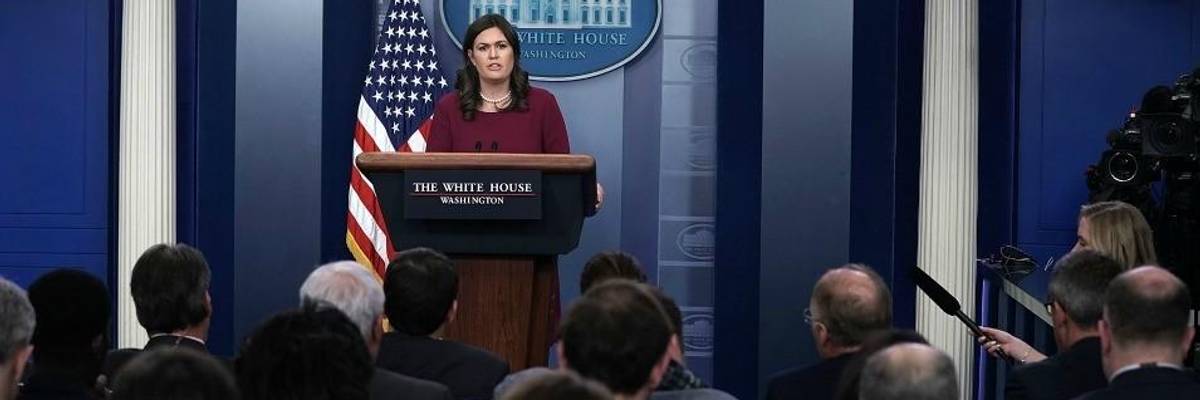
The White House has introduced new rules which will limit access for journalists in the White House Press Corps. At least one reporter has suggested his access was limited because he's a critic of the president. (Photo: Alex Wong/Getty Images)
A number of journalists are expressing alarm over new White House rules limiting access to the Trump administration, but concern is being raised that the trade organization that represents those reporters has so far been silent on the matter.
Under the new rules, concocted by press secretary Sarah Huckabee Sanders after a review of reporters' credentials, journalists will be required to work at the White House for 90 out of 180 days in order to hold "hard passes," which allow easy access to the building for reporters who regularly cover the administration.
As Politico reported, the new guidelines don't "consider that reporters are often out for weekends, vacations, campaign-trail reporting, or presidential trips abroad."
Yet, as one critic noted on social media, the White House Correspondents Association (WHCA)--which claims to "ensure a strong free press and robust coverage of the presidency"--released no statement denouncing the administration for curtailing the free press's right to report on Trump's presidency. The group's silence contrasted with its condemnation of comedian Michelle Wolf in 2018 when she delivered a blistering critique of Trump and other administration officials.
As of this writing, the WHCA has neither tweeted objections to the new rules nor issued any public statements.
Washington Post columnist Dana Milbank wrote an op-ed Wednesday describing what he called the "mass purge" of reporters, arguing that the new rules were aimed at limiting the access of journalists who have been critical of the president.
"I strongly suspect it's because I'm a Trump critic," Milbank wrote. "The move is perfectly in line with Trump's banning of certain news organizations, including The Post, from his campaign events and his threats to revoke White House credentials of journalists he doesn't like."
Although long-time White House reporters can apply for an exemption, Milbank was denied one, he wrote in The Post.
"There's something wrong with a president having the power to decide which journalists can cover him," the reporter wrote.
The White House's latest effort to control the free press's access to the Trump administration was denounced as a "hallmark of authoritarianism" by Sen. Jeff Merkley (D-Ore.).
Vermont Democrat Sen. Patrick Leahy agreed, "This is what dictators do."
Sanders's new press guidelines come six months after CNN correspondent Jim Acosta, who has frequently butted heads with the press secretary during briefings, was temporarily banned from covering the White House following a combative press conference.
Arguing that Acosta's First Amendment rights had been violated, CNN sought and was granted a court injunction. Federal Judge Timothy Kelly, a Trump appointee, ruled that Acosta's right to due process had been breached.
"Now," wrote Mathew Ingram at the Columbia Journalism Review on Thursday, "the White House has a structure in place that could allow it to remove whoever it wishes to remove. That wouldn't necessarily override First Amendment protection for press access (which Kelly didn't rule on), but in the short term it gives the Trump administration new levers with which to control the press corps."
Milbank noted in his op-ed that he was "not looking for pity." More important than his press credentials, he wrote, "is that the White House is drastically curtailing access for all journalists. Briefings have been abolished in favor of unscheduled 'gaggles' (on the record, but impromptu, and haphazard) in the White House driveway."
Other political journalists and legal experts also raised alarm about the new rules.
As of Thursday, Sanders has not held a press briefing in 59 days--a record for the White House. Some, including Milbank, noted that access to the White House under the Trump adminisation has had diminished value due to the president and other officials' propensity for lying about policies.
In light of the administration's latest attack on the press, Reed Richardson of Mediaite wrote, "The real question becomes: How does the White House press corps adapt to an on-the-ground reporting situation where its independence is increasingly compromised and so much of its coverage...has diminishing relevance?"
This country and this world are at a monumental crossroads. US voters have an opportunity to beat back the forces of fascism and confront the billionaires who are rigging the economy, our media system, and our democracy, making it increasingly impossible for ordinary people to get by. We’re not just talking about the election. We’re talking about what must be done once these fascist elements are vanquished from power. We need a bolder set of solutions than what either major party has so far been willing to offer and a working-class movement ready to fight like hell for it. Trump didn't emerge from nowhere. The conditions that fueled MAGA authoritarianism were created by decades of radical neoliberal economic policies and a corrupt political system dominated by corporate interests. They slashed taxes on the super-rich, promising that the benefits would trickle down. They said giveaways to the corporate titans would make life more affordable for the rest of us. It was all bullshit. And when a bitter, betrayed populace searches for someone to blame, right-wing demagogues have little trouble finding scapegoats. People know when they're being lied to, but you won't hear any of this from the corporate media. Only independent journalism—powered and funded by people who believe in building a better world—can deliver truly trustworthy daily news. If you share our vision, please contribute whatever you can to sustain our work. |
A number of journalists are expressing alarm over new White House rules limiting access to the Trump administration, but concern is being raised that the trade organization that represents those reporters has so far been silent on the matter.
Under the new rules, concocted by press secretary Sarah Huckabee Sanders after a review of reporters' credentials, journalists will be required to work at the White House for 90 out of 180 days in order to hold "hard passes," which allow easy access to the building for reporters who regularly cover the administration.
As Politico reported, the new guidelines don't "consider that reporters are often out for weekends, vacations, campaign-trail reporting, or presidential trips abroad."
Yet, as one critic noted on social media, the White House Correspondents Association (WHCA)--which claims to "ensure a strong free press and robust coverage of the presidency"--released no statement denouncing the administration for curtailing the free press's right to report on Trump's presidency. The group's silence contrasted with its condemnation of comedian Michelle Wolf in 2018 when she delivered a blistering critique of Trump and other administration officials.
As of this writing, the WHCA has neither tweeted objections to the new rules nor issued any public statements.
Washington Post columnist Dana Milbank wrote an op-ed Wednesday describing what he called the "mass purge" of reporters, arguing that the new rules were aimed at limiting the access of journalists who have been critical of the president.
"I strongly suspect it's because I'm a Trump critic," Milbank wrote. "The move is perfectly in line with Trump's banning of certain news organizations, including The Post, from his campaign events and his threats to revoke White House credentials of journalists he doesn't like."
Although long-time White House reporters can apply for an exemption, Milbank was denied one, he wrote in The Post.
"There's something wrong with a president having the power to decide which journalists can cover him," the reporter wrote.
The White House's latest effort to control the free press's access to the Trump administration was denounced as a "hallmark of authoritarianism" by Sen. Jeff Merkley (D-Ore.).
Vermont Democrat Sen. Patrick Leahy agreed, "This is what dictators do."
Sanders's new press guidelines come six months after CNN correspondent Jim Acosta, who has frequently butted heads with the press secretary during briefings, was temporarily banned from covering the White House following a combative press conference.
Arguing that Acosta's First Amendment rights had been violated, CNN sought and was granted a court injunction. Federal Judge Timothy Kelly, a Trump appointee, ruled that Acosta's right to due process had been breached.
"Now," wrote Mathew Ingram at the Columbia Journalism Review on Thursday, "the White House has a structure in place that could allow it to remove whoever it wishes to remove. That wouldn't necessarily override First Amendment protection for press access (which Kelly didn't rule on), but in the short term it gives the Trump administration new levers with which to control the press corps."
Milbank noted in his op-ed that he was "not looking for pity." More important than his press credentials, he wrote, "is that the White House is drastically curtailing access for all journalists. Briefings have been abolished in favor of unscheduled 'gaggles' (on the record, but impromptu, and haphazard) in the White House driveway."
Other political journalists and legal experts also raised alarm about the new rules.
As of Thursday, Sanders has not held a press briefing in 59 days--a record for the White House. Some, including Milbank, noted that access to the White House under the Trump adminisation has had diminished value due to the president and other officials' propensity for lying about policies.
In light of the administration's latest attack on the press, Reed Richardson of Mediaite wrote, "The real question becomes: How does the White House press corps adapt to an on-the-ground reporting situation where its independence is increasingly compromised and so much of its coverage...has diminishing relevance?"