SUBSCRIBE TO OUR FREE NEWSLETTER
Daily news & progressive opinion—funded by the people, not the corporations—delivered straight to your inbox.
5
#000000
#FFFFFF
To donate by check, phone, or other method, see our More Ways to Give page.
One of the worst Western US snow droughts of the century—exacerbated by a historically warm winter and a record-shattering March heatwave—has experts increasingly worried about wildfire and water supply risks heading into the spring and summer months.
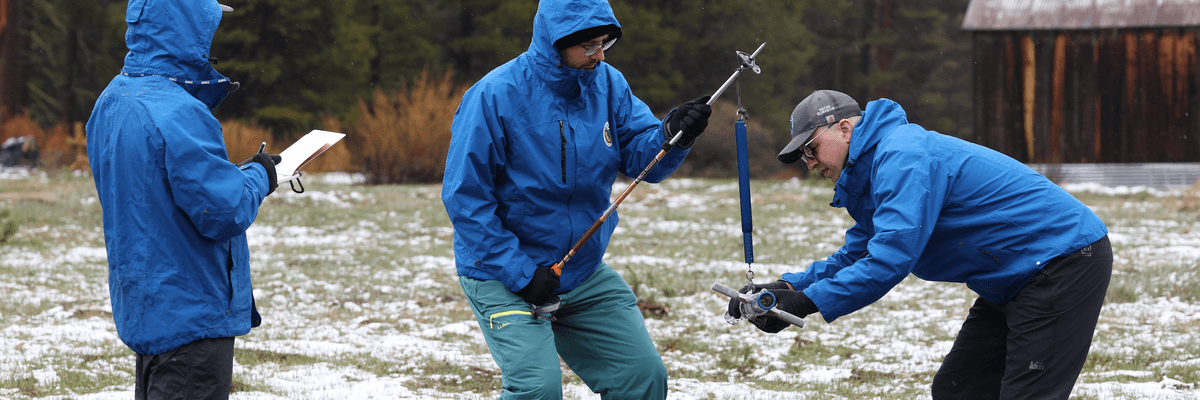
On Wednesday, the California Department of Water Resources reported "no measurable snow" recorded at Phillips Station in the Sierra Nevada range. Because there was some visible snow already on the ground, DWR is calling this the second-lowest April measurement on record.
The agency said this is "a stark indicator of how record‑hot March temperatures and high‑elevation rain have erased the Sierra Nevada snowpack months ahead of schedule."
"The combination of warm storms and unusually hot temperatures rapidly melted what remained of this year’s already sparse snowpack," DWR added. "Statewide, the snowpack is now just 18% of average for this date, according to the automated snow sensor network."
DWR Director Karla Nemeth said that “it feels like we skipped spring this year and dropped straight into a summer heatwave."
“What should be gradual snowmelt happened suddenly weeks ago," Nemeth added. "We’re seeing fewer, warmer storms and shorter wet seasons. Future water supplies will depend upon our ability to capture water when it’s available and manage it more efficiently.”
 (Image by US Department of Agriculture)
Jeff Mount, a senior fellow at the Public Policy Institute of California’s Water Policy Center, told the San Francisco Chronicle on Wednesday: "It didn’t snow where we needed it to snow, and where it did snow, it didn’t stick. This is going to be an ugly summer."
Oregon's iconic Crater Lake is experiencing its lowest snow water equivalent levels on record for this time of year, according to the National Weather Service.
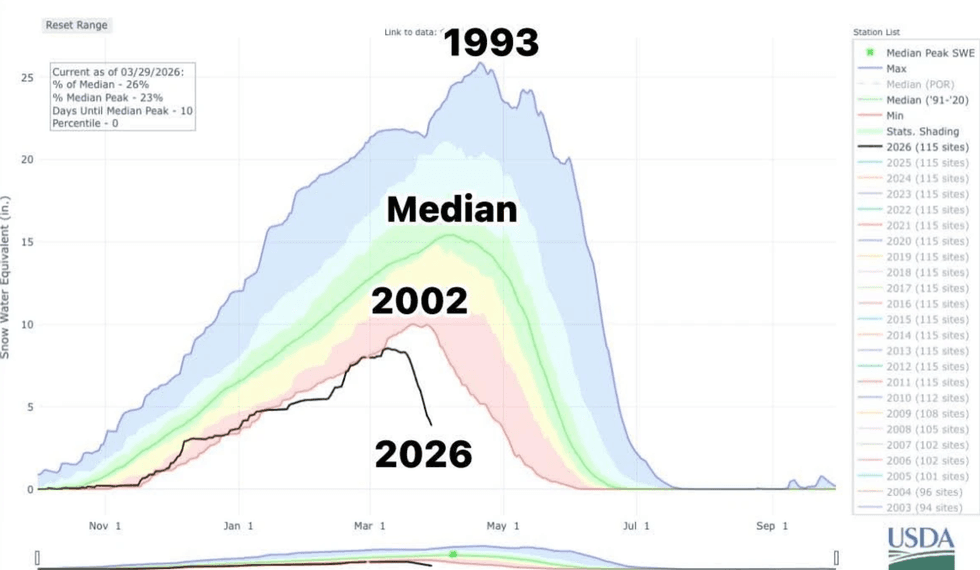
In Colorado, US Department of Agriculture (USDA) data show the statewide snowpack is at just 26% of median levels as of Thursday.
“This year is on a whole other level,” Colorado State University climatologist Russ Schumacher told The Guardian. "Seeing this year so far below any of the other years we have data for is very concerning."
Last week, the Denver Board of Water Commissioners declared Stage 1 drought restrictions, a move that seeks to reduce water use by 20%.
“The snowpack within Denver Water’s collection system has deteriorated significantly and continues to decline,” said Nathan Elder, Denver Water’s manager of water supply. “Snowpack levels in both basins are now the lowest observed in the past 40 years, with accelerated melting underway. The conditions we are experiencing are unprecedented, and we need customers to save water to protect the supply we have right now.”
April measurements of alpine snowpacks—which are sometimes described as water savings accounts—typically indicate peak levels of water that, with spring warming, melt into reservoirs, rivers, and other bodies that help hydrate the West during the parched summer and fall months.
“March is often a big month for snowstorms,” Schumacher said. “Instead of getting snow we would normally expect we got this unprecedented, way-off-the-scale warmth.”
“This year has the potential of being way worse than any of the years we have analogues for in the past,” he added.
As University of California Agriculture and Natural Resources climate scientist Daniel Swain explained last week:
Meteorologically speaking, March 2026 will go down in the record books as the warmest March on record for at least a third, and possibly half or more, of the continental United States. But even more remarkable is the ~10 day window of peak heat during this truly exceptional March heatwave—when many, if not most, locations across the western two thirds of the United States in a broad swath stretching from the Pacific Coast in California eastward past the Mississippi River broke their all-time March monthly heat records. The margin by which March heat records were shattered was so wide that more than a handful of locations also broke their all-time April heat records, and in a few locations even tied or broke their May heat records!
“Beyond the conspicuous ‘weirdness’ of it all, the most consequential impact of our record-shattering March heat will likely be the decimation of the water year 2025-26 snowpack across nearly all of the American west," Swain warned. "The toll wrought on our 'water tower in the sky' is nothing short of shocking."
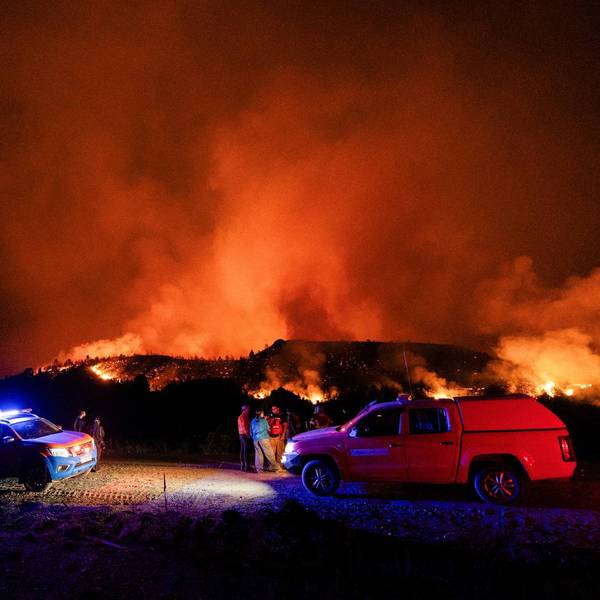
The National Interagency Fire Center is among those projecting above-normal fire risk throughout the American West in the coming months.
“Unless there’s a major change in the weather patterns and we somehow pull out some sort of miracle springtime precipitation, we’re looking at an extended fire season,” Joel Lisonbee, senior associate scientist at the Cooperative Institute for Research at the University of Colorado Boulder, told The Guardian.
In addition to the risk of drought and wildfire, low water levels threaten wildlife, including California's flagging salmon runs—which are also imperiled by Trump administration actions including habitat disruption caused by water flow manipulation.
“No sooner do we start to gain a little ground back in rebuilding our salmon runs, the federal Bureau of Reclamation is destroying them again,” Vance Staplin, executive director of the Golden State Salmon Association, told The Sacramento Bee last week. "These fish are in big trouble if the bureau doesn’t relent very soon.”
Scientists have long warned that planetary heating driven by human burning of fossil fuels will result in longer and more frequent snow droughts. One 2020 study showed how the Western United States is fast becoming a "global snow drought hot spot," with the length of such dry spells increasing by 28% between 1980 and 2018.
“Climate change is going to result in a lot of these extreme events worsening,” Clark University climatologist Abby Frazier told The Guardian on Thursday. "It is heartbreaking to see it all playing out as we have predicted for so long. The changes we have teed up for ourselves are going to be catastrophic.”
One of the worst Western US snow droughts of the century—exacerbated by a historically warm winter and a record-shattering March heatwave—has experts increasingly worried about wildfire and water supply risks heading into the spring and summer months.
On Wednesday, the California Department of Water Resources reported "no measurable snow" recorded at Phillips Station in the Sierra Nevada range. Because there was some visible snow already on the ground, DWR is calling this the second-lowest April measurement on record.
The agency said this is "a stark indicator of how record‑hot March temperatures and high‑elevation rain have erased the Sierra Nevada snowpack months ahead of schedule."
"The combination of warm storms and unusually hot temperatures rapidly melted what remained of this year’s already sparse snowpack," DWR added. "Statewide, the snowpack is now just 18% of average for this date, according to the automated snow sensor network."
DWR Director Karla Nemeth said that “it feels like we skipped spring this year and dropped straight into a summer heatwave."
“What should be gradual snowmelt happened suddenly weeks ago," Nemeth added. "We’re seeing fewer, warmer storms and shorter wet seasons. Future water supplies will depend upon our ability to capture water when it’s available and manage it more efficiently.”
(Image by US Department of Agriculture)
Jeff Mount, a senior fellow at the Public Policy Institute of California’s Water Policy Center, told the San Francisco Chronicle on Wednesday: "It didn’t snow where we needed it to snow, and where it did snow, it didn’t stick. This is going to be an ugly summer."
Oregon's iconic Crater Lake is experiencing its lowest snow water equivalent levels on record for this time of year, according to the National Weather Service.
In Colorado, US Department of Agriculture (USDA) data show the statewide snowpack is at just 26% of median levels as of Thursday.
“This year is on a whole other level,” Colorado State University climatologist Russ Schumacher told The Guardian. "Seeing this year so far below any of the other years we have data for is very concerning."
Last week, the Denver Board of Water Commissioners declared Stage 1 drought restrictions, a move that seeks to reduce water use by 20%.
“The snowpack within Denver Water’s collection system has deteriorated significantly and continues to decline,” said Nathan Elder, Denver Water’s manager of water supply. “Snowpack levels in both basins are now the lowest observed in the past 40 years, with accelerated melting underway. The conditions we are experiencing are unprecedented, and we need customers to save water to protect the supply we have right now.”
April measurements of alpine snowpacks—which are sometimes described as water savings accounts—typically indicate peak levels of water that, with spring warming, melt into reservoirs, rivers, and other bodies that help hydrate the West during the parched summer and fall months.
“March is often a big month for snowstorms,” Schumacher said. “Instead of getting snow we would normally expect we got this unprecedented, way-off-the-scale warmth.”
“This year has the potential of being way worse than any of the years we have analogues for in the past,” he added.
As University of California Agriculture and Natural Resources climate scientist Daniel Swain explained last week:
Meteorologically speaking, March 2026 will go down in the record books as the warmest March on record for at least a third, and possibly half or more, of the continental United States. But even more remarkable is the ~10 day window of peak heat during this truly exceptional March heatwave—when many, if not most, locations across the western two thirds of the United States in a broad swath stretching from the Pacific Coast in California eastward past the Mississippi River broke their all-time March monthly heat records. The margin by which March heat records were shattered was so wide that more than a handful of locations also broke their all-time April heat records, and in a few locations even tied or broke their May heat records!
“Beyond the conspicuous ‘weirdness’ of it all, the most consequential impact of our record-shattering March heat will likely be the decimation of the water year 2025-26 snowpack across nearly all of the American west," Swain warned. "The toll wrought on our 'water tower in the sky' is nothing short of shocking."
The National Interagency Fire Center is among those projecting above-normal fire risk throughout the American West in the coming months.
“Unless there’s a major change in the weather patterns and we somehow pull out some sort of miracle springtime precipitation, we’re looking at an extended fire season,” Joel Lisonbee, senior associate scientist at the Cooperative Institute for Research at the University of Colorado Boulder, told The Guardian.
In addition to the risk of drought and wildfire, low water levels threaten wildlife, including California's flagging salmon runs—which are also imperiled by Trump administration actions including habitat disruption caused by water flow manipulation.
“No sooner do we start to gain a little ground back in rebuilding our salmon runs, the federal Bureau of Reclamation is destroying them again,” Vance Staplin, executive director of the Golden State Salmon Association, told The Sacramento Bee last week. "These fish are in big trouble if the bureau doesn’t relent very soon.”
Scientists have long warned that planetary heating driven by human burning of fossil fuels will result in longer and more frequent snow droughts. One 2020 study showed how the Western United States is fast becoming a "global snow drought hot spot," with the length of such dry spells increasing by 28% between 1980 and 2018.
“Climate change is going to result in a lot of these extreme events worsening,” Clark University climatologist Abby Frazier told The Guardian on Thursday. "It is heartbreaking to see it all playing out as we have predicted for so long. The changes we have teed up for ourselves are going to be catastrophic.”
One of the worst Western US snow droughts of the century—exacerbated by a historically warm winter and a record-shattering March heatwave—has experts increasingly worried about wildfire and water supply risks heading into the spring and summer months.
On Wednesday, the California Department of Water Resources reported "no measurable snow" recorded at Phillips Station in the Sierra Nevada range. Because there was some visible snow already on the ground, DWR is calling this the second-lowest April measurement on record.
The agency said this is "a stark indicator of how record‑hot March temperatures and high‑elevation rain have erased the Sierra Nevada snowpack months ahead of schedule."
"The combination of warm storms and unusually hot temperatures rapidly melted what remained of this year’s already sparse snowpack," DWR added. "Statewide, the snowpack is now just 18% of average for this date, according to the automated snow sensor network."
DWR Director Karla Nemeth said that “it feels like we skipped spring this year and dropped straight into a summer heatwave."
“What should be gradual snowmelt happened suddenly weeks ago," Nemeth added. "We’re seeing fewer, warmer storms and shorter wet seasons. Future water supplies will depend upon our ability to capture water when it’s available and manage it more efficiently.”
(Image by US Department of Agriculture)
Jeff Mount, a senior fellow at the Public Policy Institute of California’s Water Policy Center, told the San Francisco Chronicle on Wednesday: "It didn’t snow where we needed it to snow, and where it did snow, it didn’t stick. This is going to be an ugly summer."
Oregon's iconic Crater Lake is experiencing its lowest snow water equivalent levels on record for this time of year, according to the National Weather Service.
In Colorado, US Department of Agriculture (USDA) data show the statewide snowpack is at just 26% of median levels as of Thursday.
“This year is on a whole other level,” Colorado State University climatologist Russ Schumacher told The Guardian. "Seeing this year so far below any of the other years we have data for is very concerning."
Last week, the Denver Board of Water Commissioners declared Stage 1 drought restrictions, a move that seeks to reduce water use by 20%.
“The snowpack within Denver Water’s collection system has deteriorated significantly and continues to decline,” said Nathan Elder, Denver Water’s manager of water supply. “Snowpack levels in both basins are now the lowest observed in the past 40 years, with accelerated melting underway. The conditions we are experiencing are unprecedented, and we need customers to save water to protect the supply we have right now.”
April measurements of alpine snowpacks—which are sometimes described as water savings accounts—typically indicate peak levels of water that, with spring warming, melt into reservoirs, rivers, and other bodies that help hydrate the West during the parched summer and fall months.
“March is often a big month for snowstorms,” Schumacher said. “Instead of getting snow we would normally expect we got this unprecedented, way-off-the-scale warmth.”
“This year has the potential of being way worse than any of the years we have analogues for in the past,” he added.
As University of California Agriculture and Natural Resources climate scientist Daniel Swain explained last week:
Meteorologically speaking, March 2026 will go down in the record books as the warmest March on record for at least a third, and possibly half or more, of the continental United States. But even more remarkable is the ~10 day window of peak heat during this truly exceptional March heatwave—when many, if not most, locations across the western two thirds of the United States in a broad swath stretching from the Pacific Coast in California eastward past the Mississippi River broke their all-time March monthly heat records. The margin by which March heat records were shattered was so wide that more than a handful of locations also broke their all-time April heat records, and in a few locations even tied or broke their May heat records!
“Beyond the conspicuous ‘weirdness’ of it all, the most consequential impact of our record-shattering March heat will likely be the decimation of the water year 2025-26 snowpack across nearly all of the American west," Swain warned. "The toll wrought on our 'water tower in the sky' is nothing short of shocking."
The National Interagency Fire Center is among those projecting above-normal fire risk throughout the American West in the coming months.
“Unless there’s a major change in the weather patterns and we somehow pull out some sort of miracle springtime precipitation, we’re looking at an extended fire season,” Joel Lisonbee, senior associate scientist at the Cooperative Institute for Research at the University of Colorado Boulder, told The Guardian.
In addition to the risk of drought and wildfire, low water levels threaten wildlife, including California's flagging salmon runs—which are also imperiled by Trump administration actions including habitat disruption caused by water flow manipulation.
“No sooner do we start to gain a little ground back in rebuilding our salmon runs, the federal Bureau of Reclamation is destroying them again,” Vance Staplin, executive director of the Golden State Salmon Association, told The Sacramento Bee last week. "These fish are in big trouble if the bureau doesn’t relent very soon.”
Scientists have long warned that planetary heating driven by human burning of fossil fuels will result in longer and more frequent snow droughts. One 2020 study showed how the Western United States is fast becoming a "global snow drought hot spot," with the length of such dry spells increasing by 28% between 1980 and 2018.
“Climate change is going to result in a lot of these extreme events worsening,” Clark University climatologist Abby Frazier told The Guardian on Thursday. "It is heartbreaking to see it all playing out as we have predicted for so long. The changes we have teed up for ourselves are going to be catastrophic.”