SUBSCRIBE TO OUR FREE NEWSLETTER
Daily news & progressive opinion—funded by the people, not the corporations—delivered straight to your inbox.
5
#000000
#FFFFFF
To donate by check, phone, or other method, see our More Ways to Give page.
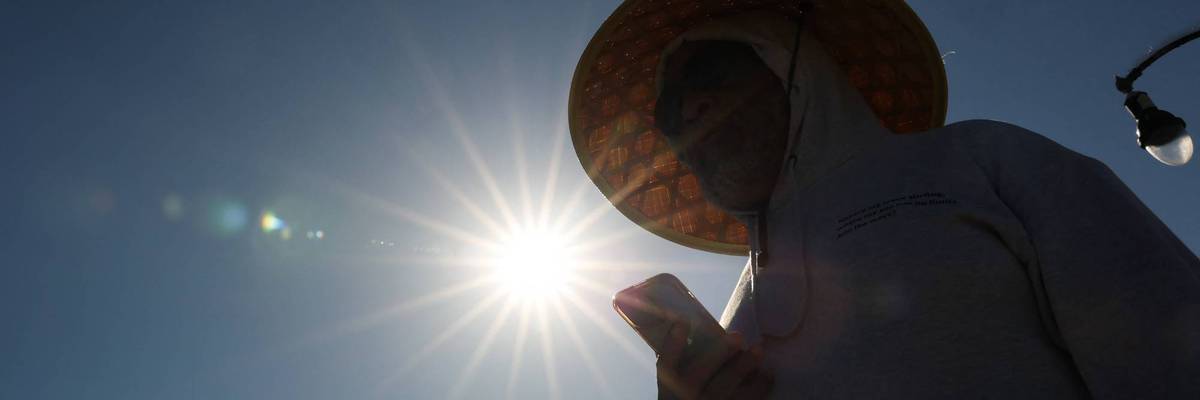
The National Oceanic and Atmospheric Administration confirmed Thursday that last month—which featured a heatwave that cooked the US West and caused a snow drought—was the hottest March in the 132-year record for the contiguous United States.
The average temperature "was 50.85°F, 9.35°F above the 20th-century average, marking the first time any month's average has exceeded 9°F above that baseline," according to NOAA's National Centers for Environmental Information. NCEI also said April 2025-March 2026 was the warmest 12-month span observed for the Lower 48 since recordkeeping began in 1895, and over half of the area had its hottest single March day on record, dating back to 1950.
"Maximum daytime temperatures were especially high, averaging 11.4°F above the March average and 0.9°F above the April long-term average," NCEI noted. "Ten states recorded their warmest March on record: Arizona, California, Colorado, Idaho, Nevada, New Mexico, Oklahoma, Texas, Utah, and Wyoming. Across all of these states, average temperatures exceeded their respective April averages, with California also eclipsing its average May temperature by 0.7°F."
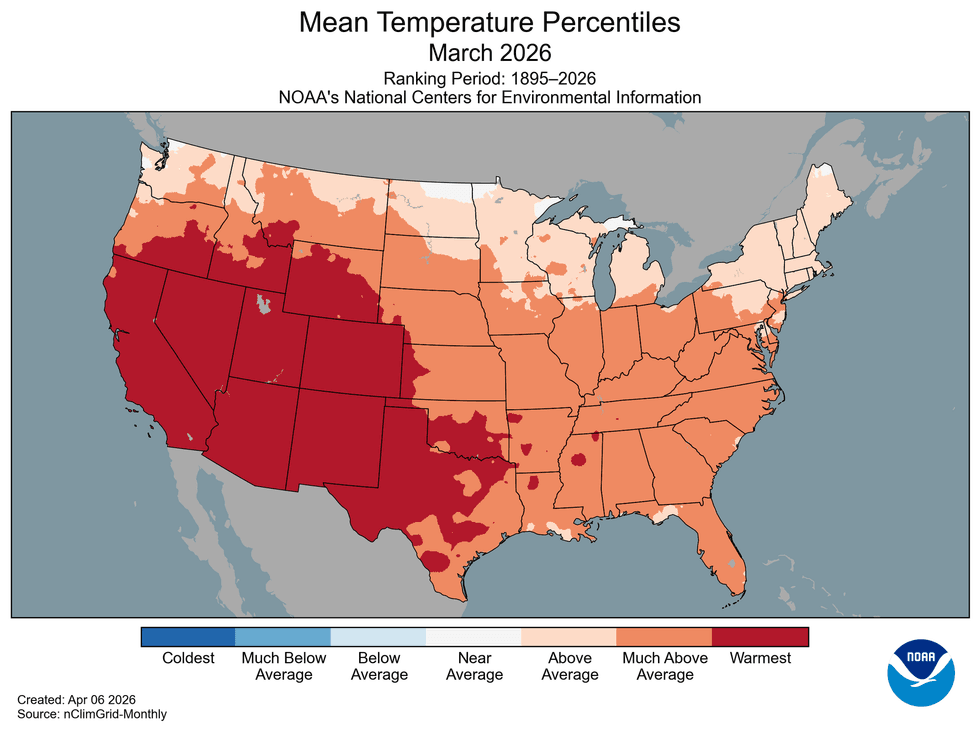 (Image by NOAA NCEI)
In a social media thread about the findings, Shel Winkley, the senior engagement specialist and meteorologist at Climate Central, stressed that "our overheating planet played a major role."
"Out of 192 cities analyzed by Climate Central, 111 experienced at least one week of heat made [more than two times] more likely by human-caused warming," he noted. "The Southwest averaged 25 out of 31 days with heat made at least two times more likely."
The "most staggering" statistic, he said, is that "on March 20, 29% of the Lower 48 saw heat made [more than five times] more likely by our warming atmosphere. Put simply: Heat that would be virtually impossible without that fingerprint."
Winkley told The Associated Press that "what we experienced in March across the United States was unprecedented," while Yale Climate Connections meteorologist Jeff Masters said that the new batch of broken records "tells us that climate change is kicking our butts."
The "January through March period was the driest on record for the contiguous US. So not only was it hot, it was record dry as well," Masters said. "And that's a bad combination for water availability, for agriculture, for river levels, for navigation."
Looking ahead, NOAA warned that "drought is expected to persist and expand across much of the interior West, Southwest, Rockies, and High Plains, as well as parts of the South, Southeast, and Mid-Atlantic... Significant wildland fire potential is above normal across portions of the Southwest, southern Plains, and central High Plains, and much of the Deep South and Southeast."
The AP also pointed out that both the US agency and Europe's Copernicus are "forecasting a 'super' strong El Niño to form in a few months and intensify into the winter. Meteorologists expect that to increase already warm temperatures across the globe, likely pushing past the hottest year mark set by 2024."
Already, as governments across the globe, including the Big Oil-backed Trump administration, refuse to take the actions that the scientific community argues are necessary to address the climate emergency—most notably, swiftly shift away from planet-warming fossil fuels—humanity is contending with deadly conditions during heatwaves.
For a study published last month in the journal Nature Communications, researchers examined heatwaves in Mecca, Saudi Arabia (2024); Bangkok, Thailand (2024); Phoenix, Arizona, the United States (2023); Mount Isa, Australia (2019); Larkana, Pakistan (2015); and Seville, Spain (2003). During each, they found spans of "nonsurvivable" conditions for people ages 65 and older in direct sun.
"My first thought was, 'Oh shit'—I really didn't expect to see that, especially when you zoom in to individual cities," Sarah Perkins-Kirkpatrick, the study's lead author and a professor at the Australian National University, told The Guardian in reporting published Wednesday. "If it's already happening now, then what does a future that is two or three degrees warmer hold?"
Sharing the report on social media, Bill McGuire, a volcanologist and emeritus professor at University College London, said, "As some of us have been saying for quite a while, dangerous climate breakdown is already here, and killing people—now, today."
The National Oceanic and Atmospheric Administration confirmed Thursday that last month—which featured a heatwave that cooked the US West and caused a snow drought—was the hottest March in the 132-year record for the contiguous United States.
The average temperature "was 50.85°F, 9.35°F above the 20th-century average, marking the first time any month's average has exceeded 9°F above that baseline," according to NOAA's National Centers for Environmental Information. NCEI also said April 2025-March 2026 was the warmest 12-month span observed for the Lower 48 since recordkeeping began in 1895, and over half of the area had its hottest single March day on record, dating back to 1950.
"Maximum daytime temperatures were especially high, averaging 11.4°F above the March average and 0.9°F above the April long-term average," NCEI noted. "Ten states recorded their warmest March on record: Arizona, California, Colorado, Idaho, Nevada, New Mexico, Oklahoma, Texas, Utah, and Wyoming. Across all of these states, average temperatures exceeded their respective April averages, with California also eclipsing its average May temperature by 0.7°F."
(Image by NOAA NCEI)
In a social media thread about the findings, Shel Winkley, the senior engagement specialist and meteorologist at Climate Central, stressed that "our overheating planet played a major role."
"Out of 192 cities analyzed by Climate Central, 111 experienced at least one week of heat made [more than two times] more likely by human-caused warming," he noted. "The Southwest averaged 25 out of 31 days with heat made at least two times more likely."
The "most staggering" statistic, he said, is that "on March 20, 29% of the Lower 48 saw heat made [more than five times] more likely by our warming atmosphere. Put simply: Heat that would be virtually impossible without that fingerprint."
Winkley told The Associated Press that "what we experienced in March across the United States was unprecedented," while Yale Climate Connections meteorologist Jeff Masters said that the new batch of broken records "tells us that climate change is kicking our butts."
The "January through March period was the driest on record for the contiguous US. So not only was it hot, it was record dry as well," Masters said. "And that's a bad combination for water availability, for agriculture, for river levels, for navigation."
Looking ahead, NOAA warned that "drought is expected to persist and expand across much of the interior West, Southwest, Rockies, and High Plains, as well as parts of the South, Southeast, and Mid-Atlantic... Significant wildland fire potential is above normal across portions of the Southwest, southern Plains, and central High Plains, and much of the Deep South and Southeast."
The AP also pointed out that both the US agency and Europe's Copernicus are "forecasting a 'super' strong El Niño to form in a few months and intensify into the winter. Meteorologists expect that to increase already warm temperatures across the globe, likely pushing past the hottest year mark set by 2024."
Already, as governments across the globe, including the Big Oil-backed Trump administration, refuse to take the actions that the scientific community argues are necessary to address the climate emergency—most notably, swiftly shift away from planet-warming fossil fuels—humanity is contending with deadly conditions during heatwaves.
For a study published last month in the journal Nature Communications, researchers examined heatwaves in Mecca, Saudi Arabia (2024); Bangkok, Thailand (2024); Phoenix, Arizona, the United States (2023); Mount Isa, Australia (2019); Larkana, Pakistan (2015); and Seville, Spain (2003). During each, they found spans of "nonsurvivable" conditions for people ages 65 and older in direct sun.
"My first thought was, 'Oh shit'—I really didn't expect to see that, especially when you zoom in to individual cities," Sarah Perkins-Kirkpatrick, the study's lead author and a professor at the Australian National University, told The Guardian in reporting published Wednesday. "If it's already happening now, then what does a future that is two or three degrees warmer hold?"
Sharing the report on social media, Bill McGuire, a volcanologist and emeritus professor at University College London, said, "As some of us have been saying for quite a while, dangerous climate breakdown is already here, and killing people—now, today."
The National Oceanic and Atmospheric Administration confirmed Thursday that last month—which featured a heatwave that cooked the US West and caused a snow drought—was the hottest March in the 132-year record for the contiguous United States.
The average temperature "was 50.85°F, 9.35°F above the 20th-century average, marking the first time any month's average has exceeded 9°F above that baseline," according to NOAA's National Centers for Environmental Information. NCEI also said April 2025-March 2026 was the warmest 12-month span observed for the Lower 48 since recordkeeping began in 1895, and over half of the area had its hottest single March day on record, dating back to 1950.
"Maximum daytime temperatures were especially high, averaging 11.4°F above the March average and 0.9°F above the April long-term average," NCEI noted. "Ten states recorded their warmest March on record: Arizona, California, Colorado, Idaho, Nevada, New Mexico, Oklahoma, Texas, Utah, and Wyoming. Across all of these states, average temperatures exceeded their respective April averages, with California also eclipsing its average May temperature by 0.7°F."
(Image by NOAA NCEI)
In a social media thread about the findings, Shel Winkley, the senior engagement specialist and meteorologist at Climate Central, stressed that "our overheating planet played a major role."
"Out of 192 cities analyzed by Climate Central, 111 experienced at least one week of heat made [more than two times] more likely by human-caused warming," he noted. "The Southwest averaged 25 out of 31 days with heat made at least two times more likely."
The "most staggering" statistic, he said, is that "on March 20, 29% of the Lower 48 saw heat made [more than five times] more likely by our warming atmosphere. Put simply: Heat that would be virtually impossible without that fingerprint."
Winkley told The Associated Press that "what we experienced in March across the United States was unprecedented," while Yale Climate Connections meteorologist Jeff Masters said that the new batch of broken records "tells us that climate change is kicking our butts."
The "January through March period was the driest on record for the contiguous US. So not only was it hot, it was record dry as well," Masters said. "And that's a bad combination for water availability, for agriculture, for river levels, for navigation."
Looking ahead, NOAA warned that "drought is expected to persist and expand across much of the interior West, Southwest, Rockies, and High Plains, as well as parts of the South, Southeast, and Mid-Atlantic... Significant wildland fire potential is above normal across portions of the Southwest, southern Plains, and central High Plains, and much of the Deep South and Southeast."
The AP also pointed out that both the US agency and Europe's Copernicus are "forecasting a 'super' strong El Niño to form in a few months and intensify into the winter. Meteorologists expect that to increase already warm temperatures across the globe, likely pushing past the hottest year mark set by 2024."
Already, as governments across the globe, including the Big Oil-backed Trump administration, refuse to take the actions that the scientific community argues are necessary to address the climate emergency—most notably, swiftly shift away from planet-warming fossil fuels—humanity is contending with deadly conditions during heatwaves.
For a study published last month in the journal Nature Communications, researchers examined heatwaves in Mecca, Saudi Arabia (2024); Bangkok, Thailand (2024); Phoenix, Arizona, the United States (2023); Mount Isa, Australia (2019); Larkana, Pakistan (2015); and Seville, Spain (2003). During each, they found spans of "nonsurvivable" conditions for people ages 65 and older in direct sun.
"My first thought was, 'Oh shit'—I really didn't expect to see that, especially when you zoom in to individual cities," Sarah Perkins-Kirkpatrick, the study's lead author and a professor at the Australian National University, told The Guardian in reporting published Wednesday. "If it's already happening now, then what does a future that is two or three degrees warmer hold?"
Sharing the report on social media, Bill McGuire, a volcanologist and emeritus professor at University College London, said, "As some of us have been saying for quite a while, dangerous climate breakdown is already here, and killing people—now, today."