SUBSCRIBE TO OUR FREE NEWSLETTER
Daily news & progressive opinion—funded by the people, not the corporations—delivered straight to your inbox.
5
#000000
#FFFFFF
To donate by check, phone, or other method, see our More Ways to Give page.
Daily news & progressive opinion—funded by the people, not the corporations—delivered straight to your inbox.
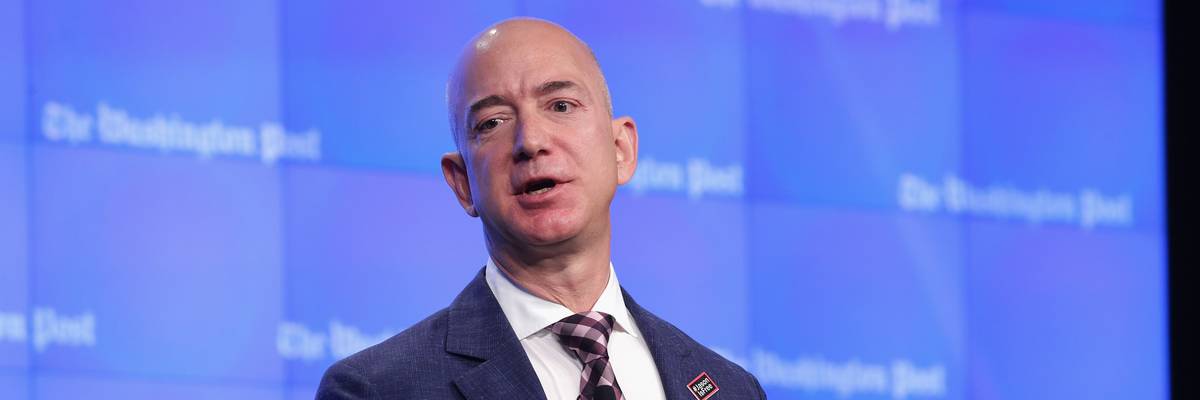
Amazon founder and Washington Post owner Jeff Bezos delivers remarks during the opening ceremony of the media company's new location January 28, 2016 in Washington, DC.
"Oligarchs are not the benevolent saviors media have long depicted them to be."
The Washington Post announced massive cuts to its newsroom staff on Wednesday, unleashing a wave of disgust directed toward its owner, billionaire Amazon founder Jeff Bezos.
As reported by Semafor reporter Maxwell Tani, Washington Post executive editor Matt Murray told staffers at the paper that it would be closing its sports department "in its current form," and would also be "killing its book section, suspending its Post Reports podcast, restructuring its metro section, and shrinking its international footprint."
With hundreds of journalists expected to lose their jobs, Murray told Post employees that the cuts were needed to help the paper "become more essential to people's lives" in "what is becoming a more crowded, competitive and complicated media landscape, and after some years when, candidly, the Post has had struggles to do that."
Many critics, however, scoffed at claims that cuts at the paper were needed to make it profitable, suggesting the real motivation came from Bezos' desire to take an ax to the US free press.
Brian Phillips, senior writer at The Ringer, rejected the notion that one of the richest men in the world couldn't afford to keep what was once a revered newspaper fully staffed.
"Bezos isn't destroying the Washington Post because it isn't profitable," he wrote in a social media post. "He's destroying the Washington Post because he's calculated that a robust free press threatens the ability of his class to warp society around their interests."
Phillips also implored other journalists to not report on the Post layoffs as "a straightforward business story," but rather "a story about coercive social transformation being imposed by people so rich they've ceased to see the rest of us as legitimate stakeholders in our own lives."
David Sirota, founder of The Lever, said the layoffs should end journalists' fantasies that billionaire owners will rescue journalism in an era of mass consolidation by corporate conglomerates, slashed newsroom budgets, and wave after wave of layoffs.
"The media world’s stunned/shocked reaction to the awful WaPo layoffs shows that even now, so many in journalism still can’t believe billionaires aren’t going to rescue them," he wrote. "This is a wake-up call: Oligarchs are not the benevolent saviors media have long depicted them to be."
Adam Serwer of the Atlantic also raised concerns about the power of wealthy oligarchs to buy and destroy historic media institutions.
"I personally do not think some rich man should be able to buy an institution like this like a toy and then break it when he doesn’t want to play with it anymore," he wrote. "Bezos fucked the paper and instead of fixing it he’s destroying it despite the fact that he could spend the money to make things right without even noticing its absence."
Jonathan Cohn, political director for Progressive Mass, noted that the Post isn't the only media organization that's being gutted by a billionaire owner, referencing billionaire Larry Ellison, a major donor to President Donald Trump, who recently acquired CBS News alongside other media properties.
"What we are seeing with WaPo and with CBS News is that the mega-rich see real financial value for themselves in destroying journalism," he wrote. "Let that sink in."
Sen. Bernie Sanders (I-Vt.), in a post written before the Post layoffs were announced, drew attention to billionaire control over not just traditional media, but social media as well.
"When we talk about authoritarianism, it’s not just Donald Trump," wrote Sanders. "[Elon] Musk owns X. Bezos owns Twitch. [Mark] Zuckerberg owns Instagram and Facebook. Larry Ellison controls TikTok. Billionaires increasingly control what we see, hear and read."
This country and this world are at a monumental crossroads. US voters have an opportunity to beat back the forces of fascism and confront the billionaires who are rigging the economy, our media system, and our democracy, making it increasingly impossible for ordinary people to get by. We’re not just talking about the election. We’re talking about what must be done once these fascist elements are vanquished from power. We need a bolder set of solutions than what either major party has so far been willing to offer and a working-class movement ready to fight like hell for it. Trump didn't emerge from nowhere. The conditions that fueled MAGA authoritarianism were created by decades of radical neoliberal economic policies and a corrupt political system dominated by corporate interests. They slashed taxes on the super-rich, promising that the benefits would trickle down. They said giveaways to the corporate titans would make life more affordable for the rest of us. It was all bullshit. And when a bitter, betrayed populace searches for someone to blame, right-wing demagogues have little trouble finding scapegoats. People know when they're being lied to, but you won't hear any of this from the corporate media. Only independent journalism—powered and funded by people who believe in building a better world—can deliver truly trustworthy daily news. If you share our vision, please contribute whatever you can to sustain our work. |
The Washington Post announced massive cuts to its newsroom staff on Wednesday, unleashing a wave of disgust directed toward its owner, billionaire Amazon founder Jeff Bezos.
As reported by Semafor reporter Maxwell Tani, Washington Post executive editor Matt Murray told staffers at the paper that it would be closing its sports department "in its current form," and would also be "killing its book section, suspending its Post Reports podcast, restructuring its metro section, and shrinking its international footprint."
With hundreds of journalists expected to lose their jobs, Murray told Post employees that the cuts were needed to help the paper "become more essential to people's lives" in "what is becoming a more crowded, competitive and complicated media landscape, and after some years when, candidly, the Post has had struggles to do that."
Many critics, however, scoffed at claims that cuts at the paper were needed to make it profitable, suggesting the real motivation came from Bezos' desire to take an ax to the US free press.
Brian Phillips, senior writer at The Ringer, rejected the notion that one of the richest men in the world couldn't afford to keep what was once a revered newspaper fully staffed.
"Bezos isn't destroying the Washington Post because it isn't profitable," he wrote in a social media post. "He's destroying the Washington Post because he's calculated that a robust free press threatens the ability of his class to warp society around their interests."
Phillips also implored other journalists to not report on the Post layoffs as "a straightforward business story," but rather "a story about coercive social transformation being imposed by people so rich they've ceased to see the rest of us as legitimate stakeholders in our own lives."
David Sirota, founder of The Lever, said the layoffs should end journalists' fantasies that billionaire owners will rescue journalism in an era of mass consolidation by corporate conglomerates, slashed newsroom budgets, and wave after wave of layoffs.
"The media world’s stunned/shocked reaction to the awful WaPo layoffs shows that even now, so many in journalism still can’t believe billionaires aren’t going to rescue them," he wrote. "This is a wake-up call: Oligarchs are not the benevolent saviors media have long depicted them to be."
Adam Serwer of the Atlantic also raised concerns about the power of wealthy oligarchs to buy and destroy historic media institutions.
"I personally do not think some rich man should be able to buy an institution like this like a toy and then break it when he doesn’t want to play with it anymore," he wrote. "Bezos fucked the paper and instead of fixing it he’s destroying it despite the fact that he could spend the money to make things right without even noticing its absence."
Jonathan Cohn, political director for Progressive Mass, noted that the Post isn't the only media organization that's being gutted by a billionaire owner, referencing billionaire Larry Ellison, a major donor to President Donald Trump, who recently acquired CBS News alongside other media properties.
"What we are seeing with WaPo and with CBS News is that the mega-rich see real financial value for themselves in destroying journalism," he wrote. "Let that sink in."
Sen. Bernie Sanders (I-Vt.), in a post written before the Post layoffs were announced, drew attention to billionaire control over not just traditional media, but social media as well.
"When we talk about authoritarianism, it’s not just Donald Trump," wrote Sanders. "[Elon] Musk owns X. Bezos owns Twitch. [Mark] Zuckerberg owns Instagram and Facebook. Larry Ellison controls TikTok. Billionaires increasingly control what we see, hear and read."