SUBSCRIBE TO OUR FREE NEWSLETTER
Daily news & progressive opinion—funded by the people, not the corporations—delivered straight to your inbox.
5
#000000
#FFFFFF
To donate by check, phone, or other method, see our More Ways to Give page.
Daily news & progressive opinion—funded by the people, not the corporations—delivered straight to your inbox.
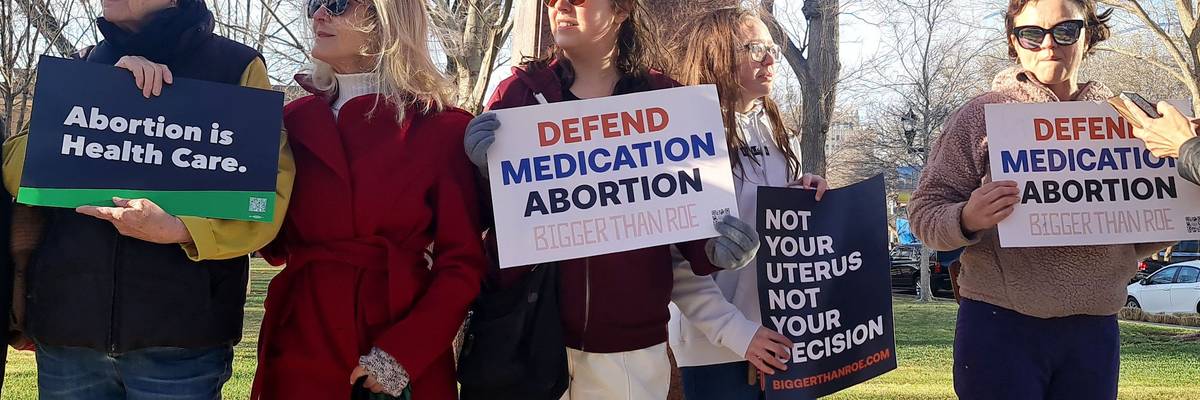
Abortion rights advocates gather in front of a courthouse in Amarillo, Texas.
"We shouldn't even be here," said one advocate. "This case should have been thrown out way before it got to the Supreme Court."
In its first major abortion decision since reversing Roe v. Wade last year, the U.S. Supreme Court on Friday granted the Biden administration's request to continue allowing widespread access to the medication mifepristone while a legal battle plays out.
"This is very welcome news, but it's frightening to think that Americans came within hours of losing access to a medication that is used in most abortions in this country and has been used for decades by millions of people to safely end a pregnancy or treat a miscarriage," said Jennifer Dalven, director of the ACLU's Reproductive Freedom Project, in response to the order. "Patients shouldn't have to monitor Twitter to see whether they can get the care they need."
"Make no mistake, we aren't out of the woods by any means," Dalven stressed. "This case, which should have been laughed out of court from the very start, will continue on. And as this baseless lawsuit shows, extremists will use every trick in the book to try to ban abortion nationwide."
Nancy Northup, president and CEO of the Center for Reproductive Rights, similarly declared that the decision "is a huge relief, but we're not out of the woods yet."
"For now, providers and patients have the assurance that mifepristone is available" and approved by the Food and Drug Administration (FDA), Northup said. "But we shouldn't even be here. This case should have been thrown out way before it got to the Supreme Court."
President Joe Biden also welcomed that the Supreme Court granted the emergency stay requested by the U.S. Department of Justice (DOJ) in Alliance for Hippocratic Medicine v. FDA, and vowed that his administration will "continue this fight in the courts."
The high court's order halts a decision from Texas-based U.S. District Judge Matthew Kacsmaryk, an appointee of former President Donald Trump who earlier this month ruled against the FDA's 2000 approval of mifepristone, in response to a lawsuit brought by right-wing activists ultimately aiming to end abortion care nationwide.
The 5th Circuit Court of Appeals then partially blocked Kacsmaryk's ruling, preserving access to mifepristone—which is often taken in tandem with misoprostol for medication abortions—but reinstating rules that it cannot be dispensed by mail and only can be used up to seven weeks of pregnancy rather than 10.
Justice Samuel Alito temporarily put the 5th Circuit ruling on hold until Wednesday, then extended the deadline by two days. On Friday, he and fellow right-winger Justice Clarence Thomas dissented. While Thomas did not explain his position, Alito wrote in part that allowing the appeals court's decision to take effect while the broader legal fight continues "would simply restore the circumstances that existed (and that the government defended) from 2000 to 2016 under three presidential administrations."
As Alio noted, oral arguments before a three-judge panel from the 5th Circuit are scheduled for mid-May—and, like arguments before Kacsmaryk in March, might feature right-wing attorneys trying to revive a 19th-century obscenity law known as the Comstock Act.
"If it were just up to the science, this case would be thrown out," Dr. Daniel Grossman—an OB-GYN who directs the research program Advancing New Standards in Reproductive Health at the University of California, San Francisco—told The Washington Post earlier this month. "We have over two decades of science showing how safe this is."
The Guttmacher Institute tweeted Friday morning: "Remember, we should not be here in the first place. This case is about politics, not the law or facts. Mifepristone is safe, effective, and should be available to everyone seeking medication abortion care."
While some patients and providers already rely on only misoprostol for abortions, using it alone is less effective than pairing the two medications, so "banning mifepristone could mean more money spent, more mental anguish over lingering symptoms of an unwanted pregnancy, and more time spent arranging treatment and figuring out how to step away from work or family responsibilities," Slate noted. "For people who live in states that restrict abortion, it could mean a second trip across state lines."
"It will also mean more pain and suffering," Slate warned, explaining that "because it takes much more misoprostol to terminate a pregnancy without the assistance of mifepristone—three doses of four tablets, left to dissolve in the mouth, rather than a single dose of four—the physical toll can be harsher," with patients reporting "a higher prevalence of diarrhea, fever, and chills."
The current legal battle over mifepristone comes as states controlled by anti-choice Republican legislators and governors continue to roll back abortion rights in the wake of the U.S. Supreme Court's right-wing justices reversing Roe last June with their Alito-authored majority decision in Dobbs v. Jackson Women's Health Organization.
In a dozen states—Alabama, Arkansas, Idaho, Kentucky, Louisiana, Mississippi, Missouri, South Dakota, Tennessee, Texas, Oklahoma, and West Virginia—abortion "is completely banned with very limited exceptions," according to the Guttmacher Institute's online tracker.
Guttmacher characterizes policies in another 14 states as "restrictive" or "very restrictive." One of them is Florida, where Republican Gov. Ron DeSantis, a presumed 2024 presidential contender, last week signed a six-week abortion ban that will take effect if the state Supreme Court upholds an earlier 15-week ban.
Stand Up America managing director for communications Monica Garcia on Friday tied the mifepristone fight to Dobbs, saying that the high court's decision "to overturn Roe v. Wade opened the door for partisan hacks like Judge Kacsmaryk to attack abortion access in the first place."
"If Kascmaryk's ban is allowed to stand, it will have devastating consequences for millions of Americans who rely on mifepristone for abortion care," Garcia said. "We cannot allow the right-wing justices on the court to continue to erode our fundamental freedoms until we no longer recognize the country we live in. Congress has the power to restore balance to this hyperpartisan Supreme Court by expanding the court, and they should use it."
Brett Wilkins contributed to this reporting.
Dear Common Dreams reader, It’s been nearly 30 years since I co-founded Common Dreams with my late wife, Lina Newhouser. We had the radical notion that journalism should serve the public good, not corporate profits. It was clear to us from the outset what it would take to build such a project. No paid advertisements. No corporate sponsors. No millionaire publisher telling us what to think or do. Many people said we wouldn't last a year, but we proved those doubters wrong. Together with a tremendous team of journalists and dedicated staff, we built an independent media outlet free from the constraints of profits and corporate control. Our mission has always been simple: To inform. To inspire. To ignite change for the common good. Building Common Dreams was not easy. Our survival was never guaranteed. When you take on the most powerful forces—Wall Street greed, fossil fuel industry destruction, Big Tech lobbyists, and uber-rich oligarchs who have spent billions upon billions rigging the economy and democracy in their favor—the only bulwark you have is supporters who believe in your work. But here’s the urgent message from me today. It's never been this bad out there. And it's never been this hard to keep us going. At the very moment Common Dreams is most needed, the threats we face are intensifying. We need your support now more than ever. We don't accept corporate advertising and never will. We don't have a paywall because we don't think people should be blocked from critical news based on their ability to pay. Everything we do is funded by the donations of readers like you. When everyone does the little they can afford, we are strong. But if that support retreats or dries up, so do we. Will you donate now to make sure Common Dreams not only survives but thrives? —Craig Brown, Co-founder |
In its first major abortion decision since reversing Roe v. Wade last year, the U.S. Supreme Court on Friday granted the Biden administration's request to continue allowing widespread access to the medication mifepristone while a legal battle plays out.
"This is very welcome news, but it's frightening to think that Americans came within hours of losing access to a medication that is used in most abortions in this country and has been used for decades by millions of people to safely end a pregnancy or treat a miscarriage," said Jennifer Dalven, director of the ACLU's Reproductive Freedom Project, in response to the order. "Patients shouldn't have to monitor Twitter to see whether they can get the care they need."
"Make no mistake, we aren't out of the woods by any means," Dalven stressed. "This case, which should have been laughed out of court from the very start, will continue on. And as this baseless lawsuit shows, extremists will use every trick in the book to try to ban abortion nationwide."
Nancy Northup, president and CEO of the Center for Reproductive Rights, similarly declared that the decision "is a huge relief, but we're not out of the woods yet."
"For now, providers and patients have the assurance that mifepristone is available" and approved by the Food and Drug Administration (FDA), Northup said. "But we shouldn't even be here. This case should have been thrown out way before it got to the Supreme Court."
President Joe Biden also welcomed that the Supreme Court granted the emergency stay requested by the U.S. Department of Justice (DOJ) in Alliance for Hippocratic Medicine v. FDA, and vowed that his administration will "continue this fight in the courts."
The high court's order halts a decision from Texas-based U.S. District Judge Matthew Kacsmaryk, an appointee of former President Donald Trump who earlier this month ruled against the FDA's 2000 approval of mifepristone, in response to a lawsuit brought by right-wing activists ultimately aiming to end abortion care nationwide.
The 5th Circuit Court of Appeals then partially blocked Kacsmaryk's ruling, preserving access to mifepristone—which is often taken in tandem with misoprostol for medication abortions—but reinstating rules that it cannot be dispensed by mail and only can be used up to seven weeks of pregnancy rather than 10.
Justice Samuel Alito temporarily put the 5th Circuit ruling on hold until Wednesday, then extended the deadline by two days. On Friday, he and fellow right-winger Justice Clarence Thomas dissented. While Thomas did not explain his position, Alito wrote in part that allowing the appeals court's decision to take effect while the broader legal fight continues "would simply restore the circumstances that existed (and that the government defended) from 2000 to 2016 under three presidential administrations."
As Alio noted, oral arguments before a three-judge panel from the 5th Circuit are scheduled for mid-May—and, like arguments before Kacsmaryk in March, might feature right-wing attorneys trying to revive a 19th-century obscenity law known as the Comstock Act.
"If it were just up to the science, this case would be thrown out," Dr. Daniel Grossman—an OB-GYN who directs the research program Advancing New Standards in Reproductive Health at the University of California, San Francisco—told The Washington Post earlier this month. "We have over two decades of science showing how safe this is."
The Guttmacher Institute tweeted Friday morning: "Remember, we should not be here in the first place. This case is about politics, not the law or facts. Mifepristone is safe, effective, and should be available to everyone seeking medication abortion care."
While some patients and providers already rely on only misoprostol for abortions, using it alone is less effective than pairing the two medications, so "banning mifepristone could mean more money spent, more mental anguish over lingering symptoms of an unwanted pregnancy, and more time spent arranging treatment and figuring out how to step away from work or family responsibilities," Slate noted. "For people who live in states that restrict abortion, it could mean a second trip across state lines."
"It will also mean more pain and suffering," Slate warned, explaining that "because it takes much more misoprostol to terminate a pregnancy without the assistance of mifepristone—three doses of four tablets, left to dissolve in the mouth, rather than a single dose of four—the physical toll can be harsher," with patients reporting "a higher prevalence of diarrhea, fever, and chills."
The current legal battle over mifepristone comes as states controlled by anti-choice Republican legislators and governors continue to roll back abortion rights in the wake of the U.S. Supreme Court's right-wing justices reversing Roe last June with their Alito-authored majority decision in Dobbs v. Jackson Women's Health Organization.
In a dozen states—Alabama, Arkansas, Idaho, Kentucky, Louisiana, Mississippi, Missouri, South Dakota, Tennessee, Texas, Oklahoma, and West Virginia—abortion "is completely banned with very limited exceptions," according to the Guttmacher Institute's online tracker.
Guttmacher characterizes policies in another 14 states as "restrictive" or "very restrictive." One of them is Florida, where Republican Gov. Ron DeSantis, a presumed 2024 presidential contender, last week signed a six-week abortion ban that will take effect if the state Supreme Court upholds an earlier 15-week ban.
Stand Up America managing director for communications Monica Garcia on Friday tied the mifepristone fight to Dobbs, saying that the high court's decision "to overturn Roe v. Wade opened the door for partisan hacks like Judge Kacsmaryk to attack abortion access in the first place."
"If Kascmaryk's ban is allowed to stand, it will have devastating consequences for millions of Americans who rely on mifepristone for abortion care," Garcia said. "We cannot allow the right-wing justices on the court to continue to erode our fundamental freedoms until we no longer recognize the country we live in. Congress has the power to restore balance to this hyperpartisan Supreme Court by expanding the court, and they should use it."
Brett Wilkins contributed to this reporting.
In its first major abortion decision since reversing Roe v. Wade last year, the U.S. Supreme Court on Friday granted the Biden administration's request to continue allowing widespread access to the medication mifepristone while a legal battle plays out.
"This is very welcome news, but it's frightening to think that Americans came within hours of losing access to a medication that is used in most abortions in this country and has been used for decades by millions of people to safely end a pregnancy or treat a miscarriage," said Jennifer Dalven, director of the ACLU's Reproductive Freedom Project, in response to the order. "Patients shouldn't have to monitor Twitter to see whether they can get the care they need."
"Make no mistake, we aren't out of the woods by any means," Dalven stressed. "This case, which should have been laughed out of court from the very start, will continue on. And as this baseless lawsuit shows, extremists will use every trick in the book to try to ban abortion nationwide."
Nancy Northup, president and CEO of the Center for Reproductive Rights, similarly declared that the decision "is a huge relief, but we're not out of the woods yet."
"For now, providers and patients have the assurance that mifepristone is available" and approved by the Food and Drug Administration (FDA), Northup said. "But we shouldn't even be here. This case should have been thrown out way before it got to the Supreme Court."
President Joe Biden also welcomed that the Supreme Court granted the emergency stay requested by the U.S. Department of Justice (DOJ) in Alliance for Hippocratic Medicine v. FDA, and vowed that his administration will "continue this fight in the courts."
The high court's order halts a decision from Texas-based U.S. District Judge Matthew Kacsmaryk, an appointee of former President Donald Trump who earlier this month ruled against the FDA's 2000 approval of mifepristone, in response to a lawsuit brought by right-wing activists ultimately aiming to end abortion care nationwide.
The 5th Circuit Court of Appeals then partially blocked Kacsmaryk's ruling, preserving access to mifepristone—which is often taken in tandem with misoprostol for medication abortions—but reinstating rules that it cannot be dispensed by mail and only can be used up to seven weeks of pregnancy rather than 10.
Justice Samuel Alito temporarily put the 5th Circuit ruling on hold until Wednesday, then extended the deadline by two days. On Friday, he and fellow right-winger Justice Clarence Thomas dissented. While Thomas did not explain his position, Alito wrote in part that allowing the appeals court's decision to take effect while the broader legal fight continues "would simply restore the circumstances that existed (and that the government defended) from 2000 to 2016 under three presidential administrations."
As Alio noted, oral arguments before a three-judge panel from the 5th Circuit are scheduled for mid-May—and, like arguments before Kacsmaryk in March, might feature right-wing attorneys trying to revive a 19th-century obscenity law known as the Comstock Act.
"If it were just up to the science, this case would be thrown out," Dr. Daniel Grossman—an OB-GYN who directs the research program Advancing New Standards in Reproductive Health at the University of California, San Francisco—told The Washington Post earlier this month. "We have over two decades of science showing how safe this is."
The Guttmacher Institute tweeted Friday morning: "Remember, we should not be here in the first place. This case is about politics, not the law or facts. Mifepristone is safe, effective, and should be available to everyone seeking medication abortion care."
While some patients and providers already rely on only misoprostol for abortions, using it alone is less effective than pairing the two medications, so "banning mifepristone could mean more money spent, more mental anguish over lingering symptoms of an unwanted pregnancy, and more time spent arranging treatment and figuring out how to step away from work or family responsibilities," Slate noted. "For people who live in states that restrict abortion, it could mean a second trip across state lines."
"It will also mean more pain and suffering," Slate warned, explaining that "because it takes much more misoprostol to terminate a pregnancy without the assistance of mifepristone—three doses of four tablets, left to dissolve in the mouth, rather than a single dose of four—the physical toll can be harsher," with patients reporting "a higher prevalence of diarrhea, fever, and chills."
The current legal battle over mifepristone comes as states controlled by anti-choice Republican legislators and governors continue to roll back abortion rights in the wake of the U.S. Supreme Court's right-wing justices reversing Roe last June with their Alito-authored majority decision in Dobbs v. Jackson Women's Health Organization.
In a dozen states—Alabama, Arkansas, Idaho, Kentucky, Louisiana, Mississippi, Missouri, South Dakota, Tennessee, Texas, Oklahoma, and West Virginia—abortion "is completely banned with very limited exceptions," according to the Guttmacher Institute's online tracker.
Guttmacher characterizes policies in another 14 states as "restrictive" or "very restrictive." One of them is Florida, where Republican Gov. Ron DeSantis, a presumed 2024 presidential contender, last week signed a six-week abortion ban that will take effect if the state Supreme Court upholds an earlier 15-week ban.
Stand Up America managing director for communications Monica Garcia on Friday tied the mifepristone fight to Dobbs, saying that the high court's decision "to overturn Roe v. Wade opened the door for partisan hacks like Judge Kacsmaryk to attack abortion access in the first place."
"If Kascmaryk's ban is allowed to stand, it will have devastating consequences for millions of Americans who rely on mifepristone for abortion care," Garcia said. "We cannot allow the right-wing justices on the court to continue to erode our fundamental freedoms until we no longer recognize the country we live in. Congress has the power to restore balance to this hyperpartisan Supreme Court by expanding the court, and they should use it."
Brett Wilkins contributed to this reporting.