

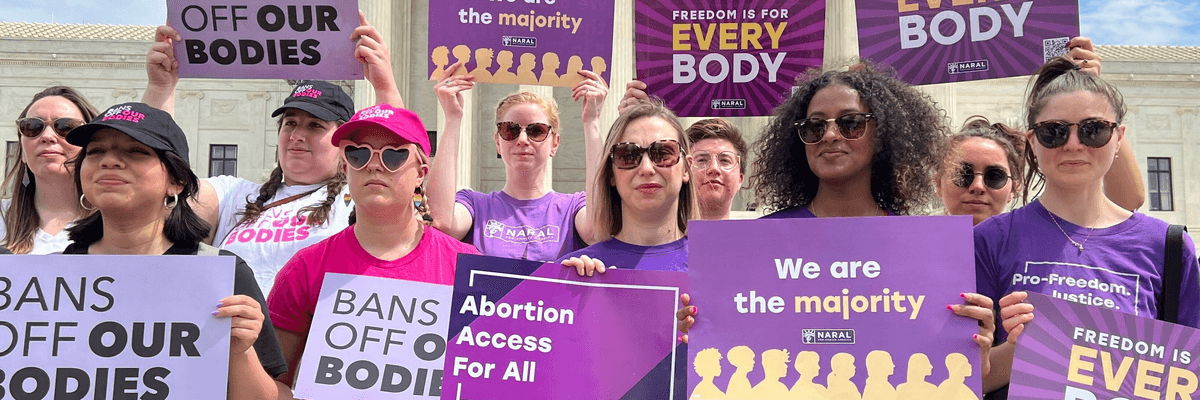
NARAL abortion rights activists pose for a photo outside the U.S. Supreme Court in Washington, D.C. on April 14, 2023.
Advocates Warn Abortion Pill Access Still at 'Severe Risk' Despite Supreme Court Reprieve
"This stay is the bare minimum," said one reproductive rights campaigner. "The imminent threat to access to mifepristone and abortion care remains."
"Mifepristone remains safe, effective, and AVAILABLE."
However, access to medication abortion remains at "severe risk." That was the message Friday from reproductive rights advocates after the United States Supreme Court temporarily blocked a ruling by a Texas federal judge that would effectively end access to abortion pills.
Justice Samuel Alitoissued a short order on the high court's "shadow docket" staying until next Wednesday last week's decision by U.S. 5th Circuit Judge Matthew Kacsmaryk, an appointee of former President Donald Trump who ruled that the U.S. Food and Drug Administration's 2000 approval of mifepristone—one of two drugs typically used in tandem to induce abortion—was illegal.
Alito, who wrote the majority opinion in Dobbs v. Jackson Women's Health Organization—the ruling that canceled half a century of federal abortion rights—is assigned to the 5th U.S. Circuit Court of Appeals.
"While medication abortion remains accessible for now, this case should never have been heard in the first place," NARAL Pro-Choice America president Minni Timmaraju said in a statement. "Nothing about the rulings from the lower courts' Trump-appointed judges had any basis in medical science–both are steeped in reckless disinformation and total disregard for the law. As this case continues, safe and effective medication abortion in all 50 states is at severe risk."
Jenny Ma, senior counsel at the Center for Reproductive Rights, said Friday that "mifepristone will remain available as it has for the last 23 years, for at least five more days."
"This week has created whiplash for healthcare providers and patients—and this order provides cold comfort for a brief few days," Ma added. "But this case is far from over. The Supreme Court must take action next week to stop the chaos unleashed by these extreme decisions."
On Wednesday, a three-judge panel of the 5th Circuit Court temporarily blocked the part of Kacsmaryk's ruling that would have invalidated the FDA's approval of mifepristone. Nancy Northup, president and CEO of the Center for Reproductive Rights, called Wednesday's ruling "a wolf in sheep's clothing."
"The court rightly found that some claims were filed too late," Northup added, "but that should not distract from the radical assault on the FDA's decision-making authority and the fact that it will wreak havoc on the provision of medication abortion if it stands."
The full Supreme Court next week is expected to consider granting a longer stay of Kacsmaryk's decision.
According to the Center for Reproductive Rights, healthcare providers "have been thrown into chaos repeatedly this week, with the accessibility of mifepristone volleying between two federal district courts and a circuit court."
After Friday's stay, NARAL Pro-Choice America asserted:
The people hurt most by these bans and restrictions are those who already face barriers to accessing abortion care—including women; Black, Latina/x, Asian American, Native Hawaiian, Pacific Islander, and Indigenous people; those working to make ends meet; the LGBTQ+ community; immigrants; young people; those living in rural communities; people with disabilities, and other historically oppressed communities.
Rachel O'Leary Carmona, executive director at Women's March, said in a statement that "had the Supreme Court refused to act today, the restrictions imposed by the 5th Circuit would have taken effect across the nation. This stay is the bare minimum. The imminent threat to access to mifepristone and abortion care remains."
"Mifepristone has been safe and effective and proven that way for more than 20 years," O'Leary Carmona continued. "There is no doubt about the FDA's authority to regulate it, or that the drug helps save lives."
"This case should be a clarion call to defenders of democracy to take action," she asserted. "If we don't act now, our courts and democracy itself will be eroded beyond repair."
"That's why Women's March is turning out in D.C. and cities across the country this weekend," she added, referring to nationwide protests planned for Saturday. "Together, we can protect the right to safe, legal abortion care and ensure that everyone has the freedom to make decisions about their own bodies and lives."
We are at a crossroads
This country and this world are at a monumental crossroads. In a few short weeks, US voters will have an opportunity to beat back the forces of fascism and confront the billionaires who are rigging the economy, our media system, and our democracy, making it increasingly impossible for ordinary people to get by. We’re not just talking about the election. We’re talking about what must be done once these fascist elements are vanquished from power. We need a bolder set of solutions than what either major party has so far been willing to offer and a working-class movement ready to fight like hell for it. Trump didn't emerge from nowhere. The conditions that fueled MAGA authoritarianism were created by decades of radical neoliberal economic policies and a corrupt political system dominated by corporate interests. They slashed taxes on the super-rich, promising that the benefits would trickle down. They said giveaways to the corporate titans would make life more affordable for the rest of us. It was all bullshit. And when a bitter, betrayed populace searches for someone to blame, right-wing demagogues have little trouble finding scapegoats. People know when they're being lied to, but you won't hear any of this from the corporate media. Only independent journalism—powered and funded by people who believe in building a better world—can deliver truly trustworthy daily news. Our Fall Campaign is underway, and we need your help. To power our newsroom through the rest of the year, we need to raise $125,000 by midnight on October 31. So if you share our vision, please contribute whatever you can to sustain our work. |
"Mifepristone remains safe, effective, and AVAILABLE."
However, access to medication abortion remains at "severe risk." That was the message Friday from reproductive rights advocates after the United States Supreme Court temporarily blocked a ruling by a Texas federal judge that would effectively end access to abortion pills.
Justice Samuel Alitoissued a short order on the high court's "shadow docket" staying until next Wednesday last week's decision by U.S. 5th Circuit Judge Matthew Kacsmaryk, an appointee of former President Donald Trump who ruled that the U.S. Food and Drug Administration's 2000 approval of mifepristone—one of two drugs typically used in tandem to induce abortion—was illegal.
Alito, who wrote the majority opinion in Dobbs v. Jackson Women's Health Organization—the ruling that canceled half a century of federal abortion rights—is assigned to the 5th U.S. Circuit Court of Appeals.
"While medication abortion remains accessible for now, this case should never have been heard in the first place," NARAL Pro-Choice America president Minni Timmaraju said in a statement. "Nothing about the rulings from the lower courts' Trump-appointed judges had any basis in medical science–both are steeped in reckless disinformation and total disregard for the law. As this case continues, safe and effective medication abortion in all 50 states is at severe risk."
Jenny Ma, senior counsel at the Center for Reproductive Rights, said Friday that "mifepristone will remain available as it has for the last 23 years, for at least five more days."
"This week has created whiplash for healthcare providers and patients—and this order provides cold comfort for a brief few days," Ma added. "But this case is far from over. The Supreme Court must take action next week to stop the chaos unleashed by these extreme decisions."
On Wednesday, a three-judge panel of the 5th Circuit Court temporarily blocked the part of Kacsmaryk's ruling that would have invalidated the FDA's approval of mifepristone. Nancy Northup, president and CEO of the Center for Reproductive Rights, called Wednesday's ruling "a wolf in sheep's clothing."
"The court rightly found that some claims were filed too late," Northup added, "but that should not distract from the radical assault on the FDA's decision-making authority and the fact that it will wreak havoc on the provision of medication abortion if it stands."
The full Supreme Court next week is expected to consider granting a longer stay of Kacsmaryk's decision.
According to the Center for Reproductive Rights, healthcare providers "have been thrown into chaos repeatedly this week, with the accessibility of mifepristone volleying between two federal district courts and a circuit court."
After Friday's stay, NARAL Pro-Choice America asserted:
The people hurt most by these bans and restrictions are those who already face barriers to accessing abortion care—including women; Black, Latina/x, Asian American, Native Hawaiian, Pacific Islander, and Indigenous people; those working to make ends meet; the LGBTQ+ community; immigrants; young people; those living in rural communities; people with disabilities, and other historically oppressed communities.
Rachel O'Leary Carmona, executive director at Women's March, said in a statement that "had the Supreme Court refused to act today, the restrictions imposed by the 5th Circuit would have taken effect across the nation. This stay is the bare minimum. The imminent threat to access to mifepristone and abortion care remains."
"Mifepristone has been safe and effective and proven that way for more than 20 years," O'Leary Carmona continued. "There is no doubt about the FDA's authority to regulate it, or that the drug helps save lives."
"This case should be a clarion call to defenders of democracy to take action," she asserted. "If we don't act now, our courts and democracy itself will be eroded beyond repair."
"That's why Women's March is turning out in D.C. and cities across the country this weekend," she added, referring to nationwide protests planned for Saturday. "Together, we can protect the right to safe, legal abortion care and ensure that everyone has the freedom to make decisions about their own bodies and lives."
- 'A Wolf in Sheep's Clothing': Experts Sound Alarm Over 5th Circuit Abortion Pill Ruling ›
- Trump-Appointed Appeals Court Judges Allow Abortion Pill Limits to Take Effect ›
- AOC Warns of 'National Abortion Ban' if Supreme Court Upholds Mifepristone Ruling ›
- Will the US Supreme Court Follow the Law in Mifepristone? ›
- 'Not Out of the Woods Yet': Supreme Court Maintains Abortion Pill Access—For Now ›
- SCOTUS Agrees to Hear Case That Could Limit Abortion Pill Access ›
- Post-Dobbs Abortion Pill Surge Highlights Stakes of Looming Supreme Court Case ›
- Opinion | Over-the-Counter Birth Control a Step Forward, But What About the Abortion Pill? | Common Dreams ›
- Abortion Defenders Decry 'Baseless' Attack on Mifepristone as SCOTUS Hears Case ›
- Rights Defenders 'Relieved' But 'Not Celebrating' Supreme Court Abortion Pill Ruling | Common Dreams ›
- Opinion | Abortion Pill Ruling Nothing to Celebrate When GOP Attack on Women Is Only Just Beginning | Common Dreams ›
- On Dobbs Anniversary, Advocates Mark 'Two Years of Outrage' and Rally for Abortion Rights | Common Dreams ›
- Opinion | Awaiting Justice: Why Community Action Matters More Than Court Decisions | Common Dreams ›
- Opinion | Abortion Pills Aren't Uncomfortable; Censorship Is | Common Dreams ›
- Mifepristone Maker Appeals to US Supreme Court Amid Fears of 'National Abortion Ban' | Common Dreams ›
"Mifepristone remains safe, effective, and AVAILABLE."
However, access to medication abortion remains at "severe risk." That was the message Friday from reproductive rights advocates after the United States Supreme Court temporarily blocked a ruling by a Texas federal judge that would effectively end access to abortion pills.
Justice Samuel Alitoissued a short order on the high court's "shadow docket" staying until next Wednesday last week's decision by U.S. 5th Circuit Judge Matthew Kacsmaryk, an appointee of former President Donald Trump who ruled that the U.S. Food and Drug Administration's 2000 approval of mifepristone—one of two drugs typically used in tandem to induce abortion—was illegal.
Alito, who wrote the majority opinion in Dobbs v. Jackson Women's Health Organization—the ruling that canceled half a century of federal abortion rights—is assigned to the 5th U.S. Circuit Court of Appeals.
"While medication abortion remains accessible for now, this case should never have been heard in the first place," NARAL Pro-Choice America president Minni Timmaraju said in a statement. "Nothing about the rulings from the lower courts' Trump-appointed judges had any basis in medical science–both are steeped in reckless disinformation and total disregard for the law. As this case continues, safe and effective medication abortion in all 50 states is at severe risk."
Jenny Ma, senior counsel at the Center for Reproductive Rights, said Friday that "mifepristone will remain available as it has for the last 23 years, for at least five more days."
"This week has created whiplash for healthcare providers and patients—and this order provides cold comfort for a brief few days," Ma added. "But this case is far from over. The Supreme Court must take action next week to stop the chaos unleashed by these extreme decisions."
On Wednesday, a three-judge panel of the 5th Circuit Court temporarily blocked the part of Kacsmaryk's ruling that would have invalidated the FDA's approval of mifepristone. Nancy Northup, president and CEO of the Center for Reproductive Rights, called Wednesday's ruling "a wolf in sheep's clothing."
"The court rightly found that some claims were filed too late," Northup added, "but that should not distract from the radical assault on the FDA's decision-making authority and the fact that it will wreak havoc on the provision of medication abortion if it stands."
The full Supreme Court next week is expected to consider granting a longer stay of Kacsmaryk's decision.
According to the Center for Reproductive Rights, healthcare providers "have been thrown into chaos repeatedly this week, with the accessibility of mifepristone volleying between two federal district courts and a circuit court."
After Friday's stay, NARAL Pro-Choice America asserted:
The people hurt most by these bans and restrictions are those who already face barriers to accessing abortion care—including women; Black, Latina/x, Asian American, Native Hawaiian, Pacific Islander, and Indigenous people; those working to make ends meet; the LGBTQ+ community; immigrants; young people; those living in rural communities; people with disabilities, and other historically oppressed communities.
Rachel O'Leary Carmona, executive director at Women's March, said in a statement that "had the Supreme Court refused to act today, the restrictions imposed by the 5th Circuit would have taken effect across the nation. This stay is the bare minimum. The imminent threat to access to mifepristone and abortion care remains."
"Mifepristone has been safe and effective and proven that way for more than 20 years," O'Leary Carmona continued. "There is no doubt about the FDA's authority to regulate it, or that the drug helps save lives."
"This case should be a clarion call to defenders of democracy to take action," she asserted. "If we don't act now, our courts and democracy itself will be eroded beyond repair."
"That's why Women's March is turning out in D.C. and cities across the country this weekend," she added, referring to nationwide protests planned for Saturday. "Together, we can protect the right to safe, legal abortion care and ensure that everyone has the freedom to make decisions about their own bodies and lives."
- 'A Wolf in Sheep's Clothing': Experts Sound Alarm Over 5th Circuit Abortion Pill Ruling ›
- Trump-Appointed Appeals Court Judges Allow Abortion Pill Limits to Take Effect ›
- AOC Warns of 'National Abortion Ban' if Supreme Court Upholds Mifepristone Ruling ›
- Will the US Supreme Court Follow the Law in Mifepristone? ›
- 'Not Out of the Woods Yet': Supreme Court Maintains Abortion Pill Access—For Now ›
- SCOTUS Agrees to Hear Case That Could Limit Abortion Pill Access ›
- Post-Dobbs Abortion Pill Surge Highlights Stakes of Looming Supreme Court Case ›
- Opinion | Over-the-Counter Birth Control a Step Forward, But What About the Abortion Pill? | Common Dreams ›
- Abortion Defenders Decry 'Baseless' Attack on Mifepristone as SCOTUS Hears Case ›
- Rights Defenders 'Relieved' But 'Not Celebrating' Supreme Court Abortion Pill Ruling | Common Dreams ›
- Opinion | Abortion Pill Ruling Nothing to Celebrate When GOP Attack on Women Is Only Just Beginning | Common Dreams ›
- On Dobbs Anniversary, Advocates Mark 'Two Years of Outrage' and Rally for Abortion Rights | Common Dreams ›
- Opinion | Awaiting Justice: Why Community Action Matters More Than Court Decisions | Common Dreams ›
- Opinion | Abortion Pills Aren't Uncomfortable; Censorship Is | Common Dreams ›
- Mifepristone Maker Appeals to US Supreme Court Amid Fears of 'National Abortion Ban' | Common Dreams ›