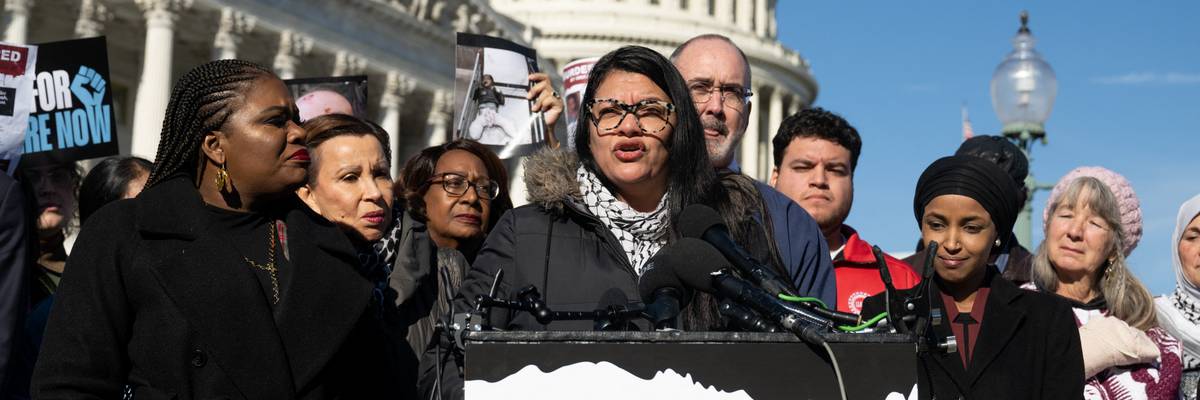
Rep. Rashida Tlaib (D-Mich.) speaks alongside Reps. Cori Bush (D-Mo.) and Ilhan Omar (D-Minn.) on December 14, 2023.
'This Is Illegal': US Lawmakers Slam Strikes on Yemen
"The people do not want more of our taxpayer dollars going to endless war and the killing of civilians," said Democratic Rep. Cori Bush. "Stop the bombing and do better by us."
U.S. lawmakers said Thursday that the Biden administration's barrage of airstrikes in Yemen—launched in coordination with American allies but without congressional approval—was blatantly unconstitutional and dangerous, heightening the risk of a full-blown regional conflict.
"This is illegal and violates Article I of the Constitution," U.S. Rep. Cori Bush (D-Mo.)
wrote on social media following the strikes. "The people do not want more of our taxpayer dollars going to endless war and the killing of civilians. Stop the bombing and do better by us."
The Biden administration said the airstrikes, which it characterized as a response to Houthi attacks on commercial shipping vessels in the Red Sea, hit
more than 60 targets in Yemen. Administration officials reportedly briefed congressional leaders on its plans to bomb Yemen, but there was no formal authorization from lawmakers.
"This is an unacceptable violation of the Constitution,"
said Rep. Pramila Jayapal (D-Wash.), chair of the Congressional Progressive Caucus. "Article 1 requires that military action be authorized by Congress."
Rep. Rashida Tlaib (D-Mich.)
echoed Jayapal, writing that U.S. President Joe Biden is "violating Article I of the Constitution by carrying out airstrikes in Yemen without congressional approval."
"The American people are tired of endless war," Tlaib added.
"Congressional authorization isn't some sort of courtesy, it's a legal requirement for this kind of act."
Article I of the Constitution states that Congress has the power to "declare war," and the
War Powers Resolution (WPR) of 1973 seeks to constrain the president's ability to take unilateral military action. As Brian Egan and Tess Bridgeman have explained, the War Powers Resolution "does not authorize the president to use force," calling the belief that it does "a common misperception."
"It takes a limited view of the president's authority to introduce U.S. armed forces into such situations in the absence of congressional authorization or an attack on the United States," Egan and Bridgeman noted.
The WPR states that, within 48 hours of a military action, the president must deliver a report to Congress explaining the rationale and legal authority under which such an action was launched. The statute clarifies that the president can only take military action under three circumstances: "(1) a declaration of war, (2) specific statutory authorization, or (3) a national emergency created by attack upon the United States, its territories or possessions, or its armed forces."
In a statement, U.S. President Joe Biden called the Yemen strikes "defensive," signaling the administration's intention to invoke Article II of the Constitution as its legal foundation for Thursday's bombing campaign. Article II designates the president as commander-in-chief of the U.S. armed forces, and it has been used by multiple administrations as a blank check for military action.
Yemen's Houthis have been targeting ships in the Red Sea since October, when Israel launched its devastating assault on the Gaza Strip in response to a deadly Hamas-led attack. The Houthis say they are acting to prevent genocide by blockading ships headed for Israel.
The U.S. and allied nations have been working to repel Houthi attacks on commercial vessels since October, shooting down Houthi drones and missiles and sinking Houthi ships in the Red Sea.
The White Housesaid Thursday that Houthi attacks on commercial shipping have had "very little" impact on the U.S. economy.
Stephen Miles, the president of Win Without War, called the U.S. strikes on Yemen "deeply troubling," arguing that "it's an action clearly at odds with both the Constitution and the War Powers Resolution."
"Congressional authorization isn't some sort of courtesy, it's a legal requirement for this kind of act," Miles wrote. "And since we're all about to hear a whole lot about 'self-defense' let's be very clear. Under the WPR, presidents are required to seek authorization before knowingly introducing U.S. forces into where combat may become imminent. It was written expressly for situations like this."
Rep. Barbara Lee (D-Calif.) said Thursday that the worsening cycle of violence in the Middle East is why she "called for a cease-fire early."
"Violence only begets more violence," Lee added. "We need a cease-fire now to prevent deadly, costly, catastrophic escalation of violence in the region."
This story has been updated to include comment from Rep. Barbara Lee.
We are at a crossroads
This country and this world are at a monumental crossroads. In a few short weeks, US voters will have an opportunity to beat back the forces of fascism and confront the billionaires who are rigging the economy, our media system, and our democracy, making it increasingly impossible for ordinary people to get by. We’re not just talking about the election. We’re talking about what must be done once these fascist elements are vanquished from power. We need a bolder set of solutions than what either major party has so far been willing to offer and a working-class movement ready to fight like hell for it. Trump didn't emerge from nowhere. The conditions that fueled MAGA authoritarianism were created by decades of radical neoliberal economic policies and a corrupt political system dominated by corporate interests. They slashed taxes on the super-rich, promising that the benefits would trickle down. They said giveaways to the corporate titans would make life more affordable for the rest of us. It was all bullshit. And when a bitter, betrayed populace searches for someone to blame, right-wing demagogues have little trouble finding scapegoats. People know when they're being lied to, but you won't hear any of this from the corporate media. Only independent journalism—powered and funded by people who believe in building a better world—can deliver truly trustworthy daily news. Our Fall Campaign is underway, and we need your help. To power our newsroom through the rest of the year, we need to raise $125,000 by midnight on October 31. So if you share our vision, please contribute whatever you can to sustain our work. |
U.S. lawmakers said Thursday that the Biden administration's barrage of airstrikes in Yemen—launched in coordination with American allies but without congressional approval—was blatantly unconstitutional and dangerous, heightening the risk of a full-blown regional conflict.
"This is illegal and violates Article I of the Constitution," U.S. Rep. Cori Bush (D-Mo.)
wrote on social media following the strikes. "The people do not want more of our taxpayer dollars going to endless war and the killing of civilians. Stop the bombing and do better by us."
The Biden administration said the airstrikes, which it characterized as a response to Houthi attacks on commercial shipping vessels in the Red Sea, hit
more than 60 targets in Yemen. Administration officials reportedly briefed congressional leaders on its plans to bomb Yemen, but there was no formal authorization from lawmakers.
"This is an unacceptable violation of the Constitution,"
said Rep. Pramila Jayapal (D-Wash.), chair of the Congressional Progressive Caucus. "Article 1 requires that military action be authorized by Congress."
Rep. Rashida Tlaib (D-Mich.)
echoed Jayapal, writing that U.S. President Joe Biden is "violating Article I of the Constitution by carrying out airstrikes in Yemen without congressional approval."
"The American people are tired of endless war," Tlaib added.
"Congressional authorization isn't some sort of courtesy, it's a legal requirement for this kind of act."
Article I of the Constitution states that Congress has the power to "declare war," and the
War Powers Resolution (WPR) of 1973 seeks to constrain the president's ability to take unilateral military action. As Brian Egan and Tess Bridgeman have explained, the War Powers Resolution "does not authorize the president to use force," calling the belief that it does "a common misperception."
"It takes a limited view of the president's authority to introduce U.S. armed forces into such situations in the absence of congressional authorization or an attack on the United States," Egan and Bridgeman noted.
The WPR states that, within 48 hours of a military action, the president must deliver a report to Congress explaining the rationale and legal authority under which such an action was launched. The statute clarifies that the president can only take military action under three circumstances: "(1) a declaration of war, (2) specific statutory authorization, or (3) a national emergency created by attack upon the United States, its territories or possessions, or its armed forces."
In a statement, U.S. President Joe Biden called the Yemen strikes "defensive," signaling the administration's intention to invoke Article II of the Constitution as its legal foundation for Thursday's bombing campaign. Article II designates the president as commander-in-chief of the U.S. armed forces, and it has been used by multiple administrations as a blank check for military action.
Yemen's Houthis have been targeting ships in the Red Sea since October, when Israel launched its devastating assault on the Gaza Strip in response to a deadly Hamas-led attack. The Houthis say they are acting to prevent genocide by blockading ships headed for Israel.
The U.S. and allied nations have been working to repel Houthi attacks on commercial vessels since October, shooting down Houthi drones and missiles and sinking Houthi ships in the Red Sea.
The White Housesaid Thursday that Houthi attacks on commercial shipping have had "very little" impact on the U.S. economy.
Stephen Miles, the president of Win Without War, called the U.S. strikes on Yemen "deeply troubling," arguing that "it's an action clearly at odds with both the Constitution and the War Powers Resolution."
"Congressional authorization isn't some sort of courtesy, it's a legal requirement for this kind of act," Miles wrote. "And since we're all about to hear a whole lot about 'self-defense' let's be very clear. Under the WPR, presidents are required to seek authorization before knowingly introducing U.S. forces into where combat may become imminent. It was written expressly for situations like this."
Rep. Barbara Lee (D-Calif.) said Thursday that the worsening cycle of violence in the Middle East is why she "called for a cease-fire early."
"Violence only begets more violence," Lee added. "We need a cease-fire now to prevent deadly, costly, catastrophic escalation of violence in the region."
This story has been updated to include comment from Rep. Barbara Lee.
- US, UK Bomb Yemeni Capital as Part of 'Sustained' Attack on Houthis ›
- Opinion | The US Is Waging an Illegal War for Faster Shipping | Common Dreams ›
- Coalition Urges Senators to Stop 'Illegal, Ineffective' US Airstrikes in Yemen | Common Dreams ›
- House Progressives Challenge Biden's 'Unauthorized' Mideast Militarism | Common Dreams ›
- Trump Bombs Yemen After Houthis Revive Blockade on Israeli Ships | Common Dreams ›
- Yemen's Health Ministry Says Majority of 53 Killed in US Strikes 'Were Women and Children' | Common Dreams ›
- A Reminder Amid Group Chat Outrage: US Strikes on Yemen Are Unconstitutional | Common Dreams ›
- Scores of Civilians Reportedly Among Victims of Latest US Airstrikes on Yemen | Common Dreams ›
U.S. lawmakers said Thursday that the Biden administration's barrage of airstrikes in Yemen—launched in coordination with American allies but without congressional approval—was blatantly unconstitutional and dangerous, heightening the risk of a full-blown regional conflict.
"This is illegal and violates Article I of the Constitution," U.S. Rep. Cori Bush (D-Mo.)
wrote on social media following the strikes. "The people do not want more of our taxpayer dollars going to endless war and the killing of civilians. Stop the bombing and do better by us."
The Biden administration said the airstrikes, which it characterized as a response to Houthi attacks on commercial shipping vessels in the Red Sea, hit
more than 60 targets in Yemen. Administration officials reportedly briefed congressional leaders on its plans to bomb Yemen, but there was no formal authorization from lawmakers.
"This is an unacceptable violation of the Constitution,"
said Rep. Pramila Jayapal (D-Wash.), chair of the Congressional Progressive Caucus. "Article 1 requires that military action be authorized by Congress."
Rep. Rashida Tlaib (D-Mich.)
echoed Jayapal, writing that U.S. President Joe Biden is "violating Article I of the Constitution by carrying out airstrikes in Yemen without congressional approval."
"The American people are tired of endless war," Tlaib added.
"Congressional authorization isn't some sort of courtesy, it's a legal requirement for this kind of act."
Article I of the Constitution states that Congress has the power to "declare war," and the
War Powers Resolution (WPR) of 1973 seeks to constrain the president's ability to take unilateral military action. As Brian Egan and Tess Bridgeman have explained, the War Powers Resolution "does not authorize the president to use force," calling the belief that it does "a common misperception."
"It takes a limited view of the president's authority to introduce U.S. armed forces into such situations in the absence of congressional authorization or an attack on the United States," Egan and Bridgeman noted.
The WPR states that, within 48 hours of a military action, the president must deliver a report to Congress explaining the rationale and legal authority under which such an action was launched. The statute clarifies that the president can only take military action under three circumstances: "(1) a declaration of war, (2) specific statutory authorization, or (3) a national emergency created by attack upon the United States, its territories or possessions, or its armed forces."
In a statement, U.S. President Joe Biden called the Yemen strikes "defensive," signaling the administration's intention to invoke Article II of the Constitution as its legal foundation for Thursday's bombing campaign. Article II designates the president as commander-in-chief of the U.S. armed forces, and it has been used by multiple administrations as a blank check for military action.
Yemen's Houthis have been targeting ships in the Red Sea since October, when Israel launched its devastating assault on the Gaza Strip in response to a deadly Hamas-led attack. The Houthis say they are acting to prevent genocide by blockading ships headed for Israel.
The U.S. and allied nations have been working to repel Houthi attacks on commercial vessels since October, shooting down Houthi drones and missiles and sinking Houthi ships in the Red Sea.
The White Housesaid Thursday that Houthi attacks on commercial shipping have had "very little" impact on the U.S. economy.
Stephen Miles, the president of Win Without War, called the U.S. strikes on Yemen "deeply troubling," arguing that "it's an action clearly at odds with both the Constitution and the War Powers Resolution."
"Congressional authorization isn't some sort of courtesy, it's a legal requirement for this kind of act," Miles wrote. "And since we're all about to hear a whole lot about 'self-defense' let's be very clear. Under the WPR, presidents are required to seek authorization before knowingly introducing U.S. forces into where combat may become imminent. It was written expressly for situations like this."
Rep. Barbara Lee (D-Calif.) said Thursday that the worsening cycle of violence in the Middle East is why she "called for a cease-fire early."
"Violence only begets more violence," Lee added. "We need a cease-fire now to prevent deadly, costly, catastrophic escalation of violence in the region."
This story has been updated to include comment from Rep. Barbara Lee.
- US, UK Bomb Yemeni Capital as Part of 'Sustained' Attack on Houthis ›
- Opinion | The US Is Waging an Illegal War for Faster Shipping | Common Dreams ›
- Coalition Urges Senators to Stop 'Illegal, Ineffective' US Airstrikes in Yemen | Common Dreams ›
- House Progressives Challenge Biden's 'Unauthorized' Mideast Militarism | Common Dreams ›
- Trump Bombs Yemen After Houthis Revive Blockade on Israeli Ships | Common Dreams ›
- Yemen's Health Ministry Says Majority of 53 Killed in US Strikes 'Were Women and Children' | Common Dreams ›
- A Reminder Amid Group Chat Outrage: US Strikes on Yemen Are Unconstitutional | Common Dreams ›
- Scores of Civilians Reportedly Among Victims of Latest US Airstrikes on Yemen | Common Dreams ›