SUBSCRIBE TO OUR FREE NEWSLETTER
Daily news & progressive opinion—funded by the people, not the corporations—delivered straight to your inbox.
5
#000000
#FFFFFF
To donate by check, phone, or other method, see our More Ways to Give page.
Daily news & progressive opinion—funded by the people, not the corporations—delivered straight to your inbox.
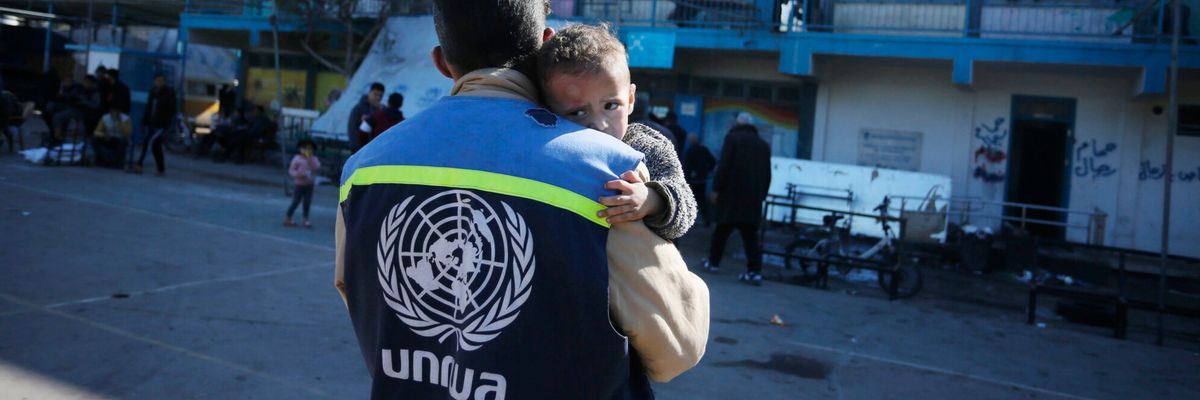
An UNRWA staffer holds a traumatized Palestinian baby in Gaza on March 13, 2023.
"The need for U.S. support is more urgent than ever," said one advocate. "The lives and well-being of millions depend on it."
Rights groups on Thursday applauded three Democratic lawmakers for their proposal of a bill to restore United States funding to the United Nations' key agency tasked with providing services and humanitarian assistance to Palestinians in Gaza, six months after the U.S. suspended contributions following unverified accusations against the agency.
James Zogby, president of the Arab American Institute, expressed gratitude to Reps. André Carson (D-Ind.), Pramila Jayapal (D-Wash.), and Jan Schakowsky (D-Ill.) for introducing the UNRWA Emergency Restoration Act of 2024, aimed at restoring funding to the U.N. Relief and Works Agency for Palestine Refugees in the Near East—legislation that Zogby said would be "lifesaving" if passed into law.
" UNRWA plays a vital role in providing essential services to millions of Palestinian refugees across the occupied Palestinian territory, Lebanon, Jordan, and Syria," said Zogby. "The ongoing genocide in Gaza has resulted in increased displacement, starvation, and death. It is both inhumane and unconscionable to continue withholding financial support from UNRWA."
The U.S.—the largest international funder of the agency, which relies almost entirely on voluntary contributions from donor states—promptly suspended funding for UNRWA last January after Israel claimed without evidence that 12 out of the agency's 13,000 staff members in Gaza had been involved in a Hamas-led attack on southern Israel last October.
Congress later passed a bill prohibiting UNRWA funding through at least March 2025.
In 2022, the U.S. contributed more than $343 million to the agency.
"UNRWA is the backbone of humanitarian aid in the Gaza Strip. U.S. funding should be restored immediately."
The Biden administration's decision to suspend donations to UNRWA pushed a number of U.S. allies to do the same, but countries including Germany, Sweden, Japan, and the United Kingdom have since reinstated their funding after an independent probe found that Israel had provided no supporting evidence of its claim.
"The United States should join our key allies in restoring this urgently needed funding for UNRWA. There is no time to lose," said Hassan El-Tayyab, legislative director for Middle East policy at the Friends Committee on National Legislation, expressing support for the newly introduced bill.
Bridget Moix, general secretary for the group, added that cutting of funding was "simply unconscionable" because the U.S.—as the Israeli military's largest international funder—bears responsibility for the "horrific violence and a massive humanitarian crisis" in Gaza.
"UNRWA is the backbone of humanitarian aid in the Gaza Strip," said Moix. "U.S. funding should be restored immediately."
Cavan Kharrazian, senior policy adviser for Demand Progress, noted that since the U.S. suspended funding to UNRWA, the humanitarian crisis in Gaza has worsened, with U.N. experts warning in July that famine had spread across the enclave.
"The need for U.S. support is more urgent than ever," said Kharrazian. "The lives and well-being of millions depend on it."
"We call on leaders in Congress to take principled stands like this as future funding bills move," he added, "removing these harmful prohibitions against UNRWA funding."
Dear Common Dreams reader, It’s been nearly 30 years since I co-founded Common Dreams with my late wife, Lina Newhouser. We had the radical notion that journalism should serve the public good, not corporate profits. It was clear to us from the outset what it would take to build such a project. No paid advertisements. No corporate sponsors. No millionaire publisher telling us what to think or do. Many people said we wouldn't last a year, but we proved those doubters wrong. Together with a tremendous team of journalists and dedicated staff, we built an independent media outlet free from the constraints of profits and corporate control. Our mission has always been simple: To inform. To inspire. To ignite change for the common good. Building Common Dreams was not easy. Our survival was never guaranteed. When you take on the most powerful forces—Wall Street greed, fossil fuel industry destruction, Big Tech lobbyists, and uber-rich oligarchs who have spent billions upon billions rigging the economy and democracy in their favor—the only bulwark you have is supporters who believe in your work. But here’s the urgent message from me today. It's never been this bad out there. And it's never been this hard to keep us going. At the very moment Common Dreams is most needed, the threats we face are intensifying. We need your support now more than ever. We don't accept corporate advertising and never will. We don't have a paywall because we don't think people should be blocked from critical news based on their ability to pay. Everything we do is funded by the donations of readers like you. When everyone does the little they can afford, we are strong. But if that support retreats or dries up, so do we. Will you donate now to make sure Common Dreams not only survives but thrives? —Craig Brown, Co-founder |
Rights groups on Thursday applauded three Democratic lawmakers for their proposal of a bill to restore United States funding to the United Nations' key agency tasked with providing services and humanitarian assistance to Palestinians in Gaza, six months after the U.S. suspended contributions following unverified accusations against the agency.
James Zogby, president of the Arab American Institute, expressed gratitude to Reps. André Carson (D-Ind.), Pramila Jayapal (D-Wash.), and Jan Schakowsky (D-Ill.) for introducing the UNRWA Emergency Restoration Act of 2024, aimed at restoring funding to the U.N. Relief and Works Agency for Palestine Refugees in the Near East—legislation that Zogby said would be "lifesaving" if passed into law.
" UNRWA plays a vital role in providing essential services to millions of Palestinian refugees across the occupied Palestinian territory, Lebanon, Jordan, and Syria," said Zogby. "The ongoing genocide in Gaza has resulted in increased displacement, starvation, and death. It is both inhumane and unconscionable to continue withholding financial support from UNRWA."
The U.S.—the largest international funder of the agency, which relies almost entirely on voluntary contributions from donor states—promptly suspended funding for UNRWA last January after Israel claimed without evidence that 12 out of the agency's 13,000 staff members in Gaza had been involved in a Hamas-led attack on southern Israel last October.
Congress later passed a bill prohibiting UNRWA funding through at least March 2025.
In 2022, the U.S. contributed more than $343 million to the agency.
"UNRWA is the backbone of humanitarian aid in the Gaza Strip. U.S. funding should be restored immediately."
The Biden administration's decision to suspend donations to UNRWA pushed a number of U.S. allies to do the same, but countries including Germany, Sweden, Japan, and the United Kingdom have since reinstated their funding after an independent probe found that Israel had provided no supporting evidence of its claim.
"The United States should join our key allies in restoring this urgently needed funding for UNRWA. There is no time to lose," said Hassan El-Tayyab, legislative director for Middle East policy at the Friends Committee on National Legislation, expressing support for the newly introduced bill.
Bridget Moix, general secretary for the group, added that cutting of funding was "simply unconscionable" because the U.S.—as the Israeli military's largest international funder—bears responsibility for the "horrific violence and a massive humanitarian crisis" in Gaza.
"UNRWA is the backbone of humanitarian aid in the Gaza Strip," said Moix. "U.S. funding should be restored immediately."
Cavan Kharrazian, senior policy adviser for Demand Progress, noted that since the U.S. suspended funding to UNRWA, the humanitarian crisis in Gaza has worsened, with U.N. experts warning in July that famine had spread across the enclave.
"The need for U.S. support is more urgent than ever," said Kharrazian. "The lives and well-being of millions depend on it."
"We call on leaders in Congress to take principled stands like this as future funding bills move," he added, "removing these harmful prohibitions against UNRWA funding."
Rights groups on Thursday applauded three Democratic lawmakers for their proposal of a bill to restore United States funding to the United Nations' key agency tasked with providing services and humanitarian assistance to Palestinians in Gaza, six months after the U.S. suspended contributions following unverified accusations against the agency.
James Zogby, president of the Arab American Institute, expressed gratitude to Reps. André Carson (D-Ind.), Pramila Jayapal (D-Wash.), and Jan Schakowsky (D-Ill.) for introducing the UNRWA Emergency Restoration Act of 2024, aimed at restoring funding to the U.N. Relief and Works Agency for Palestine Refugees in the Near East—legislation that Zogby said would be "lifesaving" if passed into law.
" UNRWA plays a vital role in providing essential services to millions of Palestinian refugees across the occupied Palestinian territory, Lebanon, Jordan, and Syria," said Zogby. "The ongoing genocide in Gaza has resulted in increased displacement, starvation, and death. It is both inhumane and unconscionable to continue withholding financial support from UNRWA."
The U.S.—the largest international funder of the agency, which relies almost entirely on voluntary contributions from donor states—promptly suspended funding for UNRWA last January after Israel claimed without evidence that 12 out of the agency's 13,000 staff members in Gaza had been involved in a Hamas-led attack on southern Israel last October.
Congress later passed a bill prohibiting UNRWA funding through at least March 2025.
In 2022, the U.S. contributed more than $343 million to the agency.
"UNRWA is the backbone of humanitarian aid in the Gaza Strip. U.S. funding should be restored immediately."
The Biden administration's decision to suspend donations to UNRWA pushed a number of U.S. allies to do the same, but countries including Germany, Sweden, Japan, and the United Kingdom have since reinstated their funding after an independent probe found that Israel had provided no supporting evidence of its claim.
"The United States should join our key allies in restoring this urgently needed funding for UNRWA. There is no time to lose," said Hassan El-Tayyab, legislative director for Middle East policy at the Friends Committee on National Legislation, expressing support for the newly introduced bill.
Bridget Moix, general secretary for the group, added that cutting of funding was "simply unconscionable" because the U.S.—as the Israeli military's largest international funder—bears responsibility for the "horrific violence and a massive humanitarian crisis" in Gaza.
"UNRWA is the backbone of humanitarian aid in the Gaza Strip," said Moix. "U.S. funding should be restored immediately."
Cavan Kharrazian, senior policy adviser for Demand Progress, noted that since the U.S. suspended funding to UNRWA, the humanitarian crisis in Gaza has worsened, with U.N. experts warning in July that famine had spread across the enclave.
"The need for U.S. support is more urgent than ever," said Kharrazian. "The lives and well-being of millions depend on it."
"We call on leaders in Congress to take principled stands like this as future funding bills move," he added, "removing these harmful prohibitions against UNRWA funding."