

SUBSCRIBE TO OUR FREE NEWSLETTER
Daily news & progressive opinion—funded by the people, not the corporations—delivered straight to your inbox.
5
#000000
#FFFFFF
To donate by check, phone, or other method, see our More Ways to Give page.
Daily news & progressive opinion—funded by the people, not the corporations—delivered straight to your inbox.
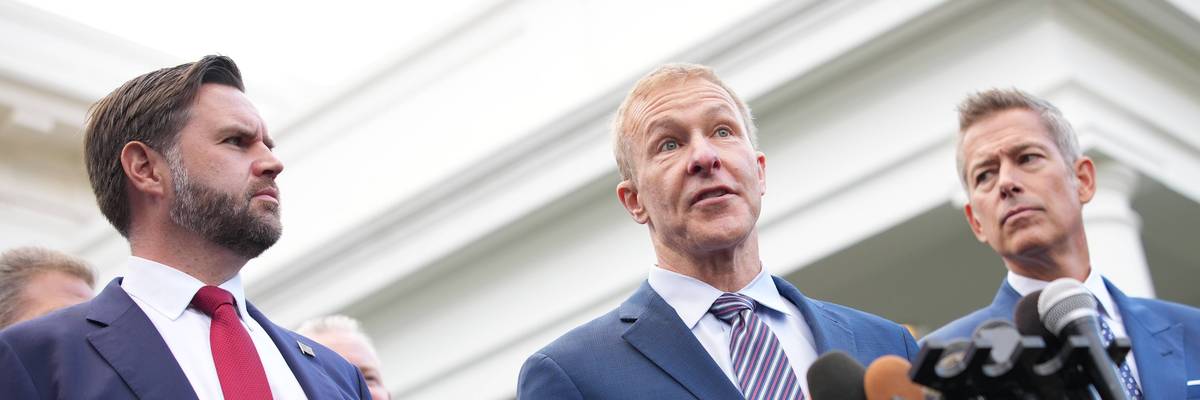
United Airlines CEO Scott Kirby speaks to reporters outside the White House on October 30, 2025 in Washington, DC.
The heads of the congressional Monopoly-Busters Caucus warned that a future administration could "break up" a merger of United and American Airlines if it is approved by Trump regulators.
The Democratic leaders of the congressional Monopoly-Busters Caucus said Wednesday that a recently floated megamerger of two of the largest airlines in the US—United and American—would be so awful for consumers that it shouldn't even be considered, let alone approved by federal regulators.
"The rumored scheme to merge United and American should never see the light of day," said Reps. Pramila Jayapal (D-Wash.), Chris Deluzio (D-Pa.), Pat Ryan (D-NY), and Angie Craig (D-Minn.). "This disaster of a merger would be illegal, consolidating more than a third of the US airline market, eliminating direct competitors on hundreds of routes across the country, and creating a near-monopoly on flights in many cities."
The House Democrats went on to say that if a United-American merger is formally proposed and approved by President Donald Trump's regulators, a future Democratic administration could break up the resulting airline behemoth.
"In a time when too many Americans just struggle to even go on vacation, much less afford their housing, childcare, and healthcare, these airline executives should not mistake the corruption of this administration as a green light to break the law," the lawmakers said. "They should also remember that there is no statute of limitations on breaking up bad deals."
"In case it is not crystal clear," they added, "that is absolutely a threat to break up this merger should it ever happen."
The lawmakers' statement came a day after Bloomberg reported that United Airlines (UA) CEO Scott Kirby floated the idea of merging his company with American Airlines (AA) "directly" to Trump during a meeting in late February. Kirby also pitched the merger idea to other "senior government officials," the outlet noted, without providing names.
"A combination would create the largest airline on the planet," Bloomberg observed. "As a result, any merger between the two aviation giants would pose serious antitrust concerns and likely face significant backlash from consumers, politicians and rival US airlines."
"That the United CEO raised the idea of a merger with American directly with Donald Trump suggests he thinks he might obtain direct approval from the president for a merger that would otherwise never be permitted.”
Contrary to claims of a "surging MAGA antitrust movement" in the early days of Trump's second White House term, the president's administration has proven friendly to corporate merger efforts, from Paramount-Skydance to UnitedHealth-Amedisys and more. Reuters reported Wednesday that "investment banking fees—earned from advising on mergers and acquisitions and underwriting deals—surged an average of 27% across six major US banks in the first quarter, with record dealmaking a key profit driver."
William McGee, senior fellow for aviation and travel at the American Economic Liberties Project, said Wednesday that "thanks to the federal preemption clause in the 1978 Airline Deregulation Act, states have virtually no airline oversight."
"So effectively the only sheriffs overseeing airlines are [the Department of Transportation] and [Department of Justice]," McGee observed. "Under Trump they've been derelict in policing competition."
"To be clear: A UA-AA merger is absurd," McGee added. "A monolith mega-mega-carrier operating 4 of every 10 domestic flights is so harmful that anyone favoring it doesn't understand airlines. Or is a regulator eager to please a president who 'loves to see big deals.'"
Robert Weissman, co-president of the consumer advocacy group Public Citizen, said in a statement Tuesday that "it would be easy to dismiss the prospect of such a merger passing antitrust scrutiny—except that the Trump Department of Justice seems content to bless dangerously high levels of corporate concentration, so long as administration cronies, allies, or flatterers are in charge of corporate goliath."
"That the United CEO raised the idea of a merger with American directly with Donald Trump," Weissman added, "suggests he thinks he might obtain direct approval from the president for a merger that would otherwise never be permitted.”
Dear Common Dreams reader, It’s been nearly 30 years since I co-founded Common Dreams with my late wife, Lina Newhouser. We had the radical notion that journalism should serve the public good, not corporate profits. It was clear to us from the outset what it would take to build such a project. No paid advertisements. No corporate sponsors. No millionaire publisher telling us what to think or do. Many people said we wouldn't last a year, but we proved those doubters wrong. Together with a tremendous team of journalists and dedicated staff, we built an independent media outlet free from the constraints of profits and corporate control. Our mission has always been simple: To inform. To inspire. To ignite change for the common good. Building Common Dreams was not easy. Our survival was never guaranteed. When you take on the most powerful forces—Wall Street greed, fossil fuel industry destruction, Big Tech lobbyists, and uber-rich oligarchs who have spent billions upon billions rigging the economy and democracy in their favor—the only bulwark you have is supporters who believe in your work. But here’s the urgent message from me today. It's never been this bad out there. And it's never been this hard to keep us going. At the very moment Common Dreams is most needed, the threats we face are intensifying. We need your support now more than ever. We don't accept corporate advertising and never will. We don't have a paywall because we don't think people should be blocked from critical news based on their ability to pay. Everything we do is funded by the donations of readers like you. When everyone does the little they can afford, we are strong. But if that support retreats or dries up, so do we. Will you donate now to make sure Common Dreams not only survives but thrives? —Craig Brown, Co-founder |
The Democratic leaders of the congressional Monopoly-Busters Caucus said Wednesday that a recently floated megamerger of two of the largest airlines in the US—United and American—would be so awful for consumers that it shouldn't even be considered, let alone approved by federal regulators.
"The rumored scheme to merge United and American should never see the light of day," said Reps. Pramila Jayapal (D-Wash.), Chris Deluzio (D-Pa.), Pat Ryan (D-NY), and Angie Craig (D-Minn.). "This disaster of a merger would be illegal, consolidating more than a third of the US airline market, eliminating direct competitors on hundreds of routes across the country, and creating a near-monopoly on flights in many cities."
The House Democrats went on to say that if a United-American merger is formally proposed and approved by President Donald Trump's regulators, a future Democratic administration could break up the resulting airline behemoth.
"In a time when too many Americans just struggle to even go on vacation, much less afford their housing, childcare, and healthcare, these airline executives should not mistake the corruption of this administration as a green light to break the law," the lawmakers said. "They should also remember that there is no statute of limitations on breaking up bad deals."
"In case it is not crystal clear," they added, "that is absolutely a threat to break up this merger should it ever happen."
The lawmakers' statement came a day after Bloomberg reported that United Airlines (UA) CEO Scott Kirby floated the idea of merging his company with American Airlines (AA) "directly" to Trump during a meeting in late February. Kirby also pitched the merger idea to other "senior government officials," the outlet noted, without providing names.
"A combination would create the largest airline on the planet," Bloomberg observed. "As a result, any merger between the two aviation giants would pose serious antitrust concerns and likely face significant backlash from consumers, politicians and rival US airlines."
"That the United CEO raised the idea of a merger with American directly with Donald Trump suggests he thinks he might obtain direct approval from the president for a merger that would otherwise never be permitted.”
Contrary to claims of a "surging MAGA antitrust movement" in the early days of Trump's second White House term, the president's administration has proven friendly to corporate merger efforts, from Paramount-Skydance to UnitedHealth-Amedisys and more. Reuters reported Wednesday that "investment banking fees—earned from advising on mergers and acquisitions and underwriting deals—surged an average of 27% across six major US banks in the first quarter, with record dealmaking a key profit driver."
William McGee, senior fellow for aviation and travel at the American Economic Liberties Project, said Wednesday that "thanks to the federal preemption clause in the 1978 Airline Deregulation Act, states have virtually no airline oversight."
"So effectively the only sheriffs overseeing airlines are [the Department of Transportation] and [Department of Justice]," McGee observed. "Under Trump they've been derelict in policing competition."
"To be clear: A UA-AA merger is absurd," McGee added. "A monolith mega-mega-carrier operating 4 of every 10 domestic flights is so harmful that anyone favoring it doesn't understand airlines. Or is a regulator eager to please a president who 'loves to see big deals.'"
Robert Weissman, co-president of the consumer advocacy group Public Citizen, said in a statement Tuesday that "it would be easy to dismiss the prospect of such a merger passing antitrust scrutiny—except that the Trump Department of Justice seems content to bless dangerously high levels of corporate concentration, so long as administration cronies, allies, or flatterers are in charge of corporate goliath."
"That the United CEO raised the idea of a merger with American directly with Donald Trump," Weissman added, "suggests he thinks he might obtain direct approval from the president for a merger that would otherwise never be permitted.”
The Democratic leaders of the congressional Monopoly-Busters Caucus said Wednesday that a recently floated megamerger of two of the largest airlines in the US—United and American—would be so awful for consumers that it shouldn't even be considered, let alone approved by federal regulators.
"The rumored scheme to merge United and American should never see the light of day," said Reps. Pramila Jayapal (D-Wash.), Chris Deluzio (D-Pa.), Pat Ryan (D-NY), and Angie Craig (D-Minn.). "This disaster of a merger would be illegal, consolidating more than a third of the US airline market, eliminating direct competitors on hundreds of routes across the country, and creating a near-monopoly on flights in many cities."
The House Democrats went on to say that if a United-American merger is formally proposed and approved by President Donald Trump's regulators, a future Democratic administration could break up the resulting airline behemoth.
"In a time when too many Americans just struggle to even go on vacation, much less afford their housing, childcare, and healthcare, these airline executives should not mistake the corruption of this administration as a green light to break the law," the lawmakers said. "They should also remember that there is no statute of limitations on breaking up bad deals."
"In case it is not crystal clear," they added, "that is absolutely a threat to break up this merger should it ever happen."
The lawmakers' statement came a day after Bloomberg reported that United Airlines (UA) CEO Scott Kirby floated the idea of merging his company with American Airlines (AA) "directly" to Trump during a meeting in late February. Kirby also pitched the merger idea to other "senior government officials," the outlet noted, without providing names.
"A combination would create the largest airline on the planet," Bloomberg observed. "As a result, any merger between the two aviation giants would pose serious antitrust concerns and likely face significant backlash from consumers, politicians and rival US airlines."
"That the United CEO raised the idea of a merger with American directly with Donald Trump suggests he thinks he might obtain direct approval from the president for a merger that would otherwise never be permitted.”
Contrary to claims of a "surging MAGA antitrust movement" in the early days of Trump's second White House term, the president's administration has proven friendly to corporate merger efforts, from Paramount-Skydance to UnitedHealth-Amedisys and more. Reuters reported Wednesday that "investment banking fees—earned from advising on mergers and acquisitions and underwriting deals—surged an average of 27% across six major US banks in the first quarter, with record dealmaking a key profit driver."
William McGee, senior fellow for aviation and travel at the American Economic Liberties Project, said Wednesday that "thanks to the federal preemption clause in the 1978 Airline Deregulation Act, states have virtually no airline oversight."
"So effectively the only sheriffs overseeing airlines are [the Department of Transportation] and [Department of Justice]," McGee observed. "Under Trump they've been derelict in policing competition."
"To be clear: A UA-AA merger is absurd," McGee added. "A monolith mega-mega-carrier operating 4 of every 10 domestic flights is so harmful that anyone favoring it doesn't understand airlines. Or is a regulator eager to please a president who 'loves to see big deals.'"
Robert Weissman, co-president of the consumer advocacy group Public Citizen, said in a statement Tuesday that "it would be easy to dismiss the prospect of such a merger passing antitrust scrutiny—except that the Trump Department of Justice seems content to bless dangerously high levels of corporate concentration, so long as administration cronies, allies, or flatterers are in charge of corporate goliath."
"That the United CEO raised the idea of a merger with American directly with Donald Trump," Weissman added, "suggests he thinks he might obtain direct approval from the president for a merger that would otherwise never be permitted.”

