SUBSCRIBE TO OUR FREE NEWSLETTER
Daily news & progressive opinion—funded by the people, not the corporations—delivered straight to your inbox.
5
#000000
#FFFFFF
To donate by check, phone, or other method, see our More Ways to Give page.
Daily news & progressive opinion—funded by the people, not the corporations—delivered straight to your inbox.
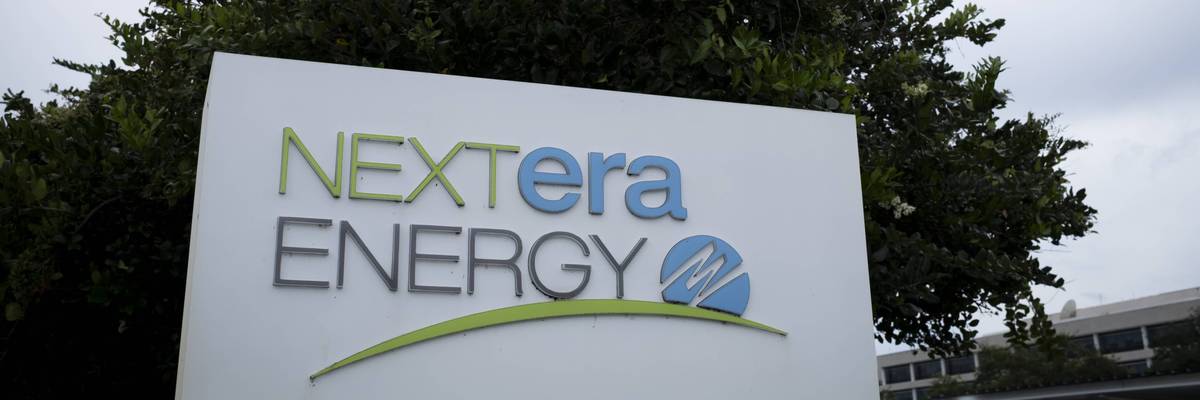
The logo of NextEra Energy is seen at the entrance of its headquarters on May 18, 2026 in Juno Beach, Florida.
"These megautilities are merely using rising concern about data centers as an excuse to concentrate political and economic power of two giant utilities to maximize financial returns to shareholders," one advocate said.
Seeking to cash in on spiking energy demand from the expansion of artificial intelligence data centers across the US, the Florida energy giant NextEra announced a $67 billion deal on Monday to acquire Virginia's Dominion Energy.
But while the deal is expected to be lucrative for the massive new entity, with national power demands projected to spike perhaps by as much as 25% over the next five years, consumer advocates fear that the proposed merger will be bad for consumers, creating an unaccountable corporate behemoth that will raise costs on ratepayers.
According to Utility Dive, the new entity created by the merger will serve a combined 10 million customers across Florida, Virginia, North Carolina, and South Carolina.
With a market cap of $250 billion, the companies said they'd be the “world’s largest regulated electric utility business by market capitalization and one of the world’s largest energy infrastructure companies.”
But the deal still needs to be approved by federal regulators, a process that will likely pose minimal difficulty given the Trump administration's friendliness toward other corporate megamergers across industries, from media to railroads.
It will also be required to obtain local approvals, including in Virginia, where the recently elected Democratic Gov. Abigail Spanberger has made lowering utility costs and requiring data centers to "pay their fair share" central campaign promises, as massive new projects have been met with furious local backlash around the country.
Tyson Slocum, director of the energy program for the consumer advocacy watchdog Public Citizen, said that "this absurd proposal to merge two massive, well-capitalized utilities should be dead on arrival for state and federal regulators." He added that "household customers have everything to lose and nothing to gain by allowing two behemoths, NextEra and Dominion, to merge."
The company’s combined rate base—the value of assets recognized by regulators when setting rates—are valued at about $138 billion, according to the deal announcement. It said they plan to expand that value by 11% by 2032 with major infrastructure expansions.
Though the company has proposed offering $2.25 billion in credits to customers for two years after the deal closes, consumer advocates fear it is simply meant to ease upfront investment costs, leaving the real rate hikes to show up later once the credits expire.
The group Clean Virginia argued that the proposal needed to be subject “to the most rigorous scrutiny possible," given NextEra's "deeply troubling track record" in Florida.
The company and its subsidiaries in Florida have faced criticism for profiting from a $1.5 billion rate hike on Floridians and for pocketing $1 billion in tax savings without passing it on to consumers.
The company is also renowned for its extensive use of dark money to influence legislators in both parties, as well as Republican Florida Gov. Ron DeSantis, to kill clean energy and other policies that disfavor its business.
David Pomerantz, the executive director of the Energy and Policy Institute, told The New York Times that "a megamonopoly of this size, with the kind of money to buy political influence that NextEra will have, will be nearly impossible to regulate.”
NextEra CEO John Ketchum has said the deal is necessary to accommodate “America’s golden age of power demand.”
“Electricity demand is rising faster than it has in decades,” Ketchum said. “We are bringing NextEra Energy and Dominion Energy together because scale matters more than ever.”
But Slocum called this "a false narrative."
"The merger will do nothing to increase generating capacity, let alone desperately needed renewable generating capacity," he said. "These megautilities are merely using rising concern about data centers as an excuse to concentrate political and economic power of two giant utilities to maximize financial returns to shareholders."
He said federal and state regulators "should reject this outlandish, unnecessary merger as completely contrary to the public interest.“
Dear Common Dreams reader, It’s been nearly 30 years since I co-founded Common Dreams with my late wife, Lina Newhouser. We had the radical notion that journalism should serve the public good, not corporate profits. It was clear to us from the outset what it would take to build such a project. No paid advertisements. No corporate sponsors. No millionaire publisher telling us what to think or do. Many people said we wouldn't last a year, but we proved those doubters wrong. Together with a tremendous team of journalists and dedicated staff, we built an independent media outlet free from the constraints of profits and corporate control. Our mission has always been simple: To inform. To inspire. To ignite change for the common good. Building Common Dreams was not easy. Our survival was never guaranteed. When you take on the most powerful forces—Wall Street greed, fossil fuel industry destruction, Big Tech lobbyists, and uber-rich oligarchs who have spent billions upon billions rigging the economy and democracy in their favor—the only bulwark you have is supporters who believe in your work. But here’s the urgent message from me today. It's never been this bad out there. And it's never been this hard to keep us going. At the very moment Common Dreams is most needed, the threats we face are intensifying. We need your support now more than ever. We don't accept corporate advertising and never will. We don't have a paywall because we don't think people should be blocked from critical news based on their ability to pay. Everything we do is funded by the donations of readers like you. When everyone does the little they can afford, we are strong. But if that support retreats or dries up, so do we. Will you donate now to make sure Common Dreams not only survives but thrives? —Craig Brown, Co-founder |
Seeking to cash in on spiking energy demand from the expansion of artificial intelligence data centers across the US, the Florida energy giant NextEra announced a $67 billion deal on Monday to acquire Virginia's Dominion Energy.
But while the deal is expected to be lucrative for the massive new entity, with national power demands projected to spike perhaps by as much as 25% over the next five years, consumer advocates fear that the proposed merger will be bad for consumers, creating an unaccountable corporate behemoth that will raise costs on ratepayers.
According to Utility Dive, the new entity created by the merger will serve a combined 10 million customers across Florida, Virginia, North Carolina, and South Carolina.
With a market cap of $250 billion, the companies said they'd be the “world’s largest regulated electric utility business by market capitalization and one of the world’s largest energy infrastructure companies.”
But the deal still needs to be approved by federal regulators, a process that will likely pose minimal difficulty given the Trump administration's friendliness toward other corporate megamergers across industries, from media to railroads.
It will also be required to obtain local approvals, including in Virginia, where the recently elected Democratic Gov. Abigail Spanberger has made lowering utility costs and requiring data centers to "pay their fair share" central campaign promises, as massive new projects have been met with furious local backlash around the country.
Tyson Slocum, director of the energy program for the consumer advocacy watchdog Public Citizen, said that "this absurd proposal to merge two massive, well-capitalized utilities should be dead on arrival for state and federal regulators." He added that "household customers have everything to lose and nothing to gain by allowing two behemoths, NextEra and Dominion, to merge."
The company’s combined rate base—the value of assets recognized by regulators when setting rates—are valued at about $138 billion, according to the deal announcement. It said they plan to expand that value by 11% by 2032 with major infrastructure expansions.
Though the company has proposed offering $2.25 billion in credits to customers for two years after the deal closes, consumer advocates fear it is simply meant to ease upfront investment costs, leaving the real rate hikes to show up later once the credits expire.
The group Clean Virginia argued that the proposal needed to be subject “to the most rigorous scrutiny possible," given NextEra's "deeply troubling track record" in Florida.
The company and its subsidiaries in Florida have faced criticism for profiting from a $1.5 billion rate hike on Floridians and for pocketing $1 billion in tax savings without passing it on to consumers.
The company is also renowned for its extensive use of dark money to influence legislators in both parties, as well as Republican Florida Gov. Ron DeSantis, to kill clean energy and other policies that disfavor its business.
David Pomerantz, the executive director of the Energy and Policy Institute, told The New York Times that "a megamonopoly of this size, with the kind of money to buy political influence that NextEra will have, will be nearly impossible to regulate.”
NextEra CEO John Ketchum has said the deal is necessary to accommodate “America’s golden age of power demand.”
“Electricity demand is rising faster than it has in decades,” Ketchum said. “We are bringing NextEra Energy and Dominion Energy together because scale matters more than ever.”
But Slocum called this "a false narrative."
"The merger will do nothing to increase generating capacity, let alone desperately needed renewable generating capacity," he said. "These megautilities are merely using rising concern about data centers as an excuse to concentrate political and economic power of two giant utilities to maximize financial returns to shareholders."
He said federal and state regulators "should reject this outlandish, unnecessary merger as completely contrary to the public interest.“
Seeking to cash in on spiking energy demand from the expansion of artificial intelligence data centers across the US, the Florida energy giant NextEra announced a $67 billion deal on Monday to acquire Virginia's Dominion Energy.
But while the deal is expected to be lucrative for the massive new entity, with national power demands projected to spike perhaps by as much as 25% over the next five years, consumer advocates fear that the proposed merger will be bad for consumers, creating an unaccountable corporate behemoth that will raise costs on ratepayers.
According to Utility Dive, the new entity created by the merger will serve a combined 10 million customers across Florida, Virginia, North Carolina, and South Carolina.
With a market cap of $250 billion, the companies said they'd be the “world’s largest regulated electric utility business by market capitalization and one of the world’s largest energy infrastructure companies.”
But the deal still needs to be approved by federal regulators, a process that will likely pose minimal difficulty given the Trump administration's friendliness toward other corporate megamergers across industries, from media to railroads.
It will also be required to obtain local approvals, including in Virginia, where the recently elected Democratic Gov. Abigail Spanberger has made lowering utility costs and requiring data centers to "pay their fair share" central campaign promises, as massive new projects have been met with furious local backlash around the country.
Tyson Slocum, director of the energy program for the consumer advocacy watchdog Public Citizen, said that "this absurd proposal to merge two massive, well-capitalized utilities should be dead on arrival for state and federal regulators." He added that "household customers have everything to lose and nothing to gain by allowing two behemoths, NextEra and Dominion, to merge."
The company’s combined rate base—the value of assets recognized by regulators when setting rates—are valued at about $138 billion, according to the deal announcement. It said they plan to expand that value by 11% by 2032 with major infrastructure expansions.
Though the company has proposed offering $2.25 billion in credits to customers for two years after the deal closes, consumer advocates fear it is simply meant to ease upfront investment costs, leaving the real rate hikes to show up later once the credits expire.
The group Clean Virginia argued that the proposal needed to be subject “to the most rigorous scrutiny possible," given NextEra's "deeply troubling track record" in Florida.
The company and its subsidiaries in Florida have faced criticism for profiting from a $1.5 billion rate hike on Floridians and for pocketing $1 billion in tax savings without passing it on to consumers.
The company is also renowned for its extensive use of dark money to influence legislators in both parties, as well as Republican Florida Gov. Ron DeSantis, to kill clean energy and other policies that disfavor its business.
David Pomerantz, the executive director of the Energy and Policy Institute, told The New York Times that "a megamonopoly of this size, with the kind of money to buy political influence that NextEra will have, will be nearly impossible to regulate.”
NextEra CEO John Ketchum has said the deal is necessary to accommodate “America’s golden age of power demand.”
“Electricity demand is rising faster than it has in decades,” Ketchum said. “We are bringing NextEra Energy and Dominion Energy together because scale matters more than ever.”
But Slocum called this "a false narrative."
"The merger will do nothing to increase generating capacity, let alone desperately needed renewable generating capacity," he said. "These megautilities are merely using rising concern about data centers as an excuse to concentrate political and economic power of two giant utilities to maximize financial returns to shareholders."
He said federal and state regulators "should reject this outlandish, unnecessary merger as completely contrary to the public interest.“