5
#000000
#FFFFFF
To donate by check, phone, or other method, see our More Ways to Give page.
Daily news & progressive opinion—funded by the people, not the corporations—delivered straight to your inbox.
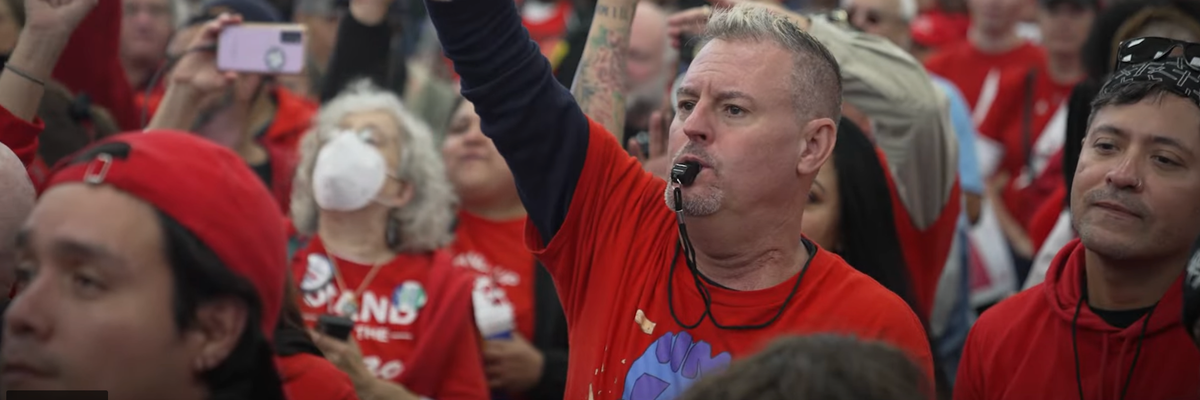
United Auto Workers union members are seen rallying in a video the union released on November 29, 2023 as part of a massive organizing effort.
"We've shown the world that this industry is harming workers and consumers to the benefit of company executives and the rich—and it's time that the working class did something about it," said the UAW president.
Days after unionized workers at the Big Three automakers voted to ratify their new contracts—secured after the United Auto Workers staged an innovative "stand up strike" that lasted six weeks—the union made clear on Wednesday it has no plans to stop its fight for economic justice for thousands of workers at car manufacturing plants across the United States.
Urging all autoworkers in the U.S. to "stand up," the UAW launched what pro-labor media organization More Perfect Union called "the largest organizing drive in modern American history," aiming to bring 150,000 employees at 13 nonunion auto companies into the union.
The UAW announced its campaign with the launch of a new website detailing the skyrocketing profits and CEO pay at firms including Germany's Volkswagen and Mercedes; Japanese and Korean manufacturers Toyota, Hyundai, and Mazda; and U.S. electric car companies Tesla and Lucid.
At Toyota, for example, top executives have enjoyed a 125% increase in pay as profits have soared 30% in the last decade—but the company is firmly against unionization, offering a 9% raise to nonunion workers shortly after the UAW secured its new contracts, which include a 25% raise over the four-and-a-half year agreement.
Tesla, headed by the world's richest man, Elon Musk, has doubled its U.S. production since 2020, but the company also remains staunchly anti-union—and Mercedes' profits have grown by 200% in recent years, but this year the company "spent $1.9 billion on stock buybacks instead of sharing those record profits with their workforce," said the UAW.
In a video posted on the union's website, UAW president Shawn Fain urged workers at the 13 nonunion manufacturers to "stand up and win [their] fair share."
"We've shown the world that this industry is harming workers and consumers to the benefit of company executives and the rich—and it's time that the working class did something about it," said Fain. "To all the autoworkers out there working without the benefit of a union, now it's your turn."
Fain said autoworkers from across the country have been reaching out to the union since it began its stand up strike, in which workers at a few auto plants at a time were called to join the work stoppage in order to preserve the union's strike fund and gradually show the Big Three the impact of the growing strike.
"We've lost so much since I started here, and the raise won't make up for that," said Jeff Allen, a worker at Toyota's Georgetown plant in Kentucky—one of several states where Republicans have passed union-weakening "right-to-work" laws. "A union contract is the only way to win what's fair."
Autoworkers across the U.S. "don't have to like paycheck to paycheck," Fain said in the video, emphasizing that "the money is there."
"You don't have to worry about how you're gonna pay your rent or feed your family while the company makes billions," he added. "A better life is out there. It starts with you—UAW."
Dear Common Dreams reader, It’s been nearly 30 years since I co-founded Common Dreams with my late wife, Lina Newhouser. We had the radical notion that journalism should serve the public good, not corporate profits. It was clear to us from the outset what it would take to build such a project. No paid advertisements. No corporate sponsors. No millionaire publisher telling us what to think or do. Many people said we wouldn't last a year, but we proved those doubters wrong. Together with a tremendous team of journalists and dedicated staff, we built an independent media outlet free from the constraints of profits and corporate control. Our mission has always been simple: To inform. To inspire. To ignite change for the common good. Building Common Dreams was not easy. Our survival was never guaranteed. When you take on the most powerful forces—Wall Street greed, fossil fuel industry destruction, Big Tech lobbyists, and uber-rich oligarchs who have spent billions upon billions rigging the economy and democracy in their favor—the only bulwark you have is supporters who believe in your work. But here’s the urgent message from me today. It's never been this bad out there. And it's never been this hard to keep us going. At the very moment Common Dreams is most needed, the threats we face are intensifying. We need your support now more than ever. We don't accept corporate advertising and never will. We don't have a paywall because we don't think people should be blocked from critical news based on their ability to pay. Everything we do is funded by the donations of readers like you. When everyone does the little they can afford, we are strong. But if that support retreats or dries up, so do we. Will you donate now to make sure Common Dreams not only survives but thrives? —Craig Brown, Co-founder |
Days after unionized workers at the Big Three automakers voted to ratify their new contracts—secured after the United Auto Workers staged an innovative "stand up strike" that lasted six weeks—the union made clear on Wednesday it has no plans to stop its fight for economic justice for thousands of workers at car manufacturing plants across the United States.
Urging all autoworkers in the U.S. to "stand up," the UAW launched what pro-labor media organization More Perfect Union called "the largest organizing drive in modern American history," aiming to bring 150,000 employees at 13 nonunion auto companies into the union.
The UAW announced its campaign with the launch of a new website detailing the skyrocketing profits and CEO pay at firms including Germany's Volkswagen and Mercedes; Japanese and Korean manufacturers Toyota, Hyundai, and Mazda; and U.S. electric car companies Tesla and Lucid.
At Toyota, for example, top executives have enjoyed a 125% increase in pay as profits have soared 30% in the last decade—but the company is firmly against unionization, offering a 9% raise to nonunion workers shortly after the UAW secured its new contracts, which include a 25% raise over the four-and-a-half year agreement.
Tesla, headed by the world's richest man, Elon Musk, has doubled its U.S. production since 2020, but the company also remains staunchly anti-union—and Mercedes' profits have grown by 200% in recent years, but this year the company "spent $1.9 billion on stock buybacks instead of sharing those record profits with their workforce," said the UAW.
In a video posted on the union's website, UAW president Shawn Fain urged workers at the 13 nonunion manufacturers to "stand up and win [their] fair share."
"We've shown the world that this industry is harming workers and consumers to the benefit of company executives and the rich—and it's time that the working class did something about it," said Fain. "To all the autoworkers out there working without the benefit of a union, now it's your turn."
Fain said autoworkers from across the country have been reaching out to the union since it began its stand up strike, in which workers at a few auto plants at a time were called to join the work stoppage in order to preserve the union's strike fund and gradually show the Big Three the impact of the growing strike.
"We've lost so much since I started here, and the raise won't make up for that," said Jeff Allen, a worker at Toyota's Georgetown plant in Kentucky—one of several states where Republicans have passed union-weakening "right-to-work" laws. "A union contract is the only way to win what's fair."
Autoworkers across the U.S. "don't have to like paycheck to paycheck," Fain said in the video, emphasizing that "the money is there."
"You don't have to worry about how you're gonna pay your rent or feed your family while the company makes billions," he added. "A better life is out there. It starts with you—UAW."
Days after unionized workers at the Big Three automakers voted to ratify their new contracts—secured after the United Auto Workers staged an innovative "stand up strike" that lasted six weeks—the union made clear on Wednesday it has no plans to stop its fight for economic justice for thousands of workers at car manufacturing plants across the United States.
Urging all autoworkers in the U.S. to "stand up," the UAW launched what pro-labor media organization More Perfect Union called "the largest organizing drive in modern American history," aiming to bring 150,000 employees at 13 nonunion auto companies into the union.
The UAW announced its campaign with the launch of a new website detailing the skyrocketing profits and CEO pay at firms including Germany's Volkswagen and Mercedes; Japanese and Korean manufacturers Toyota, Hyundai, and Mazda; and U.S. electric car companies Tesla and Lucid.
At Toyota, for example, top executives have enjoyed a 125% increase in pay as profits have soared 30% in the last decade—but the company is firmly against unionization, offering a 9% raise to nonunion workers shortly after the UAW secured its new contracts, which include a 25% raise over the four-and-a-half year agreement.
Tesla, headed by the world's richest man, Elon Musk, has doubled its U.S. production since 2020, but the company also remains staunchly anti-union—and Mercedes' profits have grown by 200% in recent years, but this year the company "spent $1.9 billion on stock buybacks instead of sharing those record profits with their workforce," said the UAW.
In a video posted on the union's website, UAW president Shawn Fain urged workers at the 13 nonunion manufacturers to "stand up and win [their] fair share."
"We've shown the world that this industry is harming workers and consumers to the benefit of company executives and the rich—and it's time that the working class did something about it," said Fain. "To all the autoworkers out there working without the benefit of a union, now it's your turn."
Fain said autoworkers from across the country have been reaching out to the union since it began its stand up strike, in which workers at a few auto plants at a time were called to join the work stoppage in order to preserve the union's strike fund and gradually show the Big Three the impact of the growing strike.
"We've lost so much since I started here, and the raise won't make up for that," said Jeff Allen, a worker at Toyota's Georgetown plant in Kentucky—one of several states where Republicans have passed union-weakening "right-to-work" laws. "A union contract is the only way to win what's fair."
Autoworkers across the U.S. "don't have to like paycheck to paycheck," Fain said in the video, emphasizing that "the money is there."
"You don't have to worry about how you're gonna pay your rent or feed your family while the company makes billions," he added. "A better life is out there. It starts with you—UAW."