

SUBSCRIBE TO OUR FREE NEWSLETTER
Daily news & progressive opinion—funded by the people, not the corporations—delivered straight to your inbox.
5
#000000
#FFFFFF
To donate by check, phone, or other method, see our More Ways to Give page.
Daily news & progressive opinion—funded by the people, not the corporations—delivered straight to your inbox.
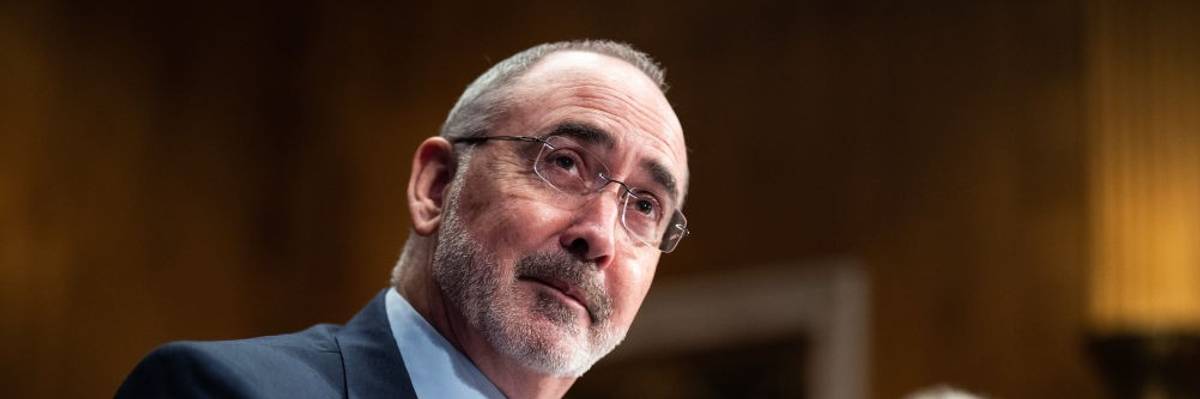
Shawn Fain, president of the United Auto Workers, testifies during a U.S. Senate Health, Education, Labor, and Pensions hearing on March 14, 2024 in Washington, D.C.
Shawn Fain slammed "the Wall Street freeloaders, the masters of passive income," for "how little they contribute to humanity."
United Auto Workers president Shawn Fain on Thursday made clear to a key U.S. Senate panel that working-class people nationwide are deeply frustrated with the "epidemic of lives dominated by work" and the fight for livable wages while executive compensation continues to climb.
"Are the employers gonna act? Will Congress act? How can working-class people take back their lives, and take back their time?" Fain asked during a Senate Health, Education, Labor, and Pensions (HELP) Committee hearing on a 32-hour workweek. "And I know what people and many in this room will say. They'll say, 'People just don't want to work,' or, 'Working-class people are lazy.'"
"But the truth is, working-class people aren't lazy, they're fed up. They're fed up with being left behind and stripped of dignity as wealth inequality in this nation, this world, spirals out of control," he continued. "They're fed up that in America... three families have as much wealth as the bottom 50% of citizens in this nation. That is criminal. America is better than this."
"So, I want to close with this: I agree there is an epidemic in this country of people who don't want to work; people who can't be bothered to get up every day and contribute to our society, but instead want to freeload off the labor of others," Fain added. "But those aren't blue-collar people; those aren't the working-class people. It's a group of people who are never talked about for how little they actually work and produce, and how little they contribute to humanity. The people I'm talking about are the Wall Street freeloaders, the masters of passive income."
The UAW leader stressed that "those who profit off the labor of others have all the time in the world, while those who make this country run, the people who build the products and contribute to labor, have less and less time for themselves, for their families, and for their lives. So our union's gonna continue to fight for the rights of working-class people to take back their lives, and take back their time, and we ask you to stand up with the American workers and support us in that mission."
After nearly seven minutes of opening remarks that led some to urge Fain to consider someday running for a political office in the United States, the UAW president took questions from Senate HELP Committee Chair Bernie Sanders (I-Vt.) and other members of the panel, touching on topics including what it is like to work in a factory, corporate greed, and work-life balance.
When Sanders announced the hearing on a shorter workweek, he noted that U.S. workers "are over 400% more productive than they were in the 1940s," but work longer hours for lower wages. He argued that "the financial gains from the major advancements in artificial intelligence, automation, and new technology must benefit the working class, not just corporate CEOs and wealthy stockholders on Wall Street."
While the senator has been a friend to the UAW, backing its strike last year and previously inviting Fain to testify to the panel, the union chief in recent months has repeatedly taken aim at billionaires and anti-worker politicians, including former Republican President Donald Trump, who is set to face UAW-endorsed President Joe Biden in November.
"Donald Trump is a scab," Fain declared in January when the UAW officially backed Biden—who, during the union's walkouts, became the first sitting president to join striking workers on the picket line. "Donald Trump is a billionaire, and that's who he represents... Donald Trump stands against everything we stand for as a union, as a society."
Since the UAW's "Stand Up Strike" led to new contracts with the "Big Three" automakers—Ford, General Motors, and Stellantis—that contain pay raises and other improvements for workers, the union has launched the largest organizing drive in U.S. history.
The new auto contracts are set to expire in April 2028, which was strategically chosen to coincide with International Workers' Day, to enable unions to "begin to flex our collective muscles," Fain
explained. "Even though May Day has its roots here in the United States, it is widely celebrated by workers all over the world. It's more than just a day of commemoration, it's a call to action."
Dear Common Dreams reader, It’s been nearly 30 years since I co-founded Common Dreams with my late wife, Lina Newhouser. We had the radical notion that journalism should serve the public good, not corporate profits. It was clear to us from the outset what it would take to build such a project. No paid advertisements. No corporate sponsors. No millionaire publisher telling us what to think or do. Many people said we wouldn't last a year, but we proved those doubters wrong. Together with a tremendous team of journalists and dedicated staff, we built an independent media outlet free from the constraints of profits and corporate control. Our mission has always been simple: To inform. To inspire. To ignite change for the common good. Building Common Dreams was not easy. Our survival was never guaranteed. When you take on the most powerful forces—Wall Street greed, fossil fuel industry destruction, Big Tech lobbyists, and uber-rich oligarchs who have spent billions upon billions rigging the economy and democracy in their favor—the only bulwark you have is supporters who believe in your work. But here’s the urgent message from me today. It's never been this bad out there. And it's never been this hard to keep us going. At the very moment Common Dreams is most needed, the threats we face are intensifying. We need your support now more than ever. We don't accept corporate advertising and never will. We don't have a paywall because we don't think people should be blocked from critical news based on their ability to pay. Everything we do is funded by the donations of readers like you. When everyone does the little they can afford, we are strong. But if that support retreats or dries up, so do we. Will you donate now to make sure Common Dreams not only survives but thrives? —Craig Brown, Co-founder |
United Auto Workers president Shawn Fain on Thursday made clear to a key U.S. Senate panel that working-class people nationwide are deeply frustrated with the "epidemic of lives dominated by work" and the fight for livable wages while executive compensation continues to climb.
"Are the employers gonna act? Will Congress act? How can working-class people take back their lives, and take back their time?" Fain asked during a Senate Health, Education, Labor, and Pensions (HELP) Committee hearing on a 32-hour workweek. "And I know what people and many in this room will say. They'll say, 'People just don't want to work,' or, 'Working-class people are lazy.'"
"But the truth is, working-class people aren't lazy, they're fed up. They're fed up with being left behind and stripped of dignity as wealth inequality in this nation, this world, spirals out of control," he continued. "They're fed up that in America... three families have as much wealth as the bottom 50% of citizens in this nation. That is criminal. America is better than this."
"So, I want to close with this: I agree there is an epidemic in this country of people who don't want to work; people who can't be bothered to get up every day and contribute to our society, but instead want to freeload off the labor of others," Fain added. "But those aren't blue-collar people; those aren't the working-class people. It's a group of people who are never talked about for how little they actually work and produce, and how little they contribute to humanity. The people I'm talking about are the Wall Street freeloaders, the masters of passive income."
The UAW leader stressed that "those who profit off the labor of others have all the time in the world, while those who make this country run, the people who build the products and contribute to labor, have less and less time for themselves, for their families, and for their lives. So our union's gonna continue to fight for the rights of working-class people to take back their lives, and take back their time, and we ask you to stand up with the American workers and support us in that mission."
After nearly seven minutes of opening remarks that led some to urge Fain to consider someday running for a political office in the United States, the UAW president took questions from Senate HELP Committee Chair Bernie Sanders (I-Vt.) and other members of the panel, touching on topics including what it is like to work in a factory, corporate greed, and work-life balance.
When Sanders announced the hearing on a shorter workweek, he noted that U.S. workers "are over 400% more productive than they were in the 1940s," but work longer hours for lower wages. He argued that "the financial gains from the major advancements in artificial intelligence, automation, and new technology must benefit the working class, not just corporate CEOs and wealthy stockholders on Wall Street."
While the senator has been a friend to the UAW, backing its strike last year and previously inviting Fain to testify to the panel, the union chief in recent months has repeatedly taken aim at billionaires and anti-worker politicians, including former Republican President Donald Trump, who is set to face UAW-endorsed President Joe Biden in November.
"Donald Trump is a scab," Fain declared in January when the UAW officially backed Biden—who, during the union's walkouts, became the first sitting president to join striking workers on the picket line. "Donald Trump is a billionaire, and that's who he represents... Donald Trump stands against everything we stand for as a union, as a society."
Since the UAW's "Stand Up Strike" led to new contracts with the "Big Three" automakers—Ford, General Motors, and Stellantis—that contain pay raises and other improvements for workers, the union has launched the largest organizing drive in U.S. history.
The new auto contracts are set to expire in April 2028, which was strategically chosen to coincide with International Workers' Day, to enable unions to "begin to flex our collective muscles," Fain
explained. "Even though May Day has its roots here in the United States, it is widely celebrated by workers all over the world. It's more than just a day of commemoration, it's a call to action."
United Auto Workers president Shawn Fain on Thursday made clear to a key U.S. Senate panel that working-class people nationwide are deeply frustrated with the "epidemic of lives dominated by work" and the fight for livable wages while executive compensation continues to climb.
"Are the employers gonna act? Will Congress act? How can working-class people take back their lives, and take back their time?" Fain asked during a Senate Health, Education, Labor, and Pensions (HELP) Committee hearing on a 32-hour workweek. "And I know what people and many in this room will say. They'll say, 'People just don't want to work,' or, 'Working-class people are lazy.'"
"But the truth is, working-class people aren't lazy, they're fed up. They're fed up with being left behind and stripped of dignity as wealth inequality in this nation, this world, spirals out of control," he continued. "They're fed up that in America... three families have as much wealth as the bottom 50% of citizens in this nation. That is criminal. America is better than this."
"So, I want to close with this: I agree there is an epidemic in this country of people who don't want to work; people who can't be bothered to get up every day and contribute to our society, but instead want to freeload off the labor of others," Fain added. "But those aren't blue-collar people; those aren't the working-class people. It's a group of people who are never talked about for how little they actually work and produce, and how little they contribute to humanity. The people I'm talking about are the Wall Street freeloaders, the masters of passive income."
The UAW leader stressed that "those who profit off the labor of others have all the time in the world, while those who make this country run, the people who build the products and contribute to labor, have less and less time for themselves, for their families, and for their lives. So our union's gonna continue to fight for the rights of working-class people to take back their lives, and take back their time, and we ask you to stand up with the American workers and support us in that mission."
After nearly seven minutes of opening remarks that led some to urge Fain to consider someday running for a political office in the United States, the UAW president took questions from Senate HELP Committee Chair Bernie Sanders (I-Vt.) and other members of the panel, touching on topics including what it is like to work in a factory, corporate greed, and work-life balance.
When Sanders announced the hearing on a shorter workweek, he noted that U.S. workers "are over 400% more productive than they were in the 1940s," but work longer hours for lower wages. He argued that "the financial gains from the major advancements in artificial intelligence, automation, and new technology must benefit the working class, not just corporate CEOs and wealthy stockholders on Wall Street."
While the senator has been a friend to the UAW, backing its strike last year and previously inviting Fain to testify to the panel, the union chief in recent months has repeatedly taken aim at billionaires and anti-worker politicians, including former Republican President Donald Trump, who is set to face UAW-endorsed President Joe Biden in November.
"Donald Trump is a scab," Fain declared in January when the UAW officially backed Biden—who, during the union's walkouts, became the first sitting president to join striking workers on the picket line. "Donald Trump is a billionaire, and that's who he represents... Donald Trump stands against everything we stand for as a union, as a society."
Since the UAW's "Stand Up Strike" led to new contracts with the "Big Three" automakers—Ford, General Motors, and Stellantis—that contain pay raises and other improvements for workers, the union has launched the largest organizing drive in U.S. history.
The new auto contracts are set to expire in April 2028, which was strategically chosen to coincide with International Workers' Day, to enable unions to "begin to flex our collective muscles," Fain
explained. "Even though May Day has its roots here in the United States, it is widely celebrated by workers all over the world. It's more than just a day of commemoration, it's a call to action."

