SUBSCRIBE TO OUR FREE NEWSLETTER
Daily news & progressive opinion—funded by the people, not the corporations—delivered straight to your inbox.
5
#000000
#FFFFFF
To donate by check, phone, or other method, see our More Ways to Give page.
Daily news & progressive opinion—funded by the people, not the corporations—delivered straight to your inbox.
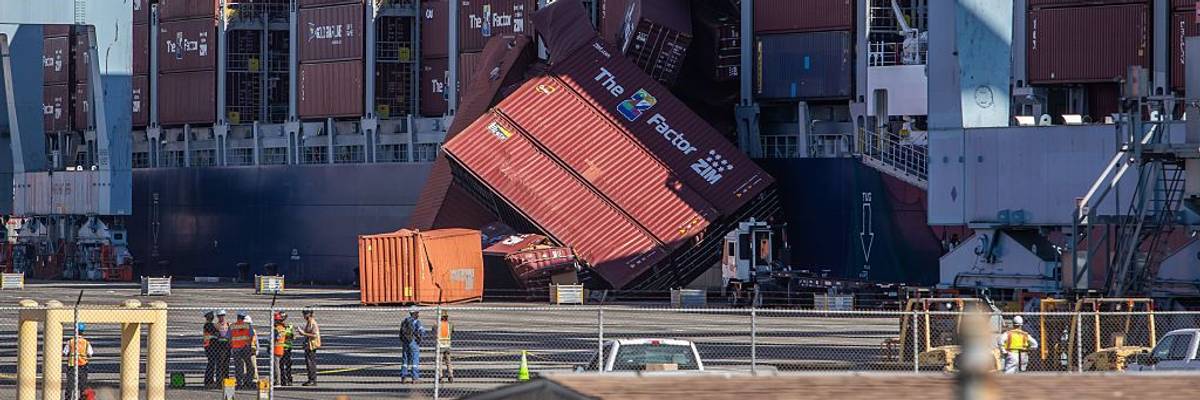
Dozens of fallen shipping containers are seen next to the Portugal-registered ship Mississippi Madera at the Port of Long Beach on September 9, 2025 in Long Beach, California.
The trade deficit has grown and the US has lost manufacturing jobs during the first nine months of Trump's second term.
A new analysis from the Economic Policy Institute claims that the signature trade deal from President Donald Trump's first term has actually "created more problems than it fixed."
The report, published Thursday, notes that the United States-Mexico-Canada Agreement (USMCA), signed into law by Trump in 2020, has completely failed to fulfill Trump's stated goal of lowering the US trade deficit with Canada and Mexico, which has grown from a combined $125 billion in 2020 to $263 billion in 2025.
This increased trade deficit was particularly notable when it comes to the auto industry, says the report, written by EPI senior economist Adam S. Hersh.
"In the critical automotive industry that Trump said he wanted to reshore, imports of motor vehicles and parts from Mexico nearly doubled following USMCA, rising to $274 billion in 2024, up from $196 billion in 2019," the report explains. "Light-duty vehicles imports from Mexico rose 36% while imports of medium- and heavy-duty vehicles increased a whopping 256%."
The report also finds that the trade deal "left a gaping loophole for Chinese manufacturers to exploit duty-free access to North American markets without reciprocal market access for US manufacturers," the result of which was "Chinese firms expanded their direct investment footprint in Mexico by as much as 288% through 2023."
The bottom line, says the report, is "Trump’s USMCA created more problems than it fixed," and that "today the pressure on manufacturing jobs and deterioration in the trade balance with Mexico are worse than before USMCA."
However, the report also says that the US, Canada, and Mexico have an opportunity to significantly improve on USMCA given that the deal is up for review next year.
Among other things, the report recommends closing the loopholes that have allowed Chinese manufacturers to rapidly expand their footprint in Mexico; expanding the the Rapid Response Labor Mechanism that "has helped improve wages and working conditions in a number of specific workplaces"; and slashing intellectual property rights provisions that "currently allow companies to preempt local laws addressing negative externalities from digital service provision."
The EPI report came on the same day that American Economic Liberties Project's Rethink Trade program released an analysis showing that Trump so far has failed to live up to his pledge to reduce the US trade deficit and revive domestic manufacturing.
In all, Rethink Trade found that the US trade deficit increased more during the first nine months of 2025 than it did during the first nine months of 2024. Additionally, the group found that the US has actually lost 49,000 manufacturing jobs since the start of Trump's second term.
Lori Wallach, director of the Rethink Trade program, said that "the nine-month data show outcomes that are the opposite of President Trump’s promises to cut the trade deficit and create more American manufacturing jobs."
She noted that Trump's trade deals so far "seem to prioritize the demands of Big Tech, Big Oil, Big Pharma, and other usual beneficiaries of decades of failed US trade policy instead of fixing the root causes of our huge trade deficit to help American manufacturing workers and firms as he promised."
Dear Common Dreams reader, It’s been nearly 30 years since I co-founded Common Dreams with my late wife, Lina Newhouser. We had the radical notion that journalism should serve the public good, not corporate profits. It was clear to us from the outset what it would take to build such a project. No paid advertisements. No corporate sponsors. No millionaire publisher telling us what to think or do. Many people said we wouldn't last a year, but we proved those doubters wrong. Together with a tremendous team of journalists and dedicated staff, we built an independent media outlet free from the constraints of profits and corporate control. Our mission has always been simple: To inform. To inspire. To ignite change for the common good. Building Common Dreams was not easy. Our survival was never guaranteed. When you take on the most powerful forces—Wall Street greed, fossil fuel industry destruction, Big Tech lobbyists, and uber-rich oligarchs who have spent billions upon billions rigging the economy and democracy in their favor—the only bulwark you have is supporters who believe in your work. But here’s the urgent message from me today. It's never been this bad out there. And it's never been this hard to keep us going. At the very moment Common Dreams is most needed, the threats we face are intensifying. We need your support now more than ever. We don't accept corporate advertising and never will. We don't have a paywall because we don't think people should be blocked from critical news based on their ability to pay. Everything we do is funded by the donations of readers like you. When everyone does the little they can afford, we are strong. But if that support retreats or dries up, so do we. Will you donate now to make sure Common Dreams not only survives but thrives? —Craig Brown, Co-founder |
A new analysis from the Economic Policy Institute claims that the signature trade deal from President Donald Trump's first term has actually "created more problems than it fixed."
The report, published Thursday, notes that the United States-Mexico-Canada Agreement (USMCA), signed into law by Trump in 2020, has completely failed to fulfill Trump's stated goal of lowering the US trade deficit with Canada and Mexico, which has grown from a combined $125 billion in 2020 to $263 billion in 2025.
This increased trade deficit was particularly notable when it comes to the auto industry, says the report, written by EPI senior economist Adam S. Hersh.
"In the critical automotive industry that Trump said he wanted to reshore, imports of motor vehicles and parts from Mexico nearly doubled following USMCA, rising to $274 billion in 2024, up from $196 billion in 2019," the report explains. "Light-duty vehicles imports from Mexico rose 36% while imports of medium- and heavy-duty vehicles increased a whopping 256%."
The report also finds that the trade deal "left a gaping loophole for Chinese manufacturers to exploit duty-free access to North American markets without reciprocal market access for US manufacturers," the result of which was "Chinese firms expanded their direct investment footprint in Mexico by as much as 288% through 2023."
The bottom line, says the report, is "Trump’s USMCA created more problems than it fixed," and that "today the pressure on manufacturing jobs and deterioration in the trade balance with Mexico are worse than before USMCA."
However, the report also says that the US, Canada, and Mexico have an opportunity to significantly improve on USMCA given that the deal is up for review next year.
Among other things, the report recommends closing the loopholes that have allowed Chinese manufacturers to rapidly expand their footprint in Mexico; expanding the the Rapid Response Labor Mechanism that "has helped improve wages and working conditions in a number of specific workplaces"; and slashing intellectual property rights provisions that "currently allow companies to preempt local laws addressing negative externalities from digital service provision."
The EPI report came on the same day that American Economic Liberties Project's Rethink Trade program released an analysis showing that Trump so far has failed to live up to his pledge to reduce the US trade deficit and revive domestic manufacturing.
In all, Rethink Trade found that the US trade deficit increased more during the first nine months of 2025 than it did during the first nine months of 2024. Additionally, the group found that the US has actually lost 49,000 manufacturing jobs since the start of Trump's second term.
Lori Wallach, director of the Rethink Trade program, said that "the nine-month data show outcomes that are the opposite of President Trump’s promises to cut the trade deficit and create more American manufacturing jobs."
She noted that Trump's trade deals so far "seem to prioritize the demands of Big Tech, Big Oil, Big Pharma, and other usual beneficiaries of decades of failed US trade policy instead of fixing the root causes of our huge trade deficit to help American manufacturing workers and firms as he promised."
A new analysis from the Economic Policy Institute claims that the signature trade deal from President Donald Trump's first term has actually "created more problems than it fixed."
The report, published Thursday, notes that the United States-Mexico-Canada Agreement (USMCA), signed into law by Trump in 2020, has completely failed to fulfill Trump's stated goal of lowering the US trade deficit with Canada and Mexico, which has grown from a combined $125 billion in 2020 to $263 billion in 2025.
This increased trade deficit was particularly notable when it comes to the auto industry, says the report, written by EPI senior economist Adam S. Hersh.
"In the critical automotive industry that Trump said he wanted to reshore, imports of motor vehicles and parts from Mexico nearly doubled following USMCA, rising to $274 billion in 2024, up from $196 billion in 2019," the report explains. "Light-duty vehicles imports from Mexico rose 36% while imports of medium- and heavy-duty vehicles increased a whopping 256%."
The report also finds that the trade deal "left a gaping loophole for Chinese manufacturers to exploit duty-free access to North American markets without reciprocal market access for US manufacturers," the result of which was "Chinese firms expanded their direct investment footprint in Mexico by as much as 288% through 2023."
The bottom line, says the report, is "Trump’s USMCA created more problems than it fixed," and that "today the pressure on manufacturing jobs and deterioration in the trade balance with Mexico are worse than before USMCA."
However, the report also says that the US, Canada, and Mexico have an opportunity to significantly improve on USMCA given that the deal is up for review next year.
Among other things, the report recommends closing the loopholes that have allowed Chinese manufacturers to rapidly expand their footprint in Mexico; expanding the the Rapid Response Labor Mechanism that "has helped improve wages and working conditions in a number of specific workplaces"; and slashing intellectual property rights provisions that "currently allow companies to preempt local laws addressing negative externalities from digital service provision."
The EPI report came on the same day that American Economic Liberties Project's Rethink Trade program released an analysis showing that Trump so far has failed to live up to his pledge to reduce the US trade deficit and revive domestic manufacturing.
In all, Rethink Trade found that the US trade deficit increased more during the first nine months of 2025 than it did during the first nine months of 2024. Additionally, the group found that the US has actually lost 49,000 manufacturing jobs since the start of Trump's second term.
Lori Wallach, director of the Rethink Trade program, said that "the nine-month data show outcomes that are the opposite of President Trump’s promises to cut the trade deficit and create more American manufacturing jobs."
She noted that Trump's trade deals so far "seem to prioritize the demands of Big Tech, Big Oil, Big Pharma, and other usual beneficiaries of decades of failed US trade policy instead of fixing the root causes of our huge trade deficit to help American manufacturing workers and firms as he promised."