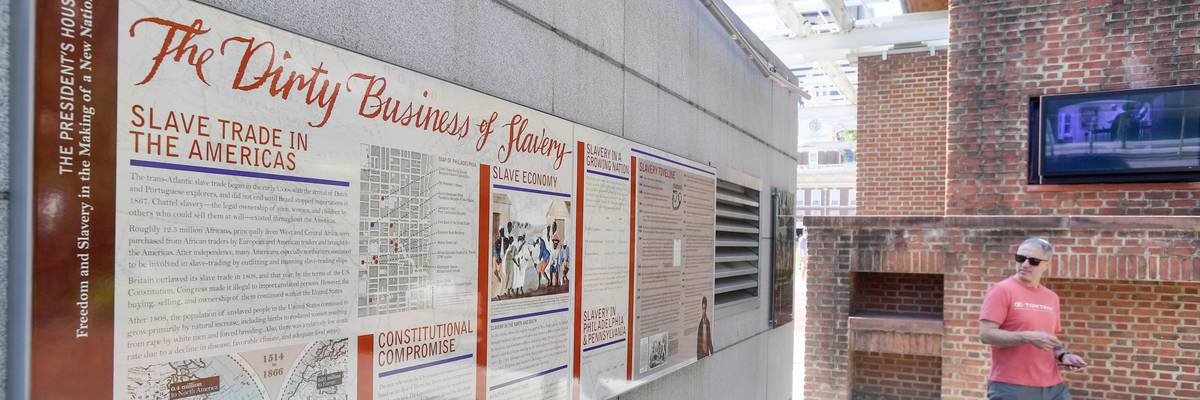
Tourists inspect a display entitled 'The Dirty Business of Slavery' at the President's House on August 9, 2025, in Philadelphia, Pennsylvania.
Philadelphia Sues Over Trump's Removal of Slavery Exhibits From George Washington’s Home
"The message is clear. American history no longer includes all Americans."
The city of Philadelphia has sued the US Department of the Interior and the National Park Service after officials were filmed dismantling exhibits on slavery at the President's House historical site at Independence Park on Thursday.
The lawsuit, filed in federal court by the office of Mayor Cherelle Parker, says “the National Park Service has removed artwork and informational displays" from the site, where George Washington lived as president from 1790 until 1797, in order to follow an executive order signed by President Donald Trump in March, which requires national parks, museums, and monuments to portray an "uplifting" message about American history.
The President's House monument, unveiled in 2010, contained information about nine enslaved people whom Washington brought with him to the nation's "first White House," and Washington's history as a slaveowner. By the time of his death in 1799, there were more than 300 enslaved people at his estate in Mount Vernon, Virginia.
Information about the President's House site and its ties to slavery still remains online. It states:
Washington brought some of his enslaved Africans to this site and they lived and toiled with other members of his household during the years that our first president was guiding the experimental development of the young nation toward modern, republican government...
The president's house in the 1790s was a mirror of the young republic, reflecting both the ideals and contradictions of the new nation. The house stood in the shadow of Independence Hall, where the words "All men are created equal" and "We the People" were adopted, but they did not apply to all who lived in the new United States of America.
A monument acknowledging this history, however, appears to have run afoul of the portion of Trump's order requiring the Interior Secretary to see that sites "do not contain descriptions, depictions, or other content that inappropriately disparage Americans past or living."
As BillyPenn.com reported:
Starting after 3 pm, placards were ripped from the wall around the site with crowbars as people walked by, some heading to the Liberty Bell Center. Signs were unbolted from the poles overlooking the dig site where America’s first “White House” had stood until 1832. They were stacked together alongside a wall, and then taken away around 4:30 pm in a park service truck. No indication was provided where the signs and exhibition parts will go
One of the employees, who did not give his name, told the Philadelphia Inquirer that his supervisor had instructed him to take down the monuments earlier that day.
“I’m just following my orders,” the employee repeatedly said.
In a statement to the Washington Post, Interior Department spokesperson Elizabeth Peace later confirmed that the placards were indeed removed in accordance with the order.
"The president has directed federal agencies to review interpretive materials to ensure accuracy, honesty, and alignment with shared national values,” she said. “Following completion of the required review, the National Park Service is now taking action to remove or revise interpretive materials in accordance with the order."
The city of Philadelphia says it was not given notice about the placards being removed. The lawsuit says their removal was "arbitrary and capricious" and says the “defendants have provided no explanation at all for their removal of the historical, educational displays at the President’s House site, let alone a reasoned one."
In a Facebook post, criminal defense attorney Michael Coard, who pushed for the monument's creation for nearly a decade, called its destruction "historically outrageous and blatantly racist."
It is the latest example of Trump's order being used to justify the removal of monuments related to slavery and Black history in the United States.
The infamous 1863 "Scourged Back" image—a picture of an enslaved man's back with severe whip scars that was used to promote the end of slavery during the Civil War—was removed from the Fort Pulaski National Monument in Georgia in September, along with other information about slavery.
The administration has also removed more than 20 displays at the Smithsonian Museum of American History, some of which dealt with slavery, civil rights, and race relations, a move that came after Trump lamented that the museum put so much focus on "how bad Slavery was."
The National Park Service also deleted information about abolitionist activist Harriet Tubman and many references to slavery from its webpage about the Underground Railroad for months last year, before restoring it following public backlash.
Pages on the Arlington Cemetery website that recognize the contributions of Black and Hispanic soldiers have also been removed.
The order has also led to the removal or alteration of numerous monuments, museum exhibits, and web pages recognizing the achievements or struggles of other racial minority groups, women, LGBTQ+ people, and Native Americans.
In a statement to NBC News, Philadelphia City Council President Kenyatta Johnson said, "Removing the exhibits is an effort to whitewash American history."
"History cannot be erased simply because it is uncomfortable," he added. "Removing items from the President’s House merely changes the landscape, not the historical record."
Daniel Pearson, a columnist for the Philadelphia Inquirer, said: "The message is clear. American history no longer includes all Americans."
We are at a crossroads
This country and this world are at a monumental crossroads. US voters have an opportunity to beat back the forces of fascism and confront the billionaires who are rigging the economy, our media system, and our democracy, making it increasingly impossible for ordinary people to get by. We’re not just talking about the election. We’re talking about what must be done once these fascist elements are vanquished from power. We need a bolder set of solutions than what either major party has so far been willing to offer and a working-class movement ready to fight like hell for it. Trump didn't emerge from nowhere. The conditions that fueled MAGA authoritarianism were created by decades of radical neoliberal economic policies and a corrupt political system dominated by corporate interests. They slashed taxes on the super-rich, promising that the benefits would trickle down. They said giveaways to the corporate titans would make life more affordable for the rest of us. It was all bullshit. And when a bitter, betrayed populace searches for someone to blame, right-wing demagogues have little trouble finding scapegoats. People know when they're being lied to, but you won't hear any of this from the corporate media. Only independent journalism—powered and funded by people who believe in building a better world—can deliver truly trustworthy daily news. Our Fall Campaign is underway, and we need your help. To power our newsroom through the rest of the year, we need to raise $125,000 by midnight on October 31. So if you share our vision, please contribute whatever you can to sustain our work. |
The city of Philadelphia has sued the US Department of the Interior and the National Park Service after officials were filmed dismantling exhibits on slavery at the President's House historical site at Independence Park on Thursday.
The lawsuit, filed in federal court by the office of Mayor Cherelle Parker, says “the National Park Service has removed artwork and informational displays" from the site, where George Washington lived as president from 1790 until 1797, in order to follow an executive order signed by President Donald Trump in March, which requires national parks, museums, and monuments to portray an "uplifting" message about American history.
The President's House monument, unveiled in 2010, contained information about nine enslaved people whom Washington brought with him to the nation's "first White House," and Washington's history as a slaveowner. By the time of his death in 1799, there were more than 300 enslaved people at his estate in Mount Vernon, Virginia.
Information about the President's House site and its ties to slavery still remains online. It states:
Washington brought some of his enslaved Africans to this site and they lived and toiled with other members of his household during the years that our first president was guiding the experimental development of the young nation toward modern, republican government...
The president's house in the 1790s was a mirror of the young republic, reflecting both the ideals and contradictions of the new nation. The house stood in the shadow of Independence Hall, where the words "All men are created equal" and "We the People" were adopted, but they did not apply to all who lived in the new United States of America.
A monument acknowledging this history, however, appears to have run afoul of the portion of Trump's order requiring the Interior Secretary to see that sites "do not contain descriptions, depictions, or other content that inappropriately disparage Americans past or living."
As BillyPenn.com reported:
Starting after 3 pm, placards were ripped from the wall around the site with crowbars as people walked by, some heading to the Liberty Bell Center. Signs were unbolted from the poles overlooking the dig site where America’s first “White House” had stood until 1832. They were stacked together alongside a wall, and then taken away around 4:30 pm in a park service truck. No indication was provided where the signs and exhibition parts will go
One of the employees, who did not give his name, told the Philadelphia Inquirer that his supervisor had instructed him to take down the monuments earlier that day.
“I’m just following my orders,” the employee repeatedly said.
In a statement to the Washington Post, Interior Department spokesperson Elizabeth Peace later confirmed that the placards were indeed removed in accordance with the order.
"The president has directed federal agencies to review interpretive materials to ensure accuracy, honesty, and alignment with shared national values,” she said. “Following completion of the required review, the National Park Service is now taking action to remove or revise interpretive materials in accordance with the order."
The city of Philadelphia says it was not given notice about the placards being removed. The lawsuit says their removal was "arbitrary and capricious" and says the “defendants have provided no explanation at all for their removal of the historical, educational displays at the President’s House site, let alone a reasoned one."
In a Facebook post, criminal defense attorney Michael Coard, who pushed for the monument's creation for nearly a decade, called its destruction "historically outrageous and blatantly racist."
It is the latest example of Trump's order being used to justify the removal of monuments related to slavery and Black history in the United States.
The infamous 1863 "Scourged Back" image—a picture of an enslaved man's back with severe whip scars that was used to promote the end of slavery during the Civil War—was removed from the Fort Pulaski National Monument in Georgia in September, along with other information about slavery.
The administration has also removed more than 20 displays at the Smithsonian Museum of American History, some of which dealt with slavery, civil rights, and race relations, a move that came after Trump lamented that the museum put so much focus on "how bad Slavery was."
The National Park Service also deleted information about abolitionist activist Harriet Tubman and many references to slavery from its webpage about the Underground Railroad for months last year, before restoring it following public backlash.
Pages on the Arlington Cemetery website that recognize the contributions of Black and Hispanic soldiers have also been removed.
The order has also led to the removal or alteration of numerous monuments, museum exhibits, and web pages recognizing the achievements or struggles of other racial minority groups, women, LGBTQ+ people, and Native Americans.
In a statement to NBC News, Philadelphia City Council President Kenyatta Johnson said, "Removing the exhibits is an effort to whitewash American history."
"History cannot be erased simply because it is uncomfortable," he added. "Removing items from the President’s House merely changes the landscape, not the historical record."
Daniel Pearson, a columnist for the Philadelphia Inquirer, said: "The message is clear. American history no longer includes all Americans."