SUBSCRIBE TO OUR FREE NEWSLETTER
Daily news & progressive opinion—funded by the people, not the corporations—delivered straight to your inbox.
5
#000000
#FFFFFF
To donate by check, phone, or other method, see our More Ways to Give page.
Daily news & progressive opinion—funded by the people, not the corporations—delivered straight to your inbox.
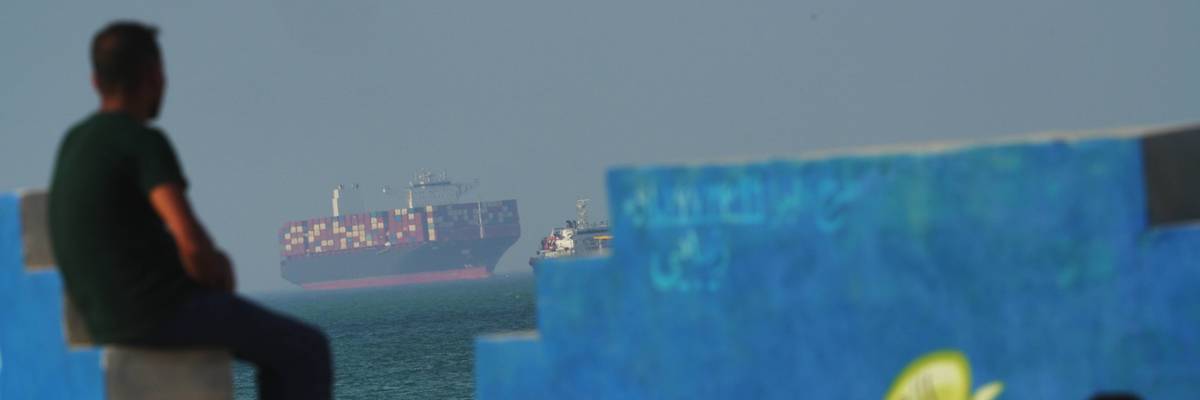
A cargo boat navigates the sea behind a mural depicting the shoreline on April 28, 2026 on Qeshm Island, Iran.
"Any American interference in the new maritime regime of the Strait of Hormuz will be considered a violation of the ceasefire," said a member of the Iranian Parliament.
Iranian officials warned Sunday that US President Donald Trump's newly announced plan to help "guide" stranded ships out of the Strait of Hormuz is an attempted provocation aimed at justifying additional military action against the Middle Eastern country.
An unnamed senior Iranian official told Drop Site that Trump's plan, announced on Truth Social and confirmed by the US military, "is primarily intended to provoke Iran into taking an initial step toward confrontation, thereby creating a pretext for escalation and enabling him to justify further military action in response to an Iranian initiative."
The official added that "our definitive position is that any commercial vessel attempting to transit through designated restricted routes without prior coordination will be promptly intercepted by Iranian forces."
"Should US military vessels respond, such actions would be met with an immediate and corresponding response from Iran," the official continued. "The US military vessels are far from the corridor area. If commercial vessels attempt to move, they would be engaged well before reaching any American ships," the official added. "Trump has effectively turned them into bargaining tools in his political game."
Ebrahim Azizi, who heads the national security commission of the Iranian Parliament, warned in response to Trump's plan that "any American interference in the new maritime regime of the Strait of Hormuz will be considered a violation of the ceasefire" that took effect in early April.
"The Strait of Hormuz and the Persian Gulf would not be managed by Trump's delusional posts," Azizi added.
Trump wrote on his social media platform on Sunday that his administration has told countries with vessels stranded in the vital strait that "we will guide their Ships safely out of these restricted Waterways, so that they can freely and ably get on with their business." Iran closed the strait—through which around 25% of the world's seaborne oil trade and a third of global fertilizer trade flows each year—in response to the US-Israeli war as well as the Trump administration's naval blockade against Iran.
The US president characterized his plan, which is titled Project Freedom and set to take effect on Monday, as a "humanitarian gesture on behalf of the United States," but provided few details on how it would work.
US Central Command (CENTCOM) said in a statement on Sunday that military support for Project Freedom would "include guided-missile destroyers, over 100 land and sea-based aircraft, multi-domain unmanned platforms, and 15,000 servicemembers."
"Last week, the U.S. Department of State announced a new initiative, in partnership with the Department of War, to enhance coordination and information sharing among international partners in support of maritime security in the strait," CENTCOM said. "The Maritime Freedom Construct aims to combine diplomatic action with military coordination, which will be critical during Project Freedom."
Brian Finucane, senior adviser to the US Program at the International Crisis Group, wrote that CENTCOM's statement makes the president's plan "sound like information-sharing backed by a vague threat of military action."
The president's scheme drew immediate support from one of the most vocal boosters of the Iran war, US Sen. Lindsey Graham (R-SC), who said he "totally" agrees with Trump's decision to launch Project Freedom.
"I hope this conflict can end diplomatically," said Graham, "but it is now time to regain freedom of navigation and forcefully respond to Iran if they insist on terrorizing the world."
Dear Common Dreams reader, It’s been nearly 30 years since I co-founded Common Dreams with my late wife, Lina Newhouser. We had the radical notion that journalism should serve the public good, not corporate profits. It was clear to us from the outset what it would take to build such a project. No paid advertisements. No corporate sponsors. No millionaire publisher telling us what to think or do. Many people said we wouldn't last a year, but we proved those doubters wrong. Together with a tremendous team of journalists and dedicated staff, we built an independent media outlet free from the constraints of profits and corporate control. Our mission has always been simple: To inform. To inspire. To ignite change for the common good. Building Common Dreams was not easy. Our survival was never guaranteed. When you take on the most powerful forces—Wall Street greed, fossil fuel industry destruction, Big Tech lobbyists, and uber-rich oligarchs who have spent billions upon billions rigging the economy and democracy in their favor—the only bulwark you have is supporters who believe in your work. But here’s the urgent message from me today. It's never been this bad out there. And it's never been this hard to keep us going. At the very moment Common Dreams is most needed, the threats we face are intensifying. We need your support now more than ever. We don't accept corporate advertising and never will. We don't have a paywall because we don't think people should be blocked from critical news based on their ability to pay. Everything we do is funded by the donations of readers like you. When everyone does the little they can afford, we are strong. But if that support retreats or dries up, so do we. Will you donate now to make sure Common Dreams not only survives but thrives? —Craig Brown, Co-founder |
Iranian officials warned Sunday that US President Donald Trump's newly announced plan to help "guide" stranded ships out of the Strait of Hormuz is an attempted provocation aimed at justifying additional military action against the Middle Eastern country.
An unnamed senior Iranian official told Drop Site that Trump's plan, announced on Truth Social and confirmed by the US military, "is primarily intended to provoke Iran into taking an initial step toward confrontation, thereby creating a pretext for escalation and enabling him to justify further military action in response to an Iranian initiative."
The official added that "our definitive position is that any commercial vessel attempting to transit through designated restricted routes without prior coordination will be promptly intercepted by Iranian forces."
"Should US military vessels respond, such actions would be met with an immediate and corresponding response from Iran," the official continued. "The US military vessels are far from the corridor area. If commercial vessels attempt to move, they would be engaged well before reaching any American ships," the official added. "Trump has effectively turned them into bargaining tools in his political game."
Ebrahim Azizi, who heads the national security commission of the Iranian Parliament, warned in response to Trump's plan that "any American interference in the new maritime regime of the Strait of Hormuz will be considered a violation of the ceasefire" that took effect in early April.
"The Strait of Hormuz and the Persian Gulf would not be managed by Trump's delusional posts," Azizi added.
Trump wrote on his social media platform on Sunday that his administration has told countries with vessels stranded in the vital strait that "we will guide their Ships safely out of these restricted Waterways, so that they can freely and ably get on with their business." Iran closed the strait—through which around 25% of the world's seaborne oil trade and a third of global fertilizer trade flows each year—in response to the US-Israeli war as well as the Trump administration's naval blockade against Iran.
The US president characterized his plan, which is titled Project Freedom and set to take effect on Monday, as a "humanitarian gesture on behalf of the United States," but provided few details on how it would work.
US Central Command (CENTCOM) said in a statement on Sunday that military support for Project Freedom would "include guided-missile destroyers, over 100 land and sea-based aircraft, multi-domain unmanned platforms, and 15,000 servicemembers."
"Last week, the U.S. Department of State announced a new initiative, in partnership with the Department of War, to enhance coordination and information sharing among international partners in support of maritime security in the strait," CENTCOM said. "The Maritime Freedom Construct aims to combine diplomatic action with military coordination, which will be critical during Project Freedom."
Brian Finucane, senior adviser to the US Program at the International Crisis Group, wrote that CENTCOM's statement makes the president's plan "sound like information-sharing backed by a vague threat of military action."
The president's scheme drew immediate support from one of the most vocal boosters of the Iran war, US Sen. Lindsey Graham (R-SC), who said he "totally" agrees with Trump's decision to launch Project Freedom.
"I hope this conflict can end diplomatically," said Graham, "but it is now time to regain freedom of navigation and forcefully respond to Iran if they insist on terrorizing the world."
Iranian officials warned Sunday that US President Donald Trump's newly announced plan to help "guide" stranded ships out of the Strait of Hormuz is an attempted provocation aimed at justifying additional military action against the Middle Eastern country.
An unnamed senior Iranian official told Drop Site that Trump's plan, announced on Truth Social and confirmed by the US military, "is primarily intended to provoke Iran into taking an initial step toward confrontation, thereby creating a pretext for escalation and enabling him to justify further military action in response to an Iranian initiative."
The official added that "our definitive position is that any commercial vessel attempting to transit through designated restricted routes without prior coordination will be promptly intercepted by Iranian forces."
"Should US military vessels respond, such actions would be met with an immediate and corresponding response from Iran," the official continued. "The US military vessels are far from the corridor area. If commercial vessels attempt to move, they would be engaged well before reaching any American ships," the official added. "Trump has effectively turned them into bargaining tools in his political game."
Ebrahim Azizi, who heads the national security commission of the Iranian Parliament, warned in response to Trump's plan that "any American interference in the new maritime regime of the Strait of Hormuz will be considered a violation of the ceasefire" that took effect in early April.
"The Strait of Hormuz and the Persian Gulf would not be managed by Trump's delusional posts," Azizi added.
Trump wrote on his social media platform on Sunday that his administration has told countries with vessels stranded in the vital strait that "we will guide their Ships safely out of these restricted Waterways, so that they can freely and ably get on with their business." Iran closed the strait—through which around 25% of the world's seaborne oil trade and a third of global fertilizer trade flows each year—in response to the US-Israeli war as well as the Trump administration's naval blockade against Iran.
The US president characterized his plan, which is titled Project Freedom and set to take effect on Monday, as a "humanitarian gesture on behalf of the United States," but provided few details on how it would work.
US Central Command (CENTCOM) said in a statement on Sunday that military support for Project Freedom would "include guided-missile destroyers, over 100 land and sea-based aircraft, multi-domain unmanned platforms, and 15,000 servicemembers."
"Last week, the U.S. Department of State announced a new initiative, in partnership with the Department of War, to enhance coordination and information sharing among international partners in support of maritime security in the strait," CENTCOM said. "The Maritime Freedom Construct aims to combine diplomatic action with military coordination, which will be critical during Project Freedom."
Brian Finucane, senior adviser to the US Program at the International Crisis Group, wrote that CENTCOM's statement makes the president's plan "sound like information-sharing backed by a vague threat of military action."
The president's scheme drew immediate support from one of the most vocal boosters of the Iran war, US Sen. Lindsey Graham (R-SC), who said he "totally" agrees with Trump's decision to launch Project Freedom.
"I hope this conflict can end diplomatically," said Graham, "but it is now time to regain freedom of navigation and forcefully respond to Iran if they insist on terrorizing the world."