
Trump Declares Iran War 'Very Complete, Pretty Much' Days After Demanding 'Total Surrender'
"The Trump administration is admitting that they have strategically failed and this has been a disaster," said one foreign policy expert.
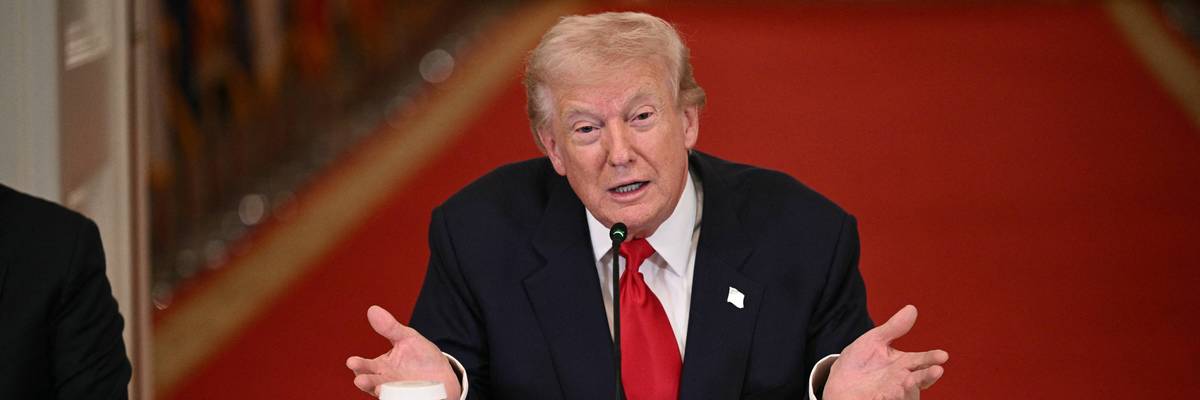
President Donald Trump signaled on Monday that he's nearly done with his unprovoked and unconstitutional war against Iran, despite declaring mere days ago that he would only accept the country's "unconditional surrender."
In an interview with CBS News' Weijia Jiang, Trump said that the Iran war is "very complete, pretty much," then falsely claimed that US and Israeli strikes had eliminated Iran's navy and even its ability to communicate.
Jiang's reporting on Trump's declaration that the war was nearly over came just one hour after the US Department of Defense (DOD) posted a message on social media declaring, "We have Only Just Begun to Fight."
Additionally, noted journalist Yashar Ali, CBS News' "60 Minutes" aired an interview with Defense Secretary Pete Hegseth on Sunday in which he said that the war was still in its early days.
The president's abrupt shift in rhetoric about the war came hours after the prices of both Brent crude oil and WTI crude oil futures surged past $100 per barrel, as countries across the Middle East announced production cuts in the wake of chaos and destruction caused by the Iran war.
The impact of the price surge on the US stock market was immediate, as the Dow Jones Industrial Average opened Monday trading down by more than 600 points, while the Nasdaq dropped by 300 points.
In the wake of Trump's statement about the war being "pretty much" complete, shares on the US stock market rallied and oil futures began to drop.
Trump administration officials said that the initial goal of the attack was ending Iran's uranium enrichment program—and while they claimed it wasn't a "regime change" war, the president last month urged Iranians to "take over" their government. However, Secretary of State Marco Rubio on Monday outlined a more modest set of goals that included destroying its navy and its missile launch capacity.
Phillips O'Brien, professor of strategic studies at the University of St Andrews in Scotland, argued that this set of goals showed "the Trump administration is admitting that they have strategically failed and this has been a disaster."
Political scientist Ian Bremmer also took note of Rubio's revised goals and said they make "declaring victory and ending war with Iran much easier."
However, just because Trump is saying he thinks the war is almost over doesn't mean that it will end soon. Iran has still shut the Strait of Hormuz, and it maintains the ability to launch drone attacks on energy infrastructure throughout the Middle East.
We are at a crossroads
This country and this world are at a monumental crossroads. In a few short weeks, US voters will have an opportunity to beat back the forces of fascism and confront the billionaires who are rigging the economy, our media system, and our democracy, making it increasingly impossible for ordinary people to get by. We’re not just talking about the election. We’re talking about what must be done once these fascist elements are vanquished from power. We need a bolder set of solutions than what either major party has so far been willing to offer and a working-class movement ready to fight like hell for it. Trump didn't emerge from nowhere. The conditions that fueled MAGA authoritarianism were created by decades of radical neoliberal economic policies and a corrupt political system dominated by corporate interests. They slashed taxes on the super-rich, promising that the benefits would trickle down. They said giveaways to the corporate titans would make life more affordable for the rest of us. It was all bullshit. And when a bitter, betrayed populace searches for someone to blame, right-wing demagogues have little trouble finding scapegoats. People know when they're being lied to, but you won't hear any of this from the corporate media. Only independent journalism—powered and funded by people who believe in building a better world—can deliver truly trustworthy daily news. Our Fall Campaign is underway, and we need your help. To power our newsroom through the rest of the year, we need to raise $125,000 by midnight on October 31. So if you share our vision, please contribute whatever you can to sustain our work. |
President Donald Trump signaled on Monday that he's nearly done with his unprovoked and unconstitutional war against Iran, despite declaring mere days ago that he would only accept the country's "unconditional surrender."
In an interview with CBS News' Weijia Jiang, Trump said that the Iran war is "very complete, pretty much," then falsely claimed that US and Israeli strikes had eliminated Iran's navy and even its ability to communicate.
Jiang's reporting on Trump's declaration that the war was nearly over came just one hour after the US Department of Defense (DOD) posted a message on social media declaring, "We have Only Just Begun to Fight."
Additionally, noted journalist Yashar Ali, CBS News' "60 Minutes" aired an interview with Defense Secretary Pete Hegseth on Sunday in which he said that the war was still in its early days.
The president's abrupt shift in rhetoric about the war came hours after the prices of both Brent crude oil and WTI crude oil futures surged past $100 per barrel, as countries across the Middle East announced production cuts in the wake of chaos and destruction caused by the Iran war.
The impact of the price surge on the US stock market was immediate, as the Dow Jones Industrial Average opened Monday trading down by more than 600 points, while the Nasdaq dropped by 300 points.
In the wake of Trump's statement about the war being "pretty much" complete, shares on the US stock market rallied and oil futures began to drop.
Trump administration officials said that the initial goal of the attack was ending Iran's uranium enrichment program—and while they claimed it wasn't a "regime change" war, the president last month urged Iranians to "take over" their government. However, Secretary of State Marco Rubio on Monday outlined a more modest set of goals that included destroying its navy and its missile launch capacity.
Phillips O'Brien, professor of strategic studies at the University of St Andrews in Scotland, argued that this set of goals showed "the Trump administration is admitting that they have strategically failed and this has been a disaster."
Political scientist Ian Bremmer also took note of Rubio's revised goals and said they make "declaring victory and ending war with Iran much easier."
However, just because Trump is saying he thinks the war is almost over doesn't mean that it will end soon. Iran has still shut the Strait of Hormuz, and it maintains the ability to launch drone attacks on energy infrastructure throughout the Middle East.
- Competing Dem War Powers Resolution Would Give Trump a Monthlong Free Pass in Iran ›
- Rubio Suggests Trump Joined Israel's Planned Attack on Iran Instead of Stopping It ›
- After Classified Iran Briefing, Dems More Convinced Trump Wants Ground Invasion and Forever War ›
- Opinion | Is Trump's Iran War the US Version of the Suez Crisis? | Common Dreams ›
- US Military Reportedly Feeds Trump a Daily Propaganda Reel of ‘Stuff Blowing Up’ in Iran | Common Dreams ›
- As Trump Prepares Iran Ground Assault, Expert Warns He's 'Run Out of Options' for Victory | Common Dreams ›
- Opinion | Trump's Iran War Is Exactly the Kind of Military Misadventure That Ends Empires | Common Dreams ›
- Anyone Still Arguing Trump's Iran War Isn't Illegal Will Soon Be Out of Excuses: Legal Scholar | Common Dreams ›
- GOP Hawks Alarmed as Trump Mulls Deal to End His Illegal Iran War | Common Dreams ›
President Donald Trump signaled on Monday that he's nearly done with his unprovoked and unconstitutional war against Iran, despite declaring mere days ago that he would only accept the country's "unconditional surrender."
In an interview with CBS News' Weijia Jiang, Trump said that the Iran war is "very complete, pretty much," then falsely claimed that US and Israeli strikes had eliminated Iran's navy and even its ability to communicate.
Jiang's reporting on Trump's declaration that the war was nearly over came just one hour after the US Department of Defense (DOD) posted a message on social media declaring, "We have Only Just Begun to Fight."
Additionally, noted journalist Yashar Ali, CBS News' "60 Minutes" aired an interview with Defense Secretary Pete Hegseth on Sunday in which he said that the war was still in its early days.
The president's abrupt shift in rhetoric about the war came hours after the prices of both Brent crude oil and WTI crude oil futures surged past $100 per barrel, as countries across the Middle East announced production cuts in the wake of chaos and destruction caused by the Iran war.
The impact of the price surge on the US stock market was immediate, as the Dow Jones Industrial Average opened Monday trading down by more than 600 points, while the Nasdaq dropped by 300 points.
In the wake of Trump's statement about the war being "pretty much" complete, shares on the US stock market rallied and oil futures began to drop.
Trump administration officials said that the initial goal of the attack was ending Iran's uranium enrichment program—and while they claimed it wasn't a "regime change" war, the president last month urged Iranians to "take over" their government. However, Secretary of State Marco Rubio on Monday outlined a more modest set of goals that included destroying its navy and its missile launch capacity.
Phillips O'Brien, professor of strategic studies at the University of St Andrews in Scotland, argued that this set of goals showed "the Trump administration is admitting that they have strategically failed and this has been a disaster."
Political scientist Ian Bremmer also took note of Rubio's revised goals and said they make "declaring victory and ending war with Iran much easier."
However, just because Trump is saying he thinks the war is almost over doesn't mean that it will end soon. Iran has still shut the Strait of Hormuz, and it maintains the ability to launch drone attacks on energy infrastructure throughout the Middle East.
- Competing Dem War Powers Resolution Would Give Trump a Monthlong Free Pass in Iran ›
- Rubio Suggests Trump Joined Israel's Planned Attack on Iran Instead of Stopping It ›
- After Classified Iran Briefing, Dems More Convinced Trump Wants Ground Invasion and Forever War ›
- Opinion | Is Trump's Iran War the US Version of the Suez Crisis? | Common Dreams ›
- US Military Reportedly Feeds Trump a Daily Propaganda Reel of ‘Stuff Blowing Up’ in Iran | Common Dreams ›
- As Trump Prepares Iran Ground Assault, Expert Warns He's 'Run Out of Options' for Victory | Common Dreams ›
- Opinion | Trump's Iran War Is Exactly the Kind of Military Misadventure That Ends Empires | Common Dreams ›
- Anyone Still Arguing Trump's Iran War Isn't Illegal Will Soon Be Out of Excuses: Legal Scholar | Common Dreams ›
- GOP Hawks Alarmed as Trump Mulls Deal to End His Illegal Iran War | Common Dreams ›