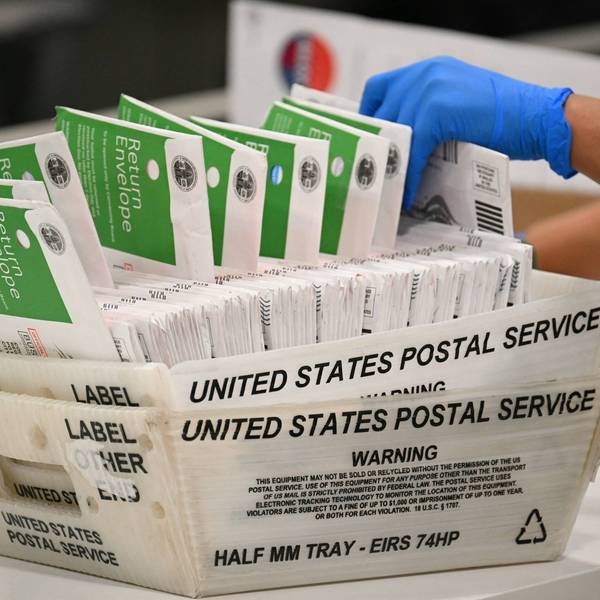
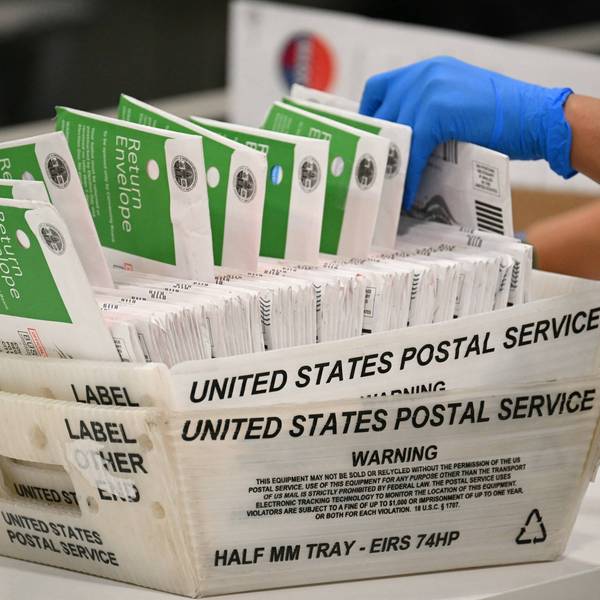
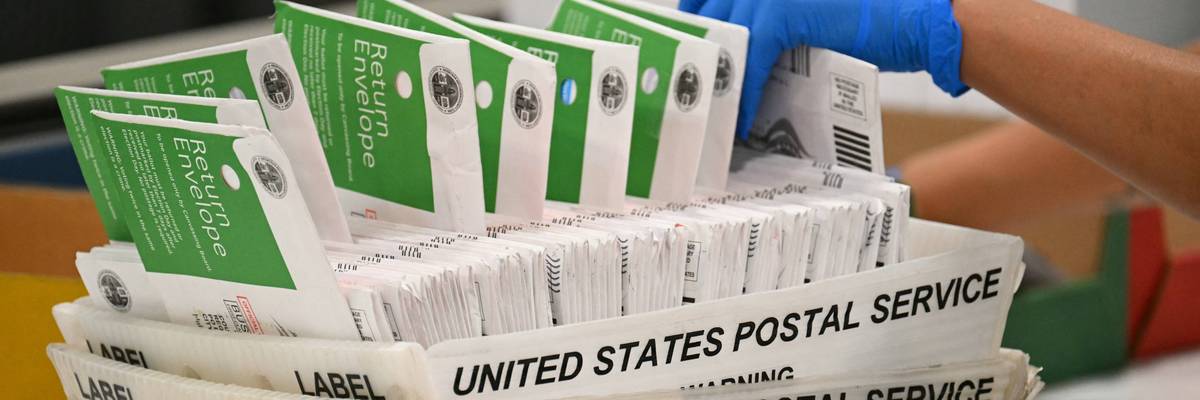
An election worker processes mail-in ballots during California's state primary election in the City of Industry on June 2, 2026.
(Photo by Patrick T. Fallon/AFP via Getty Images)
Judge Blocks 'Unconstitutional and Dangerous' Trump Order Designed to Derail Mail-In Voting
"The court rightly recognized that the president and the executive branch lack both the legal authority and the capacity to compile a complete and accurate list of US citizens or eligible voters in every state."
Jun 25, 2026
On the heels of a federal judge in the District of Massachusetts siding with Democratic state attorneys general who challenged President Donald Trump's executive order requiring Americans to show proof of citizenship when registering to vote, another judge in the same district on Thursday blocked key portions of a second Trump order attacking US elections.
In the latest decision, District Judge Indira Talwani struck down Section 2, which orders the US Department of Homeland Security to create "confirmed citizen lists" of eligible voters, as well as Section 3, which directs the US Postal Service to create rules to limit the mailing of ballots to voters not included on its own lists.
"The Constitution does not grant the president any specific powers over elections. Broadly, the Constitution vests the president with 'executive power' and commands him to 'take care that the laws be faithfully executed,'" wrote Talwani, an appointee of former President Barack Obama. "Sections 2 and 3... are legally void as they are ultra vires and unconstitutionally violate the separation of powers."
The judge also struck down Section 5, which requires the US Deparment of Justicee and all other executive agencies "with relevant authority" to "take all lawful steps to deter and address noncompliance with federal law," plus mandates that states and localities "preserve, for a five-year-period, all records and materials—excluding ballots cast—evidencing participation in any federal election (e.g., ballot envelopes, regardless of carriers)." She found that this portion of the order "is merely precatory."
Several state attorneys general were involved in both of this week's cases, including New York Democrat Letitia James, who called Thursday's decision a "major victory" as well as a "critical step in defending the foundation of our democracy and protecting the sacred right to vote."
California Attorney General Rob Bonta on Thursday also cheered the back-to-back wins against the Republican president.
"Just yesterday, President Trump's first elections-related Executive Order was blocked. Now, his second elections-related executive Order has suffered the same fate, and rightfully so. As the federal judge wrote in today's decision, 'The Constitution does not grant the president any specific powers over elections.' Those powers are reserved to the states and Congress," Bonta said. "Democracy doesn't work on its own—it requires constant vigilance. And that's what my fellow attorneys general and I will continue to provide."
The AGs weren't alone in challenging Trump's order. The Association of Americans Resident Overseas, Delta Sigma Theta Sorority, League of Women Voters, LWV of Massachusetts, OCA – Asian Pacific American Advocates, and US Vote Foundation also filed suit, represented by the national and Massachusetts arms of the ACLU as well as Asian Americans Advancing Justice, Brennan Center for Justice, Legal Defense Fund, and LatinoJustice PRLDEF.
The attorneys and plaintiffs in that case said in a joint statement that as Thursday's decision "makes clear, President Trump's executive order from March 2026 attempting to seize control of elections is unconstitutional and dangerous."
"This ruling is a critical step in preserving free and fair elections," they said. "The court rightly recognized that the president and the executive branch lack both the legal authority and the capacity to compile a complete and accurate list of US citizens or eligible voters in every state. The ruling also rightly recognizes that the US Postal Service has no authority to limit the distribution of mail ballots."
"The court has yet to rule on our request to block the executive order's provisions on mail voting on behalf of a nonpartisan coalition of voting rights groups," they noted. "The same reasoning underpinning today's decision should hold in our case. President Trump's unlawful executive order violates the separation of powers, threatens the integrity of our elections, and must be enjoined from taking effect in the upcoming primary and midterm elections."
Meanwhile, White House spokesperson Abigail Jackson signaled the administration will continue the fight, telling multiple media outlets that "President Trump is committed to ensuring that Americans have full confidence in the administration of our elections. The president's executive order lawfully protects our elections, and we are confident that we will ultimately prevail in its implementation."
Jackson also reiterated the administration's support for the proposed Safeguard American Voter Eligibility Act, saying that "President Trump has also urged Congress to pass the SAVE America Act and other legislative proposals that would establish a uniform standard of photo ID for voting, prohibit no-excuse mail-in voting, and end the practice of ballot harvesting to secure our elections for generations to come."
Trump on Wednesday canceled his planned signing ceremony for the bipartisan 21st Century ROAD to Housing Act "until such time as we pass the desperately needed SAVE AMERICA ACT, which I consider to be a National Emergency."
In response, US Sen. Elizabeth Warren (D-Mass.) summarized: "Congress overwhelmingly passed a housing bill to bring down costs. But Trump just threw a tantrum. He's refusing to sign bipartisan legislation to make housing more affordable in a bizarre effort to try to rig the elections."
An Urgent Message From Our Co-Founder
Dear Common Dreams reader, It’s been nearly 30 years since I co-founded Common Dreams with my late wife, Lina Newhouser. We had the radical notion that journalism should serve the public good, not corporate profits. It was clear to us from the outset what it would take to build such a project. No paid advertisements. No corporate sponsors. No millionaire publisher telling us what to think or do. Many people said we wouldn't last a year, but we proved those doubters wrong. Together with a tremendous team of journalists and dedicated staff, we built an independent media outlet free from the constraints of profits and corporate control. Our mission has always been simple: To inform. To inspire. To ignite change for the common good. Building Common Dreams was not easy. Our survival was never guaranteed. When you take on the most powerful forces—Wall Street greed, fossil fuel industry destruction, Big Tech lobbyists, and uber-rich oligarchs who have spent billions upon billions rigging the economy and democracy in their favor—the only bulwark you have is supporters who believe in your work. But here’s the urgent message from me today. It's never been this bad out there. And it's never been this hard to keep us going. At the very moment Common Dreams is most needed, the threats we face are intensifying. We need your support now more than ever. We don't accept corporate advertising and never will. We don't have a paywall because we don't think people should be blocked from critical news based on their ability to pay. Everything we do is funded by the donations of readers like you. When everyone does the little they can afford, we are strong. But if that support retreats or dries up, so do we. Will you donate now to make sure Common Dreams not only survives but thrives? —Craig Brown, Co-founder |
Our work is licensed under Creative Commons (CC BY-NC-ND 3.0). Feel free to republish and share widely.
On the heels of a federal judge in the District of Massachusetts siding with Democratic state attorneys general who challenged President Donald Trump's executive order requiring Americans to show proof of citizenship when registering to vote, another judge in the same district on Thursday blocked key portions of a second Trump order attacking US elections.
In the latest decision, District Judge Indira Talwani struck down Section 2, which orders the US Department of Homeland Security to create "confirmed citizen lists" of eligible voters, as well as Section 3, which directs the US Postal Service to create rules to limit the mailing of ballots to voters not included on its own lists.
"The Constitution does not grant the president any specific powers over elections. Broadly, the Constitution vests the president with 'executive power' and commands him to 'take care that the laws be faithfully executed,'" wrote Talwani, an appointee of former President Barack Obama. "Sections 2 and 3... are legally void as they are ultra vires and unconstitutionally violate the separation of powers."
The judge also struck down Section 5, which requires the US Deparment of Justicee and all other executive agencies "with relevant authority" to "take all lawful steps to deter and address noncompliance with federal law," plus mandates that states and localities "preserve, for a five-year-period, all records and materials—excluding ballots cast—evidencing participation in any federal election (e.g., ballot envelopes, regardless of carriers)." She found that this portion of the order "is merely precatory."
Several state attorneys general were involved in both of this week's cases, including New York Democrat Letitia James, who called Thursday's decision a "major victory" as well as a "critical step in defending the foundation of our democracy and protecting the sacred right to vote."
California Attorney General Rob Bonta on Thursday also cheered the back-to-back wins against the Republican president.
"Just yesterday, President Trump's first elections-related Executive Order was blocked. Now, his second elections-related executive Order has suffered the same fate, and rightfully so. As the federal judge wrote in today's decision, 'The Constitution does not grant the president any specific powers over elections.' Those powers are reserved to the states and Congress," Bonta said. "Democracy doesn't work on its own—it requires constant vigilance. And that's what my fellow attorneys general and I will continue to provide."
The AGs weren't alone in challenging Trump's order. The Association of Americans Resident Overseas, Delta Sigma Theta Sorority, League of Women Voters, LWV of Massachusetts, OCA – Asian Pacific American Advocates, and US Vote Foundation also filed suit, represented by the national and Massachusetts arms of the ACLU as well as Asian Americans Advancing Justice, Brennan Center for Justice, Legal Defense Fund, and LatinoJustice PRLDEF.
The attorneys and plaintiffs in that case said in a joint statement that as Thursday's decision "makes clear, President Trump's executive order from March 2026 attempting to seize control of elections is unconstitutional and dangerous."
"This ruling is a critical step in preserving free and fair elections," they said. "The court rightly recognized that the president and the executive branch lack both the legal authority and the capacity to compile a complete and accurate list of US citizens or eligible voters in every state. The ruling also rightly recognizes that the US Postal Service has no authority to limit the distribution of mail ballots."
"The court has yet to rule on our request to block the executive order's provisions on mail voting on behalf of a nonpartisan coalition of voting rights groups," they noted. "The same reasoning underpinning today's decision should hold in our case. President Trump's unlawful executive order violates the separation of powers, threatens the integrity of our elections, and must be enjoined from taking effect in the upcoming primary and midterm elections."
Meanwhile, White House spokesperson Abigail Jackson signaled the administration will continue the fight, telling multiple media outlets that "President Trump is committed to ensuring that Americans have full confidence in the administration of our elections. The president's executive order lawfully protects our elections, and we are confident that we will ultimately prevail in its implementation."
Jackson also reiterated the administration's support for the proposed Safeguard American Voter Eligibility Act, saying that "President Trump has also urged Congress to pass the SAVE America Act and other legislative proposals that would establish a uniform standard of photo ID for voting, prohibit no-excuse mail-in voting, and end the practice of ballot harvesting to secure our elections for generations to come."
Trump on Wednesday canceled his planned signing ceremony for the bipartisan 21st Century ROAD to Housing Act "until such time as we pass the desperately needed SAVE AMERICA ACT, which I consider to be a National Emergency."
In response, US Sen. Elizabeth Warren (D-Mass.) summarized: "Congress overwhelmingly passed a housing bill to bring down costs. But Trump just threw a tantrum. He's refusing to sign bipartisan legislation to make housing more affordable in a bizarre effort to try to rig the elections."
From Your Site Articles
- ‘Virtual Elimination of Mail-In Voting’ Feared Under Trump Postal Service Order ›
- In 'Victory for the People,' Judge Blocks Parts of Trump's Attack on Voting Rights ›
- Trump Executive Order on Voting Denounced as 'Authoritarian Power Grab' ›
- With Baseless Fraud Claim, White House Says Trump Preparing Anti-Voter Executive Order ›
- Lawsuits Expected After Trump Orders Creation of National Voter List, Mail-In Voting Crackdown ›
On the heels of a federal judge in the District of Massachusetts siding with Democratic state attorneys general who challenged President Donald Trump's executive order requiring Americans to show proof of citizenship when registering to vote, another judge in the same district on Thursday blocked key portions of a second Trump order attacking US elections.
In the latest decision, District Judge Indira Talwani struck down Section 2, which orders the US Department of Homeland Security to create "confirmed citizen lists" of eligible voters, as well as Section 3, which directs the US Postal Service to create rules to limit the mailing of ballots to voters not included on its own lists.
"The Constitution does not grant the president any specific powers over elections. Broadly, the Constitution vests the president with 'executive power' and commands him to 'take care that the laws be faithfully executed,'" wrote Talwani, an appointee of former President Barack Obama. "Sections 2 and 3... are legally void as they are ultra vires and unconstitutionally violate the separation of powers."
The judge also struck down Section 5, which requires the US Deparment of Justicee and all other executive agencies "with relevant authority" to "take all lawful steps to deter and address noncompliance with federal law," plus mandates that states and localities "preserve, for a five-year-period, all records and materials—excluding ballots cast—evidencing participation in any federal election (e.g., ballot envelopes, regardless of carriers)." She found that this portion of the order "is merely precatory."
Several state attorneys general were involved in both of this week's cases, including New York Democrat Letitia James, who called Thursday's decision a "major victory" as well as a "critical step in defending the foundation of our democracy and protecting the sacred right to vote."
California Attorney General Rob Bonta on Thursday also cheered the back-to-back wins against the Republican president.
"Just yesterday, President Trump's first elections-related Executive Order was blocked. Now, his second elections-related executive Order has suffered the same fate, and rightfully so. As the federal judge wrote in today's decision, 'The Constitution does not grant the president any specific powers over elections.' Those powers are reserved to the states and Congress," Bonta said. "Democracy doesn't work on its own—it requires constant vigilance. And that's what my fellow attorneys general and I will continue to provide."
The AGs weren't alone in challenging Trump's order. The Association of Americans Resident Overseas, Delta Sigma Theta Sorority, League of Women Voters, LWV of Massachusetts, OCA – Asian Pacific American Advocates, and US Vote Foundation also filed suit, represented by the national and Massachusetts arms of the ACLU as well as Asian Americans Advancing Justice, Brennan Center for Justice, Legal Defense Fund, and LatinoJustice PRLDEF.
The attorneys and plaintiffs in that case said in a joint statement that as Thursday's decision "makes clear, President Trump's executive order from March 2026 attempting to seize control of elections is unconstitutional and dangerous."
"This ruling is a critical step in preserving free and fair elections," they said. "The court rightly recognized that the president and the executive branch lack both the legal authority and the capacity to compile a complete and accurate list of US citizens or eligible voters in every state. The ruling also rightly recognizes that the US Postal Service has no authority to limit the distribution of mail ballots."
"The court has yet to rule on our request to block the executive order's provisions on mail voting on behalf of a nonpartisan coalition of voting rights groups," they noted. "The same reasoning underpinning today's decision should hold in our case. President Trump's unlawful executive order violates the separation of powers, threatens the integrity of our elections, and must be enjoined from taking effect in the upcoming primary and midterm elections."
Meanwhile, White House spokesperson Abigail Jackson signaled the administration will continue the fight, telling multiple media outlets that "President Trump is committed to ensuring that Americans have full confidence in the administration of our elections. The president's executive order lawfully protects our elections, and we are confident that we will ultimately prevail in its implementation."
Jackson also reiterated the administration's support for the proposed Safeguard American Voter Eligibility Act, saying that "President Trump has also urged Congress to pass the SAVE America Act and other legislative proposals that would establish a uniform standard of photo ID for voting, prohibit no-excuse mail-in voting, and end the practice of ballot harvesting to secure our elections for generations to come."
Trump on Wednesday canceled his planned signing ceremony for the bipartisan 21st Century ROAD to Housing Act "until such time as we pass the desperately needed SAVE AMERICA ACT, which I consider to be a National Emergency."
In response, US Sen. Elizabeth Warren (D-Mass.) summarized: "Congress overwhelmingly passed a housing bill to bring down costs. But Trump just threw a tantrum. He's refusing to sign bipartisan legislation to make housing more affordable in a bizarre effort to try to rig the elections."
From Your Site Articles
- ‘Virtual Elimination of Mail-In Voting’ Feared Under Trump Postal Service Order ›
- In 'Victory for the People,' Judge Blocks Parts of Trump's Attack on Voting Rights ›
- Trump Executive Order on Voting Denounced as 'Authoritarian Power Grab' ›
- With Baseless Fraud Claim, White House Says Trump Preparing Anti-Voter Executive Order ›
- Lawsuits Expected After Trump Orders Creation of National Voter List, Mail-In Voting Crackdown ›
We've had enough. The 1% own and operate the corporate media. They are doing everything they can to defend the status quo, squash dissent and protect the wealthy and the powerful. The Common Dreams media model is different. We cover the news that matters to the 99%. Our mission? To inform. To inspire. To ignite change for the common good. How? Nonprofit. Independent. Reader-supported. Free to read. Free to republish. Free to share. With no advertising. No paywalls. No selling of your data. Thousands of small donations fund our newsroom and allow us to continue publishing. Can you chip in? We can't do it without you. Thank you.