SUBSCRIBE TO OUR FREE NEWSLETTER
Daily news & progressive opinion—funded by the people, not the corporations—delivered straight to your inbox.
5
#000000
#FFFFFF
To donate by check, phone, or other method, see our More Ways to Give page.
Daily news & progressive opinion—funded by the people, not the corporations—delivered straight to your inbox.
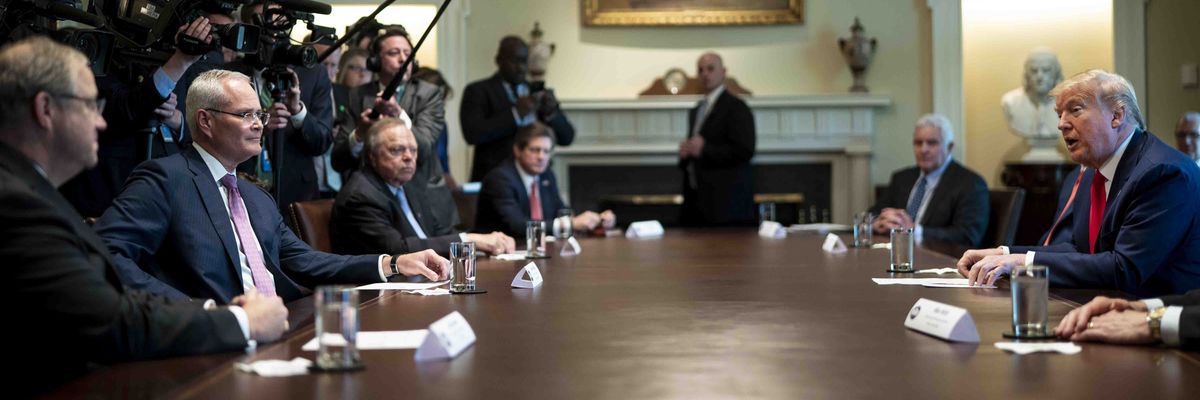
U.S. President Donald Trump speaks during a roundtable meeting with energy sector CEOs on April 3, 2020 in Washington, DC.
With "a supportive administration that has pledged to protect their interests," new analysis warns industry groups "may turn attention to influencing the public."
The first Trump administration was a boon for fossil fuel executives, and a new analysis shows the efforts the industry is already making to ensure it benefits when Trump takes office again in January, including by directing their lobbying efforts at the American public.
"Many of the tactics already being deployed by industry are reminiscent of the first Trump presidency, indicating a continuation of familiar fossil fuel tactics to shape climate policy and politics," reads the analysis by InfluenceMap.
The analysis shows fossil fuel companies have already revived three key tactics from the first Trump term ahead of the president-elect's inauguration:
"It is alarming to see the extent to which fossil fuel actors are gearing up to use their old tactics to roll back climate policy and present themselves as the 'good guys' ahead of the next presidency," said Kendra Haven, director of projects at InfluenceMap.
The report details how ahead of the first Trump term, fossil fuel interests like the U.S. Chamber of Commerce and the American Petroleum Institute (API) filed a number of lawsuits to challenge and weaken Obama-era climate regulations, many of them already weaker than experts said was necessary, including the Clean Power Plan.
But after Trump took office in 2017, the groups shifted their attention to lobbying for rollbacks which, according to Carbon Brief, would amount to "a staggering 4 billion tonnes of carbon dioxide equivalent by 2030, equivalent to the annual emissions of the EU and Japan combined."
Starting in January, InfluenceMap said, fossil fuel industry groups "will likely issue various statements and comments urging and supporting these moves," such as the "5-Point Policy Roadmap" API released just after the election on November 12, calling for the next Trump administration to repeal the Environmental Protection Agency's (EPA) tailpipe rules, retain the 21% corporate tax rate, and take other industry-friendly steps.
API's roadmap also called for a heavy focus on permitting reform, demanding changes to the National Environmental Protection Act (NEPA), which requires federal agencies to consider the environmental impacts of projects before approving them, and the Clean Water Act.
"In 2025 and the years following, issues of permitting, infrastructure, and the future of gas are likely to remain a focus of corporate advocacy," said InfluenceMap.
Fossil fuel companies have submitted numerous public comments regarding state-level efforts to phase out the use of fossil gas as an energy source, with WEC Energy Group submitted several comments "promoting the 'crucial role' of fossil gas" in Illinois and warning that "'forced electrification' would inhibit the competitiveness of the state's economy."
But while fossil fuel groups are expected to continue lobbying policymakers to support industry-friendly measures, InfluenceMap noted that oil and gas interests also spent a "vast amount of time and resources that fossil fuel companies invest in reaching the public to protect their 'social license' or public reputation."
With "a supportive administration that has pledged to protect their interests" taking office next month, industry groups "may turn attention to influencing the public."
The strategy for influencing the American people is evident in API's policy roadmap, which uses a phrase the InfluenceMap points to several times in its analysis: "consumer choice."
"In 2024 alone, there were over 100 instances of corporate interests centering the 'consumer choice' narrative in their public advocacy on autos," reads the analysis.
The American Fuel and Petrochemical Manufacturers (AFPM) criticized Vice President Kamala Harris' electric vehicle mandates as harming "consumer choice," and just after the election Toyota urged the incoming Trump administration to protect "consumer choice" by overturning federal greenhouse gas emissions standards.
"Recognizing industry narratives is a critical component of any action to confront industry influence over climate policy," said InfluenceMap, "particularly given that many fossil fuel interests are likely to publicly position themselves as proponents of climate action leading up to and throughout the new administration."
Haven said the group expects "industry associations to be at the forefront of the most negative advocacy in the U.S. going into 2025, just as they were during the first Trump term, providing essential cover for individual companies."
"The science is clear, as is the long-term harm this advocacy will cause to climate and communities," said Haven. "Misleading narratives from industry must be challenged accordingly."
Dear Common Dreams reader, It’s been nearly 30 years since I co-founded Common Dreams with my late wife, Lina Newhouser. We had the radical notion that journalism should serve the public good, not corporate profits. It was clear to us from the outset what it would take to build such a project. No paid advertisements. No corporate sponsors. No millionaire publisher telling us what to think or do. Many people said we wouldn't last a year, but we proved those doubters wrong. Together with a tremendous team of journalists and dedicated staff, we built an independent media outlet free from the constraints of profits and corporate control. Our mission has always been simple: To inform. To inspire. To ignite change for the common good. Building Common Dreams was not easy. Our survival was never guaranteed. When you take on the most powerful forces—Wall Street greed, fossil fuel industry destruction, Big Tech lobbyists, and uber-rich oligarchs who have spent billions upon billions rigging the economy and democracy in their favor—the only bulwark you have is supporters who believe in your work. But here’s the urgent message from me today. It's never been this bad out there. And it's never been this hard to keep us going. At the very moment Common Dreams is most needed, the threats we face are intensifying. We need your support now more than ever. We don't accept corporate advertising and never will. We don't have a paywall because we don't think people should be blocked from critical news based on their ability to pay. Everything we do is funded by the donations of readers like you. When everyone does the little they can afford, we are strong. But if that support retreats or dries up, so do we. Will you donate now to make sure Common Dreams not only survives but thrives? —Craig Brown, Co-founder |
The first Trump administration was a boon for fossil fuel executives, and a new analysis shows the efforts the industry is already making to ensure it benefits when Trump takes office again in January, including by directing their lobbying efforts at the American public.
"Many of the tactics already being deployed by industry are reminiscent of the first Trump presidency, indicating a continuation of familiar fossil fuel tactics to shape climate policy and politics," reads the analysis by InfluenceMap.
The analysis shows fossil fuel companies have already revived three key tactics from the first Trump term ahead of the president-elect's inauguration:
"It is alarming to see the extent to which fossil fuel actors are gearing up to use their old tactics to roll back climate policy and present themselves as the 'good guys' ahead of the next presidency," said Kendra Haven, director of projects at InfluenceMap.
The report details how ahead of the first Trump term, fossil fuel interests like the U.S. Chamber of Commerce and the American Petroleum Institute (API) filed a number of lawsuits to challenge and weaken Obama-era climate regulations, many of them already weaker than experts said was necessary, including the Clean Power Plan.
But after Trump took office in 2017, the groups shifted their attention to lobbying for rollbacks which, according to Carbon Brief, would amount to "a staggering 4 billion tonnes of carbon dioxide equivalent by 2030, equivalent to the annual emissions of the EU and Japan combined."
Starting in January, InfluenceMap said, fossil fuel industry groups "will likely issue various statements and comments urging and supporting these moves," such as the "5-Point Policy Roadmap" API released just after the election on November 12, calling for the next Trump administration to repeal the Environmental Protection Agency's (EPA) tailpipe rules, retain the 21% corporate tax rate, and take other industry-friendly steps.
API's roadmap also called for a heavy focus on permitting reform, demanding changes to the National Environmental Protection Act (NEPA), which requires federal agencies to consider the environmental impacts of projects before approving them, and the Clean Water Act.
"In 2025 and the years following, issues of permitting, infrastructure, and the future of gas are likely to remain a focus of corporate advocacy," said InfluenceMap.
Fossil fuel companies have submitted numerous public comments regarding state-level efforts to phase out the use of fossil gas as an energy source, with WEC Energy Group submitted several comments "promoting the 'crucial role' of fossil gas" in Illinois and warning that "'forced electrification' would inhibit the competitiveness of the state's economy."
But while fossil fuel groups are expected to continue lobbying policymakers to support industry-friendly measures, InfluenceMap noted that oil and gas interests also spent a "vast amount of time and resources that fossil fuel companies invest in reaching the public to protect their 'social license' or public reputation."
With "a supportive administration that has pledged to protect their interests" taking office next month, industry groups "may turn attention to influencing the public."
The strategy for influencing the American people is evident in API's policy roadmap, which uses a phrase the InfluenceMap points to several times in its analysis: "consumer choice."
"In 2024 alone, there were over 100 instances of corporate interests centering the 'consumer choice' narrative in their public advocacy on autos," reads the analysis.
The American Fuel and Petrochemical Manufacturers (AFPM) criticized Vice President Kamala Harris' electric vehicle mandates as harming "consumer choice," and just after the election Toyota urged the incoming Trump administration to protect "consumer choice" by overturning federal greenhouse gas emissions standards.
"Recognizing industry narratives is a critical component of any action to confront industry influence over climate policy," said InfluenceMap, "particularly given that many fossil fuel interests are likely to publicly position themselves as proponents of climate action leading up to and throughout the new administration."
Haven said the group expects "industry associations to be at the forefront of the most negative advocacy in the U.S. going into 2025, just as they were during the first Trump term, providing essential cover for individual companies."
"The science is clear, as is the long-term harm this advocacy will cause to climate and communities," said Haven. "Misleading narratives from industry must be challenged accordingly."
The first Trump administration was a boon for fossil fuel executives, and a new analysis shows the efforts the industry is already making to ensure it benefits when Trump takes office again in January, including by directing their lobbying efforts at the American public.
"Many of the tactics already being deployed by industry are reminiscent of the first Trump presidency, indicating a continuation of familiar fossil fuel tactics to shape climate policy and politics," reads the analysis by InfluenceMap.
The analysis shows fossil fuel companies have already revived three key tactics from the first Trump term ahead of the president-elect's inauguration:
"It is alarming to see the extent to which fossil fuel actors are gearing up to use their old tactics to roll back climate policy and present themselves as the 'good guys' ahead of the next presidency," said Kendra Haven, director of projects at InfluenceMap.
The report details how ahead of the first Trump term, fossil fuel interests like the U.S. Chamber of Commerce and the American Petroleum Institute (API) filed a number of lawsuits to challenge and weaken Obama-era climate regulations, many of them already weaker than experts said was necessary, including the Clean Power Plan.
But after Trump took office in 2017, the groups shifted their attention to lobbying for rollbacks which, according to Carbon Brief, would amount to "a staggering 4 billion tonnes of carbon dioxide equivalent by 2030, equivalent to the annual emissions of the EU and Japan combined."
Starting in January, InfluenceMap said, fossil fuel industry groups "will likely issue various statements and comments urging and supporting these moves," such as the "5-Point Policy Roadmap" API released just after the election on November 12, calling for the next Trump administration to repeal the Environmental Protection Agency's (EPA) tailpipe rules, retain the 21% corporate tax rate, and take other industry-friendly steps.
API's roadmap also called for a heavy focus on permitting reform, demanding changes to the National Environmental Protection Act (NEPA), which requires federal agencies to consider the environmental impacts of projects before approving them, and the Clean Water Act.
"In 2025 and the years following, issues of permitting, infrastructure, and the future of gas are likely to remain a focus of corporate advocacy," said InfluenceMap.
Fossil fuel companies have submitted numerous public comments regarding state-level efforts to phase out the use of fossil gas as an energy source, with WEC Energy Group submitted several comments "promoting the 'crucial role' of fossil gas" in Illinois and warning that "'forced electrification' would inhibit the competitiveness of the state's economy."
But while fossil fuel groups are expected to continue lobbying policymakers to support industry-friendly measures, InfluenceMap noted that oil and gas interests also spent a "vast amount of time and resources that fossil fuel companies invest in reaching the public to protect their 'social license' or public reputation."
With "a supportive administration that has pledged to protect their interests" taking office next month, industry groups "may turn attention to influencing the public."
The strategy for influencing the American people is evident in API's policy roadmap, which uses a phrase the InfluenceMap points to several times in its analysis: "consumer choice."
"In 2024 alone, there were over 100 instances of corporate interests centering the 'consumer choice' narrative in their public advocacy on autos," reads the analysis.
The American Fuel and Petrochemical Manufacturers (AFPM) criticized Vice President Kamala Harris' electric vehicle mandates as harming "consumer choice," and just after the election Toyota urged the incoming Trump administration to protect "consumer choice" by overturning federal greenhouse gas emissions standards.
"Recognizing industry narratives is a critical component of any action to confront industry influence over climate policy," said InfluenceMap, "particularly given that many fossil fuel interests are likely to publicly position themselves as proponents of climate action leading up to and throughout the new administration."
Haven said the group expects "industry associations to be at the forefront of the most negative advocacy in the U.S. going into 2025, just as they were during the first Trump term, providing essential cover for individual companies."
"The science is clear, as is the long-term harm this advocacy will cause to climate and communities," said Haven. "Misleading narratives from industry must be challenged accordingly."