

SUBSCRIBE TO OUR FREE NEWSLETTER
Daily news & progressive opinion—funded by the people, not the corporations—delivered straight to your inbox.
5
#000000
#FFFFFF
To donate by check, phone, or other method, see our More Ways to Give page.
Daily news & progressive opinion—funded by the people, not the corporations—delivered straight to your inbox.
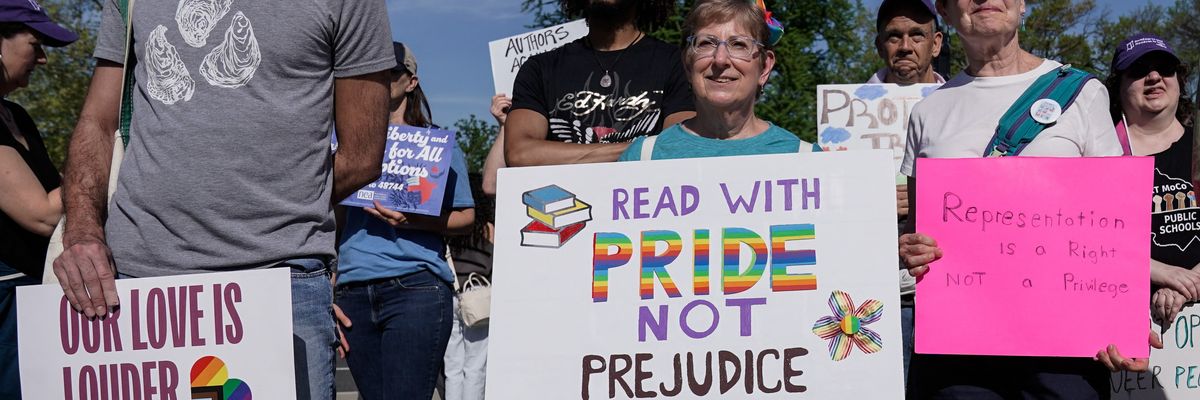
Supporters of LGBTQ+ rights hold signs as they demonstrate outside the U.S. Supreme Court in Washington, D.C. on April 22, 2025.
The ruling, said Justice Sonia Sotomayor, reflects the right-wing majority's "failure to accept and account for a fundamental truth: LGBTQ people exist."
A day after many LGBTQ+ Americans celebrated the 10th anniversary of the landmark U.S. Supreme Court ruling that established marriage equality in the United States, right-wing Justice Samuel Alito suggested in a new decision that public schools should not promote "acceptance of same-sex marriage."
Alito's opinion was handed down in a 6-3 ruling in Mahmoud v. Taylor, in which the high court's right-wing majority held that parents should be permitted to opt their children out of certain lessons in public schools on religious grounds.
The ruling stemmed from a lawsuit filed by parents of several religious backgrounds in Montgomery County, Maryland, who sued the county's school system for not giving parents advance notice and an opportunity to opt out of a curriculum that included storybooks dealing with LGBTQ+ themes.
The books included Pride Puppy, about a dog that gets lost at an LGBTQ+ pride parade; Love, Violet, about a girl who has a same-sex crush; Born Ready, about a transgender boy; and Uncle Bobby's Wedding, about a gay couple getting married.
Alito pointed to the latter book in particular in his opinion.
"It is significant that this book does not simply refer to same-sex marriage as an existing practice," wrote the judge. "Instead, it presents acceptance of same-sex marriage as a perspective that should be celebrated."
Elly Brinkley, staff attorney for U.S. Free Expression Programs at the free speech group PEN America, noted the timing of Alito's comments about marriage equality.
"Just after the 10th anniversary of Obergefell v. Hodges and as we celebrate Pride Month, the Supreme Court has delivered a devastating blow to the dignity of LGBTQ+ people and families," said Brinkley. "This ruling means that parents can opt their children out of any classroom activity that acknowledges same-sex marriages, the right to which this very court held was guaranteed by the Constitution."
The right-wing majority ruled that Montgomery County Public Schools must allow families to opt out of any lessons that parents believe will interfere with their children's religious education, including stories or discussions with LGBTQ+ themes.
"This ruling threatens to give any religious parent veto power over public school curricula. If this dangerous logic is carried forward, it could unravel decades of progress toward inclusive education and equal rights."
Legal scholars said that in addition to stigmatizing the families of an estimated 5 million children in the U.S. who have one or more LGBTQ+ parents, the ruling could pave the way for parents to argue that their children shouldn't be exposed at school to materials involving any number of topics, including evolution, yoga, and mothers who work outside the home—all issues that have been the subject of earlier, unsuccessful lawsuits against schools.
"The decision could have far-reaching consequences for public schools' ability to create an inclusive and welcoming environment that reflects the diversity of their communities, as well schools' ability to implement any secular lesson plan that may trigger religious objections," said the ACLU, which filed an amicus brief in the case arguing that the school district's "policy prohibiting opt-outs from the English Language Arts curriculum is religiously neutral and applicable across the board."
Daniel Mach, director of the ACLU's Program on Freedom of Religion and Belief, said that religious freedom is "fundamentally important" under U.S. law.
But freedom of religion, Mach said, "shouldn't force public schools to exempt students from any secular lessons that don't align with their families' religious views. This decision could wreak havoc on public schools, tying their hands on basic curricular decisions and undermining their ability to prepare students to live in our pluralistic society."
Cecilia Wang, national legal director of the ACLU, added that parents with religious objections will now be "empowered to pick and choose from a secular public school curriculum, interfering with the school district's legitimate educational purposes and its ability to operate schools without disruption—ironically, in a case where the curriculum is designed to foster civility and understanding across differences."
Liberal Justices Sonia Sotomayor, Elena Kagan, and Ketanji Brown Jackson dissented in the case, with Sotomayor making the unusual move of announcing her dissent from the bench.
Citizens fully experiencing the United States' multicultural society, said Sotomayor, "is critical to our nation's civic vitality. Yet it will become a mere memory if children must be insulated from exposure to ideas and concepts that may conflict with their parents' religious beliefs."
She also accused the majority of making a "myopic attempt to resolve a major constitutional question through close textual analysis of Uncle Bobby's Wedding," which revealed, she said, "its failure to accept and account for a fundamental truth: LGBTQ people exist."
The ruling is the latest victory for right-wing advocates of what they view as religious freedom at the high court; other recent rulings have allowed a web designer to refuse to make a website for same-sex couples and a high school football coach to pray with his team at school games.
Annie Laurie Gaylor, co-president of the Freedom From Religion Foundation, called Friday's ruling a "deeply troubling outcome for public education, equality, and the constitutional principle of the separation between state and church."
"This ruling threatens to give any religious parent veto power over public school curricula. If this dangerous logic is carried forward, it could unravel decades of progress toward inclusive education and equal rights," said Gaylor. "Public schools must be grounded in facts and reality and not subject to religious censors."
Dear Common Dreams reader, It’s been nearly 30 years since I co-founded Common Dreams with my late wife, Lina Newhouser. We had the radical notion that journalism should serve the public good, not corporate profits. It was clear to us from the outset what it would take to build such a project. No paid advertisements. No corporate sponsors. No millionaire publisher telling us what to think or do. Many people said we wouldn't last a year, but we proved those doubters wrong. Together with a tremendous team of journalists and dedicated staff, we built an independent media outlet free from the constraints of profits and corporate control. Our mission has always been simple: To inform. To inspire. To ignite change for the common good. Building Common Dreams was not easy. Our survival was never guaranteed. When you take on the most powerful forces—Wall Street greed, fossil fuel industry destruction, Big Tech lobbyists, and uber-rich oligarchs who have spent billions upon billions rigging the economy and democracy in their favor—the only bulwark you have is supporters who believe in your work. But here’s the urgent message from me today. It's never been this bad out there. And it's never been this hard to keep us going. At the very moment Common Dreams is most needed, the threats we face are intensifying. We need your support now more than ever. We don't accept corporate advertising and never will. We don't have a paywall because we don't think people should be blocked from critical news based on their ability to pay. Everything we do is funded by the donations of readers like you. When everyone does the little they can afford, we are strong. But if that support retreats or dries up, so do we. Will you donate now to make sure Common Dreams not only survives but thrives? —Craig Brown, Co-founder |
A day after many LGBTQ+ Americans celebrated the 10th anniversary of the landmark U.S. Supreme Court ruling that established marriage equality in the United States, right-wing Justice Samuel Alito suggested in a new decision that public schools should not promote "acceptance of same-sex marriage."
Alito's opinion was handed down in a 6-3 ruling in Mahmoud v. Taylor, in which the high court's right-wing majority held that parents should be permitted to opt their children out of certain lessons in public schools on religious grounds.
The ruling stemmed from a lawsuit filed by parents of several religious backgrounds in Montgomery County, Maryland, who sued the county's school system for not giving parents advance notice and an opportunity to opt out of a curriculum that included storybooks dealing with LGBTQ+ themes.
The books included Pride Puppy, about a dog that gets lost at an LGBTQ+ pride parade; Love, Violet, about a girl who has a same-sex crush; Born Ready, about a transgender boy; and Uncle Bobby's Wedding, about a gay couple getting married.
Alito pointed to the latter book in particular in his opinion.
"It is significant that this book does not simply refer to same-sex marriage as an existing practice," wrote the judge. "Instead, it presents acceptance of same-sex marriage as a perspective that should be celebrated."
Elly Brinkley, staff attorney for U.S. Free Expression Programs at the free speech group PEN America, noted the timing of Alito's comments about marriage equality.
"Just after the 10th anniversary of Obergefell v. Hodges and as we celebrate Pride Month, the Supreme Court has delivered a devastating blow to the dignity of LGBTQ+ people and families," said Brinkley. "This ruling means that parents can opt their children out of any classroom activity that acknowledges same-sex marriages, the right to which this very court held was guaranteed by the Constitution."
The right-wing majority ruled that Montgomery County Public Schools must allow families to opt out of any lessons that parents believe will interfere with their children's religious education, including stories or discussions with LGBTQ+ themes.
"This ruling threatens to give any religious parent veto power over public school curricula. If this dangerous logic is carried forward, it could unravel decades of progress toward inclusive education and equal rights."
Legal scholars said that in addition to stigmatizing the families of an estimated 5 million children in the U.S. who have one or more LGBTQ+ parents, the ruling could pave the way for parents to argue that their children shouldn't be exposed at school to materials involving any number of topics, including evolution, yoga, and mothers who work outside the home—all issues that have been the subject of earlier, unsuccessful lawsuits against schools.
"The decision could have far-reaching consequences for public schools' ability to create an inclusive and welcoming environment that reflects the diversity of their communities, as well schools' ability to implement any secular lesson plan that may trigger religious objections," said the ACLU, which filed an amicus brief in the case arguing that the school district's "policy prohibiting opt-outs from the English Language Arts curriculum is religiously neutral and applicable across the board."
Daniel Mach, director of the ACLU's Program on Freedom of Religion and Belief, said that religious freedom is "fundamentally important" under U.S. law.
But freedom of religion, Mach said, "shouldn't force public schools to exempt students from any secular lessons that don't align with their families' religious views. This decision could wreak havoc on public schools, tying their hands on basic curricular decisions and undermining their ability to prepare students to live in our pluralistic society."
Cecilia Wang, national legal director of the ACLU, added that parents with religious objections will now be "empowered to pick and choose from a secular public school curriculum, interfering with the school district's legitimate educational purposes and its ability to operate schools without disruption—ironically, in a case where the curriculum is designed to foster civility and understanding across differences."
Liberal Justices Sonia Sotomayor, Elena Kagan, and Ketanji Brown Jackson dissented in the case, with Sotomayor making the unusual move of announcing her dissent from the bench.
Citizens fully experiencing the United States' multicultural society, said Sotomayor, "is critical to our nation's civic vitality. Yet it will become a mere memory if children must be insulated from exposure to ideas and concepts that may conflict with their parents' religious beliefs."
She also accused the majority of making a "myopic attempt to resolve a major constitutional question through close textual analysis of Uncle Bobby's Wedding," which revealed, she said, "its failure to accept and account for a fundamental truth: LGBTQ people exist."
The ruling is the latest victory for right-wing advocates of what they view as religious freedom at the high court; other recent rulings have allowed a web designer to refuse to make a website for same-sex couples and a high school football coach to pray with his team at school games.
Annie Laurie Gaylor, co-president of the Freedom From Religion Foundation, called Friday's ruling a "deeply troubling outcome for public education, equality, and the constitutional principle of the separation between state and church."
"This ruling threatens to give any religious parent veto power over public school curricula. If this dangerous logic is carried forward, it could unravel decades of progress toward inclusive education and equal rights," said Gaylor. "Public schools must be grounded in facts and reality and not subject to religious censors."
A day after many LGBTQ+ Americans celebrated the 10th anniversary of the landmark U.S. Supreme Court ruling that established marriage equality in the United States, right-wing Justice Samuel Alito suggested in a new decision that public schools should not promote "acceptance of same-sex marriage."
Alito's opinion was handed down in a 6-3 ruling in Mahmoud v. Taylor, in which the high court's right-wing majority held that parents should be permitted to opt their children out of certain lessons in public schools on religious grounds.
The ruling stemmed from a lawsuit filed by parents of several religious backgrounds in Montgomery County, Maryland, who sued the county's school system for not giving parents advance notice and an opportunity to opt out of a curriculum that included storybooks dealing with LGBTQ+ themes.
The books included Pride Puppy, about a dog that gets lost at an LGBTQ+ pride parade; Love, Violet, about a girl who has a same-sex crush; Born Ready, about a transgender boy; and Uncle Bobby's Wedding, about a gay couple getting married.
Alito pointed to the latter book in particular in his opinion.
"It is significant that this book does not simply refer to same-sex marriage as an existing practice," wrote the judge. "Instead, it presents acceptance of same-sex marriage as a perspective that should be celebrated."
Elly Brinkley, staff attorney for U.S. Free Expression Programs at the free speech group PEN America, noted the timing of Alito's comments about marriage equality.
"Just after the 10th anniversary of Obergefell v. Hodges and as we celebrate Pride Month, the Supreme Court has delivered a devastating blow to the dignity of LGBTQ+ people and families," said Brinkley. "This ruling means that parents can opt their children out of any classroom activity that acknowledges same-sex marriages, the right to which this very court held was guaranteed by the Constitution."
The right-wing majority ruled that Montgomery County Public Schools must allow families to opt out of any lessons that parents believe will interfere with their children's religious education, including stories or discussions with LGBTQ+ themes.
"This ruling threatens to give any religious parent veto power over public school curricula. If this dangerous logic is carried forward, it could unravel decades of progress toward inclusive education and equal rights."
Legal scholars said that in addition to stigmatizing the families of an estimated 5 million children in the U.S. who have one or more LGBTQ+ parents, the ruling could pave the way for parents to argue that their children shouldn't be exposed at school to materials involving any number of topics, including evolution, yoga, and mothers who work outside the home—all issues that have been the subject of earlier, unsuccessful lawsuits against schools.
"The decision could have far-reaching consequences for public schools' ability to create an inclusive and welcoming environment that reflects the diversity of their communities, as well schools' ability to implement any secular lesson plan that may trigger religious objections," said the ACLU, which filed an amicus brief in the case arguing that the school district's "policy prohibiting opt-outs from the English Language Arts curriculum is religiously neutral and applicable across the board."
Daniel Mach, director of the ACLU's Program on Freedom of Religion and Belief, said that religious freedom is "fundamentally important" under U.S. law.
But freedom of religion, Mach said, "shouldn't force public schools to exempt students from any secular lessons that don't align with their families' religious views. This decision could wreak havoc on public schools, tying their hands on basic curricular decisions and undermining their ability to prepare students to live in our pluralistic society."
Cecilia Wang, national legal director of the ACLU, added that parents with religious objections will now be "empowered to pick and choose from a secular public school curriculum, interfering with the school district's legitimate educational purposes and its ability to operate schools without disruption—ironically, in a case where the curriculum is designed to foster civility and understanding across differences."
Liberal Justices Sonia Sotomayor, Elena Kagan, and Ketanji Brown Jackson dissented in the case, with Sotomayor making the unusual move of announcing her dissent from the bench.
Citizens fully experiencing the United States' multicultural society, said Sotomayor, "is critical to our nation's civic vitality. Yet it will become a mere memory if children must be insulated from exposure to ideas and concepts that may conflict with their parents' religious beliefs."
She also accused the majority of making a "myopic attempt to resolve a major constitutional question through close textual analysis of Uncle Bobby's Wedding," which revealed, she said, "its failure to accept and account for a fundamental truth: LGBTQ people exist."
The ruling is the latest victory for right-wing advocates of what they view as religious freedom at the high court; other recent rulings have allowed a web designer to refuse to make a website for same-sex couples and a high school football coach to pray with his team at school games.
Annie Laurie Gaylor, co-president of the Freedom From Religion Foundation, called Friday's ruling a "deeply troubling outcome for public education, equality, and the constitutional principle of the separation between state and church."
"This ruling threatens to give any religious parent veto power over public school curricula. If this dangerous logic is carried forward, it could unravel decades of progress toward inclusive education and equal rights," said Gaylor. "Public schools must be grounded in facts and reality and not subject to religious censors."

