SUBSCRIBE TO OUR FREE NEWSLETTER
Daily news & progressive opinion—funded by the people, not the corporations—delivered straight to your inbox.
5
#000000
#FFFFFF
To donate by check, phone, or other method, see our More Ways to Give page.
Daily news & progressive opinion—funded by the people, not the corporations—delivered straight to your inbox.
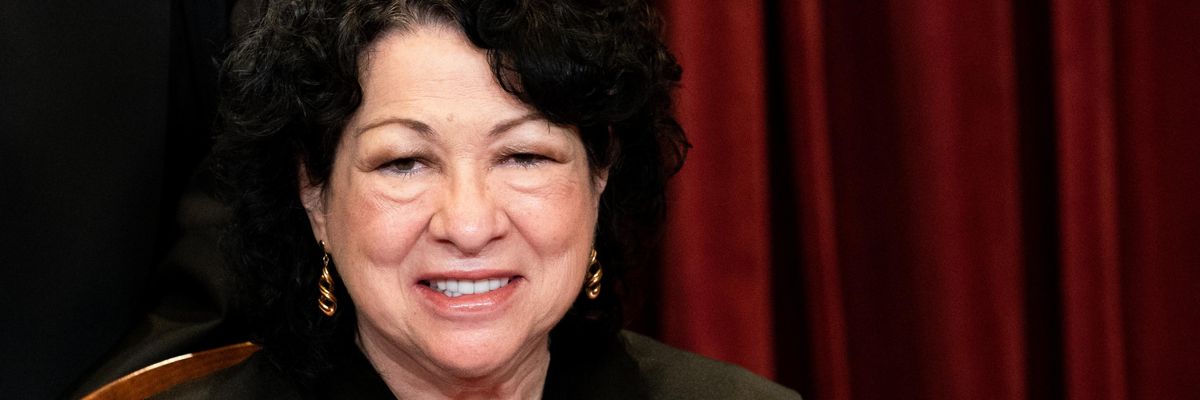
Associate Justice Sonia Sotomayor sits during a group photo of the justices at the Supreme Court in Washington, D.C. on April 23, 2021. (Photo: Erin Schaff-Pool/Getty Images)
U.S. Supreme Court Justice Sonia Sotomayor on Tuesday warned that the court's right-wing majority had further eroded the nation's bedrock laws separating church and government when it ruled that Maine must include religious schools in a state-run tuition program.
"Today, the court leads us to a place where separation of church and state becomes a constitutional violation," wrote Sotomayor in the minority's dissent of the 6-3 decision.
"Forcing American taxpayers to fund private religious education... erodes the foundation of our democracy and harms students."
Sotomayor was joined by fellow liberal Justices Elena Kagan and Stephen Breyer to oppose the majority opinion in Carson v. Makin, which centered on two families in Maine who wanted state taxpayers to pay for to send their children to attend private religious schools.
In Maine, where many rural communities do not have public high schools, towns must either contract with nearby public school districts so children can receive education there or pay tuition at a private "nonsectarian school in accordance with the First Amendment of the United States Constitution."
The schools named in the case aim to instill "a Christian worldview" in its students and are openly discriminatory against "homosexuals, individuals who are transgender, and non-Christians," according to a legal filing.
Under Tuesday's Supreme Court ruling, said one legal expert, those institutions and others like them now have "a right to taxpayer funding."
"Education is an opportunity for students to learn about themselves and others, which is why all students deserve to see themselves reflected in curricula and engage in learning that exposes them to new points of view," said Jesse O'Connell, senior vice president for education at the Center for American Progress. "By diverting tax dollars away from public schools and to schools that can openly discriminate, this ruling puts these core tenets in jeopardy."
In her dissent, Sotomayor wrote that the court's right-wing majority "continues to dismantle the wall of separation between church and state that the Framers fought to build."
"In just a few years, the Court has upended constitutional doctrine," the justice wrote, "shifting from a rule that permits States to decline to fund religious organizations to one that requires States in many circumstances to subsidize religious indoctrination with taxpayer dollars."
The ruling follows a number of decisions by the court favoring the religious right in recent years, including one allowing religious exemptions for employers that don't want to include contraception in healthcare coverage and one allowing Christian prayers before government meetings.
The latest "radical ruling," said Becky Pringle, president of the National Education Association, will undermine "public schools and the students they serve."
"Forcing American taxpayers to fund private religious education--even when those private schools fail to meet education standards, intentionally discriminate against students, or use public funds to promote religious training, worship, and instruction--erodes the foundation of our democracy and harms students," Pringle said.
"We are witnessing one of the most extreme Supreme Courts in modern history rewrite the most basic social commitments of our society--that publicly-funded education should be free and open to all without discrimination is one of those commitments," she added. "Shamefully, today's decision tosses aside that social commitment."
Dear Common Dreams reader, It’s been nearly 30 years since I co-founded Common Dreams with my late wife, Lina Newhouser. We had the radical notion that journalism should serve the public good, not corporate profits. It was clear to us from the outset what it would take to build such a project. No paid advertisements. No corporate sponsors. No millionaire publisher telling us what to think or do. Many people said we wouldn't last a year, but we proved those doubters wrong. Together with a tremendous team of journalists and dedicated staff, we built an independent media outlet free from the constraints of profits and corporate control. Our mission has always been simple: To inform. To inspire. To ignite change for the common good. Building Common Dreams was not easy. Our survival was never guaranteed. When you take on the most powerful forces—Wall Street greed, fossil fuel industry destruction, Big Tech lobbyists, and uber-rich oligarchs who have spent billions upon billions rigging the economy and democracy in their favor—the only bulwark you have is supporters who believe in your work. But here’s the urgent message from me today. It's never been this bad out there. And it's never been this hard to keep us going. At the very moment Common Dreams is most needed, the threats we face are intensifying. We need your support now more than ever. We don't accept corporate advertising and never will. We don't have a paywall because we don't think people should be blocked from critical news based on their ability to pay. Everything we do is funded by the donations of readers like you. When everyone does the little they can afford, we are strong. But if that support retreats or dries up, so do we. Will you donate now to make sure Common Dreams not only survives but thrives? —Craig Brown, Co-founder |
U.S. Supreme Court Justice Sonia Sotomayor on Tuesday warned that the court's right-wing majority had further eroded the nation's bedrock laws separating church and government when it ruled that Maine must include religious schools in a state-run tuition program.
"Today, the court leads us to a place where separation of church and state becomes a constitutional violation," wrote Sotomayor in the minority's dissent of the 6-3 decision.
"Forcing American taxpayers to fund private religious education... erodes the foundation of our democracy and harms students."
Sotomayor was joined by fellow liberal Justices Elena Kagan and Stephen Breyer to oppose the majority opinion in Carson v. Makin, which centered on two families in Maine who wanted state taxpayers to pay for to send their children to attend private religious schools.
In Maine, where many rural communities do not have public high schools, towns must either contract with nearby public school districts so children can receive education there or pay tuition at a private "nonsectarian school in accordance with the First Amendment of the United States Constitution."
The schools named in the case aim to instill "a Christian worldview" in its students and are openly discriminatory against "homosexuals, individuals who are transgender, and non-Christians," according to a legal filing.
Under Tuesday's Supreme Court ruling, said one legal expert, those institutions and others like them now have "a right to taxpayer funding."
"Education is an opportunity for students to learn about themselves and others, which is why all students deserve to see themselves reflected in curricula and engage in learning that exposes them to new points of view," said Jesse O'Connell, senior vice president for education at the Center for American Progress. "By diverting tax dollars away from public schools and to schools that can openly discriminate, this ruling puts these core tenets in jeopardy."
In her dissent, Sotomayor wrote that the court's right-wing majority "continues to dismantle the wall of separation between church and state that the Framers fought to build."
"In just a few years, the Court has upended constitutional doctrine," the justice wrote, "shifting from a rule that permits States to decline to fund religious organizations to one that requires States in many circumstances to subsidize religious indoctrination with taxpayer dollars."
The ruling follows a number of decisions by the court favoring the religious right in recent years, including one allowing religious exemptions for employers that don't want to include contraception in healthcare coverage and one allowing Christian prayers before government meetings.
The latest "radical ruling," said Becky Pringle, president of the National Education Association, will undermine "public schools and the students they serve."
"Forcing American taxpayers to fund private religious education--even when those private schools fail to meet education standards, intentionally discriminate against students, or use public funds to promote religious training, worship, and instruction--erodes the foundation of our democracy and harms students," Pringle said.
"We are witnessing one of the most extreme Supreme Courts in modern history rewrite the most basic social commitments of our society--that publicly-funded education should be free and open to all without discrimination is one of those commitments," she added. "Shamefully, today's decision tosses aside that social commitment."
U.S. Supreme Court Justice Sonia Sotomayor on Tuesday warned that the court's right-wing majority had further eroded the nation's bedrock laws separating church and government when it ruled that Maine must include religious schools in a state-run tuition program.
"Today, the court leads us to a place where separation of church and state becomes a constitutional violation," wrote Sotomayor in the minority's dissent of the 6-3 decision.
"Forcing American taxpayers to fund private religious education... erodes the foundation of our democracy and harms students."
Sotomayor was joined by fellow liberal Justices Elena Kagan and Stephen Breyer to oppose the majority opinion in Carson v. Makin, which centered on two families in Maine who wanted state taxpayers to pay for to send their children to attend private religious schools.
In Maine, where many rural communities do not have public high schools, towns must either contract with nearby public school districts so children can receive education there or pay tuition at a private "nonsectarian school in accordance with the First Amendment of the United States Constitution."
The schools named in the case aim to instill "a Christian worldview" in its students and are openly discriminatory against "homosexuals, individuals who are transgender, and non-Christians," according to a legal filing.
Under Tuesday's Supreme Court ruling, said one legal expert, those institutions and others like them now have "a right to taxpayer funding."
"Education is an opportunity for students to learn about themselves and others, which is why all students deserve to see themselves reflected in curricula and engage in learning that exposes them to new points of view," said Jesse O'Connell, senior vice president for education at the Center for American Progress. "By diverting tax dollars away from public schools and to schools that can openly discriminate, this ruling puts these core tenets in jeopardy."
In her dissent, Sotomayor wrote that the court's right-wing majority "continues to dismantle the wall of separation between church and state that the Framers fought to build."
"In just a few years, the Court has upended constitutional doctrine," the justice wrote, "shifting from a rule that permits States to decline to fund religious organizations to one that requires States in many circumstances to subsidize religious indoctrination with taxpayer dollars."
The ruling follows a number of decisions by the court favoring the religious right in recent years, including one allowing religious exemptions for employers that don't want to include contraception in healthcare coverage and one allowing Christian prayers before government meetings.
The latest "radical ruling," said Becky Pringle, president of the National Education Association, will undermine "public schools and the students they serve."
"Forcing American taxpayers to fund private religious education--even when those private schools fail to meet education standards, intentionally discriminate against students, or use public funds to promote religious training, worship, and instruction--erodes the foundation of our democracy and harms students," Pringle said.
"We are witnessing one of the most extreme Supreme Courts in modern history rewrite the most basic social commitments of our society--that publicly-funded education should be free and open to all without discrimination is one of those commitments," she added. "Shamefully, today's decision tosses aside that social commitment."