SUBSCRIBE TO OUR FREE NEWSLETTER
Daily news & progressive opinion—funded by the people, not the corporations—delivered straight to your inbox.
5
#000000
#FFFFFF
To donate by check, phone, or other method, see our More Ways to Give page.
Daily news & progressive opinion—funded by the people, not the corporations—delivered straight to your inbox.
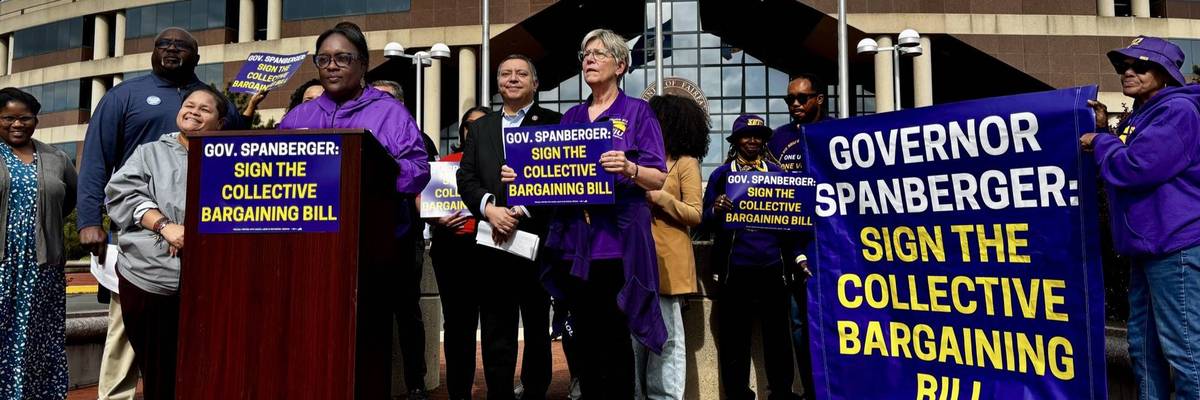
Members of the Service Employees International Union (SEIU) Virginia are joined by local government officials to call on Gov. Abigail Spanberger (D) to sign collective bargaining legislation outside the Fairfax County Government Center on May 6, 2026.
“We believed that she was being authentic and honest with us," said one Virginia labor leader. "She just flat-out flipped."
Labor unions are feeling betrayed after Virginia's Democratic Gov. Abigail Spanberger vetoed a bill on Thursday that would have restored collective bargaining rights for half a million public sector workers.
Virginia is one of the most restrictive states in the country for public sector bargaining, a holdover from the Jim Crow era when the General Assembly and other state legislatures across the South sought to crush the power of a public workforce with many Black employees.
According to the Economic Policy Institute, Virginia has one of the largest public sector pay gaps in the country, with state and local government employees making about 27% less on average than their private-sector peers, and it is similarly stratified in other states with weak collective bargaining rights.
Spanberger, a former US representative who was elected governor this past November, made pro-union messaging central to her affordability-focused platform. She decried President Donald Trump's executive order stripping federal workers of collective bargaining rights last year and said that as governor, she'd "look forward to working with members of our General Assembly to make sure more Virginians can negotiate for the benefits and fair treatment that they earn.”
But since taking office, Spanberger's support for restoring public sector union rights has been more tepid as she's gotten an earful from fiscally conservative Right-to-Work and taxpayer advocacy groups who claimed higher salaries for public employees would drain state funds and raise the cost of services.
When a bill to immediately mandate collective bargaining rights to 500,000 workers was proposed in the Democratic-controlled General Assembly, she introduced amendments aimed at watering down the bill—making it optional for employers to recognize unions, delaying the full implementation until 2030, and introducing what unions called a "kill-switch" that would have allowed future governors to revoke collective bargaining power.
The legislature shot Spanberger's amendments down and passed the bill in its original form. On Thursday, the governor vetoed it altogether.
In her veto message, Spanberger said she wanted the bill's other collective bargaining provisions for state employees, home care workers, and higher education employees to go into effect first "in order to demonstrate the efficacy of this new system" before it was opened up to all public employees.
But the unions that advocated for the bill say Spanberger led workers on with false promises.
"This veto is a devastating betrayal to the hundreds of thousands of public employees who have spent years, and in many cases decades, fighting for a seat at the table," said Doris Crouse-Mays, the president of the Virginia AFL-CIO. "Spanberger campaigned publicly and privately on promises [of] affordability, to support working families and respect workers' rights... Instead, when presented with the opportunity to make history and deliver on those promises, she chose to side with fear, political calculation, business, and the same anti-worker arguments that have been used for generations to deny workers power in Virginia."
LaNoral Thomas, the president of the Service Employees International Union (SEIU) Virginia 512—a union which helped lead the charge to pass the bill—told the Virginia news site Dogwood that her union had "high hopes" for Spanberger when she was elected.
“We believed that she was being authentic and honest with us," Thomas said. "She just flat-out flipped. It is shocking.”
"Public employees are not a special interest. They are our neighbors. They are the educators, bus drivers, social workers, librarians, custodians, and first responders who hold our communities together," said a joint statement from Carol Bauer, president of the Virginia Education Association, and Becky Pringle, president of the National Education Association.
They emphasized that the veto also carried "a deep racial and gender impact," noting that "Virginia’s public sector bargaining ban is rooted in a Jim Crow era effort to silence Black workers at the University of Virginia Hospital who organized for fair pay and dignity." They said, "Preserving that legacy today disproportionately harms women and workers of color, who make up so much of the public-service workforce and who have the most to gain from fair wages, safer workplaces, and a real voice on the job."
Lee Saunders, the president of the American Federation of State, County and Municipal Employees (AFSCME)—the largest national union of public sector workers in the US, with more than 1.4 million members—said that Spanberger had caved to "anti-worker extremists [who] have sidelined working people while starving the public services Virginia families rely on, earning the state a reputation as one of the most anti-worker in the country."
"While the governor has broken her word," Saunders said, "AFSCME members are deeply grateful to the bill’s sponsors and the leadership of both chambers, who kept theirs. Their commitment to working people stands in stark contrast to the governor and will not be forgotten."
"Gov. Spanberger made a choice today," he added. "Working people will remember it."
Dear Common Dreams reader, It’s been nearly 30 years since I co-founded Common Dreams with my late wife, Lina Newhouser. We had the radical notion that journalism should serve the public good, not corporate profits. It was clear to us from the outset what it would take to build such a project. No paid advertisements. No corporate sponsors. No millionaire publisher telling us what to think or do. Many people said we wouldn't last a year, but we proved those doubters wrong. Together with a tremendous team of journalists and dedicated staff, we built an independent media outlet free from the constraints of profits and corporate control. Our mission has always been simple: To inform. To inspire. To ignite change for the common good. Building Common Dreams was not easy. Our survival was never guaranteed. When you take on the most powerful forces—Wall Street greed, fossil fuel industry destruction, Big Tech lobbyists, and uber-rich oligarchs who have spent billions upon billions rigging the economy and democracy in their favor—the only bulwark you have is supporters who believe in your work. But here’s the urgent message from me today. It's never been this bad out there. And it's never been this hard to keep us going. At the very moment Common Dreams is most needed, the threats we face are intensifying. We need your support now more than ever. We don't accept corporate advertising and never will. We don't have a paywall because we don't think people should be blocked from critical news based on their ability to pay. Everything we do is funded by the donations of readers like you. When everyone does the little they can afford, we are strong. But if that support retreats or dries up, so do we. Will you donate now to make sure Common Dreams not only survives but thrives? —Craig Brown, Co-founder |
Labor unions are feeling betrayed after Virginia's Democratic Gov. Abigail Spanberger vetoed a bill on Thursday that would have restored collective bargaining rights for half a million public sector workers.
Virginia is one of the most restrictive states in the country for public sector bargaining, a holdover from the Jim Crow era when the General Assembly and other state legislatures across the South sought to crush the power of a public workforce with many Black employees.
According to the Economic Policy Institute, Virginia has one of the largest public sector pay gaps in the country, with state and local government employees making about 27% less on average than their private-sector peers, and it is similarly stratified in other states with weak collective bargaining rights.
Spanberger, a former US representative who was elected governor this past November, made pro-union messaging central to her affordability-focused platform. She decried President Donald Trump's executive order stripping federal workers of collective bargaining rights last year and said that as governor, she'd "look forward to working with members of our General Assembly to make sure more Virginians can negotiate for the benefits and fair treatment that they earn.”
But since taking office, Spanberger's support for restoring public sector union rights has been more tepid as she's gotten an earful from fiscally conservative Right-to-Work and taxpayer advocacy groups who claimed higher salaries for public employees would drain state funds and raise the cost of services.
When a bill to immediately mandate collective bargaining rights to 500,000 workers was proposed in the Democratic-controlled General Assembly, she introduced amendments aimed at watering down the bill—making it optional for employers to recognize unions, delaying the full implementation until 2030, and introducing what unions called a "kill-switch" that would have allowed future governors to revoke collective bargaining power.
The legislature shot Spanberger's amendments down and passed the bill in its original form. On Thursday, the governor vetoed it altogether.
In her veto message, Spanberger said she wanted the bill's other collective bargaining provisions for state employees, home care workers, and higher education employees to go into effect first "in order to demonstrate the efficacy of this new system" before it was opened up to all public employees.
But the unions that advocated for the bill say Spanberger led workers on with false promises.
"This veto is a devastating betrayal to the hundreds of thousands of public employees who have spent years, and in many cases decades, fighting for a seat at the table," said Doris Crouse-Mays, the president of the Virginia AFL-CIO. "Spanberger campaigned publicly and privately on promises [of] affordability, to support working families and respect workers' rights... Instead, when presented with the opportunity to make history and deliver on those promises, she chose to side with fear, political calculation, business, and the same anti-worker arguments that have been used for generations to deny workers power in Virginia."
LaNoral Thomas, the president of the Service Employees International Union (SEIU) Virginia 512—a union which helped lead the charge to pass the bill—told the Virginia news site Dogwood that her union had "high hopes" for Spanberger when she was elected.
“We believed that she was being authentic and honest with us," Thomas said. "She just flat-out flipped. It is shocking.”
"Public employees are not a special interest. They are our neighbors. They are the educators, bus drivers, social workers, librarians, custodians, and first responders who hold our communities together," said a joint statement from Carol Bauer, president of the Virginia Education Association, and Becky Pringle, president of the National Education Association.
They emphasized that the veto also carried "a deep racial and gender impact," noting that "Virginia’s public sector bargaining ban is rooted in a Jim Crow era effort to silence Black workers at the University of Virginia Hospital who organized for fair pay and dignity." They said, "Preserving that legacy today disproportionately harms women and workers of color, who make up so much of the public-service workforce and who have the most to gain from fair wages, safer workplaces, and a real voice on the job."
Lee Saunders, the president of the American Federation of State, County and Municipal Employees (AFSCME)—the largest national union of public sector workers in the US, with more than 1.4 million members—said that Spanberger had caved to "anti-worker extremists [who] have sidelined working people while starving the public services Virginia families rely on, earning the state a reputation as one of the most anti-worker in the country."
"While the governor has broken her word," Saunders said, "AFSCME members are deeply grateful to the bill’s sponsors and the leadership of both chambers, who kept theirs. Their commitment to working people stands in stark contrast to the governor and will not be forgotten."
"Gov. Spanberger made a choice today," he added. "Working people will remember it."
Labor unions are feeling betrayed after Virginia's Democratic Gov. Abigail Spanberger vetoed a bill on Thursday that would have restored collective bargaining rights for half a million public sector workers.
Virginia is one of the most restrictive states in the country for public sector bargaining, a holdover from the Jim Crow era when the General Assembly and other state legislatures across the South sought to crush the power of a public workforce with many Black employees.
According to the Economic Policy Institute, Virginia has one of the largest public sector pay gaps in the country, with state and local government employees making about 27% less on average than their private-sector peers, and it is similarly stratified in other states with weak collective bargaining rights.
Spanberger, a former US representative who was elected governor this past November, made pro-union messaging central to her affordability-focused platform. She decried President Donald Trump's executive order stripping federal workers of collective bargaining rights last year and said that as governor, she'd "look forward to working with members of our General Assembly to make sure more Virginians can negotiate for the benefits and fair treatment that they earn.”
But since taking office, Spanberger's support for restoring public sector union rights has been more tepid as she's gotten an earful from fiscally conservative Right-to-Work and taxpayer advocacy groups who claimed higher salaries for public employees would drain state funds and raise the cost of services.
When a bill to immediately mandate collective bargaining rights to 500,000 workers was proposed in the Democratic-controlled General Assembly, she introduced amendments aimed at watering down the bill—making it optional for employers to recognize unions, delaying the full implementation until 2030, and introducing what unions called a "kill-switch" that would have allowed future governors to revoke collective bargaining power.
The legislature shot Spanberger's amendments down and passed the bill in its original form. On Thursday, the governor vetoed it altogether.
In her veto message, Spanberger said she wanted the bill's other collective bargaining provisions for state employees, home care workers, and higher education employees to go into effect first "in order to demonstrate the efficacy of this new system" before it was opened up to all public employees.
But the unions that advocated for the bill say Spanberger led workers on with false promises.
"This veto is a devastating betrayal to the hundreds of thousands of public employees who have spent years, and in many cases decades, fighting for a seat at the table," said Doris Crouse-Mays, the president of the Virginia AFL-CIO. "Spanberger campaigned publicly and privately on promises [of] affordability, to support working families and respect workers' rights... Instead, when presented with the opportunity to make history and deliver on those promises, she chose to side with fear, political calculation, business, and the same anti-worker arguments that have been used for generations to deny workers power in Virginia."
LaNoral Thomas, the president of the Service Employees International Union (SEIU) Virginia 512—a union which helped lead the charge to pass the bill—told the Virginia news site Dogwood that her union had "high hopes" for Spanberger when she was elected.
“We believed that she was being authentic and honest with us," Thomas said. "She just flat-out flipped. It is shocking.”
"Public employees are not a special interest. They are our neighbors. They are the educators, bus drivers, social workers, librarians, custodians, and first responders who hold our communities together," said a joint statement from Carol Bauer, president of the Virginia Education Association, and Becky Pringle, president of the National Education Association.
They emphasized that the veto also carried "a deep racial and gender impact," noting that "Virginia’s public sector bargaining ban is rooted in a Jim Crow era effort to silence Black workers at the University of Virginia Hospital who organized for fair pay and dignity." They said, "Preserving that legacy today disproportionately harms women and workers of color, who make up so much of the public-service workforce and who have the most to gain from fair wages, safer workplaces, and a real voice on the job."
Lee Saunders, the president of the American Federation of State, County and Municipal Employees (AFSCME)—the largest national union of public sector workers in the US, with more than 1.4 million members—said that Spanberger had caved to "anti-worker extremists [who] have sidelined working people while starving the public services Virginia families rely on, earning the state a reputation as one of the most anti-worker in the country."
"While the governor has broken her word," Saunders said, "AFSCME members are deeply grateful to the bill’s sponsors and the leadership of both chambers, who kept theirs. Their commitment to working people stands in stark contrast to the governor and will not be forgotten."
"Gov. Spanberger made a choice today," he added. "Working people will remember it."