

SUBSCRIBE TO OUR FREE NEWSLETTER
Daily news & progressive opinion—funded by the people, not the corporations—delivered straight to your inbox.
5
#000000
#FFFFFF
To donate by check, phone, or other method, see our More Ways to Give page.
Daily news & progressive opinion—funded by the people, not the corporations—delivered straight to your inbox.
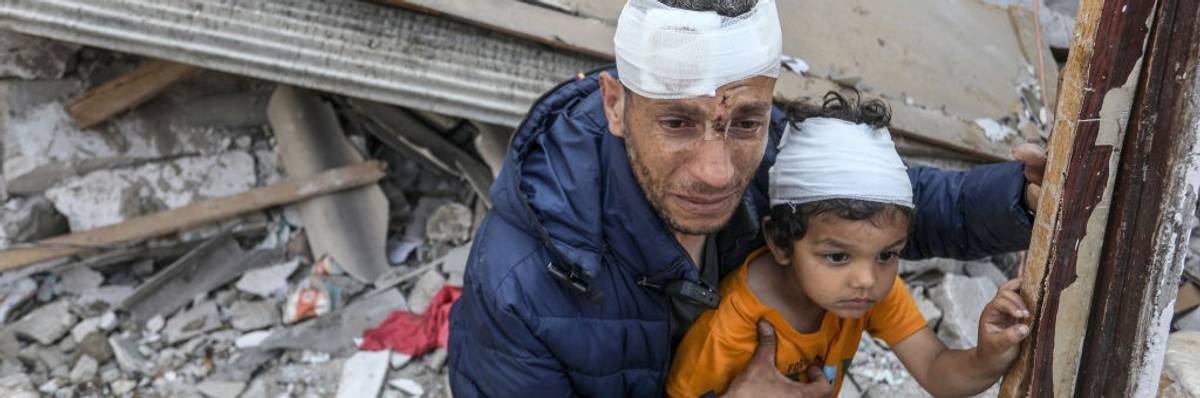
Palestinians wounded in Israeli attacks on Rafah attempt to collect belongings from bombed-out homes on May 1, 2024 in the southern Gaza city.
"The simplest truth is that a ground operation in Rafah will be nothing short of a tragedy beyond words," said a top U.N. aid official. "No humanitarian plan can counter that."
The United Nations' humanitarian aid agency warned Friday that an Israeli ground invasion of Rafah would put hundreds of thousands of Palestinians "at imminent risk of death."
"Any ground operation would mean more suffering and death" for the approximately 1.5 million Palestinians—including around 1.2 million people forcibly displaced from other areas of the embattled enclave—sheltering in Gaza's southernmost city, U.N. Office for the Coordination of Humanitarian Affairs (OCHA) spokesperson Jens Laerke told reporters in Geneva on Friday.
"The hundreds of thousands of people who are there would be at imminent risk of death if there is an assault," he added, warning of not only "a slaughter of civilians, but also at the same time an incredible blow to the humanitarian operation in the entire strip, because it is run primarily out of Rafah."
Gaza: “This contingency plan is Band-Aids. It will absolutely not prevent the expected substantial additional mortality and morbidity caused by a military operation.” - Dr Richard Peeperkorn of @WHOoPt
“Any ground operation would mean more suffering and death” - @UNOCHA
. pic.twitter.com/tJHt8dh3D7
— United Nations Geneva (@UNGeneva) May 3, 2024
According to Politico, Israel has shared with the U.S. government its plan to move the civilian population out of Rafah ahead of a looming ground assault the Wall Street Journal reported earlier on Friday could begin next week.
Conditions in Rafah are already dire. The city—which was home to fewer than 300,000 people before the war—is now one of the most densely populated places on the planet. Hundreds of thousands of refugees are crowded together in tents and other makeshift shelters. Water and other necessities are in desperately short supply. According to James Elder, the global spokesperson for the United Nations Children's Fund (UNICEF), there is approximately one toilet for every 850 people in Rafah and one shower for every 3,500 people.
"Try to imagine, as a teenage girl, or elderly man, or pregnant woman, queueing for an entire day just to have a shower," Elder wrote for The Guardian this week.
There are nearly 600,000 children in Rafah, nearly all of whom are "injured, sick, malnourished, traumatized, or living with disabilities," UNICEF executive director Catherine Russell said Wednesday.
The war in Gaza is taking an unimaginable toll on children.
In Rafah, a city of children, the impact of a further escalation would be devastating.
The lives of children must be protected.
All the hostages must be released.
The nightmare for so many families must end. pic.twitter.com/5kOye5VySZ
— Catherine Russell (@unicefchief) May 1, 2024
Dr. Rik Peeperkorn, who represents the U.N. World Health Organization in the illegally occupied Palestinian territories, on Friday called contingency response plans for a Rafah invasion a "Band-Aid" solution.
"It will absolutely not prevent the expected substantial additional mortality and morbidity caused by a military operation," he stressed.
Israel's 210-day assault on Gaza in retaliation for the October 7 attacks has already killed at least 34,622 Palestinians—a large majority of them civilian men, women, and children—while wounding more than 77,800 others, according to Palestinian and international officials. At least 11,000 other Gazans are missing and presumed dead and buried beneath the rubble of the more than 370,000 homes and other buildings destroyed or damaged during the war.
That means around 5% of Gazans have been killed or wounded during Israel's onslaught, the U.N. Development Program and the U.N. Economic Commission for Western Asia said in a report published Wednesday. The agencies called this an "unprecedented" level of casualties in modern warfare and said it would take until at least 2040 to restore all the homes destroyed or damaged during the war.
As many as 90% of Gaza's 2.3 million people have also been forcibly displaced by Israeli forces, who despite a January International Court of Justice (ICJ) order to prevent genocidal acts continue to block adequate humanitarian aid from reaching the starving people of Gaza.
Despite pleas and protestations from world leaders including U.S. President Joe Biden, Israeli Prime Minister Benjamin Netanyahu has vowed to invade Rafah to "eliminate Hamas' battalions there."
Earlier this week, far-right Israeli Finance Minister Bezalel Smotrich called for the "total annihilation" of Gaza, specifically mentioning Rafah. The South Africa-led case against Israel at the ICJ has centered similar statements of intent to destroy Palestinians—which are key to proving the crime of genocide—made by Israeli officials since October.
Meanwhile, Israeli forces have ramped up aerial attacks on Rafah in what is likely preparation for a ground invasion. Palestinian and international media reported Friday that an overnight Israeli airstrike on a home killed at least eight people, mostly children.
"After almost seven months of brutal hostilities that have killed tens of thousands of people and maimed tens of thousands more, Gaza is bracing for even more suffering and misery," U.N. Under-Secretary-General for Humanitarian Affairs and Emergency Relief Coordinator Martin Griffiths said earlier this week.
"The world has been appealing to the Israeli authorities for weeks to spare Rafah, but a ground operation there is on the immediate horizon," he continued. "For the hundreds of thousands of people who have fled to Gaza's southernmost point to escape disease, famine, mass graves, and direct fighting, a ground invasion would spell even more trauma and death."
"The simplest truth is that a ground operation in Rafah will be nothing short of a tragedy beyond words," Griffiths added. "No humanitarian plan can counter that. The rest is detail."
U.S. officials have also privately sounded the alarm over the likely consequences of an Israeli invasion of Rafah.
In March, according to a leaked cable obtained by The Intercept, members of the Bureau for Humanitarian Assistance at the U.S. Agency for International Development warned the State Department that a Rafah invasion "could result in catastrophic humanitarian consequences, including mass civilian casualties, extensive population displacement, and the collapse of the existing humanitarian response."
Dear Common Dreams reader, It’s been nearly 30 years since I co-founded Common Dreams with my late wife, Lina Newhouser. We had the radical notion that journalism should serve the public good, not corporate profits. It was clear to us from the outset what it would take to build such a project. No paid advertisements. No corporate sponsors. No millionaire publisher telling us what to think or do. Many people said we wouldn't last a year, but we proved those doubters wrong. Together with a tremendous team of journalists and dedicated staff, we built an independent media outlet free from the constraints of profits and corporate control. Our mission has always been simple: To inform. To inspire. To ignite change for the common good. Building Common Dreams was not easy. Our survival was never guaranteed. When you take on the most powerful forces—Wall Street greed, fossil fuel industry destruction, Big Tech lobbyists, and uber-rich oligarchs who have spent billions upon billions rigging the economy and democracy in their favor—the only bulwark you have is supporters who believe in your work. But here’s the urgent message from me today. It's never been this bad out there. And it's never been this hard to keep us going. At the very moment Common Dreams is most needed, the threats we face are intensifying. We need your support now more than ever. We don't accept corporate advertising and never will. We don't have a paywall because we don't think people should be blocked from critical news based on their ability to pay. Everything we do is funded by the donations of readers like you. When everyone does the little they can afford, we are strong. But if that support retreats or dries up, so do we. Will you donate now to make sure Common Dreams not only survives but thrives? —Craig Brown, Co-founder |
The United Nations' humanitarian aid agency warned Friday that an Israeli ground invasion of Rafah would put hundreds of thousands of Palestinians "at imminent risk of death."
"Any ground operation would mean more suffering and death" for the approximately 1.5 million Palestinians—including around 1.2 million people forcibly displaced from other areas of the embattled enclave—sheltering in Gaza's southernmost city, U.N. Office for the Coordination of Humanitarian Affairs (OCHA) spokesperson Jens Laerke told reporters in Geneva on Friday.
"The hundreds of thousands of people who are there would be at imminent risk of death if there is an assault," he added, warning of not only "a slaughter of civilians, but also at the same time an incredible blow to the humanitarian operation in the entire strip, because it is run primarily out of Rafah."
Gaza: “This contingency plan is Band-Aids. It will absolutely not prevent the expected substantial additional mortality and morbidity caused by a military operation.” - Dr Richard Peeperkorn of @WHOoPt
“Any ground operation would mean more suffering and death” - @UNOCHA
. pic.twitter.com/tJHt8dh3D7
— United Nations Geneva (@UNGeneva) May 3, 2024
According to Politico, Israel has shared with the U.S. government its plan to move the civilian population out of Rafah ahead of a looming ground assault the Wall Street Journal reported earlier on Friday could begin next week.
Conditions in Rafah are already dire. The city—which was home to fewer than 300,000 people before the war—is now one of the most densely populated places on the planet. Hundreds of thousands of refugees are crowded together in tents and other makeshift shelters. Water and other necessities are in desperately short supply. According to James Elder, the global spokesperson for the United Nations Children's Fund (UNICEF), there is approximately one toilet for every 850 people in Rafah and one shower for every 3,500 people.
"Try to imagine, as a teenage girl, or elderly man, or pregnant woman, queueing for an entire day just to have a shower," Elder wrote for The Guardian this week.
There are nearly 600,000 children in Rafah, nearly all of whom are "injured, sick, malnourished, traumatized, or living with disabilities," UNICEF executive director Catherine Russell said Wednesday.
The war in Gaza is taking an unimaginable toll on children.
In Rafah, a city of children, the impact of a further escalation would be devastating.
The lives of children must be protected.
All the hostages must be released.
The nightmare for so many families must end. pic.twitter.com/5kOye5VySZ
— Catherine Russell (@unicefchief) May 1, 2024
Dr. Rik Peeperkorn, who represents the U.N. World Health Organization in the illegally occupied Palestinian territories, on Friday called contingency response plans for a Rafah invasion a "Band-Aid" solution.
"It will absolutely not prevent the expected substantial additional mortality and morbidity caused by a military operation," he stressed.
Israel's 210-day assault on Gaza in retaliation for the October 7 attacks has already killed at least 34,622 Palestinians—a large majority of them civilian men, women, and children—while wounding more than 77,800 others, according to Palestinian and international officials. At least 11,000 other Gazans are missing and presumed dead and buried beneath the rubble of the more than 370,000 homes and other buildings destroyed or damaged during the war.
That means around 5% of Gazans have been killed or wounded during Israel's onslaught, the U.N. Development Program and the U.N. Economic Commission for Western Asia said in a report published Wednesday. The agencies called this an "unprecedented" level of casualties in modern warfare and said it would take until at least 2040 to restore all the homes destroyed or damaged during the war.
As many as 90% of Gaza's 2.3 million people have also been forcibly displaced by Israeli forces, who despite a January International Court of Justice (ICJ) order to prevent genocidal acts continue to block adequate humanitarian aid from reaching the starving people of Gaza.
Despite pleas and protestations from world leaders including U.S. President Joe Biden, Israeli Prime Minister Benjamin Netanyahu has vowed to invade Rafah to "eliminate Hamas' battalions there."
Earlier this week, far-right Israeli Finance Minister Bezalel Smotrich called for the "total annihilation" of Gaza, specifically mentioning Rafah. The South Africa-led case against Israel at the ICJ has centered similar statements of intent to destroy Palestinians—which are key to proving the crime of genocide—made by Israeli officials since October.
Meanwhile, Israeli forces have ramped up aerial attacks on Rafah in what is likely preparation for a ground invasion. Palestinian and international media reported Friday that an overnight Israeli airstrike on a home killed at least eight people, mostly children.
"After almost seven months of brutal hostilities that have killed tens of thousands of people and maimed tens of thousands more, Gaza is bracing for even more suffering and misery," U.N. Under-Secretary-General for Humanitarian Affairs and Emergency Relief Coordinator Martin Griffiths said earlier this week.
"The world has been appealing to the Israeli authorities for weeks to spare Rafah, but a ground operation there is on the immediate horizon," he continued. "For the hundreds of thousands of people who have fled to Gaza's southernmost point to escape disease, famine, mass graves, and direct fighting, a ground invasion would spell even more trauma and death."
"The simplest truth is that a ground operation in Rafah will be nothing short of a tragedy beyond words," Griffiths added. "No humanitarian plan can counter that. The rest is detail."
U.S. officials have also privately sounded the alarm over the likely consequences of an Israeli invasion of Rafah.
In March, according to a leaked cable obtained by The Intercept, members of the Bureau for Humanitarian Assistance at the U.S. Agency for International Development warned the State Department that a Rafah invasion "could result in catastrophic humanitarian consequences, including mass civilian casualties, extensive population displacement, and the collapse of the existing humanitarian response."
The United Nations' humanitarian aid agency warned Friday that an Israeli ground invasion of Rafah would put hundreds of thousands of Palestinians "at imminent risk of death."
"Any ground operation would mean more suffering and death" for the approximately 1.5 million Palestinians—including around 1.2 million people forcibly displaced from other areas of the embattled enclave—sheltering in Gaza's southernmost city, U.N. Office for the Coordination of Humanitarian Affairs (OCHA) spokesperson Jens Laerke told reporters in Geneva on Friday.
"The hundreds of thousands of people who are there would be at imminent risk of death if there is an assault," he added, warning of not only "a slaughter of civilians, but also at the same time an incredible blow to the humanitarian operation in the entire strip, because it is run primarily out of Rafah."
Gaza: “This contingency plan is Band-Aids. It will absolutely not prevent the expected substantial additional mortality and morbidity caused by a military operation.” - Dr Richard Peeperkorn of @WHOoPt
“Any ground operation would mean more suffering and death” - @UNOCHA
. pic.twitter.com/tJHt8dh3D7
— United Nations Geneva (@UNGeneva) May 3, 2024
According to Politico, Israel has shared with the U.S. government its plan to move the civilian population out of Rafah ahead of a looming ground assault the Wall Street Journal reported earlier on Friday could begin next week.
Conditions in Rafah are already dire. The city—which was home to fewer than 300,000 people before the war—is now one of the most densely populated places on the planet. Hundreds of thousands of refugees are crowded together in tents and other makeshift shelters. Water and other necessities are in desperately short supply. According to James Elder, the global spokesperson for the United Nations Children's Fund (UNICEF), there is approximately one toilet for every 850 people in Rafah and one shower for every 3,500 people.
"Try to imagine, as a teenage girl, or elderly man, or pregnant woman, queueing for an entire day just to have a shower," Elder wrote for The Guardian this week.
There are nearly 600,000 children in Rafah, nearly all of whom are "injured, sick, malnourished, traumatized, or living with disabilities," UNICEF executive director Catherine Russell said Wednesday.
The war in Gaza is taking an unimaginable toll on children.
In Rafah, a city of children, the impact of a further escalation would be devastating.
The lives of children must be protected.
All the hostages must be released.
The nightmare for so many families must end. pic.twitter.com/5kOye5VySZ
— Catherine Russell (@unicefchief) May 1, 2024
Dr. Rik Peeperkorn, who represents the U.N. World Health Organization in the illegally occupied Palestinian territories, on Friday called contingency response plans for a Rafah invasion a "Band-Aid" solution.
"It will absolutely not prevent the expected substantial additional mortality and morbidity caused by a military operation," he stressed.
Israel's 210-day assault on Gaza in retaliation for the October 7 attacks has already killed at least 34,622 Palestinians—a large majority of them civilian men, women, and children—while wounding more than 77,800 others, according to Palestinian and international officials. At least 11,000 other Gazans are missing and presumed dead and buried beneath the rubble of the more than 370,000 homes and other buildings destroyed or damaged during the war.
That means around 5% of Gazans have been killed or wounded during Israel's onslaught, the U.N. Development Program and the U.N. Economic Commission for Western Asia said in a report published Wednesday. The agencies called this an "unprecedented" level of casualties in modern warfare and said it would take until at least 2040 to restore all the homes destroyed or damaged during the war.
As many as 90% of Gaza's 2.3 million people have also been forcibly displaced by Israeli forces, who despite a January International Court of Justice (ICJ) order to prevent genocidal acts continue to block adequate humanitarian aid from reaching the starving people of Gaza.
Despite pleas and protestations from world leaders including U.S. President Joe Biden, Israeli Prime Minister Benjamin Netanyahu has vowed to invade Rafah to "eliminate Hamas' battalions there."
Earlier this week, far-right Israeli Finance Minister Bezalel Smotrich called for the "total annihilation" of Gaza, specifically mentioning Rafah. The South Africa-led case against Israel at the ICJ has centered similar statements of intent to destroy Palestinians—which are key to proving the crime of genocide—made by Israeli officials since October.
Meanwhile, Israeli forces have ramped up aerial attacks on Rafah in what is likely preparation for a ground invasion. Palestinian and international media reported Friday that an overnight Israeli airstrike on a home killed at least eight people, mostly children.
"After almost seven months of brutal hostilities that have killed tens of thousands of people and maimed tens of thousands more, Gaza is bracing for even more suffering and misery," U.N. Under-Secretary-General for Humanitarian Affairs and Emergency Relief Coordinator Martin Griffiths said earlier this week.
"The world has been appealing to the Israeli authorities for weeks to spare Rafah, but a ground operation there is on the immediate horizon," he continued. "For the hundreds of thousands of people who have fled to Gaza's southernmost point to escape disease, famine, mass graves, and direct fighting, a ground invasion would spell even more trauma and death."
"The simplest truth is that a ground operation in Rafah will be nothing short of a tragedy beyond words," Griffiths added. "No humanitarian plan can counter that. The rest is detail."
U.S. officials have also privately sounded the alarm over the likely consequences of an Israeli invasion of Rafah.
In March, according to a leaked cable obtained by The Intercept, members of the Bureau for Humanitarian Assistance at the U.S. Agency for International Development warned the State Department that a Rafah invasion "could result in catastrophic humanitarian consequences, including mass civilian casualties, extensive population displacement, and the collapse of the existing humanitarian response."

