SUBSCRIBE TO OUR FREE NEWSLETTER
Daily news & progressive opinion—funded by the people, not the corporations—delivered straight to your inbox.
5
#000000
#FFFFFF
To donate by check, phone, or other method, see our More Ways to Give page.
Daily news & progressive opinion—funded by the people, not the corporations—delivered straight to your inbox.
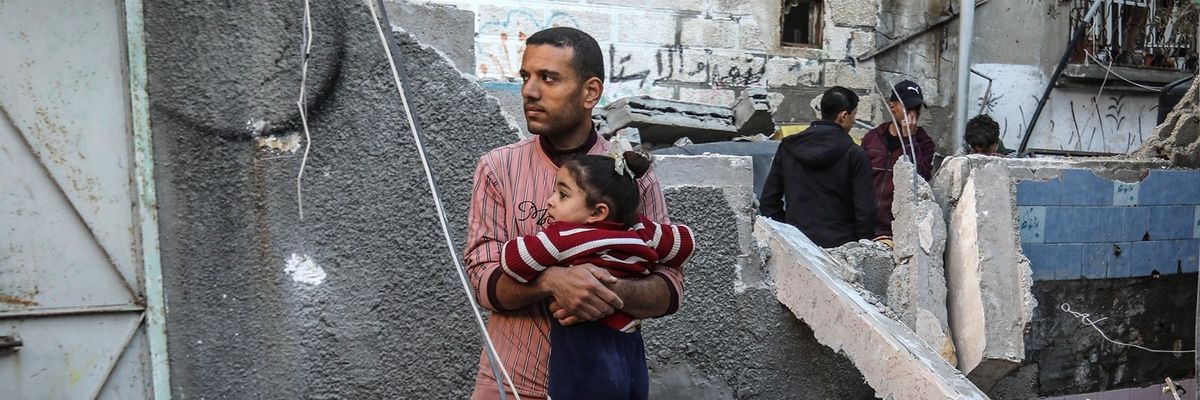
A Palestinian man consoles a girl near a damaged building after an Israeli attack in Rafah, Gaza on February 8, 2024.
The head of the Norwegian Refugee Council called for "an immediate cease-fire to reach the women, children, families who are at breaking point, with lifesaving aid."
Accusing Israel of waging war on a "gigantic refugee camp" where more than 1 million Palestinians have moved to escape air and ground attacks over the last four months, the head of the Norwegian Refugee Council on Thursday called on the Israel Defense Forces to stop its shelling of the southern Gaza city of Rafah and halt further plans for an intensified assault.
With Israeli military officials reporting that they have not devised a plan to protect civilian lives in Rafah, NRC Secretary-General Jan Egeland said that a ground offensive in the city—previously designated a "safe zone" where more than 1 million Palestinians were told to go as the Israel Defense Forces (IDF) launched air and ground attacks across the enclave—would be a "stain on both Israel and those nations providing arms," including the United States.
"It would be a bloodbath, and among children and women, among the innocent," Egeland told CNN, adding that reports of Hamas' tactic of "blending in with civilians... does not in any way justify indiscriminate attacks."
Egeland repeated the NRC's call for "an immediate cease-fire to reach the women, children, families who are at breaking point, with lifesaving aid."
The United Nations Office for the Coordination of Humanitarian Affairs earlier this week warned that Israel would likely commit "war crimes" if it launched expanded attacks on Rafah, which Netanyahu ordered on Wednesday after rejecting a cease-fire agreement proposed by Hamas.
Two-thirds of Gaza's population is now crammed into Rafah, where shelters are at 150% capacity and displaced people are struggling with a lack of safe drinking water, hygiene products, or showers. In the NRC's assessment of nine shelters—where 27,400 displaced people are staying—"diseases, including hepatitis A, gastroenteritis, diarrhoea, smallpox, lice, influenza, were reported in every location assessed."
"Conditions in Rafah are already dire, and a full-scale Israeli military operation will lead to even more loss of civilian life. Aid workers have been grappling with insecurity and insufficient aid for months. Attacks in areas where they provide food, water and shelter means this life-saving support will be impeded, if not entirely stopped," said Angelita Caredda, Middle East and North Africa regional director for the NRC.
"Further deterioration of humanitarian conditions in Rafah would be catastrophic as disease and starvation already persist among the displaced population," Caredda continued.
Overnight air strikes on Wednesday into Thursday in Rafah killed 14 people, including five children, and Al Jazeera's Hani Mahmoud reported that displaced people in the town are facing "a surge in attacks from air, land, and sea."
At one shelter, a children's entertainment event—which humanitarian aid workers have continued to provide to give Gaza's youngest residents a sense of normalcy—was interrupted by a bombing "just meters away," reported Al Jazeera.
Tedros Adhanom Ghebreyesus, director-general of the World Health Organization (WHO), said the reports of intensified shelling in Rafah were "deeply alarming."
" Gaza is one of the most densely populated places on Earth, and Rafah is now the most densely populated place in Gaza," Omar Shakir, Israel-Palestine director at Human Rights Watch, told Al Jazeera. "Any sort of military campaign or air strike would amplify risks of disproportionate attacks."
Agnes Callamard, secretary-general of Amnesty International, called for all efforts to be accelerated to secure a cease-fire "to save the thousands of people who have found refuge in Rafah."
Representatives of Hamas arrived in Cairo on Thursday for discussions with Israel regarding a new potential cease-fire deal. Egyptian officials told Al Jazeera that talks could take at least 10 days before a possible truce begins. Over the past 10 days, more than 1,200 Palestinians have been killed in Gaza.
Dear Common Dreams reader, It’s been nearly 30 years since I co-founded Common Dreams with my late wife, Lina Newhouser. We had the radical notion that journalism should serve the public good, not corporate profits. It was clear to us from the outset what it would take to build such a project. No paid advertisements. No corporate sponsors. No millionaire publisher telling us what to think or do. Many people said we wouldn't last a year, but we proved those doubters wrong. Together with a tremendous team of journalists and dedicated staff, we built an independent media outlet free from the constraints of profits and corporate control. Our mission has always been simple: To inform. To inspire. To ignite change for the common good. Building Common Dreams was not easy. Our survival was never guaranteed. When you take on the most powerful forces—Wall Street greed, fossil fuel industry destruction, Big Tech lobbyists, and uber-rich oligarchs who have spent billions upon billions rigging the economy and democracy in their favor—the only bulwark you have is supporters who believe in your work. But here’s the urgent message from me today. It's never been this bad out there. And it's never been this hard to keep us going. At the very moment Common Dreams is most needed, the threats we face are intensifying. We need your support now more than ever. We don't accept corporate advertising and never will. We don't have a paywall because we don't think people should be blocked from critical news based on their ability to pay. Everything we do is funded by the donations of readers like you. When everyone does the little they can afford, we are strong. But if that support retreats or dries up, so do we. Will you donate now to make sure Common Dreams not only survives but thrives? —Craig Brown, Co-founder |
Accusing Israel of waging war on a "gigantic refugee camp" where more than 1 million Palestinians have moved to escape air and ground attacks over the last four months, the head of the Norwegian Refugee Council on Thursday called on the Israel Defense Forces to stop its shelling of the southern Gaza city of Rafah and halt further plans for an intensified assault.
With Israeli military officials reporting that they have not devised a plan to protect civilian lives in Rafah, NRC Secretary-General Jan Egeland said that a ground offensive in the city—previously designated a "safe zone" where more than 1 million Palestinians were told to go as the Israel Defense Forces (IDF) launched air and ground attacks across the enclave—would be a "stain on both Israel and those nations providing arms," including the United States.
"It would be a bloodbath, and among children and women, among the innocent," Egeland told CNN, adding that reports of Hamas' tactic of "blending in with civilians... does not in any way justify indiscriminate attacks."
Egeland repeated the NRC's call for "an immediate cease-fire to reach the women, children, families who are at breaking point, with lifesaving aid."
The United Nations Office for the Coordination of Humanitarian Affairs earlier this week warned that Israel would likely commit "war crimes" if it launched expanded attacks on Rafah, which Netanyahu ordered on Wednesday after rejecting a cease-fire agreement proposed by Hamas.
Two-thirds of Gaza's population is now crammed into Rafah, where shelters are at 150% capacity and displaced people are struggling with a lack of safe drinking water, hygiene products, or showers. In the NRC's assessment of nine shelters—where 27,400 displaced people are staying—"diseases, including hepatitis A, gastroenteritis, diarrhoea, smallpox, lice, influenza, were reported in every location assessed."
"Conditions in Rafah are already dire, and a full-scale Israeli military operation will lead to even more loss of civilian life. Aid workers have been grappling with insecurity and insufficient aid for months. Attacks in areas where they provide food, water and shelter means this life-saving support will be impeded, if not entirely stopped," said Angelita Caredda, Middle East and North Africa regional director for the NRC.
"Further deterioration of humanitarian conditions in Rafah would be catastrophic as disease and starvation already persist among the displaced population," Caredda continued.
Overnight air strikes on Wednesday into Thursday in Rafah killed 14 people, including five children, and Al Jazeera's Hani Mahmoud reported that displaced people in the town are facing "a surge in attacks from air, land, and sea."
At one shelter, a children's entertainment event—which humanitarian aid workers have continued to provide to give Gaza's youngest residents a sense of normalcy—was interrupted by a bombing "just meters away," reported Al Jazeera.
Tedros Adhanom Ghebreyesus, director-general of the World Health Organization (WHO), said the reports of intensified shelling in Rafah were "deeply alarming."
" Gaza is one of the most densely populated places on Earth, and Rafah is now the most densely populated place in Gaza," Omar Shakir, Israel-Palestine director at Human Rights Watch, told Al Jazeera. "Any sort of military campaign or air strike would amplify risks of disproportionate attacks."
Agnes Callamard, secretary-general of Amnesty International, called for all efforts to be accelerated to secure a cease-fire "to save the thousands of people who have found refuge in Rafah."
Representatives of Hamas arrived in Cairo on Thursday for discussions with Israel regarding a new potential cease-fire deal. Egyptian officials told Al Jazeera that talks could take at least 10 days before a possible truce begins. Over the past 10 days, more than 1,200 Palestinians have been killed in Gaza.
Accusing Israel of waging war on a "gigantic refugee camp" where more than 1 million Palestinians have moved to escape air and ground attacks over the last four months, the head of the Norwegian Refugee Council on Thursday called on the Israel Defense Forces to stop its shelling of the southern Gaza city of Rafah and halt further plans for an intensified assault.
With Israeli military officials reporting that they have not devised a plan to protect civilian lives in Rafah, NRC Secretary-General Jan Egeland said that a ground offensive in the city—previously designated a "safe zone" where more than 1 million Palestinians were told to go as the Israel Defense Forces (IDF) launched air and ground attacks across the enclave—would be a "stain on both Israel and those nations providing arms," including the United States.
"It would be a bloodbath, and among children and women, among the innocent," Egeland told CNN, adding that reports of Hamas' tactic of "blending in with civilians... does not in any way justify indiscriminate attacks."
Egeland repeated the NRC's call for "an immediate cease-fire to reach the women, children, families who are at breaking point, with lifesaving aid."
The United Nations Office for the Coordination of Humanitarian Affairs earlier this week warned that Israel would likely commit "war crimes" if it launched expanded attacks on Rafah, which Netanyahu ordered on Wednesday after rejecting a cease-fire agreement proposed by Hamas.
Two-thirds of Gaza's population is now crammed into Rafah, where shelters are at 150% capacity and displaced people are struggling with a lack of safe drinking water, hygiene products, or showers. In the NRC's assessment of nine shelters—where 27,400 displaced people are staying—"diseases, including hepatitis A, gastroenteritis, diarrhoea, smallpox, lice, influenza, were reported in every location assessed."
"Conditions in Rafah are already dire, and a full-scale Israeli military operation will lead to even more loss of civilian life. Aid workers have been grappling with insecurity and insufficient aid for months. Attacks in areas where they provide food, water and shelter means this life-saving support will be impeded, if not entirely stopped," said Angelita Caredda, Middle East and North Africa regional director for the NRC.
"Further deterioration of humanitarian conditions in Rafah would be catastrophic as disease and starvation already persist among the displaced population," Caredda continued.
Overnight air strikes on Wednesday into Thursday in Rafah killed 14 people, including five children, and Al Jazeera's Hani Mahmoud reported that displaced people in the town are facing "a surge in attacks from air, land, and sea."
At one shelter, a children's entertainment event—which humanitarian aid workers have continued to provide to give Gaza's youngest residents a sense of normalcy—was interrupted by a bombing "just meters away," reported Al Jazeera.
Tedros Adhanom Ghebreyesus, director-general of the World Health Organization (WHO), said the reports of intensified shelling in Rafah were "deeply alarming."
" Gaza is one of the most densely populated places on Earth, and Rafah is now the most densely populated place in Gaza," Omar Shakir, Israel-Palestine director at Human Rights Watch, told Al Jazeera. "Any sort of military campaign or air strike would amplify risks of disproportionate attacks."
Agnes Callamard, secretary-general of Amnesty International, called for all efforts to be accelerated to secure a cease-fire "to save the thousands of people who have found refuge in Rafah."
Representatives of Hamas arrived in Cairo on Thursday for discussions with Israel regarding a new potential cease-fire deal. Egyptian officials told Al Jazeera that talks could take at least 10 days before a possible truce begins. Over the past 10 days, more than 1,200 Palestinians have been killed in Gaza.