

SUBSCRIBE TO OUR FREE NEWSLETTER
Daily news & progressive opinion—funded by the people, not the corporations—delivered straight to your inbox.
5
#000000
#FFFFFF
To donate by check, phone, or other method, see our More Ways to Give page.
Daily news & progressive opinion—funded by the people, not the corporations—delivered straight to your inbox.
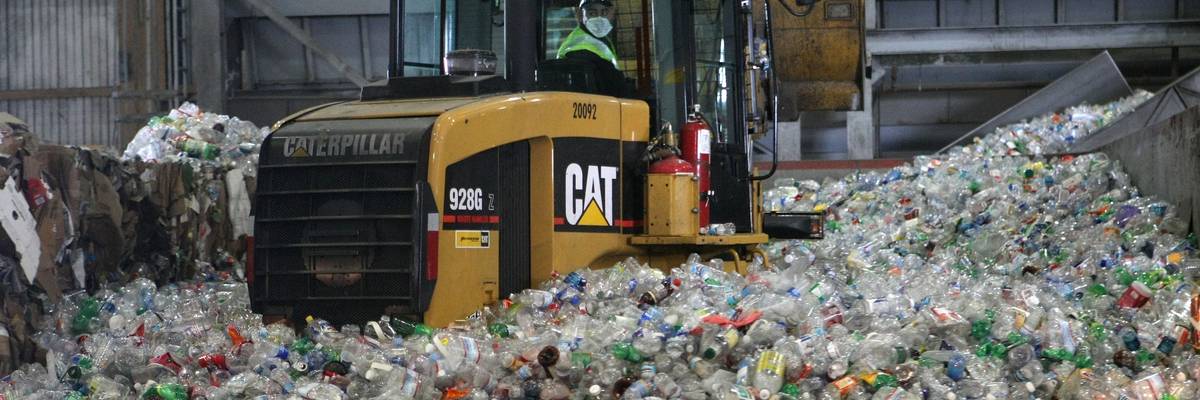
A tractor drives through a giant pile of plastic bottles at the San Francisco Recycling Center in 2008.
"No one is really OK with a corporation lying to consumers. What jumps out here is the overwhelming agreement among voters that it's deceptive and wrong for companies to label a product as recyclable when it's not."
Most U.S. voters would support officials in their state taking legal action against the plastics and fossil fuel industries for creating plastic pollution, based on evidence that they misled the public about the viability of recycling their products, according to a poll released Monday.
The poll, conducted by Data for Progress and the Center for Climate Integrity, follows a report CCI released in February that showed decades of industry deception about the recyclability of plastics and a yearslong, ongoing investigation by the California attorney general, which could lead to a lawsuit.
The poll indicates that 70% of voters support such a lawsuit and even 54% of Republicans do so.
"Regardless of your politics, no one is really OK with a corporation lying to consumers," Davis Allen, a CCI researcher, said in a statement. "What jumps out here is the overwhelming agreement among voters that it's deceptive and wrong for companies to label a product as recyclable when it's not."
Allen's colleague Alyssa Johl, a CCI vice president, argued that the poll bolsters the case that attorneys general should pursue lawsuits against industry for its role in creating plastic waste and deceiving the public about recycling.
"As we're watching to see what comes from California's investigation, it's clear that the public is very concerned about the plastic waste crisis and would support holding Big Oil and the plastics industry accountable for the fraud of plastic recycling," she said. "Any attorney general or public official who is considering action on this issue should know that both the law and public opinion are on their side."
📣 New poll from us & @DataProgress:
The vast majority of U.S. voters — including 54% of Republicans — support legal action against Big Oil & the plastics industry for lying about the viability of plastic recycling and causing the plastic waste crisis. https://t.co/YFjmxzeOYT pic.twitter.com/0oHAMHPtem
— Center for Climate Integrity (@climatecosts) September 9, 2024
The survey, conducted on 1,231 web panel respondents, also included a number of other plastics-related questions. More than two-thirds of respondents, after being prompted with information during the course of the survey, said the plastics industry should have "a great deal of responsibility" to address the plastic crisis, while 59% said the same about the fossil fuel industry. The industries are in fact connected; almost all plastics are made out of fossil fuels.
More than 60% of respondents strongly agreed—and 85% agreed at least "somewhat"—that it was deceptive to put the "chasing arrows" symbol on products that were not in fact recyclable. California restricted the practice with a 2021 law, and the Federal Trade Commission is revising its guidelines following recommendations issued last year by the U.S. Environmental Protection Agency, which said the use of the symbol can be "deceptive or misleading."
The poll showed that Americans tend to overestimate the amount of plastic being recycled. The average respondent guessed that about 45% of plastic gets recycled, when in fact a 2021 Greenpeace report indicated that the real figure is about 6%.
Despite the negative impacts of plastic waste, plastic production continues to increase worldwide. About 220 million tons of plastic waste are expected to be generated this year alone. Last week, a study in Nature, a leading journal, estimated global plastic waste emissions at about 52 million metric tons per year.
Recycling plastic is logistically challenging because many products are made of composites of different types of plastic and because the quality of the material goes down with each generation of use.
The poll comes out during the final stages of negotiations on a global plastics treaty, which has been in the works for several years. Ahead of United Nations General Assembly meetings this week, a group of celebrities including Bette Midler called for strong action on plastics in an open letter published by Greenpeace.
The final global plastics treaty negotiations will be held in Busan, South Korea starting November 25. The previous major round of negotiations, in April, was dominated by corporate lobbyists, advocates said. Activists and Indigenous leaders were also left out of a smaller meeting in Thailand last month, drawing criticism.
The call for accountability for plastics producers comes as the fossil fuel industry already faces legal action for its role in perpetuating the climate crisis. Dozens of cities and states have filed suits. None has yet reached the trial stage. The one that is closest to doing so, City and County of Honolulu v. Sunoco et al., has been the subject of political and legal wrangling, with the industry trying to have the suit dismissed.
Dear Common Dreams reader, It’s been nearly 30 years since I co-founded Common Dreams with my late wife, Lina Newhouser. We had the radical notion that journalism should serve the public good, not corporate profits. It was clear to us from the outset what it would take to build such a project. No paid advertisements. No corporate sponsors. No millionaire publisher telling us what to think or do. Many people said we wouldn't last a year, but we proved those doubters wrong. Together with a tremendous team of journalists and dedicated staff, we built an independent media outlet free from the constraints of profits and corporate control. Our mission has always been simple: To inform. To inspire. To ignite change for the common good. Building Common Dreams was not easy. Our survival was never guaranteed. When you take on the most powerful forces—Wall Street greed, fossil fuel industry destruction, Big Tech lobbyists, and uber-rich oligarchs who have spent billions upon billions rigging the economy and democracy in their favor—the only bulwark you have is supporters who believe in your work. But here’s the urgent message from me today. It's never been this bad out there. And it's never been this hard to keep us going. At the very moment Common Dreams is most needed, the threats we face are intensifying. We need your support now more than ever. We don't accept corporate advertising and never will. We don't have a paywall because we don't think people should be blocked from critical news based on their ability to pay. Everything we do is funded by the donations of readers like you. When everyone does the little they can afford, we are strong. But if that support retreats or dries up, so do we. Will you donate now to make sure Common Dreams not only survives but thrives? —Craig Brown, Co-founder |
Most U.S. voters would support officials in their state taking legal action against the plastics and fossil fuel industries for creating plastic pollution, based on evidence that they misled the public about the viability of recycling their products, according to a poll released Monday.
The poll, conducted by Data for Progress and the Center for Climate Integrity, follows a report CCI released in February that showed decades of industry deception about the recyclability of plastics and a yearslong, ongoing investigation by the California attorney general, which could lead to a lawsuit.
The poll indicates that 70% of voters support such a lawsuit and even 54% of Republicans do so.
"Regardless of your politics, no one is really OK with a corporation lying to consumers," Davis Allen, a CCI researcher, said in a statement. "What jumps out here is the overwhelming agreement among voters that it's deceptive and wrong for companies to label a product as recyclable when it's not."
Allen's colleague Alyssa Johl, a CCI vice president, argued that the poll bolsters the case that attorneys general should pursue lawsuits against industry for its role in creating plastic waste and deceiving the public about recycling.
"As we're watching to see what comes from California's investigation, it's clear that the public is very concerned about the plastic waste crisis and would support holding Big Oil and the plastics industry accountable for the fraud of plastic recycling," she said. "Any attorney general or public official who is considering action on this issue should know that both the law and public opinion are on their side."
📣 New poll from us & @DataProgress:
The vast majority of U.S. voters — including 54% of Republicans — support legal action against Big Oil & the plastics industry for lying about the viability of plastic recycling and causing the plastic waste crisis. https://t.co/YFjmxzeOYT pic.twitter.com/0oHAMHPtem
— Center for Climate Integrity (@climatecosts) September 9, 2024
The survey, conducted on 1,231 web panel respondents, also included a number of other plastics-related questions. More than two-thirds of respondents, after being prompted with information during the course of the survey, said the plastics industry should have "a great deal of responsibility" to address the plastic crisis, while 59% said the same about the fossil fuel industry. The industries are in fact connected; almost all plastics are made out of fossil fuels.
More than 60% of respondents strongly agreed—and 85% agreed at least "somewhat"—that it was deceptive to put the "chasing arrows" symbol on products that were not in fact recyclable. California restricted the practice with a 2021 law, and the Federal Trade Commission is revising its guidelines following recommendations issued last year by the U.S. Environmental Protection Agency, which said the use of the symbol can be "deceptive or misleading."
The poll showed that Americans tend to overestimate the amount of plastic being recycled. The average respondent guessed that about 45% of plastic gets recycled, when in fact a 2021 Greenpeace report indicated that the real figure is about 6%.
Despite the negative impacts of plastic waste, plastic production continues to increase worldwide. About 220 million tons of plastic waste are expected to be generated this year alone. Last week, a study in Nature, a leading journal, estimated global plastic waste emissions at about 52 million metric tons per year.
Recycling plastic is logistically challenging because many products are made of composites of different types of plastic and because the quality of the material goes down with each generation of use.
The poll comes out during the final stages of negotiations on a global plastics treaty, which has been in the works for several years. Ahead of United Nations General Assembly meetings this week, a group of celebrities including Bette Midler called for strong action on plastics in an open letter published by Greenpeace.
The final global plastics treaty negotiations will be held in Busan, South Korea starting November 25. The previous major round of negotiations, in April, was dominated by corporate lobbyists, advocates said. Activists and Indigenous leaders were also left out of a smaller meeting in Thailand last month, drawing criticism.
The call for accountability for plastics producers comes as the fossil fuel industry already faces legal action for its role in perpetuating the climate crisis. Dozens of cities and states have filed suits. None has yet reached the trial stage. The one that is closest to doing so, City and County of Honolulu v. Sunoco et al., has been the subject of political and legal wrangling, with the industry trying to have the suit dismissed.
Most U.S. voters would support officials in their state taking legal action against the plastics and fossil fuel industries for creating plastic pollution, based on evidence that they misled the public about the viability of recycling their products, according to a poll released Monday.
The poll, conducted by Data for Progress and the Center for Climate Integrity, follows a report CCI released in February that showed decades of industry deception about the recyclability of plastics and a yearslong, ongoing investigation by the California attorney general, which could lead to a lawsuit.
The poll indicates that 70% of voters support such a lawsuit and even 54% of Republicans do so.
"Regardless of your politics, no one is really OK with a corporation lying to consumers," Davis Allen, a CCI researcher, said in a statement. "What jumps out here is the overwhelming agreement among voters that it's deceptive and wrong for companies to label a product as recyclable when it's not."
Allen's colleague Alyssa Johl, a CCI vice president, argued that the poll bolsters the case that attorneys general should pursue lawsuits against industry for its role in creating plastic waste and deceiving the public about recycling.
"As we're watching to see what comes from California's investigation, it's clear that the public is very concerned about the plastic waste crisis and would support holding Big Oil and the plastics industry accountable for the fraud of plastic recycling," she said. "Any attorney general or public official who is considering action on this issue should know that both the law and public opinion are on their side."
📣 New poll from us & @DataProgress:
The vast majority of U.S. voters — including 54% of Republicans — support legal action against Big Oil & the plastics industry for lying about the viability of plastic recycling and causing the plastic waste crisis. https://t.co/YFjmxzeOYT pic.twitter.com/0oHAMHPtem
— Center for Climate Integrity (@climatecosts) September 9, 2024
The survey, conducted on 1,231 web panel respondents, also included a number of other plastics-related questions. More than two-thirds of respondents, after being prompted with information during the course of the survey, said the plastics industry should have "a great deal of responsibility" to address the plastic crisis, while 59% said the same about the fossil fuel industry. The industries are in fact connected; almost all plastics are made out of fossil fuels.
More than 60% of respondents strongly agreed—and 85% agreed at least "somewhat"—that it was deceptive to put the "chasing arrows" symbol on products that were not in fact recyclable. California restricted the practice with a 2021 law, and the Federal Trade Commission is revising its guidelines following recommendations issued last year by the U.S. Environmental Protection Agency, which said the use of the symbol can be "deceptive or misleading."
The poll showed that Americans tend to overestimate the amount of plastic being recycled. The average respondent guessed that about 45% of plastic gets recycled, when in fact a 2021 Greenpeace report indicated that the real figure is about 6%.
Despite the negative impacts of plastic waste, plastic production continues to increase worldwide. About 220 million tons of plastic waste are expected to be generated this year alone. Last week, a study in Nature, a leading journal, estimated global plastic waste emissions at about 52 million metric tons per year.
Recycling plastic is logistically challenging because many products are made of composites of different types of plastic and because the quality of the material goes down with each generation of use.
The poll comes out during the final stages of negotiations on a global plastics treaty, which has been in the works for several years. Ahead of United Nations General Assembly meetings this week, a group of celebrities including Bette Midler called for strong action on plastics in an open letter published by Greenpeace.
The final global plastics treaty negotiations will be held in Busan, South Korea starting November 25. The previous major round of negotiations, in April, was dominated by corporate lobbyists, advocates said. Activists and Indigenous leaders were also left out of a smaller meeting in Thailand last month, drawing criticism.
The call for accountability for plastics producers comes as the fossil fuel industry already faces legal action for its role in perpetuating the climate crisis. Dozens of cities and states have filed suits. None has yet reached the trial stage. The one that is closest to doing so, City and County of Honolulu v. Sunoco et al., has been the subject of political and legal wrangling, with the industry trying to have the suit dismissed.

