SUBSCRIBE TO OUR FREE NEWSLETTER
Daily news & progressive opinion—funded by the people, not the corporations—delivered straight to your inbox.
5
#000000
#FFFFFF
To donate by check, phone, or other method, see our More Ways to Give page.
Daily news & progressive opinion—funded by the people, not the corporations—delivered straight to your inbox.
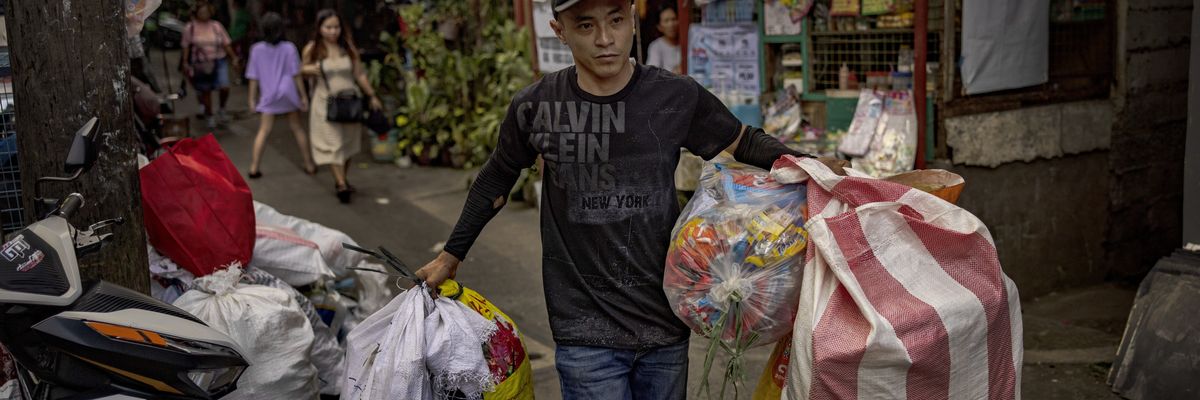
A village worker scavenges recyclable materials, including single-use plastics, to sell to a "Trash to Cashback" scheme in exchange for groceries, on January 4, 2024 in Quezon, Metro Manila, Philippines.
"Plastic pollution is a global crisis, fueled by our addiction to single-use plastics," said one organizer.
Amid concerns over the exclusion of Indigenous leaders, environmental advocates, and scientists from a four-day summit beginning Saturday in Bangkok to help advance a global plastics treaty, campaigners on Friday called on the political leaders and experts who will be in attendance to develop "robust criteria" to eliminate single-use plastics by drastically cutting down on their production.
Break Free From Plastic (BFFP) led a call for delegates, who will represent United Nations member states, to focus the talks on single-use plastics like sachets—small, sealed pouches and packets that have flooded markets in Asia and much of the Global South as businesses see them as affordable and convenient.
"Plastic pollution is a global crisis, fueled by our addiction to single-use plastics," said Von Hernandez, global coordinator of BFFP. "The solution is clear: Eliminate these nonessential products and reinstate reuse and refill systems which have been in place before our markets were overwhelmed with sachets and other disposable plastics."
A 2020 report by GAIA found that sachets account for an estimated 52% of the residual plastic waste stream and increasingly "defile the natural landscape, choke waterways, harm wildlife, and threaten livelihoods like tourism and fisheries."
Multinational corporations that sell fast-moving consumer goods like soda, chewing gum, and over-the-counter medications are major contributors to what GAIA called the "sachet economy," which has led to one of the most common types of plastic pollution in Africa and Southeast Asia.
"It is essential to reject the empty promises of petrochemical and fossil fuel industries who pursue profit over our collective welfare and avoid ineffective technologies like plastic credits and chemical recycling."
Tara Buakamsri, country director for Greenpeace Thailand, expressed hope that the Thai government will use the upcoming meeting as a "once-in-a-generation opportunity to end the plastic crisis by championing a global plastics treaty that limits production and bans single-use plastics."
"It is essential to reject the empty promises of petrochemical and fossil fuel industries who pursue profit over our collective welfare and avoid ineffective technologies like plastic credits and chemical recycling," said Buakamsri.
The meeting is the latest step in a treaty process that began in 2022, when countries agreed to hold talks hammering out the first legally binding treaty to stop plastic pollution.
The final treaty negotiations are set for November 25-December 1 in Busan, South Korea.
At the meeting in Bangkok, policymakers aim to "identify criteria for plastic products, chemicals, and product design, as well as potential sources and means of implementation for a plastics treaty, including financial mechanisms," according to BFFP.
But civil society groups have denounced the U.N. for including in the talks only two dozen invited technical experts and members of national delegations—who include plastic and oil industry representatives, in the case of countries such as China and Iran.
Jyoti Mathur-Filipp, executive secretary for the Intergovernmental Negotiating Committee (INC), told campaigners in a letter last month that countries had not agreed to allow observers to participate in the talks.
"Civil society and rights holders, including Indigenous peoples, must be recognized as essential stakeholders," said Dharmesh Shah of the Civil Society and Rights Holder Coalition on Plastics Treaty. "We are deeply disappointed that the INC Secretariat and [U.N. Environment Program] have not shifted their stance on observer participation despite multiple representations from the civil society and rights holders groups."
"The exclusion of these constituencies," added Shah, "disregards the fundamental human right to participation in environmental decision-making, a right that is vital for ensuring that the voices of all stakeholders, especially those most affected, are heard and respected."
Dear Common Dreams reader, It’s been nearly 30 years since I co-founded Common Dreams with my late wife, Lina Newhouser. We had the radical notion that journalism should serve the public good, not corporate profits. It was clear to us from the outset what it would take to build such a project. No paid advertisements. No corporate sponsors. No millionaire publisher telling us what to think or do. Many people said we wouldn't last a year, but we proved those doubters wrong. Together with a tremendous team of journalists and dedicated staff, we built an independent media outlet free from the constraints of profits and corporate control. Our mission has always been simple: To inform. To inspire. To ignite change for the common good. Building Common Dreams was not easy. Our survival was never guaranteed. When you take on the most powerful forces—Wall Street greed, fossil fuel industry destruction, Big Tech lobbyists, and uber-rich oligarchs who have spent billions upon billions rigging the economy and democracy in their favor—the only bulwark you have is supporters who believe in your work. But here’s the urgent message from me today. It's never been this bad out there. And it's never been this hard to keep us going. At the very moment Common Dreams is most needed, the threats we face are intensifying. We need your support now more than ever. We don't accept corporate advertising and never will. We don't have a paywall because we don't think people should be blocked from critical news based on their ability to pay. Everything we do is funded by the donations of readers like you. When everyone does the little they can afford, we are strong. But if that support retreats or dries up, so do we. Will you donate now to make sure Common Dreams not only survives but thrives? —Craig Brown, Co-founder |
Amid concerns over the exclusion of Indigenous leaders, environmental advocates, and scientists from a four-day summit beginning Saturday in Bangkok to help advance a global plastics treaty, campaigners on Friday called on the political leaders and experts who will be in attendance to develop "robust criteria" to eliminate single-use plastics by drastically cutting down on their production.
Break Free From Plastic (BFFP) led a call for delegates, who will represent United Nations member states, to focus the talks on single-use plastics like sachets—small, sealed pouches and packets that have flooded markets in Asia and much of the Global South as businesses see them as affordable and convenient.
"Plastic pollution is a global crisis, fueled by our addiction to single-use plastics," said Von Hernandez, global coordinator of BFFP. "The solution is clear: Eliminate these nonessential products and reinstate reuse and refill systems which have been in place before our markets were overwhelmed with sachets and other disposable plastics."
A 2020 report by GAIA found that sachets account for an estimated 52% of the residual plastic waste stream and increasingly "defile the natural landscape, choke waterways, harm wildlife, and threaten livelihoods like tourism and fisheries."
Multinational corporations that sell fast-moving consumer goods like soda, chewing gum, and over-the-counter medications are major contributors to what GAIA called the "sachet economy," which has led to one of the most common types of plastic pollution in Africa and Southeast Asia.
"It is essential to reject the empty promises of petrochemical and fossil fuel industries who pursue profit over our collective welfare and avoid ineffective technologies like plastic credits and chemical recycling."
Tara Buakamsri, country director for Greenpeace Thailand, expressed hope that the Thai government will use the upcoming meeting as a "once-in-a-generation opportunity to end the plastic crisis by championing a global plastics treaty that limits production and bans single-use plastics."
"It is essential to reject the empty promises of petrochemical and fossil fuel industries who pursue profit over our collective welfare and avoid ineffective technologies like plastic credits and chemical recycling," said Buakamsri.
The meeting is the latest step in a treaty process that began in 2022, when countries agreed to hold talks hammering out the first legally binding treaty to stop plastic pollution.
The final treaty negotiations are set for November 25-December 1 in Busan, South Korea.
At the meeting in Bangkok, policymakers aim to "identify criteria for plastic products, chemicals, and product design, as well as potential sources and means of implementation for a plastics treaty, including financial mechanisms," according to BFFP.
But civil society groups have denounced the U.N. for including in the talks only two dozen invited technical experts and members of national delegations—who include plastic and oil industry representatives, in the case of countries such as China and Iran.
Jyoti Mathur-Filipp, executive secretary for the Intergovernmental Negotiating Committee (INC), told campaigners in a letter last month that countries had not agreed to allow observers to participate in the talks.
"Civil society and rights holders, including Indigenous peoples, must be recognized as essential stakeholders," said Dharmesh Shah of the Civil Society and Rights Holder Coalition on Plastics Treaty. "We are deeply disappointed that the INC Secretariat and [U.N. Environment Program] have not shifted their stance on observer participation despite multiple representations from the civil society and rights holders groups."
"The exclusion of these constituencies," added Shah, "disregards the fundamental human right to participation in environmental decision-making, a right that is vital for ensuring that the voices of all stakeholders, especially those most affected, are heard and respected."
Amid concerns over the exclusion of Indigenous leaders, environmental advocates, and scientists from a four-day summit beginning Saturday in Bangkok to help advance a global plastics treaty, campaigners on Friday called on the political leaders and experts who will be in attendance to develop "robust criteria" to eliminate single-use plastics by drastically cutting down on their production.
Break Free From Plastic (BFFP) led a call for delegates, who will represent United Nations member states, to focus the talks on single-use plastics like sachets—small, sealed pouches and packets that have flooded markets in Asia and much of the Global South as businesses see them as affordable and convenient.
"Plastic pollution is a global crisis, fueled by our addiction to single-use plastics," said Von Hernandez, global coordinator of BFFP. "The solution is clear: Eliminate these nonessential products and reinstate reuse and refill systems which have been in place before our markets were overwhelmed with sachets and other disposable plastics."
A 2020 report by GAIA found that sachets account for an estimated 52% of the residual plastic waste stream and increasingly "defile the natural landscape, choke waterways, harm wildlife, and threaten livelihoods like tourism and fisheries."
Multinational corporations that sell fast-moving consumer goods like soda, chewing gum, and over-the-counter medications are major contributors to what GAIA called the "sachet economy," which has led to one of the most common types of plastic pollution in Africa and Southeast Asia.
"It is essential to reject the empty promises of petrochemical and fossil fuel industries who pursue profit over our collective welfare and avoid ineffective technologies like plastic credits and chemical recycling."
Tara Buakamsri, country director for Greenpeace Thailand, expressed hope that the Thai government will use the upcoming meeting as a "once-in-a-generation opportunity to end the plastic crisis by championing a global plastics treaty that limits production and bans single-use plastics."
"It is essential to reject the empty promises of petrochemical and fossil fuel industries who pursue profit over our collective welfare and avoid ineffective technologies like plastic credits and chemical recycling," said Buakamsri.
The meeting is the latest step in a treaty process that began in 2022, when countries agreed to hold talks hammering out the first legally binding treaty to stop plastic pollution.
The final treaty negotiations are set for November 25-December 1 in Busan, South Korea.
At the meeting in Bangkok, policymakers aim to "identify criteria for plastic products, chemicals, and product design, as well as potential sources and means of implementation for a plastics treaty, including financial mechanisms," according to BFFP.
But civil society groups have denounced the U.N. for including in the talks only two dozen invited technical experts and members of national delegations—who include plastic and oil industry representatives, in the case of countries such as China and Iran.
Jyoti Mathur-Filipp, executive secretary for the Intergovernmental Negotiating Committee (INC), told campaigners in a letter last month that countries had not agreed to allow observers to participate in the talks.
"Civil society and rights holders, including Indigenous peoples, must be recognized as essential stakeholders," said Dharmesh Shah of the Civil Society and Rights Holder Coalition on Plastics Treaty. "We are deeply disappointed that the INC Secretariat and [U.N. Environment Program] have not shifted their stance on observer participation despite multiple representations from the civil society and rights holders groups."
"The exclusion of these constituencies," added Shah, "disregards the fundamental human right to participation in environmental decision-making, a right that is vital for ensuring that the voices of all stakeholders, especially those most affected, are heard and respected."