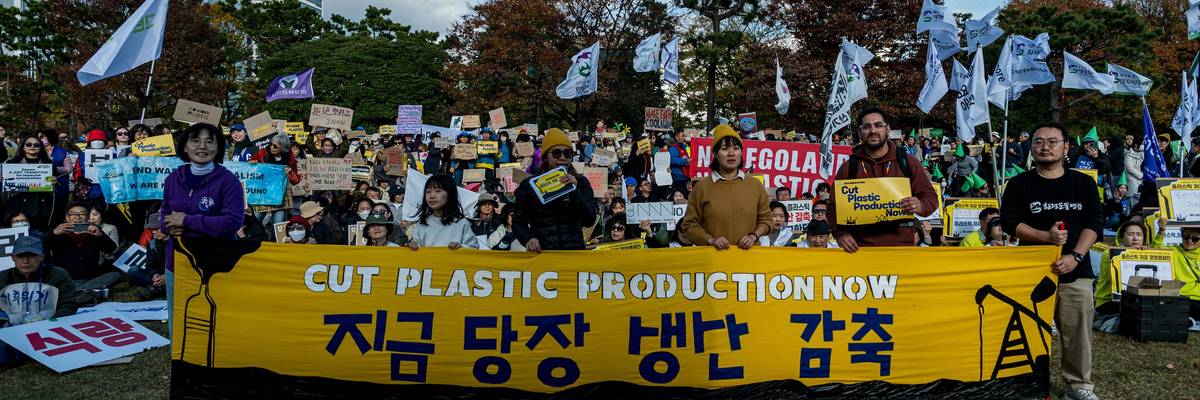
With the fifth and final round of global plastics treaty negotiations set to begin Monday in Busan, South Korea, an estimated 1,500 people took to the city's streets and nearly 3 million more signed a petition calling for a legally binding pact "to drastically reduce production and use, and protect human health and the environment."
The Saturday march at the Busan Exhibition and Convention Center was led by the global Break Free From Plastic (BFFP) movement and local allies from the Uproot Plastics Coalition. They want the treaty to include targets to slash production.
"Mandatory targets to reduce plastic production are essential to combat the triple planetary crisis of climate change, biodiversity loss, and toxic pollution," BFFP's Semee Rhee said in a statement. "Failure to check the untrammeled production of primary plastic polymers would mean allowing the plastic pollution crisis to persist and perpetuate social and environmental injustices for generations to come."
Indonesia youth activist Aeshnina Azzahra Aqilani stressed that "this plastic crisis is rooted in the overproduction of single-use plastics, building for us and future generations a very toxic legacy. Waste created today will poison all children and the planet through toxic plastic emission and microplastic exposure along the plastic life cycle."
"Safeguard the health and survival of future generations by advocating for a legally binding global plastic treaty—a treaty that encompasses ambitious goals for a reduction in plastic production, with accountability placed on corporations for reuse and refill solutions in its place," the campaigner urged. "The world is watching. The future is waiting. Make the right decision."
The first session of the Intergovernmental Negotiating Committee (INC) was held two years ago in Uruguay. Since then, there have been meetings in France, Kenya, and Canada. The latest lobbyist-dominated round of talks concluded in April with no clear path to curbing production, which civil society and frontline groups have argued is a "nonnegotiable" component of the treaty.
The Busan meeting is scheduled to run from Monday through next weekend, on the heels of the United Nations climate summit that just wrapped up after running into overtime in Baku, Azerbaijan. Plastic production is not only a waste problem but also a contributor to the climate emergency, because 99% of it is made from chemicals sourced from fossil fuels.
"As the host country of INC-5 and the world's fourth-largest producer of plastic raw materials, the South Korean government bears a significant responsibility in addressing plastic pollution," said Sammy Yu of Green Korea United. "Despite its passive stance during INC-4, the Korean government must take a decisive position on 'reducing production' at the fifth round of negotiations and advocate for it strongly."
"Moreover, negotiations are not confined to the conference room," Yu asserted. "To effectively push for a production reduction stance in these discussions, the government must first restore its domestic resource circulation policies, which have regressed over the past two years, and align them with its negotiation position."
Sunryul Kim of Greenpeace Seoul office said that "the people are speaking with one voice, demanding that the negotiators ensure that the plastics treaty will ensure cuts in production and end single-use plastic."
"We are at the most critical part of creating this agreement and what will come out of this negotiation will affect our future for generations to come," Kim continued. "As the host country and a member of High Ambition Coalition (HAC), the South Korean government must listen to its citizens and lead the way for strong production reduction targets at the negotiating table."
Greenpeace, BFFP, and the World Wide Fund for Nature (WWF) collected 2,899,202 petition signatures, which were delivered during a Sunday event in Busan to U.S. Sen. Jeff Merkley (D-Ore.), sponsor of the Break Free From Plastic Pollution Act, and Rwanda Environment Management Authority Director General Juliet Kabera, whose country co-chairs the HAC with Norway.
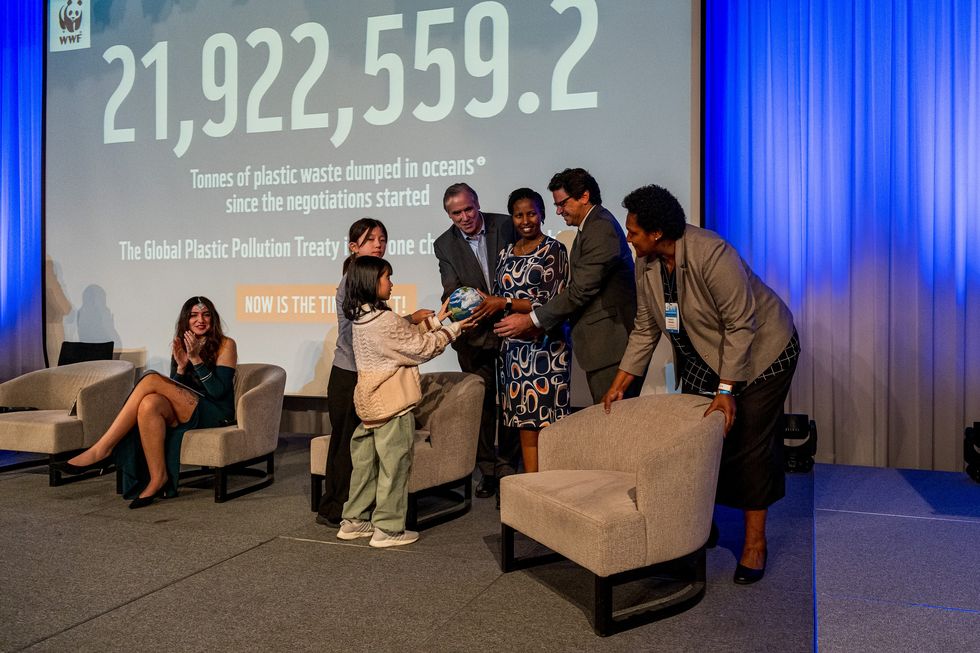 Politicians receive nearly 3 million petition signatures calling for an end to the age of plastic before treaty talks in Busan, South Korea on November 24, 2024. (Photo: Sungwoo Lee/Greenpeace)
"These signatures reinforce what is already commonly known—that a legally binding global treaty that regulates plastics across the entire life cycle and eliminates harmful plastic products and chemicals is the only way our leaders can deliver on their promise to end plastic pollution," said Eirik Lindebjerg, WWF global plastics policy lead and head of delegation to INC-5.
"We simply cannot achieve this goal through fragmented and voluntary actions which have dominated our collective response for so many years," Lindebjerg added. "At INC-5, governments can and must create the treaty people are demanding, one which decisively and definitely protects people and nature now and for generations to come."
Also on Sunday, hundreds of activists with Friends of the Earth International (FOEI) and its South Korean arm made a human sign spelling out "End Plastic" on a beach near where over 175 governments are set to meet for the final round of negotiations.
"We are united in our call for a strong treaty that tackles the plastic pollution crisis head-on, demanding action that cuts plastic production at its very source," said FOEI chair Hemantha Withanage. "The urgency of the plastic issue can no longer be understated. Every day, the equivalent of 2,000 garbage trucks full of plastic are dumped into the world's oceans, rivers, and lakes, choking ecosystems and communities."
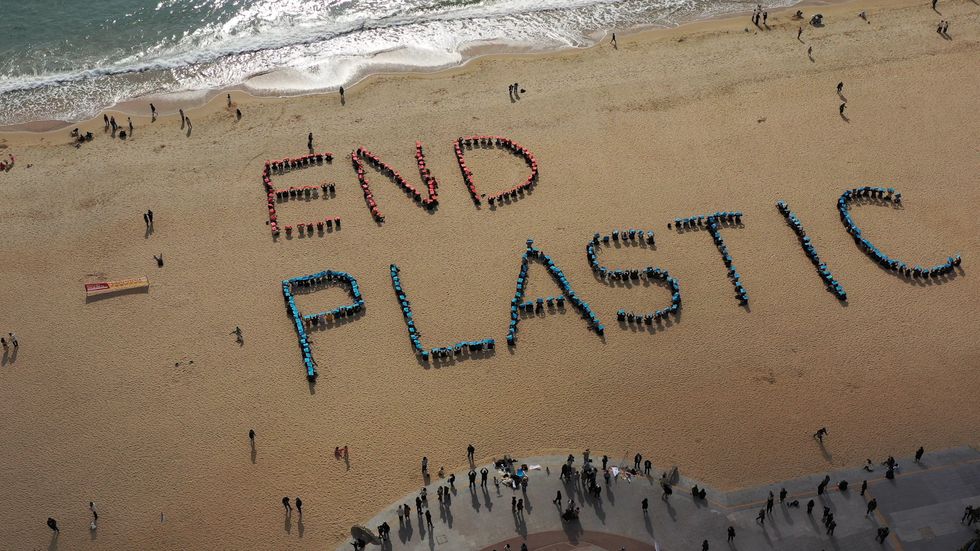 Activists with Friends of the Earth International made a human sign spelling out "End Plastic" on a beach near the final round of treaty negotiations in Busan, South Korea on November 24, 2024. (Photo: FOEI)
Speaking with The Guardian ahead of the talks, Norwegian Minister of International Development Anne Beathe Tvinnereim warned that the world will be "unable to cope" with plastic waste a decade from now unless there is a deal reached to cut production.
"We are not going to land a perfect treaty. But we need to get further. And I think we will. I choose to be hopeful," Tvinnereim said. "With High Ambition Coalition countries, we will continue to demonstrate that there is a big group of countries that sticks to its ambitions. The world desperately needs some leadership now, and some good news."
With the fifth and final round of global plastics treaty negotiations set to begin Monday in Busan, South Korea, an estimated 1,500 people took to the city's streets and nearly 3 million more signed a petition calling for a legally binding pact "to drastically reduce production and use, and protect human health and the environment."
The Saturday march at the Busan Exhibition and Convention Center was led by the global Break Free From Plastic (BFFP) movement and local allies from the Uproot Plastics Coalition. They want the treaty to include targets to slash production.
"Mandatory targets to reduce plastic production are essential to combat the triple planetary crisis of climate change, biodiversity loss, and toxic pollution," BFFP's Semee Rhee said in a statement. "Failure to check the untrammeled production of primary plastic polymers would mean allowing the plastic pollution crisis to persist and perpetuate social and environmental injustices for generations to come."
Indonesia youth activist Aeshnina Azzahra Aqilani stressed that "this plastic crisis is rooted in the overproduction of single-use plastics, building for us and future generations a very toxic legacy. Waste created today will poison all children and the planet through toxic plastic emission and microplastic exposure along the plastic life cycle."
"Safeguard the health and survival of future generations by advocating for a legally binding global plastic treaty—a treaty that encompasses ambitious goals for a reduction in plastic production, with accountability placed on corporations for reuse and refill solutions in its place," the campaigner urged. "The world is watching. The future is waiting. Make the right decision."
The first session of the Intergovernmental Negotiating Committee (INC) was held two years ago in Uruguay. Since then, there have been meetings in France, Kenya, and Canada. The latest lobbyist-dominated round of talks concluded in April with no clear path to curbing production, which civil society and frontline groups have argued is a "nonnegotiable" component of the treaty.
The Busan meeting is scheduled to run from Monday through next weekend, on the heels of the United Nations climate summit that just wrapped up after running into overtime in Baku, Azerbaijan. Plastic production is not only a waste problem but also a contributor to the climate emergency, because 99% of it is made from chemicals sourced from fossil fuels.
"As the host country of INC-5 and the world's fourth-largest producer of plastic raw materials, the South Korean government bears a significant responsibility in addressing plastic pollution," said Sammy Yu of Green Korea United. "Despite its passive stance during INC-4, the Korean government must take a decisive position on 'reducing production' at the fifth round of negotiations and advocate for it strongly."
"Moreover, negotiations are not confined to the conference room," Yu asserted. "To effectively push for a production reduction stance in these discussions, the government must first restore its domestic resource circulation policies, which have regressed over the past two years, and align them with its negotiation position."
Sunryul Kim of Greenpeace Seoul office said that "the people are speaking with one voice, demanding that the negotiators ensure that the plastics treaty will ensure cuts in production and end single-use plastic."
"We are at the most critical part of creating this agreement and what will come out of this negotiation will affect our future for generations to come," Kim continued. "As the host country and a member of High Ambition Coalition (HAC), the South Korean government must listen to its citizens and lead the way for strong production reduction targets at the negotiating table."
Greenpeace, BFFP, and the World Wide Fund for Nature (WWF) collected 2,899,202 petition signatures, which were delivered during a Sunday event in Busan to U.S. Sen. Jeff Merkley (D-Ore.), sponsor of the Break Free From Plastic Pollution Act, and Rwanda Environment Management Authority Director General Juliet Kabera, whose country co-chairs the HAC with Norway.
Politicians receive nearly 3 million petition signatures calling for an end to the age of plastic before treaty talks in Busan, South Korea on November 24, 2024. (Photo: Sungwoo Lee/Greenpeace)
"These signatures reinforce what is already commonly known—that a legally binding global treaty that regulates plastics across the entire life cycle and eliminates harmful plastic products and chemicals is the only way our leaders can deliver on their promise to end plastic pollution," said Eirik Lindebjerg, WWF global plastics policy lead and head of delegation to INC-5.
"We simply cannot achieve this goal through fragmented and voluntary actions which have dominated our collective response for so many years," Lindebjerg added. "At INC-5, governments can and must create the treaty people are demanding, one which decisively and definitely protects people and nature now and for generations to come."
Also on Sunday, hundreds of activists with Friends of the Earth International (FOEI) and its South Korean arm made a human sign spelling out "End Plastic" on a beach near where over 175 governments are set to meet for the final round of negotiations.
"We are united in our call for a strong treaty that tackles the plastic pollution crisis head-on, demanding action that cuts plastic production at its very source," said FOEI chair Hemantha Withanage. "The urgency of the plastic issue can no longer be understated. Every day, the equivalent of 2,000 garbage trucks full of plastic are dumped into the world's oceans, rivers, and lakes, choking ecosystems and communities."
Activists with Friends of the Earth International made a human sign spelling out "End Plastic" on a beach near the final round of treaty negotiations in Busan, South Korea on November 24, 2024. (Photo: FOEI)
Speaking with The Guardian ahead of the talks, Norwegian Minister of International Development Anne Beathe Tvinnereim warned that the world will be "unable to cope" with plastic waste a decade from now unless there is a deal reached to cut production.
"We are not going to land a perfect treaty. But we need to get further. And I think we will. I choose to be hopeful," Tvinnereim said. "With High Ambition Coalition countries, we will continue to demonstrate that there is a big group of countries that sticks to its ambitions. The world desperately needs some leadership now, and some good news."
- Treaty Negotiations Should See Plastics for What They Are: an Ocean Justice Crisis ›
- Most US Voters Want Plastics Industry Held Accountable for Recycling Deception: Poll ›
- Shut Out of Treaty Summit, Campaigners Call for Elimination of Plastic Sachets ›
- Lobbyist-Dominated Plastics Talks End Without Clear Path to Production Cuts ›
- Opinion | Will World Leaders Deliver the Plastics Treaty We Need? | Common Dreams ›
- Greenpeace Calls for Oil Giants' Ejection From Global Plastics Summit | Common Dreams ›
- Opinion | Corporate Greed and National Interests Torpedoed the UN Plastics Treaty | Common Dreams ›
With the fifth and final round of global plastics treaty negotiations set to begin Monday in Busan, South Korea, an estimated 1,500 people took to the city's streets and nearly 3 million more signed a petition calling for a legally binding pact "to drastically reduce production and use, and protect human health and the environment."
The Saturday march at the Busan Exhibition and Convention Center was led by the global Break Free From Plastic (BFFP) movement and local allies from the Uproot Plastics Coalition. They want the treaty to include targets to slash production.
"Mandatory targets to reduce plastic production are essential to combat the triple planetary crisis of climate change, biodiversity loss, and toxic pollution," BFFP's Semee Rhee said in a statement. "Failure to check the untrammeled production of primary plastic polymers would mean allowing the plastic pollution crisis to persist and perpetuate social and environmental injustices for generations to come."
Indonesia youth activist Aeshnina Azzahra Aqilani stressed that "this plastic crisis is rooted in the overproduction of single-use plastics, building for us and future generations a very toxic legacy. Waste created today will poison all children and the planet through toxic plastic emission and microplastic exposure along the plastic life cycle."
"Safeguard the health and survival of future generations by advocating for a legally binding global plastic treaty—a treaty that encompasses ambitious goals for a reduction in plastic production, with accountability placed on corporations for reuse and refill solutions in its place," the campaigner urged. "The world is watching. The future is waiting. Make the right decision."
The first session of the Intergovernmental Negotiating Committee (INC) was held two years ago in Uruguay. Since then, there have been meetings in France, Kenya, and Canada. The latest lobbyist-dominated round of talks concluded in April with no clear path to curbing production, which civil society and frontline groups have argued is a "nonnegotiable" component of the treaty.
The Busan meeting is scheduled to run from Monday through next weekend, on the heels of the United Nations climate summit that just wrapped up after running into overtime in Baku, Azerbaijan. Plastic production is not only a waste problem but also a contributor to the climate emergency, because 99% of it is made from chemicals sourced from fossil fuels.
"As the host country of INC-5 and the world's fourth-largest producer of plastic raw materials, the South Korean government bears a significant responsibility in addressing plastic pollution," said Sammy Yu of Green Korea United. "Despite its passive stance during INC-4, the Korean government must take a decisive position on 'reducing production' at the fifth round of negotiations and advocate for it strongly."
"Moreover, negotiations are not confined to the conference room," Yu asserted. "To effectively push for a production reduction stance in these discussions, the government must first restore its domestic resource circulation policies, which have regressed over the past two years, and align them with its negotiation position."
Sunryul Kim of Greenpeace Seoul office said that "the people are speaking with one voice, demanding that the negotiators ensure that the plastics treaty will ensure cuts in production and end single-use plastic."
"We are at the most critical part of creating this agreement and what will come out of this negotiation will affect our future for generations to come," Kim continued. "As the host country and a member of High Ambition Coalition (HAC), the South Korean government must listen to its citizens and lead the way for strong production reduction targets at the negotiating table."
Greenpeace, BFFP, and the World Wide Fund for Nature (WWF) collected 2,899,202 petition signatures, which were delivered during a Sunday event in Busan to U.S. Sen. Jeff Merkley (D-Ore.), sponsor of the Break Free From Plastic Pollution Act, and Rwanda Environment Management Authority Director General Juliet Kabera, whose country co-chairs the HAC with Norway.
Politicians receive nearly 3 million petition signatures calling for an end to the age of plastic before treaty talks in Busan, South Korea on November 24, 2024. (Photo: Sungwoo Lee/Greenpeace)
"These signatures reinforce what is already commonly known—that a legally binding global treaty that regulates plastics across the entire life cycle and eliminates harmful plastic products and chemicals is the only way our leaders can deliver on their promise to end plastic pollution," said Eirik Lindebjerg, WWF global plastics policy lead and head of delegation to INC-5.
"We simply cannot achieve this goal through fragmented and voluntary actions which have dominated our collective response for so many years," Lindebjerg added. "At INC-5, governments can and must create the treaty people are demanding, one which decisively and definitely protects people and nature now and for generations to come."
Also on Sunday, hundreds of activists with Friends of the Earth International (FOEI) and its South Korean arm made a human sign spelling out "End Plastic" on a beach near where over 175 governments are set to meet for the final round of negotiations.
"We are united in our call for a strong treaty that tackles the plastic pollution crisis head-on, demanding action that cuts plastic production at its very source," said FOEI chair Hemantha Withanage. "The urgency of the plastic issue can no longer be understated. Every day, the equivalent of 2,000 garbage trucks full of plastic are dumped into the world's oceans, rivers, and lakes, choking ecosystems and communities."
Activists with Friends of the Earth International made a human sign spelling out "End Plastic" on a beach near the final round of treaty negotiations in Busan, South Korea on November 24, 2024. (Photo: FOEI)
Speaking with The Guardian ahead of the talks, Norwegian Minister of International Development Anne Beathe Tvinnereim warned that the world will be "unable to cope" with plastic waste a decade from now unless there is a deal reached to cut production.
"We are not going to land a perfect treaty. But we need to get further. And I think we will. I choose to be hopeful," Tvinnereim said. "With High Ambition Coalition countries, we will continue to demonstrate that there is a big group of countries that sticks to its ambitions. The world desperately needs some leadership now, and some good news."
- Treaty Negotiations Should See Plastics for What They Are: an Ocean Justice Crisis ›
- Most US Voters Want Plastics Industry Held Accountable for Recycling Deception: Poll ›
- Shut Out of Treaty Summit, Campaigners Call for Elimination of Plastic Sachets ›
- Lobbyist-Dominated Plastics Talks End Without Clear Path to Production Cuts ›
- Opinion | Will World Leaders Deliver the Plastics Treaty We Need? | Common Dreams ›
- Greenpeace Calls for Oil Giants' Ejection From Global Plastics Summit | Common Dreams ›
- Opinion | Corporate Greed and National Interests Torpedoed the UN Plastics Treaty | Common Dreams ›