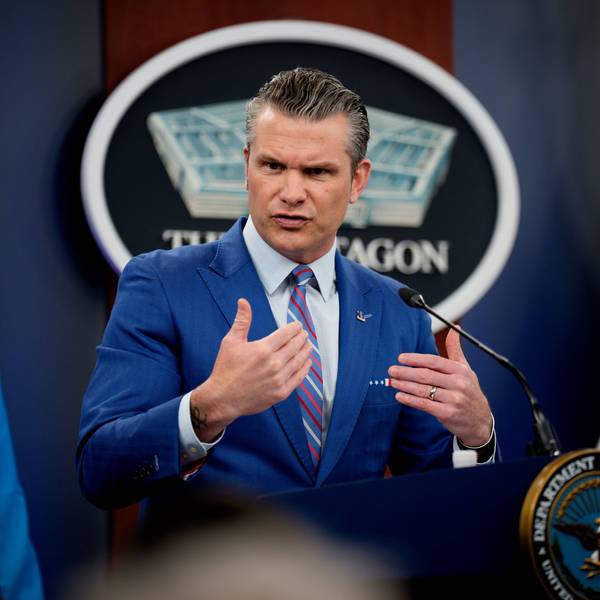


US Under Secretary of Defense for Policy Elbridge Colby testifies before the Senate Armed Services Committee on March 3, 2026 in Washington, DC.
Top Pentagon Official Does Backflips Trying to Claim US War on Iran Is Not ‘Interventionism’
Grilled by Sen. Elizabeth Warren, the Pentagon's third-ranking official denied that the US attack on Iran conflicts with the Trump administration's stated National Security Strategy.
A top Pentagon official attempted to argue during a US Senate hearing on Tuesday that the Trump administration's illegal war on Iran, which has included a massive bombing campaign and explicit calls from the president to topple and reshape the country's government, does not constitute "interventionism," "regime change," "nation-building," or "endless war."
Sen. Elizabeth Warren (D-Mass.) started her questioning of Elbridge Colby, the Pentagon's under secretary of defense for policy, by quoting from Defense Secretary Pete Hegseth's summary of his department's 2026 National Defense Strategy, under which he said the Pentagon would no longer "be distracted by interventionism, endless wars, regime change, and nation-building."
"Interventionism, that means going to another country and bombing them," said Warren. "Endless wars: wars that may last we don't know how long, because there's no clear endpoint. Regime change, which the president has said this is all about. And nation-building: Evidently, the president seems to think he's going to come in and build a different Iran."
Colby, the third-ranking official at the Pentagon, tried to dispute that the US assault on Iran—carried out in partnership with Israel—falls under any of those categories.
"I think I would characterize it fundamentally differently," said Colby. "This is certainly not nation-building. This is not gonna be endless."
Watch the full exchange:
Warren: The Trump administration's national defense strategy: No longer will the department be distracted by interventionism, endless wars, regime change, and nation building.
Colby: This is not nation building.
Warren: So this is not interventionism?
Colby: No.… pic.twitter.com/CWXNoeCnjV
— Acyn (@Acyn) March 3, 2026
Asked if the assault on Iran is "interventionism," Colby responded, "No... Interventionism is a more, I would say, kind of responsibility to protect or something. I mean it's not, obviously, precisely defined."
"Really? And we didn't do this in order to try to protect Israel?" Warren asked.
"Well, that's one of the goals," Colby said, prompting Warren to respond, "Oh, so it is interventionism."
Warren said the decision to wage war on Iran shows that President Donald Trump and his lackeys are willing to "say one thing in a campaign, write it down on paper, and then go do whatever the hell [they] want."
"So the Trump administration first says it's gonna be America first, then puts out a National Defense Strategy, and then goes to war alongside Israel—illegally, unconstitutionally—and that is now the policy of the Trump administration," the senator said.
During his 2024 election-night victory speech, Trump vowed that he was "not going to start a war," but since taking office he has attacked seven nations: Yemen, Syria, Iraq, Nigeria, Somalia, Venezuela, and Iran.
The assault on Iran, and the killing of its leader, came just weeks after the Trump administration abducted Venezuelan President Nicolás Maduro—all brazen violations of domestic and international law.
"Trump spent years ranting against the regime change wars started by his predecessors—and the damage they inflicted on Americans," Mohamad Bazzi, director of the Center for Near Eastern Studies, wrote in a Guardian column over the weekend. "On Saturday, he launched his own war in the Middle East, with little hint of how it might end."
We are at a crossroads
This country and this world are at a monumental crossroads. In a few short weeks, US voters will have an opportunity to beat back the forces of fascism and confront the billionaires who are rigging the economy, our media system, and our democracy, making it increasingly impossible for ordinary people to get by. We’re not just talking about the election. We’re talking about what must be done once these fascist elements are vanquished from power. We need a bolder set of solutions than what either major party has so far been willing to offer and a working-class movement ready to fight like hell for it. Trump didn't emerge from nowhere. The conditions that fueled MAGA authoritarianism were created by decades of radical neoliberal economic policies and a corrupt political system dominated by corporate interests. They slashed taxes on the super-rich, promising that the benefits would trickle down. They said giveaways to the corporate titans would make life more affordable for the rest of us. It was all bullshit. And when a bitter, betrayed populace searches for someone to blame, right-wing demagogues have little trouble finding scapegoats. People know when they're being lied to, but you won't hear any of this from the corporate media. Only independent journalism—powered and funded by people who believe in building a better world—can deliver truly trustworthy daily news. Our Fall Campaign is underway, and we need your help. To power our newsroom through the rest of the year, we need to raise $125,000 by midnight on October 31. So if you share our vision, please contribute whatever you can to sustain our work. |
A top Pentagon official attempted to argue during a US Senate hearing on Tuesday that the Trump administration's illegal war on Iran, which has included a massive bombing campaign and explicit calls from the president to topple and reshape the country's government, does not constitute "interventionism," "regime change," "nation-building," or "endless war."
Sen. Elizabeth Warren (D-Mass.) started her questioning of Elbridge Colby, the Pentagon's under secretary of defense for policy, by quoting from Defense Secretary Pete Hegseth's summary of his department's 2026 National Defense Strategy, under which he said the Pentagon would no longer "be distracted by interventionism, endless wars, regime change, and nation-building."
"Interventionism, that means going to another country and bombing them," said Warren. "Endless wars: wars that may last we don't know how long, because there's no clear endpoint. Regime change, which the president has said this is all about. And nation-building: Evidently, the president seems to think he's going to come in and build a different Iran."
Colby, the third-ranking official at the Pentagon, tried to dispute that the US assault on Iran—carried out in partnership with Israel—falls under any of those categories.
"I think I would characterize it fundamentally differently," said Colby. "This is certainly not nation-building. This is not gonna be endless."
Watch the full exchange:
Warren: The Trump administration's national defense strategy: No longer will the department be distracted by interventionism, endless wars, regime change, and nation building.
Colby: This is not nation building.
Warren: So this is not interventionism?
Colby: No.… pic.twitter.com/CWXNoeCnjV
— Acyn (@Acyn) March 3, 2026
Asked if the assault on Iran is "interventionism," Colby responded, "No... Interventionism is a more, I would say, kind of responsibility to protect or something. I mean it's not, obviously, precisely defined."
"Really? And we didn't do this in order to try to protect Israel?" Warren asked.
"Well, that's one of the goals," Colby said, prompting Warren to respond, "Oh, so it is interventionism."
Warren said the decision to wage war on Iran shows that President Donald Trump and his lackeys are willing to "say one thing in a campaign, write it down on paper, and then go do whatever the hell [they] want."
"So the Trump administration first says it's gonna be America first, then puts out a National Defense Strategy, and then goes to war alongside Israel—illegally, unconstitutionally—and that is now the policy of the Trump administration," the senator said.
During his 2024 election-night victory speech, Trump vowed that he was "not going to start a war," but since taking office he has attacked seven nations: Yemen, Syria, Iraq, Nigeria, Somalia, Venezuela, and Iran.
The assault on Iran, and the killing of its leader, came just weeks after the Trump administration abducted Venezuelan President Nicolás Maduro—all brazen violations of domestic and international law.
"Trump spent years ranting against the regime change wars started by his predecessors—and the damage they inflicted on Americans," Mohamad Bazzi, director of the Center for Near Eastern Studies, wrote in a Guardian column over the weekend. "On Saturday, he launched his own war in the Middle East, with little hint of how it might end."
A top Pentagon official attempted to argue during a US Senate hearing on Tuesday that the Trump administration's illegal war on Iran, which has included a massive bombing campaign and explicit calls from the president to topple and reshape the country's government, does not constitute "interventionism," "regime change," "nation-building," or "endless war."
Sen. Elizabeth Warren (D-Mass.) started her questioning of Elbridge Colby, the Pentagon's under secretary of defense for policy, by quoting from Defense Secretary Pete Hegseth's summary of his department's 2026 National Defense Strategy, under which he said the Pentagon would no longer "be distracted by interventionism, endless wars, regime change, and nation-building."
"Interventionism, that means going to another country and bombing them," said Warren. "Endless wars: wars that may last we don't know how long, because there's no clear endpoint. Regime change, which the president has said this is all about. And nation-building: Evidently, the president seems to think he's going to come in and build a different Iran."
Colby, the third-ranking official at the Pentagon, tried to dispute that the US assault on Iran—carried out in partnership with Israel—falls under any of those categories.
"I think I would characterize it fundamentally differently," said Colby. "This is certainly not nation-building. This is not gonna be endless."
Watch the full exchange:
Warren: The Trump administration's national defense strategy: No longer will the department be distracted by interventionism, endless wars, regime change, and nation building.
Colby: This is not nation building.
Warren: So this is not interventionism?
Colby: No.… pic.twitter.com/CWXNoeCnjV
— Acyn (@Acyn) March 3, 2026
Asked if the assault on Iran is "interventionism," Colby responded, "No... Interventionism is a more, I would say, kind of responsibility to protect or something. I mean it's not, obviously, precisely defined."
"Really? And we didn't do this in order to try to protect Israel?" Warren asked.
"Well, that's one of the goals," Colby said, prompting Warren to respond, "Oh, so it is interventionism."
Warren said the decision to wage war on Iran shows that President Donald Trump and his lackeys are willing to "say one thing in a campaign, write it down on paper, and then go do whatever the hell [they] want."
"So the Trump administration first says it's gonna be America first, then puts out a National Defense Strategy, and then goes to war alongside Israel—illegally, unconstitutionally—and that is now the policy of the Trump administration," the senator said.
During his 2024 election-night victory speech, Trump vowed that he was "not going to start a war," but since taking office he has attacked seven nations: Yemen, Syria, Iraq, Nigeria, Somalia, Venezuela, and Iran.
The assault on Iran, and the killing of its leader, came just weeks after the Trump administration abducted Venezuelan President Nicolás Maduro—all brazen violations of domestic and international law.
"Trump spent years ranting against the regime change wars started by his predecessors—and the damage they inflicted on Americans," Mohamad Bazzi, director of the Center for Near Eastern Studies, wrote in a Guardian column over the weekend. "On Saturday, he launched his own war in the Middle East, with little hint of how it might end."