
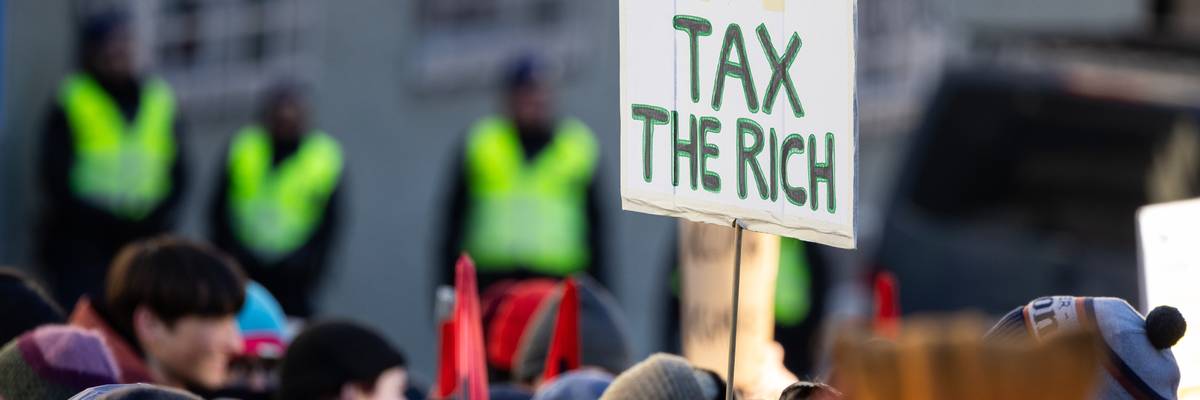
A demonstrator holds a sign that reads "tax the rich" during a protest in Davos, Switzerland ahead of the World Economic Forum on January 14, 2024.
World's First Trillionaire Just 10 Years Away as Richest Men Double Their Wealth
"This inequality is no accident; the billionaire class is ensuring corporations deliver more wealth to them at the expense of everyone else," said Oxfam's interim executive director.
Since 2020, a year marked by the spread of a pathogen that killed millions of people, the world's five richest men have seen their collective wealth more than double as five billion people across the globe have lost ground and hunger has surged, underscoring the deep inequality that is fueling mass discontent and eroding democracies.
The finding by Oxfam International was published Monday as elites gathered in Davos, Switzerland for the annual World Economic Forum, a summit that—while ostensibly aimed at confronting the planet's most pressing crises—has long been seen as a symbol of global capital's stranglehold on key institutions.
Oxfam calculated that the combined wealth of the five richest billionaires on the planet grew from $405 billion in 2020 to roughly $869 billion today—a rate of $14 million an hour. During that same period, 60% of the global population got poorer, with the real wages of around 800 million workers across 52 countries falling in the face of high inflation.
Under the status quo, global poverty won't be eradicated for nearly two and a half centuries—but the world will have its first trillionaire within the next 10 years, Oxfam found.
"We're witnessing the beginnings of a decade of division, with billions of people shouldering the economic shockwaves of pandemic, inflation, and war, while billionaires' fortunes boom," Amitabh Behar, Oxfam's interim executive director, said in a statement. "This inequality is no accident; the billionaire class is ensuring corporations deliver more wealth to them at the expense of everyone else."
Overall, the world's billionaires have gotten $3.3 trillion richer since the start of the decade, Oxfam said, noting that their wealth grew three times faster than inflation.
Large corporations, too, have seen their fortunes surge since 2020, with around 150 of the world's biggest companies bringing in a combined $1.8 trillion in profits—a massive boon for wealthy shareholders that came as workers suffered from the economic turmoil induced by the coronavirus pandemic, Russia's invasion of Ukraine, worsening climate impacts, and other global shocks.
Seventy percent of the largest companies have a billionaire as their chief executive or top shareholder.
Oxfam's report spotlights the "sustained and highly effective war on taxation" that powerful corporations have been waging over the past several decades—a war that has yielded a significantly lower corporate income tax rate that has allowed companies to amass vast riches and entrench their political influence.
"Corporate taxes are disproportionately borne by the richest, thus the collapse in corporate taxes in recent decades has essentially provided another tax cut for the wealthy," the report states. "It has also deprived governments around the world, but especially in the Global South, of trillions of U.S. dollars in revenue that could be used to reduce inequality and end poverty. Every tax dollar dodged is a nurse that will never be hired or a school that cannot be built."
To rein in excessive corporate power and accelerating inequality, Oxfam recommended several broad policy solutions, including the break-up of monopolistic companies such as Amazon and a global wealth tax on the world's millionaires and billionaires, which the group estimated could generate $1.8 trillion a year in revenue that could be invested in education, healthcare, environmental protection, and other critical priorities.
"Runaway corporate and monopoly power is an inequality-generating machine: Through squeezing workers, dodging tax, privatizing the state, and spurring climate breakdown, corporations are funneling endless wealth to their ultra-rich owners," said Behar. "But they're also funneling power, undermining our democracies and our rights. No corporation or individual should have this much power over our economies and our lives—to be clear, nobody should have a billion dollars."
We are at a crossroads
This country and this world are at a monumental crossroads. In a few short weeks, US voters will have an opportunity to beat back the forces of fascism and confront the billionaires who are rigging the economy, our media system, and our democracy, making it increasingly impossible for ordinary people to get by. We’re not just talking about the election. We’re talking about what must be done once these fascist elements are vanquished from power. We need a bolder set of solutions than what either major party has so far been willing to offer and a working-class movement ready to fight like hell for it. Trump didn't emerge from nowhere. The conditions that fueled MAGA authoritarianism were created by decades of radical neoliberal economic policies and a corrupt political system dominated by corporate interests. They slashed taxes on the super-rich, promising that the benefits would trickle down. They said giveaways to the corporate titans would make life more affordable for the rest of us. It was all bullshit. And when a bitter, betrayed populace searches for someone to blame, right-wing demagogues have little trouble finding scapegoats. People know when they're being lied to, but you won't hear any of this from the corporate media. Only independent journalism—powered and funded by people who believe in building a better world—can deliver truly trustworthy daily news. Our Fall Campaign is underway, and we need your help. To power our newsroom through the rest of the year, we need to raise $125,000 by midnight on October 31. So if you share our vision, please contribute whatever you can to sustain our work. |
Since 2020, a year marked by the spread of a pathogen that killed millions of people, the world's five richest men have seen their collective wealth more than double as five billion people across the globe have lost ground and hunger has surged, underscoring the deep inequality that is fueling mass discontent and eroding democracies.
The finding by Oxfam International was published Monday as elites gathered in Davos, Switzerland for the annual World Economic Forum, a summit that—while ostensibly aimed at confronting the planet's most pressing crises—has long been seen as a symbol of global capital's stranglehold on key institutions.
Oxfam calculated that the combined wealth of the five richest billionaires on the planet grew from $405 billion in 2020 to roughly $869 billion today—a rate of $14 million an hour. During that same period, 60% of the global population got poorer, with the real wages of around 800 million workers across 52 countries falling in the face of high inflation.
Under the status quo, global poverty won't be eradicated for nearly two and a half centuries—but the world will have its first trillionaire within the next 10 years, Oxfam found.
"We're witnessing the beginnings of a decade of division, with billions of people shouldering the economic shockwaves of pandemic, inflation, and war, while billionaires' fortunes boom," Amitabh Behar, Oxfam's interim executive director, said in a statement. "This inequality is no accident; the billionaire class is ensuring corporations deliver more wealth to them at the expense of everyone else."
Overall, the world's billionaires have gotten $3.3 trillion richer since the start of the decade, Oxfam said, noting that their wealth grew three times faster than inflation.
Large corporations, too, have seen their fortunes surge since 2020, with around 150 of the world's biggest companies bringing in a combined $1.8 trillion in profits—a massive boon for wealthy shareholders that came as workers suffered from the economic turmoil induced by the coronavirus pandemic, Russia's invasion of Ukraine, worsening climate impacts, and other global shocks.
Seventy percent of the largest companies have a billionaire as their chief executive or top shareholder.
Oxfam's report spotlights the "sustained and highly effective war on taxation" that powerful corporations have been waging over the past several decades—a war that has yielded a significantly lower corporate income tax rate that has allowed companies to amass vast riches and entrench their political influence.
"Corporate taxes are disproportionately borne by the richest, thus the collapse in corporate taxes in recent decades has essentially provided another tax cut for the wealthy," the report states. "It has also deprived governments around the world, but especially in the Global South, of trillions of U.S. dollars in revenue that could be used to reduce inequality and end poverty. Every tax dollar dodged is a nurse that will never be hired or a school that cannot be built."
To rein in excessive corporate power and accelerating inequality, Oxfam recommended several broad policy solutions, including the break-up of monopolistic companies such as Amazon and a global wealth tax on the world's millionaires and billionaires, which the group estimated could generate $1.8 trillion a year in revenue that could be invested in education, healthcare, environmental protection, and other critical priorities.
"Runaway corporate and monopoly power is an inequality-generating machine: Through squeezing workers, dodging tax, privatizing the state, and spurring climate breakdown, corporations are funneling endless wealth to their ultra-rich owners," said Behar. "But they're also funneling power, undermining our democracies and our rights. No corporation or individual should have this much power over our economies and our lives—to be clear, nobody should have a billion dollars."
Since 2020, a year marked by the spread of a pathogen that killed millions of people, the world's five richest men have seen their collective wealth more than double as five billion people across the globe have lost ground and hunger has surged, underscoring the deep inequality that is fueling mass discontent and eroding democracies.
The finding by Oxfam International was published Monday as elites gathered in Davos, Switzerland for the annual World Economic Forum, a summit that—while ostensibly aimed at confronting the planet's most pressing crises—has long been seen as a symbol of global capital's stranglehold on key institutions.
Oxfam calculated that the combined wealth of the five richest billionaires on the planet grew from $405 billion in 2020 to roughly $869 billion today—a rate of $14 million an hour. During that same period, 60% of the global population got poorer, with the real wages of around 800 million workers across 52 countries falling in the face of high inflation.
Under the status quo, global poverty won't be eradicated for nearly two and a half centuries—but the world will have its first trillionaire within the next 10 years, Oxfam found.
"We're witnessing the beginnings of a decade of division, with billions of people shouldering the economic shockwaves of pandemic, inflation, and war, while billionaires' fortunes boom," Amitabh Behar, Oxfam's interim executive director, said in a statement. "This inequality is no accident; the billionaire class is ensuring corporations deliver more wealth to them at the expense of everyone else."
Overall, the world's billionaires have gotten $3.3 trillion richer since the start of the decade, Oxfam said, noting that their wealth grew three times faster than inflation.
Large corporations, too, have seen their fortunes surge since 2020, with around 150 of the world's biggest companies bringing in a combined $1.8 trillion in profits—a massive boon for wealthy shareholders that came as workers suffered from the economic turmoil induced by the coronavirus pandemic, Russia's invasion of Ukraine, worsening climate impacts, and other global shocks.
Seventy percent of the largest companies have a billionaire as their chief executive or top shareholder.
Oxfam's report spotlights the "sustained and highly effective war on taxation" that powerful corporations have been waging over the past several decades—a war that has yielded a significantly lower corporate income tax rate that has allowed companies to amass vast riches and entrench their political influence.
"Corporate taxes are disproportionately borne by the richest, thus the collapse in corporate taxes in recent decades has essentially provided another tax cut for the wealthy," the report states. "It has also deprived governments around the world, but especially in the Global South, of trillions of U.S. dollars in revenue that could be used to reduce inequality and end poverty. Every tax dollar dodged is a nurse that will never be hired or a school that cannot be built."
To rein in excessive corporate power and accelerating inequality, Oxfam recommended several broad policy solutions, including the break-up of monopolistic companies such as Amazon and a global wealth tax on the world's millionaires and billionaires, which the group estimated could generate $1.8 trillion a year in revenue that could be invested in education, healthcare, environmental protection, and other critical priorities.
"Runaway corporate and monopoly power is an inequality-generating machine: Through squeezing workers, dodging tax, privatizing the state, and spurring climate breakdown, corporations are funneling endless wealth to their ultra-rich owners," said Behar. "But they're also funneling power, undermining our democracies and our rights. No corporation or individual should have this much power over our economies and our lives—to be clear, nobody should have a billion dollars."