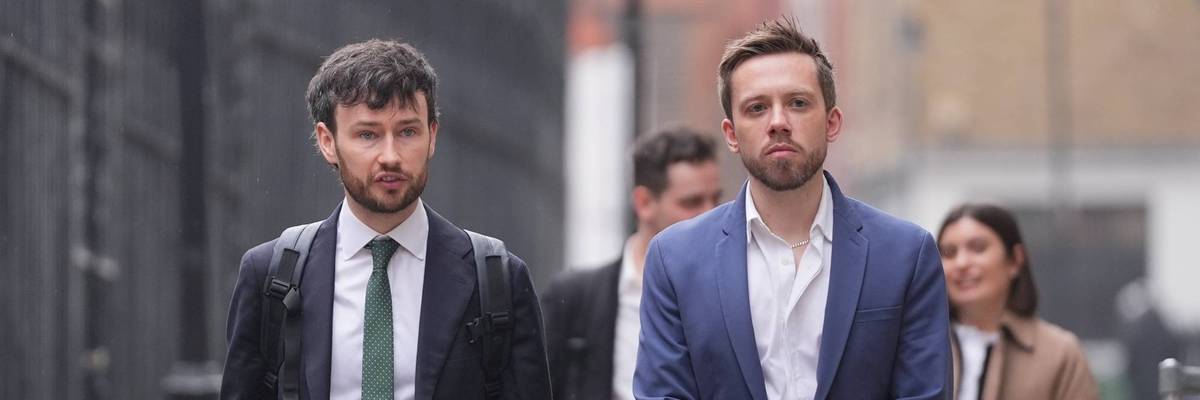
Journalist Owen Jones (right) is seen leaving the Royal Courts of Justice in London, where he was being sued by Raffi Berg for libel, on March 6, 2026.
Leftist Journalist Owen Jones Vindicated in Libel Case Over BBC's Biased Coverage of Gaza Genocide
The BBC has long been accused of centering Israel and dismissing the humanity of Palestinians in its coverage of Gaza.
British journalist Owen Jones on Thursday celebrated a UK High Court judge's ruling in his favor in a libel lawsuit that a BBC editor brought against him—and said that should the editor choose to move forward with his case despite the decision, he was looking forward "to defending my article in court."
The High Court ruled that Jones was expressing an opinion when he wrote an article for Drop Site News in December 2024 titled "The BBC's Civil War Over Gaza," in which he spoke to BBC staffers about Middle East online editor Raffi Berg's influence over the news outlet's coverage of Israel and Palestine.
The court also said Jones had expressed his opinion and that of his sources based on concrete examples of Berg's editorial role and journalism.
Jones' article described staffers' allegations that "internal complaints about how the BBC covers Gaza have been repeatedly brushed aside" as Berg "sets the tone" for the outlet's online coverage of Israel's onslaught in the exclave, where more than 75,000 Palestinians have been killed since October 2023 in what's been called a genocide by top Holocaust scholars and human rights groups.
It noted that the BBC failed to report on Amnesty International's finding that Israel was committing genocide in Gaza and displayed an on-screen chyron reading, "Israel rejects 'fabricated' claims of genocide.'"
"Journalists expressed concerns over bias in the shaping of the Middle East index of the BBC news website," wrote Jones. "Several allege that Berg 'micromanages' this section, ensuring that it fails to uphold impartiality."
The BBC has long been criticized for centering Israel and "dehumanizing" Palestinians, as more than 1,000 artists said in a letter last year when they condemned the network for refusing to air a documentary about the impact of Israel's attacks on children in Gaza, on the grounds that it featured the child of the exclave's deputy minister of agriculture—suggesting "that Palestinians holding administrative roles are inherently complicit in violence."
The article also pointed to Berg's own history of pro-Israel coverage, including a 2002 story "that presented young [Israel Defense Forces] soldiers as courageous defenders of their country while failing to mention the occupation and settlement of Palestinian land or the widespread allegations of crimes" documented by human rights groups and the US government.
Berg also presented Israeli settlers in the West Bank as "victims seeking 'a better quality of life' and did not mention the fact that the settlements have been repeatedly deemed illegal," and wrote about the Mossad "in glowing terms" in a book he wrote with extensive cooperation from the Israeli intelligence agency.
He also posted a photo on social media showing Prime Minister Benjamin Netanyahu with a copy of Berg's book on his bookshelf, Jones reported.
Berg's lawyer said last year that Jones' reporting attacked Berg's "professional reputation as a journalist and editor," and led to death threats.
In order for his case against Jones to proceed, Berg would now need to prove in court that "Jones did not genuinely hold the opinion he expressed in his reporting, or demonstrate that the opinion is not one an honest person could hold on the basis of any fact that existed at the time of its publication," Middle East Eye reported.
"I am proud to stand by my journalism," said Jones Thursday.
We are at a crossroads
This country and this world are at a monumental crossroads. In a few short weeks, US voters will have an opportunity to beat back the forces of fascism and confront the billionaires who are rigging the economy, our media system, and our democracy, making it increasingly impossible for ordinary people to get by. We’re not just talking about the election. We’re talking about what must be done once these fascist elements are vanquished from power. We need a bolder set of solutions than what either major party has so far been willing to offer and a working-class movement ready to fight like hell for it. Trump didn't emerge from nowhere. The conditions that fueled MAGA authoritarianism were created by decades of radical neoliberal economic policies and a corrupt political system dominated by corporate interests. They slashed taxes on the super-rich, promising that the benefits would trickle down. They said giveaways to the corporate titans would make life more affordable for the rest of us. It was all bullshit. And when a bitter, betrayed populace searches for someone to blame, right-wing demagogues have little trouble finding scapegoats. People know when they're being lied to, but you won't hear any of this from the corporate media. Only independent journalism—powered and funded by people who believe in building a better world—can deliver truly trustworthy daily news. Our Fall Campaign is underway, and we need your help. To power our newsroom through the rest of the year, we need to raise $125,000 by midnight on October 31. So if you share our vision, please contribute whatever you can to sustain our work. |
British journalist Owen Jones on Thursday celebrated a UK High Court judge's ruling in his favor in a libel lawsuit that a BBC editor brought against him—and said that should the editor choose to move forward with his case despite the decision, he was looking forward "to defending my article in court."
The High Court ruled that Jones was expressing an opinion when he wrote an article for Drop Site News in December 2024 titled "The BBC's Civil War Over Gaza," in which he spoke to BBC staffers about Middle East online editor Raffi Berg's influence over the news outlet's coverage of Israel and Palestine.
The court also said Jones had expressed his opinion and that of his sources based on concrete examples of Berg's editorial role and journalism.
Jones' article described staffers' allegations that "internal complaints about how the BBC covers Gaza have been repeatedly brushed aside" as Berg "sets the tone" for the outlet's online coverage of Israel's onslaught in the exclave, where more than 75,000 Palestinians have been killed since October 2023 in what's been called a genocide by top Holocaust scholars and human rights groups.
It noted that the BBC failed to report on Amnesty International's finding that Israel was committing genocide in Gaza and displayed an on-screen chyron reading, "Israel rejects 'fabricated' claims of genocide.'"
"Journalists expressed concerns over bias in the shaping of the Middle East index of the BBC news website," wrote Jones. "Several allege that Berg 'micromanages' this section, ensuring that it fails to uphold impartiality."
The BBC has long been criticized for centering Israel and "dehumanizing" Palestinians, as more than 1,000 artists said in a letter last year when they condemned the network for refusing to air a documentary about the impact of Israel's attacks on children in Gaza, on the grounds that it featured the child of the exclave's deputy minister of agriculture—suggesting "that Palestinians holding administrative roles are inherently complicit in violence."
The article also pointed to Berg's own history of pro-Israel coverage, including a 2002 story "that presented young [Israel Defense Forces] soldiers as courageous defenders of their country while failing to mention the occupation and settlement of Palestinian land or the widespread allegations of crimes" documented by human rights groups and the US government.
Berg also presented Israeli settlers in the West Bank as "victims seeking 'a better quality of life' and did not mention the fact that the settlements have been repeatedly deemed illegal," and wrote about the Mossad "in glowing terms" in a book he wrote with extensive cooperation from the Israeli intelligence agency.
He also posted a photo on social media showing Prime Minister Benjamin Netanyahu with a copy of Berg's book on his bookshelf, Jones reported.
Berg's lawyer said last year that Jones' reporting attacked Berg's "professional reputation as a journalist and editor," and led to death threats.
In order for his case against Jones to proceed, Berg would now need to prove in court that "Jones did not genuinely hold the opinion he expressed in his reporting, or demonstrate that the opinion is not one an honest person could hold on the basis of any fact that existed at the time of its publication," Middle East Eye reported.
"I am proud to stand by my journalism," said Jones Thursday.
British journalist Owen Jones on Thursday celebrated a UK High Court judge's ruling in his favor in a libel lawsuit that a BBC editor brought against him—and said that should the editor choose to move forward with his case despite the decision, he was looking forward "to defending my article in court."
The High Court ruled that Jones was expressing an opinion when he wrote an article for Drop Site News in December 2024 titled "The BBC's Civil War Over Gaza," in which he spoke to BBC staffers about Middle East online editor Raffi Berg's influence over the news outlet's coverage of Israel and Palestine.
The court also said Jones had expressed his opinion and that of his sources based on concrete examples of Berg's editorial role and journalism.
Jones' article described staffers' allegations that "internal complaints about how the BBC covers Gaza have been repeatedly brushed aside" as Berg "sets the tone" for the outlet's online coverage of Israel's onslaught in the exclave, where more than 75,000 Palestinians have been killed since October 2023 in what's been called a genocide by top Holocaust scholars and human rights groups.
It noted that the BBC failed to report on Amnesty International's finding that Israel was committing genocide in Gaza and displayed an on-screen chyron reading, "Israel rejects 'fabricated' claims of genocide.'"
"Journalists expressed concerns over bias in the shaping of the Middle East index of the BBC news website," wrote Jones. "Several allege that Berg 'micromanages' this section, ensuring that it fails to uphold impartiality."
The BBC has long been criticized for centering Israel and "dehumanizing" Palestinians, as more than 1,000 artists said in a letter last year when they condemned the network for refusing to air a documentary about the impact of Israel's attacks on children in Gaza, on the grounds that it featured the child of the exclave's deputy minister of agriculture—suggesting "that Palestinians holding administrative roles are inherently complicit in violence."
The article also pointed to Berg's own history of pro-Israel coverage, including a 2002 story "that presented young [Israel Defense Forces] soldiers as courageous defenders of their country while failing to mention the occupation and settlement of Palestinian land or the widespread allegations of crimes" documented by human rights groups and the US government.
Berg also presented Israeli settlers in the West Bank as "victims seeking 'a better quality of life' and did not mention the fact that the settlements have been repeatedly deemed illegal," and wrote about the Mossad "in glowing terms" in a book he wrote with extensive cooperation from the Israeli intelligence agency.
He also posted a photo on social media showing Prime Minister Benjamin Netanyahu with a copy of Berg's book on his bookshelf, Jones reported.
Berg's lawyer said last year that Jones' reporting attacked Berg's "professional reputation as a journalist and editor," and led to death threats.
In order for his case against Jones to proceed, Berg would now need to prove in court that "Jones did not genuinely hold the opinion he expressed in his reporting, or demonstrate that the opinion is not one an honest person could hold on the basis of any fact that existed at the time of its publication," Middle East Eye reported.
"I am proud to stand by my journalism," said Jones Thursday.