

SUBSCRIBE TO OUR FREE NEWSLETTER
Daily news & progressive opinion—funded by the people, not the corporations—delivered straight to your inbox.
5
#000000
#FFFFFF
To donate by check, phone, or other method, see our More Ways to Give page.
Daily news & progressive opinion—funded by the people, not the corporations—delivered straight to your inbox.
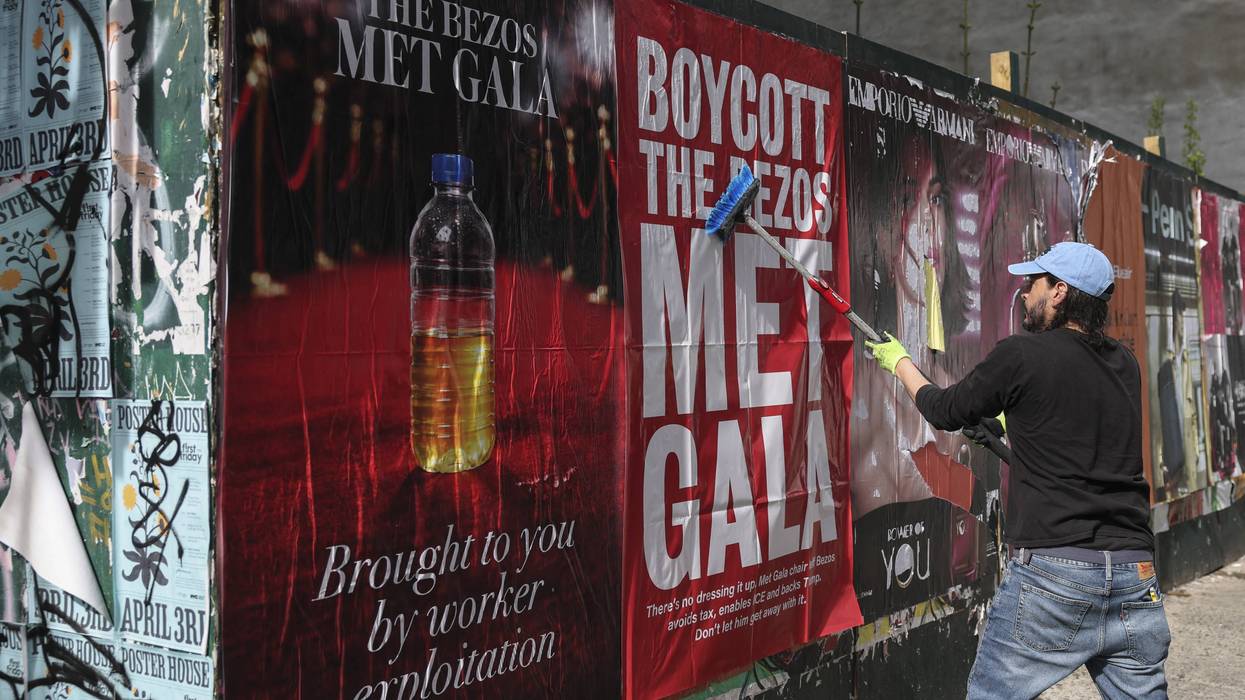
"It's a thin line between celebrating glamor and artwashing extreme wealth," said the Tax Justice Network.
As celebrities prepared to attend the 2026 Met Gala at the Metropolitan Museum of Art in New York on Monday, a coalition of nearly three dozen civil society groups warned that with Amazon founder Jeff Bezos—currently the fourth-richest person on Earth—chairing the annual fundraiser, the gala risks "artwashing the harms of extreme wealth."
Groups including Greenpeace International, Patriotic Millionaires, and War on Want signed a letter organized by the Tax the Superrich Alliance, calling on the museum and Vogue magazine, which hosts the event, not to honor Bezos and warning that the billionaire is using the two cultural institutions as tools "to launder his public image."
The Metropolitan Museum of Art has a celebrated collection of art spanning centuries, many of it made "in defiance of power—work that exposed injustice, gave voice to the silenced, and held the powerful to account," reads the letter.
But the tech mogul chosen to chair the gala "has made his loyalties clear" since President Donald Trump first took office in 2017 and during the Republican's second term, said the groups, pointing to Bezos' purchase of The Washington Post, the mass firing of hundreds of the newspaper's reporters this year, and his remaking of the publication's opinion section into one focusing on "free markets."
He "gutted" the Post "while reportedly pouring $75 million into a film promoting Melania Trump," reads the letter, referring to the Amazon-produced documentary film Melania.
"A 2% wealth tax on just three necklaces previously worn by celebrities to the Met Gala’s red carpet could fully fund New York City’s home energy assistance program, helping 1 million households heat and cool their homes."
"He is not just a bystander to Trump’s administration," wrote the organizations. "He is one of its enablers. This is not philanthropy. This effectively is influence bought and paid for by Bezos’ pocket change—and the Met Gala is his latest purchase."
The groups added that in addition to aligning himself with the White House through his ownership of the Post, Bezos and Amazon—a government contractor where he is still the largest individual shareholder—is working with Trump to "make possible a concentration of power that not only threatens lives in the US but across the world as well."
"While so many of these policies aren’t new, they have been exacerbated under Trump and with the help of people like Bezos—from families torn apart by ICE [US Immigration and Customs Enforcement] raids reportedly enabled by Amazon's own technology, to a White House emboldened to threaten and carry out military action against sovereign nations without consequence—including to ‘destroy a whole civilization’ in Iran—with no accountability," reads the letter.
The Tax Justice Network, one of the signatories, emphasized that just a fraction of the money that goes to the $100,000-per ticket Met Gala could alleviate the economic inequality that's grown worse under the Trump administration.
"A 2% wealth tax on just three necklaces previously worn by celebrities to the Met Gala’s red carpet could fully fund New York City’s home energy assistance program, helping 1 million households heat and cool their homes," said the Tax Justice Network, citing its analysis released Monday.
Bezos is among the billionaires who have contributed donations to Trump's pet projects—a luxury ballroom and a 250-foot-tall arch in Washington, DC—while the president has tried to cut the home energy assistance program, said the group.
“There’s a thin line between celebrating glamorous fashion and artwashing extreme wealth, and that line gets bulldozed when your poster boy is an ICE-profiteering billionaire bankrolling Trump’s vanity projects and a top spender on anti-worker lobbying,” said Alex Cobham, chief executive at the Tax Justice Network.
In the first two hours of the Met Gala, Cobham added, "Bezos’s wealth will grow by the equivalent of 130,000 hours of a teacher’s labor... This extreme distortion throws economies out of whack. Our economies are supposed to let people earn the wealth they need to lead secure and comfortable lives, but most countries’ tax rules make it easier for the superrich to collect wealth than for the rest of us to earn it."
It's a thin line between celebrating glamor & artwashing extreme wealth. That line gets bulldozed when your patron is an ICE-profiteering billionaire bankrolling Trump’s vanity projects & a top spender on antiworker lobbying. Don't let Bezos artwash his at the Met Gala taxjustice.net/press/2-tax-...
[image or embed]
— Tax Justice Network (@taxjustice.net) May 4, 2026 at 3:25 AM
"In Bezos’ case, it’s easy to see how that undertaxed collected wealth goes towards lobbying further against workers’ rights and pay, while his company Amazon remains one of the biggest recipients of US subsidies," said Cobham.
According to the Tax Justice Network's analysis, Bezos accumulated $3.8 million every house from 2023-25, when his total wealth grew by more than $100 billion.
"If Bezos were to continue to accumulate wealth at this rate," said the group, "he would accumulate $7.6 million in the first two hours of the Met Gala event, which is the equivalent of 110 NYC Public Schools teachers’ starting salaries"—$68,902.
Those organizing the gala can and must "stop celebrating those destroying our countries and humanity itself," reads the letter sent by the Tax the Superrich Alliance, by not honoring Bezos and backing the fair taxation of the wealthiest households and corporations.
"End the oligarchy," reads the letter. "Tax the super rich. Now."
New York City Mayor Zohran Mamdani, a proponent of taxing the rich to pay for crucial public programs and services, planned to skip the Met Gala in a break with tradition. Last month Mamdani announced plans for a tax on second homes valued at $5 million or more in New York City.
Celebrities who are reportedly planning to skip the event include Palestinian-American model Bella Hadid, who has spoken out against ICE and in favor of Palestinian rights, and actress Zendaya.
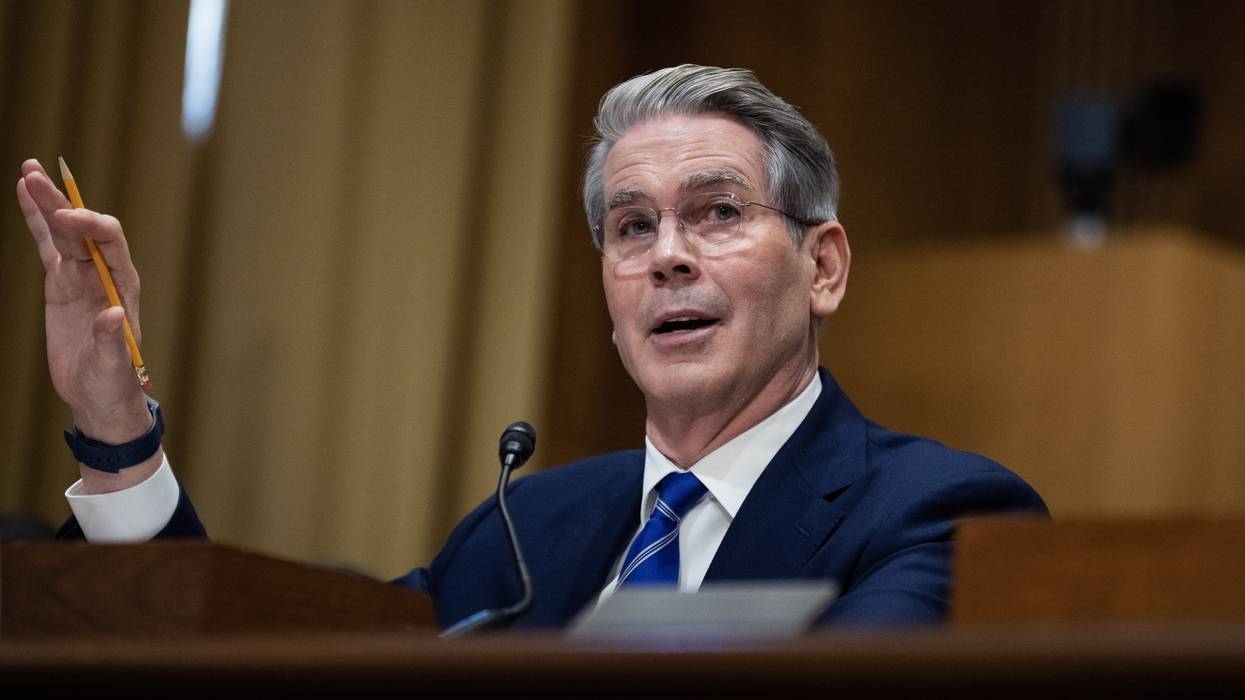
“The Trump administration has chosen to prioritize maintaining rock-bottom taxes for big corporations to the detriment of ordinary Americans and our allies across the globe," said one critic.
The Organization of Economic Cooperation and Development is facing criticism for buckling under US demands when finalizing an update to the global minimum corporate tax agreement.
As reported by Reuters on Monday, the OECD agreed to amend a 2021 deal to enforce a 15% global minimum corporate tax to include "simplifications and carve-outs to align US minimum tax laws with global standards, accommodating earlier objections raised by the Trump administration."
Under the original framework, OECD members agreed to apply a 15% corporate tax on multinational corporations that book profits in jurisdictions that have lower tax rates.
President Donald Trump objected to this, however, and insisted that some US corporations be given exemptions that have subsequently been granted by OECD states.
US Treasury Secretary Scott Bessent said that the revised deal "represents a historic victory in preserving US sovereignty and protecting American workers and businesses from extraterritorial overreach," while noting that it allowed for US-headquartered firms to be subject only to US global minimum taxes.
Some critics, though, accused the OECD of letting the US get away with robbery.
Zorka Milin, policy director at the Financial Accountability and Corporate Transparency Coalition, warned that the deal "risks nearly a decade of global progress on corporate taxation" by allowing "the largest, most profitable American companies to keep parking profits in tax havens."
“The Trump administration has chosen to prioritize maintaining rock-bottom taxes for big corporations to the detriment of ordinary Americans and our allies across the globe," Milin added.
Alex Cobham, chief executive at Tax Justice Network, said other OECD members were only hurting themselves by caving to Trump's demands.
"By the Tax Justice Network’s assessment, France for example is already losing $14 billion a year to tax cheating US firms, Germany is losing $16 billion, and the UK is losing $9 billion," Cobham explained. "Today’s bending of the knee to Trump will cost countries billions more. But how much more? Tellingly, the OECD, which has delivered this shameful result, and OECD members have not put a number on the scale of tax losses that will result."
An analysis published last month by the Institute on Taxation and Economic Policy (ITEP) made the case that global minimum corporate taxes were needed to prevent US companies from sheltering vast profits by reporting them in nations that serve as offshore tax havens.
As an example, ITEP pointed to data showing that the profits US companies reported in notorious tax havens such as Barbados and the British Virgin Islands were more than 100% of those territories' gross domestic product, which the report noted "is obviously impossible."
ITEP went on to state that full implementation of this global minimum tax is "the best hope for blocking the types of tax avoidance that have weakened corporate income taxes all over the world" by making it "difficult for any single government (even one as powerful as the US) to ignore or weaken it."
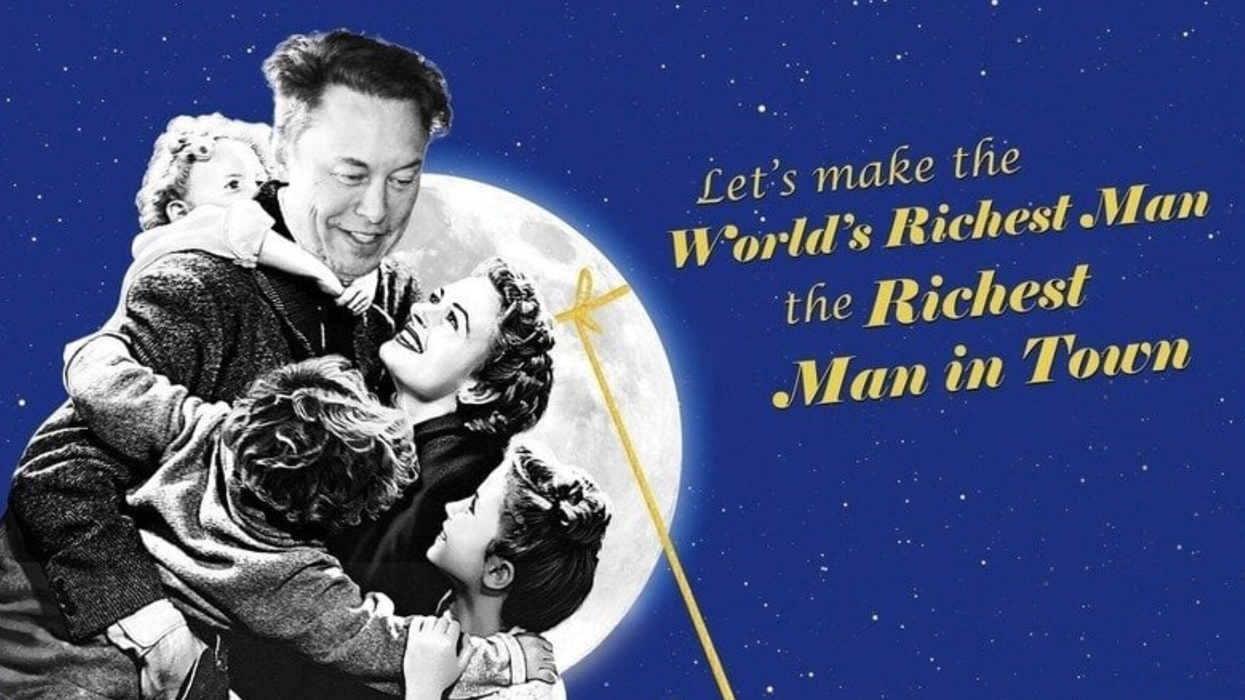
... by giving nearly half of his $500 billion fortune to the children of the world.
"Let's make the world's richest man the richest man in town!" urges a new campaign launched Friday by the economic advocacy group Tax Justice Network, borrowing a memorable line from the classic film "It's a Wonderful Life."
The group's global petition emphasizes that SpaceX owner Elon Musk is already the richest person in the world, with a net worth of $508.4 billion—more than double the assets of the planet's next-richest person, Google co-founder Larry Page.
Tax Justice Network's (TJN) petition invites Musk to give 44% of his wealth—$223.6 billion—to the children of the world. That amount of money would allow the purchase of a $90 gift card for all 2.4 billion of the planet's children under the age of 18, and could stop more than 100 million children from going hungry this holiday season.
And Musk would still be the richest person alive, emphasized the group.
Let’s make the world’s richest man feel like the richest man in town this Christmas! Sign our Christmas card inviting Elon Musk to gift 44% of his wealth to the children of the world to create 2 billion smiles and still be the world’s richest man alive! #WealthTax #TaxTheSuperRichc.org/jnnZhmp6J4
[image or embed]
— Tax Justice Network (@taxjustice.net) December 12, 2025 at 10:40 AM
The campaign quotes Harry Bailey's famous line declaring his brother George Bailey, played by Jimmy Stewart, "the richest man in town" in "It's a Wonderful Life," after George's neighbors donate money to save him from financial ruin.
“We’re obviously poking a little fun here but the point is to show how extreme the concentration of wealth has become," said Alex Cobham, chief executive at TJN. "Depending on where you are in the world, if you earn the average wage, you’d need to work anywhere from 20 times to a thousand times longer than humans have existed to earn as much wealth as Elon Musk has collected."
The petition notes that TJN and the world's children "would also settle for a 2% wealth tax on the superrich," which would allow countries around the world to raise $2 trillion per year if it was applied to the richest 0.5% of people on the planet.
"That’s enough public money to meet most countries’ climate finance needs, and leave billions to spare for local public services," the group said.
The group pointed to a recent G20 report declaring a global "inequality emergency" and last week's World Inequality Report, which found that fewer than 60,000 multimillionaires—just 0.001% of the world's population—own three times more wealth than the entire bottom 50% of humanity.
"Within almost every region, the top 1% alone hold more wealth than the bottom 90% combined," noted TJN.
The petition emphasizes the difference between collected wealth—the kind enjoyed by Musk and other superrich people—and earned wealth. The vast majority of people earn money for what they do, notes TJN. Musk and other billionaires "get paid for what [they] own, so dividends for owning stocks and rent money for owning real estate."
Billionaires including Musk, Meta CEO Mark Zuckerberg, and Oracle executive Larry Ellison famously take salaries of just $1, but the money that's made them part of the world's superrich is their collected wealth, emphasized TJN.
"Earned wealth cannot create billionaires," said TJN. "Only collected wealth grows fast enough to do so. It’s impossible to earn a billion dollars."
A ProPublica report in 2021 detailed how billionaires like Musk and Amazon founder Jeff Bezos paid a collective "true tax rate" of just 3.4% while the median American household made $70,000 and paid a tax rate of 14%.
"This special tax treatment has helped the superrich quadruple their wealth since the 1980s to extreme levels," said TJN. "Studies directly link this rise in extreme wealth to lower economic productivity, to more households going into debt and to people living shorter lives."
Musk in the past has pledged to use his extreme wealth to help people around the world—only to renege on his promises. In 2022, he challenged then-World Food Program chief David Beasley to prove, as Beasley had stated, that a small fraction of Musk's wealth could help address world hunger. He pledged to donate $6 billion by selling his Tesla stock if the WFP could prove the contribution would "solve world hunger."
The WFP responded with a report detailing how $6 billion could feed 42 million at-risk people and prevent them from going hungry for a year. But Musk didn't follow through with his pledge, instead donating $5.7 billion of his Tesla shares to his own foundation.
This year, Musk spearheaded a push to slash government spending on foreign aid, with the US Agency for International Development a key target. The cuts have already proven deadly for children in impoverished nations.
Cobham on Monday pointed to research showing that the skyrocketing wealth of the richest 1% of Americans over the past 40 years has not led "to more investments, and instead resulted in dissaving among non-rich households."
“We now have plenty of evidence showing that extreme wealth shrinks economies, makes people poorer, and threatens democracy," said Cobham. "The best way to protect people, economies, and planet from the harms of extreme wealth is to end the special tax treatment that collected wealth gets over earned wealth. We must tax extreme wealth more effectively to protect the earner way of life we all rely on. Whether you’re a wealth collector or a wealth earner, we all have an equal responsibility to pitch in our fair share.”
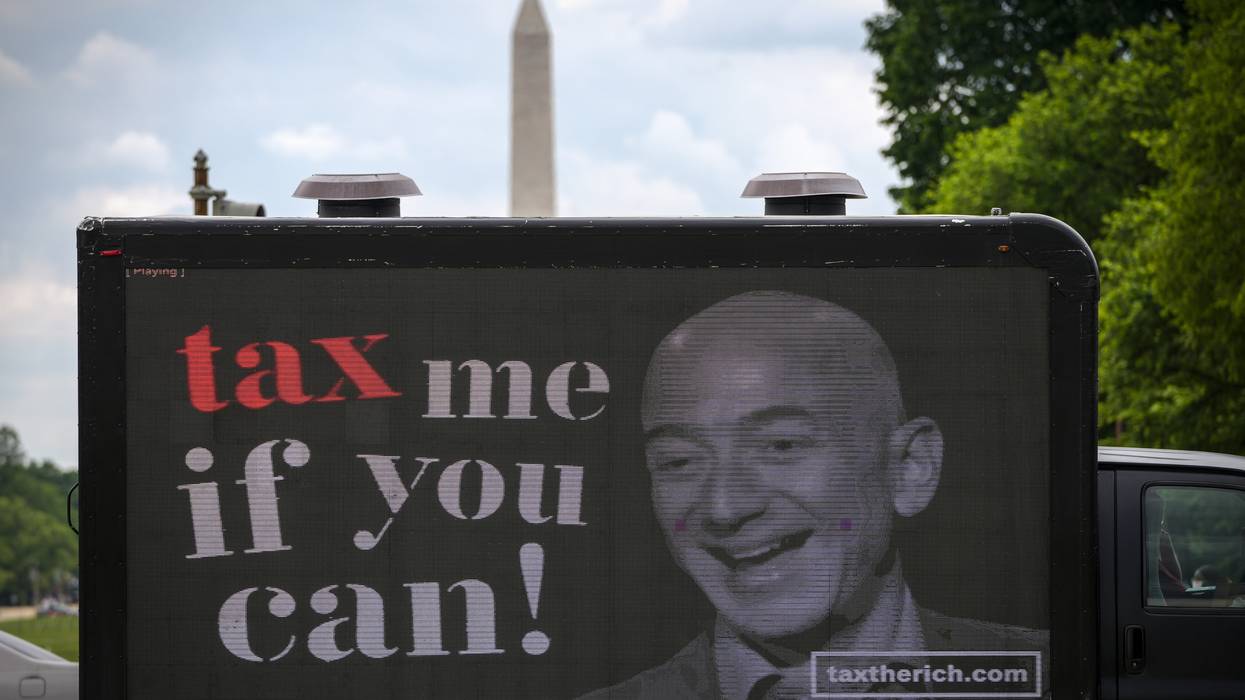
New analysis by the Tax Justice Network shows that governments could raise an additional $2.6 trillion each year by applying a modest wealth tax to the richest 0.5% of households and ending corporate tax abuse.
As the climate crisis accelerates, global fault lines are widening. Wealthy nations are gutting aid budgets while pouring fortunes into their militaries. Their climate finance commitments ring empty, masked by claims that public funds have run dry. But the reality is different: The money is there, and a bold tax justice agenda can unlock it. Reclaiming tax sovereignty—the power to decide how wealth is taxed and where it goes—can shift resources away from billionaires and corporate giants to fund real climate solutions.
This isn’t a funding gap. It’s a sovereignty gap.
New analysis by the Tax Justice Network shows that governments could raise an additional $2.6 trillion each year by applying a modest wealth tax to the richest 0.5% of households and ending corporate tax abuse. That would be more than enough to meet global climate finance needs and still leave most countries with billions to invest in care, education, and green jobs at home.
Extreme wealth fuels climate inaction, rising debt, and inequality. In a world on fire, refusing to tax those who profit most is no longer neutral—it’s a global risk.
The climate crisis is accelerating. Floods, heatwaves, and crop failures are pushing more people into precarity. The costs of climate adaptation, mitigation, and loss and damage are projected to reach $9 trillion per year by 2030. Yet the global community is still scrambling to honor a $100 billion pledge first made over 15 years ago.
As the Bonn climate talks come to a close and attention turns to the fourth Financing for Development conference in Seville, climate finance remains a structural void that policy declarations alone cannot fill. On the road to COP30 in Belém, governments face a critical choice: Keep chasing inadequate voluntary climate finance handouts, or finally confront the rigged tax systems that let the superrich and big polluters amass obscene wealth while the planet burns.
Tax Justice Network reveals that fair taxation of extreme wealth combined with measures to curb cross-border tax abuse by multinational corporations could raise $2.6 trillion each year—enough to more than double the $1.3 trillion annual climate finance goal that United Nations member countries are aiming to reach by 2030. The real issue isn’t where new money will come from, but why governments keep letting existing public resources leak through the cracks of a broken tax system.
By applying a minimal annual wealth tax of 1.7-3.5% and reclaiming tax revenue from multinationals that underpay tax, countries could unlock additional tax revenue equivalent to 2.4%of global GDP. This is money that could be raised today if governments stopped letting it slip away through loopholes and inaction.
We modeled what countries could raise and contribute based on historic responsibility for emissions. The results are striking. If countries were to contribute to a global climate finance fund sized at $300 billion—the lower end of the current debate—then 89% of countries could cover their share and still have billions left over for public services. Even if the fund were scaled up to $1.5 trillion, 58% of countries would still contribute their fair share and have billions to spare.
Take the United States. It could raise enough additional revenue to contribute $365 billion a year toward climate finance and still be left with $412 billion to spend at home. China, India, the United Kingdom, and Brazil follow the same pattern.
This is the core message of our climate finance slider tool. Taxing extreme wealth and curbing tax abuse does not pit climate justice against development. It enables both. The interactive tool shows how much countries could raise and how much they could contribute if tax rules were rebalanced in favor of people and planet.
So why are countries still acting like climate finance is unaffordable?
The answer lies in decades of eroded tax sovereignty. Countries have signed away their taxing rights through outdated and unfair treaties, allowed wealth to flow into secrecy jurisdictions, and catered to corporate demands for tax cuts and incentives—often under conditions of debt dependence and economic coercion. In the process, governments have weakened their ability and willingness to tax those most responsible for fuelling the climate crisis.
Today, 61% of countries were found to have an “endangered” level of tax sovereignty or worse—meaning they are failing to collect tax revenue worth at least 5% f what they already raise, largely from their richest households and from multinational corporations that underpay tax. Nearly a fifth of countries (19%) fall into the “negated” category, missing out on the equivalent of 15% or more of their annual tax revenue. These are not natural constraints. They are political outcomes shaped by an unequal global financial system.
Across the Global South, the consequences are particularly acute. Many governments face impossible tradeoffs—between education and adaptation, between debt service and disaster response. As United Nations independent expert Attiya Waris has warned:
Across the Global South, care and climate responses are being sacrificed to servicing debts that dwarf the funds we need for a just transition. These sacrifices reflect an international financial order that prioritises creditor claims over human and planetary well-being.
Climate finance cannot be separated from this wider context of fiscal injustice. When governments are forced to borrow for every disaster or rely on discretionary aid pledges, they lose both agency and time. The race to build resilience becomes a race against the clock—one they cannot win without revenue.
It is time to reframe the debate. Climate finance must not rely on broken promises or voluntary pledges. It must be embedded in systems that are fair and redistributive. That means tax systems—ones that reflect both capacity to pay and responsibility for emissions.
The upcoming U.N. Tax Convention offers a once in a generation opportunity to rebalance global tax rules. If done right, it could help all countries reclaim the power to tax their richest residents and corporations fairly. It could end the era of tax havens, profit shifting, and billionaire impunity.
But we do not need to wait for negotiations to conclude. Countries can act now by introducing wealth taxes, renegotiating exploitative tax treaties, increasing transparency, and aligning fiscal policies with climate goals. These reforms are not only possible. They are popular. Polling consistently shows widespread support for taxing extreme wealth to fund public goods.
Extreme wealth fuels climate inaction, rising debt, and inequality. In a world on fire, refusing to tax those who profit most is no longer neutral—it’s a global risk.
By reclaiming tax sovereignty, governments can do what markets and private finance have failed to deliver: fund climate solutions at scale, protect the most vulnerable, and make those most responsible pay their fair share. Refusing to tax isn’t sovereignty—it’s surrender to the idea that tax is a tool for catering to the desires of the superrich, rather than a tool for protecting people’s well-being, the planet, and our collective survival.
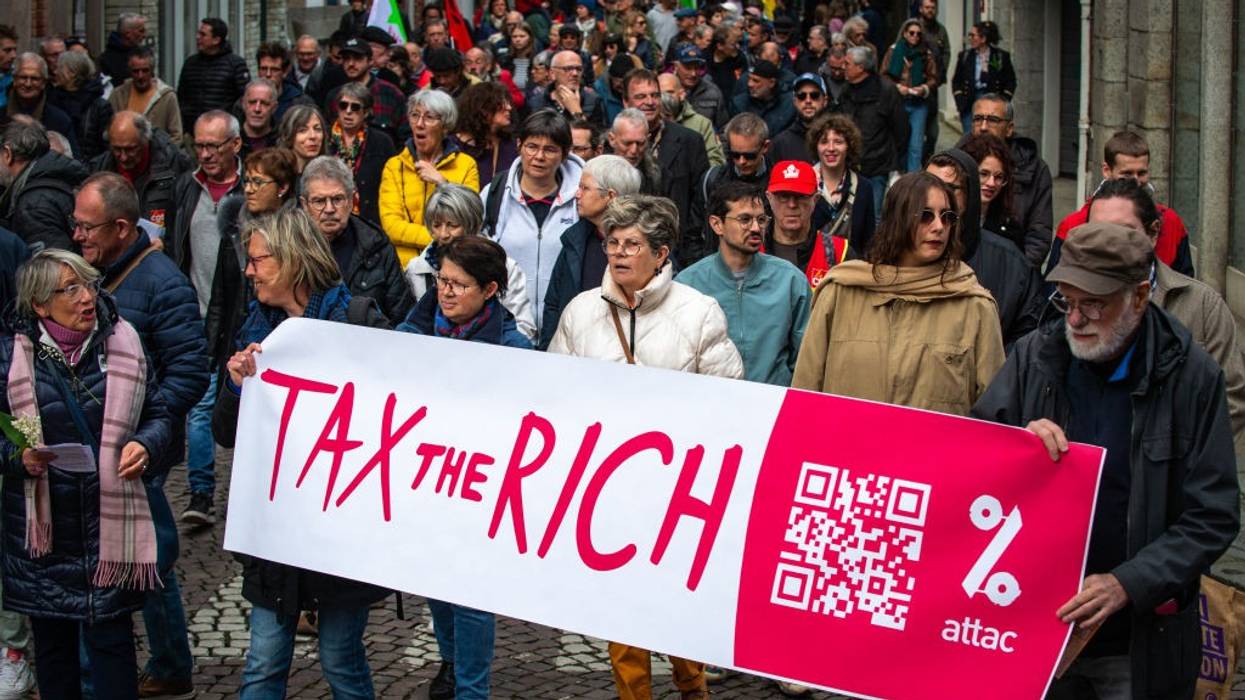
"The U.K. and the U.S. are both among the biggest enablers and the biggest losers of this lose-lose tax system," said the chief executive of the Tax Justice Network.
A study published Tuesday estimates that tax dodging enabled by the United States, the United Kingdom, and other wealthy nations is costing countries around the world nearly half a trillion dollars in revenue each year, underscoring the urgent need for global reforms to prevent rich individuals and large corporations from shirking their obligations.
The new study, conducted by the Tax Justice Network (TJN), finds that "the combined costs of cross-border tax abuse by multinational companies and by individuals with undeclared assets offshore stands at an estimated $492 billion." Of that total in lost revenue, corporate tax dodging is responsible for more than $347 billion, according to TJN's calculations.
"For people everywhere, the losses translate into foregone public services, and weakened states at greater risk of falling prey to political extremism," the study reads. "And in the same way, there is scope for all to benefit from moving tax rule-setting out of the OECD and into a globally inclusive and fully transparent process at the United Nations."
The analysis estimates that just eight countries—the U.S., Canada, the U.K., Japan, Israel, South Korea, Australia, and New Zealand—are enabling large-scale tax avoidance by opposing popular global reform efforts. Late last year, those same eight countries were the lonely opponents of the United Nations General Assembly's vote to set in motion the process of establishing a U.N. tax convention.
According to the new TJN study, those eight countries are responsible for roughly half of the $492 billion lost per year globally to tax avoidance by the rich and large multinational corporations, despite being home to just 8% of the world's population.
"The hurtful eight voted for a world where we all keep losing half a trillion a year to tax-cheating multinational corporations and the super-rich," Alex Cobham, chief executive of the Tax Justice Network, said in a statement Tuesday. "The U.K. and the U.S. are both among the biggest enablers and the biggest losers of this lose-lose tax system, and their people consistently demand an end to tax abuse, so it's absurd that the U.S. and U.K. are seeking to preserve it."
"It's perhaps harder to understand why the other handful of blockers, like Australia, Canada, and Japan, who don't play anything like such a damaging role, would be willing to go along with this," Cobham added.
TJN released its study as G20 nations—a group that includes most of the "hurtful eight"—issued a communiqué pledging to "engage cooperatively to ensure that ultra-high-net-worth individuals are effectively taxed." Brazil, which hosted the G20 summit, led the push for language calling for taxation of the global super-rich.
The document drew praise from advocacy groups including the Fight Inequality Alliance, which stressed the need to "transform the rhetoric on taxing the rich into global reality."
The communiqué was released amid concerns that the election of far-right billionaire Donald Trump in the U.S. could derail progress toward a global solution to pervasive and costly tax avoidance.
The new TJN study cites Trump's pledge to cut the statutory U.S. corporate tax rate from 21% to 15% and warns such a move would accelerate the global "race to the bottom" on corporate taxation.
"People in countries around the world are calling in large majorities on their governments to tax multinational corporations properly," Liz Nelson, TJN's director of advocacy and research, said Tuesday. "But governments continue to exercise a policy of appeasement on corporate tax."
"We now have data from these governments showing that when they asked multinational corporations to pay less tax, the corporations cheated even more," Nelson added. "It's time governments found the spines their people deserve from their leaders."
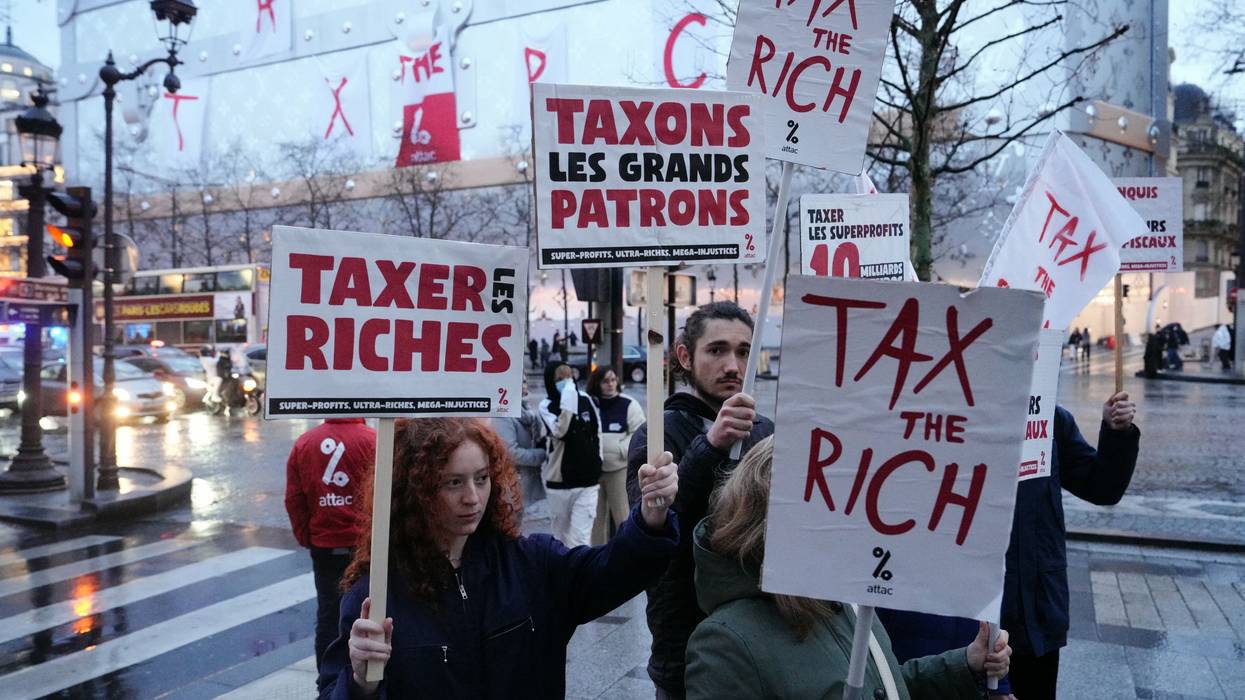
"At the U.N., low- and middle-income countries are in the majority, and they want a fair system where their voices are heard."
Tax justice advocates this week are expressing hope that delegates at a United Nations summit aimed at drafting an international tax convention will take the "once-in-a-century opportunity," as one campaigner and researcher said, to place the common good at the center of the global tax system instead of individual and corporate greed.
Representatives of U.N. member states are meeting for the Ad Hoc Committee to Draft Terms of Reference for a United Nations Framework on International Tax Cooperation, following decades of campaigning by countries in the Global South.
"It's happening," said Rebecca Riddell, policy lead for Oxfam America. "The start of historic negotiations for a fairer global tax system. We're here because of the leadership of African countries. Because of the 125 states that voted yes. And because of tireless civil society efforts."
The U.N. General Assembly passed a resolution last November calling for the meeting, with the committee required to submit "terms of reference to the General Assembly by August and a final vote on a tax convention framework expected by the end of 2025.
At the Tax Justice Network (TJN), Sergio Chaparro-Hernandez wrote last week that the negotiations are taking place with an "unprecedented level of transparency," with civil society groups able to account for the positions adopted by each state.
Another "noteworthy development" as the meeting gets underway, said Chaparro-Hernandez, is that "several of the 48 countries that had voted against Resolution 78/230 last year are now actively participating in the process."
"The European Union, for example, which voted as a bloc against the resolution last year, accepted the path set out by the resolution by stating in its initial statement at the organizational session that, 'the UN framework convention on tax cooperation can and should serve to further promote tax transparency and fair taxation,'" he added.
Along with TJN, other civil society groups including the Center for Economic and Social Rights (CESR), Eurodad, and Greenpeace are participating in the committee meeting and lobbying for a far-reaching convention framework that will "redefine the pillars of the international tax system and to make it fully inclusive, just, and effective."
"At the U.N., low- and middle-income countries are in the majority, and they want a fair system where their voices are heard," said Maria Ron Balsera, a researcher at CESR.
Under current global tax rules, the wealthiest individuals and corporations pocket $480 billion each year through the use of tax havens and other forms of tax evasion, said Greenpeace on Tuesday, "most countries just can't cover people's basic needs, nor meet their climate and biodiversity targets and commitments."
"The U.N. Tax Convention is a historical opportunity to create well-being for all, by moving decision-making power from a few rich [Organization for Economic Cooperation and Development] countries to the U.N. where every country has a vote," said the group.
Chenai Mukumba, executive director of Tax Justice Network Africa, spoke to attendees of the committee meeting about prioritizing mechanisms to crack down on tax evasion.
"While we flag the importance of this work to developing countries, we cannot overemphasize that inclusive and effective tax cooperation is important that has benefits for our global community," said Mukumba. "The international community as a whole is better off when we have more countries that have resources and capacity to provide their citizens with essential services."
On Monday, Greenpeace Africa's pan-African political strategist Fred Njehu wrote to Ramy Mohamed Youssef, chair of the U.N. Tax Convention Committee, and addressed him not only as an advocate but as "a dad, a concerned citizen, and a taxpayer."
Changing global tax rules and ensuring the wealthy pay their fair share, said Njehu would unlock "the money for everyone’s basic needs and the recovery of climate and nature."
"We both know that this is mostly because multinational corporations have been exploiting the majority of the world for way too long, and governments in some rich countries have facilitated it," said Njehu. "They're making billions on the destruction of the world and our suffering. And then, they hide their profits in tax havens. A downward spiral where wealth and power have become so concentrated as to threaten democracy, civilization, and the living world we're part of."
"Mr. Youssef, you have a big responsibility and a unique opportunity to turn things around this year," he added. "Civil society, academics, and countries that represent 80% of the world’s population are backing you and your colleagues at the U.N. Tax Convention Committee to change the global tax rules, which are critical for how the global economy works... Now we need equality, transparency and accountability. Polluters must pay and the wealthy must be taxed fairly."
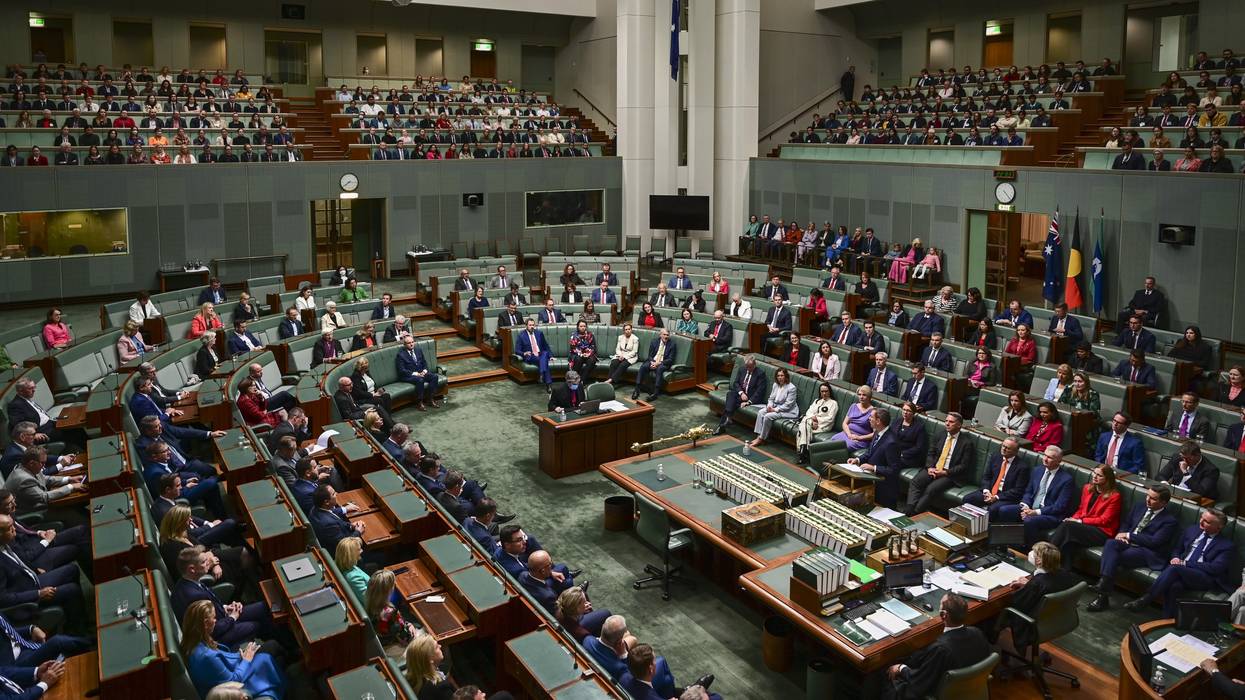
"What little credibility the OECD had is now in tatters," said one campaigner. "The OECD makes promises about ending global tax abuse but was evidently doing everything it could behind closed doors to protect tax abusers."
The Financial Times confirmed Friday that the Organization for Economic Cooperation and Development lobbied Australia to weaken a law that would have compelled about 2,500 highly profitable multinational corporations to reveal where they pay taxes, eliciting outrage from tax justice advocates.
Citing two unnamed people familiar with the discussions, FT reported that the Paris-based club of wealthy nations "pressured Australia's ruling Labor government to drop a crucial part of a new finance bill that would have required some multinationals to publicly disclose their country-by-country tax bills."
"This shows the true colors of the OECD."
According to the newspaper, "The OECD, which has driven efforts to force the world's largest companies to pay their fair share of tax, believed the bill would have undermined its own efforts to make multinationals' affairs less opaque."
Campaigners were incredulous given that the legislation the OECD enfeebled "would have delivered the biggest transparency breakthrough to date on the taxes of multinational corporations," as the Tax Justice Network put it.
The advocacy group estimates that multinationals shift more than $1.1 trillion of profit into tax havens annually, costing the world $312 billion per year in foregone corporate tax revenue. It also calculates that at least 1 of every 4 of those lost tax dollars could be saved if corporations were required to publish country-by-country reporting data.
"The OECD yet again doing the bidding for big business, the only winners here," tweeted Nabil Ahmed, economic justice director at Oxfam America.
Ahmed's observation was shared by Isabel Ortiz, the former director of social protection at the United Nations' International Labor Organization, who said, "This shows the true colors of the OECD and who [it is] serving."
Australia's original proposal "would have exposed unprecedented details about companies' tax affairs in each country they operate," FT reported, aiding efforts to crack down on tax evasion by forcing an estimated 21% of the world's multinational corporations—including many of the biggest firms in history—to come clean about "how much of their revenues are booked in low-tax jurisdictions."
As the newspaper explained:
The bill was expected to clear the Australian parliament in June and come into force on July 1. However, the version of the bill that passed last month removed crucial disclosures, with the Australian government announcing a delay of the planned public country-by-country tax reporting regime for a year.
People close to the decision said officials from the intergovernmental body had stressed to the Australian Treasury that countries that signed the 2015 OECD agreement did so on the basis the tax reports would not become public.
"This is not a good look for the OECD," the Fair Tax Foundation wrote on social media. "Their work is by definition consensus-based and often lowest common denominator. If a country wants to push on and do something more substantial, they should applaud, not oppose."
David McNair, executive director of global policy at the anti-poverty nonprofit One, argued that "this story seriously undermines the OECD's credibility in the one area that it was leading in recent years."
"I hope it prompts some soul searching on the mission and values of the organization," he added.
"OECD has put itself firmly on the side of secrecy—on the side of tax abuse—against one of its members. That's an extraordinary state of affairs."
As FT observed, "For the past decade the OECD has spearheaded global efforts to close loopholes and restrict the use of tax havens after it was asked by the G20 in 2013 to address the growing problem of corporate tax avoidance."
"While large multinationals already report some country-by-country data to tax authorities under an international agreement brokered by the OECD in 2015, the Australian proposal would have disclosed additional new data points," the newspaper noted. "And crucially the OECD country tax reports are not shared with the public."
FT's article corroborates earlier reporting by the Center for International Corporate Tax Accountability and Research (CICTAR) and the Tax Justice Network.
Two weeks ago, immediately after the Australian government unexpectedly postponed key components of its landmark bill, both groups suggested that "lobbying against the legislation by multinational corporations and their professional enablers may have been bolstered by the OECD itself—the organization which claims to set international tax rules in order to reduce corporate tax abuse."
In the wake of FT's bombshell story, Tax Justice Network chief executive Alex Cobham said in a statement that "what little credibility the OECD had is now in tatters."
"The OECD makes promises about ending global tax abuse," said Cobham, "but was evidently doing everything it could behind closed doors to protect tax abusers."
The Australian law opposed by the OECD – which may yet be adopted despite the delay – would force one 1 in 5 multinational corporations around the world to come clean about their profits and taxes. This includes many of the world’s biggest multinational corporations... pic.twitter.com/9j3KqNPee4
— Tax Justice Network (@TaxJusticeNet) July 8, 2023
Cobham called it "genuinely shocking to see it confirmed that the OECD has lobbied its own member country against introducing a key measure to fight corporate tax abuse."
"Public country-by-country reporting, when it arrives, will increase revenues around the world to the tune of billions of dollars, by exposing the most egregious profit shifting," Cobham continued. "Investors will benefit from reduced risk in their shareholdings, and employees will benefit both from lower risk and from the chance to negotiate fairly based on a true reporting of the profits of their work. Smaller and domestic businesses will benefit from a more level playing field, instead of a system that subsidizes multinationals' tax bills by effectively granting them immunity from abuse."
"OECD has put itself firmly on the side of secrecy—on the side of tax abuse—against one of its members. That's an extraordinary state of affairs," he added. "And it couldn't send a clearer signal to countries wondering whether the OECD's proposed tax rules will help them to curb tax abuse. They won't, and countries should pursue their own alternatives while preparing for negotiations to establish a proper tax body at the United Nations instead."
Supporters of UN tax leadership have pointed to the OECD’s failure to meaningfully include most countries in its rulemaking process – a concern unlikely to be eased by news of the OECD lobbying its own member against introducing a key measure to fight corporate tax abuse.
— Tax Justice Network (@TaxJusticeNet) July 8, 2023
As economic historian Adam Tooze pointed out, the OECD strong-armed Australia's left-leaning government while being led by Mathias Cormann, a right-wing Australian who previously served as the country's finance minister.
On Saturday, Cormann said in a statement that "the OECD has a proud record of facilitating global cooperation on tax policy and administration, to help ensure globally effective measures to tackle multinational tax avoidance."
"Suggestions the OECD pressured Australia into weakening legislation to tackle such tax avoidance are false," he claimed.
Cobham criticized Cormann's response, pointing out that the OECD secretary-general goes on to admit that the body's experts "raised a number of technical issues," after which Australian lawmakers watered down their proposal.
According to Cobham, the "possible unintended consequences" brought up by OECD experts are "flat wrong." He added that "Cormann seems to have confessed that the OECD did lobby Australia to weaken their proposals to fight corporate tax abuse... and also that they used a false threat to do so—one which, as experts in their own standard, they surely knew was erroneous."
Last week, the IRS asked anyone who might be exposed in the Panama Papers to come forward before they get caught. And for good reason--America is a hotbed of tax evasion.
There's an old myth that we can't have a comfortable lifestyle--cars, homes, creature comforts--without sacrificing clean water and clean air, because it requires lots of energy and we don't have the money to transition to cleaner energy sources.
Conservatives argue we can't afford advancements. Liberals argue a transition is possible, but we need bridge fuels or "All of the Above" to fund a slow transition. The Panama Papers show we have the money to transition right now, but it's being looted by the global elite.
Climate change is wreaking havoc on the lives of people across the U.S. and the globe--from heat waves to floods to hurricanes to droughts. Regardless of how you feel about that, it's simply fact that the fossil fuel industry has systematically poisoned low income communities and communities of color across the globe, like the one I grew up in.
My family lived in some of the worst neighborhoods in Oakland, California. Like many others in my community, we struggled to make ends meet. As a child, it was normal for me to see families dealing with severe economic, mental and environmental problems. It wasn't until I was able to travel and live in other parts of the U.S. that I understood it was not normal for families to live in cramped apartments festering with cockroaches; kids to attend schools that are surrounded with chain-linked fences that look like prisons; or breath air filled with toxins from nearby factories or expansive highways.
In the Gulf Coast, oil and gas refineries have lead to sky-high cancer rates, asthma rates and lowered life expectancies. Many families continue living by coal plants even though their kids can't safely breathe outside because they can't afford to move nor have other viable options. And we are seeing that weird rashes, cancers and chronic health issues have become the new normal for families living near gas fracking facilities.
The fossil fuel economy wreaks havoc wherever it exists. It's past time for us to move beyond it.
But what do we hear time and time again? We can't afford to get off fossil fuels. It's just too expensive. Now, solar and battery technology are fast changing that tune--allowing rock-bottom prices that out-compete coal and gas across the country and incredible electric cars with ranges that rival their gas-guzzling competitors.
We have the money to fix it. The Panama Papers revealed just how far the ultra-rich will go to not pay taxes.
And let's not glorify it. Not one has ever gotten rich without using goods and resources financed by everybody else--electricity, the internet, roads, air, water, land. These public resources are built up by low income communities and communities of color who pay their taxes year in and year out, because to do anything else would mean facing consequences.
Not these bad actors. They've been stealing access to our national wealth all to build up their personal wealth--and then using tax havens to build yet more. At least $150 billion dollars a year of American taxes aren't paid by the ultra-wealthy. And if you look at global estimates by the Tax Justice Network--the rich are likely hiding more than $21 trillion dollars of tax-free assets offshore.
Just a small portion of these robbed assets could transform America's economy and put us on track to achieving 100 percent clean and renewable energy by 2050 and 50 percent clean energy by 2030.
We have the money to transform America's economy and moral reality--creating millions of jobs and ending our country's dark history of allowing the health of whole communities to be sacrificed for fossil fuels.
Let's put this stain on America's human rights record behind us. Let's invest in the low-income communities and communities of color we've allowed to be poisoned for far too long. You can't say we don't have the money.