

SUBSCRIBE TO OUR FREE NEWSLETTER
Daily news & progressive opinion—funded by the people, not the corporations—delivered straight to your inbox.
5
#000000
#FFFFFF
To donate by check, phone, or other method, see our More Ways to Give page.
Daily news & progressive opinion—funded by the people, not the corporations—delivered straight to your inbox.
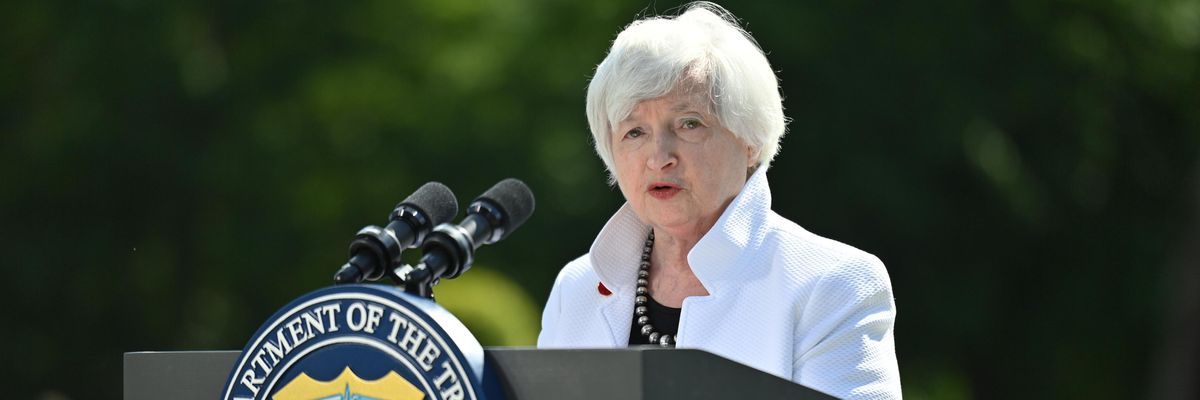
U.S. Treasury Secretary Janet Yellen speaks during a press conference on June 5, 2021 in London, England.
"To reject the very idea of a global minimum tax on billionaires is to cede control of our economies and our democracies to oligarchs and plutocrats," warned one progressive critic over the U.S. Treasury Secretary's position.
U.S. Treasury Secretary Janet Yellen is being taken to task by progressive critics after coming out Monday in opposition to a proposed global tax on billionaires at an upcoming Group of 7 nations meeting where the measure is on the agenda.
Speaking to the Wall Street Journal, Yellen told the newspaper that while the Biden administration broadly supports more progressive taxation, in which those at the top of the income and wealth scale pay higher rates, the U.S. will not back a plan—put forth by Brazil and backed other G20 leaders earlier this year—that would set a minimum international rate for the planet's ultra-wealthy.
In her remarks, Yellen said the "notion of some common global arrangement for taxing billionaires with proceeds redistributed in some way—we're not supportive of a process to try to achieve that. That's something we can't sign on to."
The proposed 2% global tax on the assets of the world's billionaires, backers of the idea argue, would be a way to curb the international race to the bottom on taxation by hampering the ability of those with vast fortunes to move their money from bank to bank and nation to nation as a way to avoid paying their fair share into public coffers.
The EU Tax Observatory, which helped formulate and backs the proposal, estimates that the 2% levy on the billionaires would raise $250 billion in annual revenues.
Given President Joe Biden and Yellen's support for a global minimum corporate tax and recent political messaging on the need to compel corporations and the wealthiest to pay higher taxes domestically, Morris Pearl, chair of the advocacy group Patriotic Millionaires, said opposition to a global billionaire tax was confounding.
"We are mystified by Secretary Yellen's comment suggesting she has rejected the G20 proposal for a global minimum tax on billionaires," Pearl said. "Her comment is starkly at odds with President Biden's stated goal of compelling billionaires to pay their fair share; it is at odds with the growing consensus on taxing the ultra-wealthy; and it is at odds with her own history of being a champion of international cooperation on tax matters."
Successful implementation of a billionaires tax, reports the WSJ, "would allow countries to raise more in tax revenue to finance other priorities and use the tax code to reduce income inequality, which has widened sharply in recent decades."
Floating the idea back in January, Brazil's Finance Minister Fernando Haddad said, "In a world where economic activities are increasingly transnational, we have to find new and creative ways to tax these activities [and] thus direct the revenues to common global endeavors such as ending hunger and poverty and fighting climate change."
According to Pearl:
Secretary Yellen's statement seems to stem from concerns that the revenue from such a tax would be"redistributed." However, the proposal would not institute a global tax that is then globally redistributed. The blueprint for this proposal is the OECD agreement for a global corporate minimum tax that she herself championed, which enables individual governments to determine how the taxes collected within their borders are spent.
If her concerns are simply about redistribution, she should clarify that ahead of her meetings later this week. But to reject the very idea of a global minimum tax on billionaires is to cede control of our economies and our democracies to oligarchs and plutocrats. In short, a wholesale surrender to the political influence of the ultra-rich would be a grave mistake.
Oxfam International calculated earlier this year that a 5% wealth tax targeting multimillionaires and billionaires in G20 countries could raise around $1.5 trillion a year in revenue globally. Such funds, the group said, would be "enough to end global hunger, help low- and middle-income countries adapt to climate change, and bring the world back on track to meeting the United Nations’ Sustainable Development Goals (SDG)—and still leave more than $546 billion to invest in inequality-busting public services and climate action in G20 countries."
Over the weekend, economist Gabriel Zucman, one the key architects behind the billionaires tax proposal put forward by Brazil, said "the super-rich will fight" such measures "tooth and nail," but "yes—we will have, one day, a coordinated minimum max on the super-rich. And perhaps sooner than you think!"
If he's correct, it doesn't look like Secretary Yellen or President Biden have received the memo.
Dear Common Dreams reader, It’s been nearly 30 years since I co-founded Common Dreams with my late wife, Lina Newhouser. We had the radical notion that journalism should serve the public good, not corporate profits. It was clear to us from the outset what it would take to build such a project. No paid advertisements. No corporate sponsors. No millionaire publisher telling us what to think or do. Many people said we wouldn't last a year, but we proved those doubters wrong. Together with a tremendous team of journalists and dedicated staff, we built an independent media outlet free from the constraints of profits and corporate control. Our mission has always been simple: To inform. To inspire. To ignite change for the common good. Building Common Dreams was not easy. Our survival was never guaranteed. When you take on the most powerful forces—Wall Street greed, fossil fuel industry destruction, Big Tech lobbyists, and uber-rich oligarchs who have spent billions upon billions rigging the economy and democracy in their favor—the only bulwark you have is supporters who believe in your work. But here’s the urgent message from me today. It's never been this bad out there. And it's never been this hard to keep us going. At the very moment Common Dreams is most needed, the threats we face are intensifying. We need your support now more than ever. We don't accept corporate advertising and never will. We don't have a paywall because we don't think people should be blocked from critical news based on their ability to pay. Everything we do is funded by the donations of readers like you. When everyone does the little they can afford, we are strong. But if that support retreats or dries up, so do we. Will you donate now to make sure Common Dreams not only survives but thrives? —Craig Brown, Co-founder |
U.S. Treasury Secretary Janet Yellen is being taken to task by progressive critics after coming out Monday in opposition to a proposed global tax on billionaires at an upcoming Group of 7 nations meeting where the measure is on the agenda.
Speaking to the Wall Street Journal, Yellen told the newspaper that while the Biden administration broadly supports more progressive taxation, in which those at the top of the income and wealth scale pay higher rates, the U.S. will not back a plan—put forth by Brazil and backed other G20 leaders earlier this year—that would set a minimum international rate for the planet's ultra-wealthy.
In her remarks, Yellen said the "notion of some common global arrangement for taxing billionaires with proceeds redistributed in some way—we're not supportive of a process to try to achieve that. That's something we can't sign on to."
The proposed 2% global tax on the assets of the world's billionaires, backers of the idea argue, would be a way to curb the international race to the bottom on taxation by hampering the ability of those with vast fortunes to move their money from bank to bank and nation to nation as a way to avoid paying their fair share into public coffers.
The EU Tax Observatory, which helped formulate and backs the proposal, estimates that the 2% levy on the billionaires would raise $250 billion in annual revenues.
Given President Joe Biden and Yellen's support for a global minimum corporate tax and recent political messaging on the need to compel corporations and the wealthiest to pay higher taxes domestically, Morris Pearl, chair of the advocacy group Patriotic Millionaires, said opposition to a global billionaire tax was confounding.
"We are mystified by Secretary Yellen's comment suggesting she has rejected the G20 proposal for a global minimum tax on billionaires," Pearl said. "Her comment is starkly at odds with President Biden's stated goal of compelling billionaires to pay their fair share; it is at odds with the growing consensus on taxing the ultra-wealthy; and it is at odds with her own history of being a champion of international cooperation on tax matters."
Successful implementation of a billionaires tax, reports the WSJ, "would allow countries to raise more in tax revenue to finance other priorities and use the tax code to reduce income inequality, which has widened sharply in recent decades."
Floating the idea back in January, Brazil's Finance Minister Fernando Haddad said, "In a world where economic activities are increasingly transnational, we have to find new and creative ways to tax these activities [and] thus direct the revenues to common global endeavors such as ending hunger and poverty and fighting climate change."
According to Pearl:
Secretary Yellen's statement seems to stem from concerns that the revenue from such a tax would be"redistributed." However, the proposal would not institute a global tax that is then globally redistributed. The blueprint for this proposal is the OECD agreement for a global corporate minimum tax that she herself championed, which enables individual governments to determine how the taxes collected within their borders are spent.
If her concerns are simply about redistribution, she should clarify that ahead of her meetings later this week. But to reject the very idea of a global minimum tax on billionaires is to cede control of our economies and our democracies to oligarchs and plutocrats. In short, a wholesale surrender to the political influence of the ultra-rich would be a grave mistake.
Oxfam International calculated earlier this year that a 5% wealth tax targeting multimillionaires and billionaires in G20 countries could raise around $1.5 trillion a year in revenue globally. Such funds, the group said, would be "enough to end global hunger, help low- and middle-income countries adapt to climate change, and bring the world back on track to meeting the United Nations’ Sustainable Development Goals (SDG)—and still leave more than $546 billion to invest in inequality-busting public services and climate action in G20 countries."
Over the weekend, economist Gabriel Zucman, one the key architects behind the billionaires tax proposal put forward by Brazil, said "the super-rich will fight" such measures "tooth and nail," but "yes—we will have, one day, a coordinated minimum max on the super-rich. And perhaps sooner than you think!"
If he's correct, it doesn't look like Secretary Yellen or President Biden have received the memo.
U.S. Treasury Secretary Janet Yellen is being taken to task by progressive critics after coming out Monday in opposition to a proposed global tax on billionaires at an upcoming Group of 7 nations meeting where the measure is on the agenda.
Speaking to the Wall Street Journal, Yellen told the newspaper that while the Biden administration broadly supports more progressive taxation, in which those at the top of the income and wealth scale pay higher rates, the U.S. will not back a plan—put forth by Brazil and backed other G20 leaders earlier this year—that would set a minimum international rate for the planet's ultra-wealthy.
In her remarks, Yellen said the "notion of some common global arrangement for taxing billionaires with proceeds redistributed in some way—we're not supportive of a process to try to achieve that. That's something we can't sign on to."
The proposed 2% global tax on the assets of the world's billionaires, backers of the idea argue, would be a way to curb the international race to the bottom on taxation by hampering the ability of those with vast fortunes to move their money from bank to bank and nation to nation as a way to avoid paying their fair share into public coffers.
The EU Tax Observatory, which helped formulate and backs the proposal, estimates that the 2% levy on the billionaires would raise $250 billion in annual revenues.
Given President Joe Biden and Yellen's support for a global minimum corporate tax and recent political messaging on the need to compel corporations and the wealthiest to pay higher taxes domestically, Morris Pearl, chair of the advocacy group Patriotic Millionaires, said opposition to a global billionaire tax was confounding.
"We are mystified by Secretary Yellen's comment suggesting she has rejected the G20 proposal for a global minimum tax on billionaires," Pearl said. "Her comment is starkly at odds with President Biden's stated goal of compelling billionaires to pay their fair share; it is at odds with the growing consensus on taxing the ultra-wealthy; and it is at odds with her own history of being a champion of international cooperation on tax matters."
Successful implementation of a billionaires tax, reports the WSJ, "would allow countries to raise more in tax revenue to finance other priorities and use the tax code to reduce income inequality, which has widened sharply in recent decades."
Floating the idea back in January, Brazil's Finance Minister Fernando Haddad said, "In a world where economic activities are increasingly transnational, we have to find new and creative ways to tax these activities [and] thus direct the revenues to common global endeavors such as ending hunger and poverty and fighting climate change."
According to Pearl:
Secretary Yellen's statement seems to stem from concerns that the revenue from such a tax would be"redistributed." However, the proposal would not institute a global tax that is then globally redistributed. The blueprint for this proposal is the OECD agreement for a global corporate minimum tax that she herself championed, which enables individual governments to determine how the taxes collected within their borders are spent.
If her concerns are simply about redistribution, she should clarify that ahead of her meetings later this week. But to reject the very idea of a global minimum tax on billionaires is to cede control of our economies and our democracies to oligarchs and plutocrats. In short, a wholesale surrender to the political influence of the ultra-rich would be a grave mistake.
Oxfam International calculated earlier this year that a 5% wealth tax targeting multimillionaires and billionaires in G20 countries could raise around $1.5 trillion a year in revenue globally. Such funds, the group said, would be "enough to end global hunger, help low- and middle-income countries adapt to climate change, and bring the world back on track to meeting the United Nations’ Sustainable Development Goals (SDG)—and still leave more than $546 billion to invest in inequality-busting public services and climate action in G20 countries."
Over the weekend, economist Gabriel Zucman, one the key architects behind the billionaires tax proposal put forward by Brazil, said "the super-rich will fight" such measures "tooth and nail," but "yes—we will have, one day, a coordinated minimum max on the super-rich. And perhaps sooner than you think!"
If he's correct, it doesn't look like Secretary Yellen or President Biden have received the memo.

