SUBSCRIBE TO OUR FREE NEWSLETTER
Daily news & progressive opinion—funded by the people, not the corporations—delivered straight to your inbox.
5
#000000
#FFFFFF
To donate by check, phone, or other method, see our More Ways to Give page.
Daily news & progressive opinion—funded by the people, not the corporations—delivered straight to your inbox.
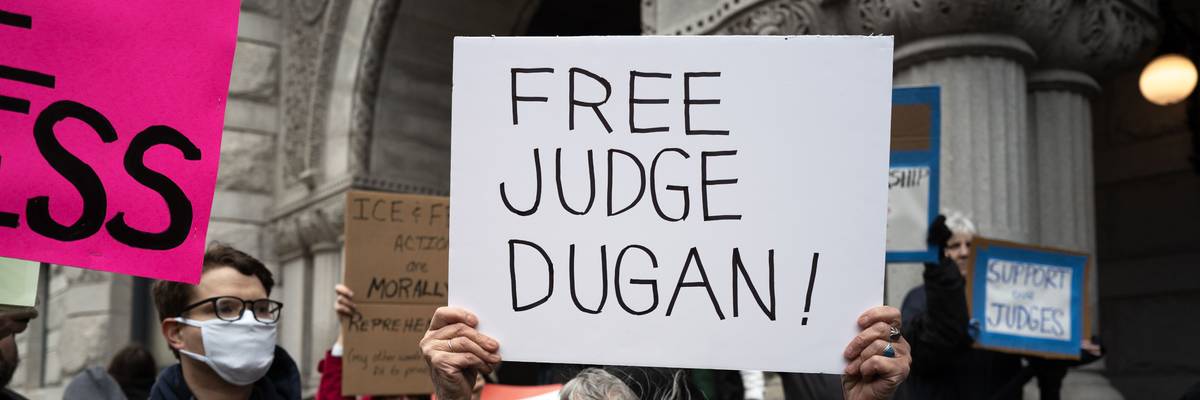
Demonstrators protest in front of the federal courthouse in Milwaukee, Wisconsin where Judge Hannah Dugan appeared in front of a judge after being arrested by the FBI on April 25, 2025.
Judge Hannah Dugan's case is "not about one judge," said an advocacy group, but rather "the normalization of ICE operating in courthouses."
The case of Wisconsin Judge Hannah Dugan "is a long way from over" said a lawyer for the judge after a jury found her guilty late Thursday of the felony charge of obstructing immigration agents who showed up at her courtroom in April with the aim of arresting an immigrant who was appearing before Dugan.
The jury deliberated for six hours before finding Dugan, a Milwaukee County circuit court judge, guilty of obstructing an official proceeding. The jurors acquitted her of a misdemeanor charge of concealing a person from arrest—a result her lawyer, Steve Biskupic, said he would question when he seeks to have the conviction thrown out by a court.
"While we are disappointed in today's outcome, the failure of the prosecution to secure convictions on both counts demonstrates the opportunity we have to clear Judge Dugan's name and show she did nothing wrong in this matter," said Dugan's legal team.
The Trump administration seized on the case in April after Dugan responded to FBI and US Immigration and Customs Enforcement (ICE) agents' presence in the courthouse by telling the defendant, Eduardo Flores-Ruiz, to go out a back door of her courtroom after she had sent the agents to another part of the building.
FBI Director Kash Patel posted a photo of Dugan in handcuffs on social media in April, and Attorney General Pam Bondi attacked the judge in television appearances, accusing her of “protecting a criminal defendant over victims of crime.”
The case began at Milwaukee County Courthouse in April, when Dugan was hearing a number of misdemeanor cases in one day. Flores-Ruiz, who had been deported in 2013 and had reentered the US without authorization, was facing battery charges.
Emails presented in Dugan's case this week showed she had tried to push Milwaukee County Chief Judge Carl Ashley to make an official policy regarding how judges should handle the arrival of federal agents at a time when President Donald Trump's rapid escalation of his mass deportation campaign was sending ICE officers to courthouses across the country. Courts had previously been treated as protected areas where immigration enforcement could not take place.
"We reject a system that uses prosecution and brute force to advance a far-right, anti-immigrant agenda and criminalizes those who stand up against this assault on our human and constitutional rights."
Without official guidelines in place, the court clerk who notified Dugan of the ICE agents' presence, Alan Freed, testified that he had been "upset and a little bit outraged" that the officers were there.
Dugan confronted the agents, who were sitting in the hallway and waiting to arrest Flores-Ruiz, and told them to go down the hall to Ashley's office.
An FBI special agent testified that Dugan "seemed to be angry" when she confronted the officers.
Dugan then returned to her courtroom and told Flores-Ruiz's lawyer she would find a new date for his hearing. She spoke privately to a court reporter saying Flores-Ruiz could leave the room through a side door that was not open to the public.
“I’ll get the heat," Dugan said.
The side door led to a stairwell and also to another door that opened into a public hallway where the federal agents were. Flores-Ruiz and his lawyer went through the door and an agent followed and then chased the defendant, arresting him outside the courthouse. Flores-Ruiz was deported last month.
Prosecutors said during the case that Dugan had intended for Flores-Ruiz to escape the agents by going down the stairwell—even though he did the opposite.
An attorney on Dugan's legal team said during closing arguments that she "never acted corruptly in doing her job as a judge in the middle of a stressful, new, and confusing situation."
Dugan could serve up to five years in prison and will likely be barred from serving as a judge, as the Wisconsin Constitution prohibits people convicted of felonies from holding public office.
Norm Eisen, executive chair of Democracy Defenders Fund, also emphasized that the case is "far from over."
"Substantial legal and constitutional issues remain unresolved, and they are exactly the kinds of questions appellate courts are meant to address. Higher courts will have the opportunity to determine whether this prosecution crossed the lines that protect the judiciary from executive overreach," said Eisen.
Milwaukee-based advocacy group Voces de la Frontera emphasized that Dugan's case "is not about one judge," but rather "the normalization of ICE operating in courthouses and the expansion of immigration enforcement into spaces meant to guarantee fairness, safety, and access to justice."
"By validating this prosecution, the verdict blurs the line between the courts and executive enforcement power, signaling that the law will be enforced aggressively against immigrants and those who dare to defend their rights, while the privileged and powerful continue to evade accountability," said the group, calling Dugan's case "a political prosecution that criminalized the exercise of judicial independence and the defense of due process."
Christine Neumann-Ortiz, executive director of Vocesde la Frontera, said the verdict "tells judges, court staff, and our communities that defending due process comes with consequences."
"That is not justice, it is intimidation," she said. "We reject a system that uses prosecution and brute force to advance a far-right, anti-immigrant agenda and criminalizes those who stand up against this assault on our human and constitutional rights. We stand in solidarity with Judge Hannah Dugan as her legal defense moves forward to clear her name, and we stand with the immigrant community in calling for ICE out of our courtrooms."
Dear Common Dreams reader, It’s been nearly 30 years since I co-founded Common Dreams with my late wife, Lina Newhouser. We had the radical notion that journalism should serve the public good, not corporate profits. It was clear to us from the outset what it would take to build such a project. No paid advertisements. No corporate sponsors. No millionaire publisher telling us what to think or do. Many people said we wouldn't last a year, but we proved those doubters wrong. Together with a tremendous team of journalists and dedicated staff, we built an independent media outlet free from the constraints of profits and corporate control. Our mission has always been simple: To inform. To inspire. To ignite change for the common good. Building Common Dreams was not easy. Our survival was never guaranteed. When you take on the most powerful forces—Wall Street greed, fossil fuel industry destruction, Big Tech lobbyists, and uber-rich oligarchs who have spent billions upon billions rigging the economy and democracy in their favor—the only bulwark you have is supporters who believe in your work. But here’s the urgent message from me today. It's never been this bad out there. And it's never been this hard to keep us going. At the very moment Common Dreams is most needed, the threats we face are intensifying. We need your support now more than ever. We don't accept corporate advertising and never will. We don't have a paywall because we don't think people should be blocked from critical news based on their ability to pay. Everything we do is funded by the donations of readers like you. When everyone does the little they can afford, we are strong. But if that support retreats or dries up, so do we. Will you donate now to make sure Common Dreams not only survives but thrives? —Craig Brown, Co-founder |
The case of Wisconsin Judge Hannah Dugan "is a long way from over" said a lawyer for the judge after a jury found her guilty late Thursday of the felony charge of obstructing immigration agents who showed up at her courtroom in April with the aim of arresting an immigrant who was appearing before Dugan.
The jury deliberated for six hours before finding Dugan, a Milwaukee County circuit court judge, guilty of obstructing an official proceeding. The jurors acquitted her of a misdemeanor charge of concealing a person from arrest—a result her lawyer, Steve Biskupic, said he would question when he seeks to have the conviction thrown out by a court.
"While we are disappointed in today's outcome, the failure of the prosecution to secure convictions on both counts demonstrates the opportunity we have to clear Judge Dugan's name and show she did nothing wrong in this matter," said Dugan's legal team.
The Trump administration seized on the case in April after Dugan responded to FBI and US Immigration and Customs Enforcement (ICE) agents' presence in the courthouse by telling the defendant, Eduardo Flores-Ruiz, to go out a back door of her courtroom after she had sent the agents to another part of the building.
FBI Director Kash Patel posted a photo of Dugan in handcuffs on social media in April, and Attorney General Pam Bondi attacked the judge in television appearances, accusing her of “protecting a criminal defendant over victims of crime.”
The case began at Milwaukee County Courthouse in April, when Dugan was hearing a number of misdemeanor cases in one day. Flores-Ruiz, who had been deported in 2013 and had reentered the US without authorization, was facing battery charges.
Emails presented in Dugan's case this week showed she had tried to push Milwaukee County Chief Judge Carl Ashley to make an official policy regarding how judges should handle the arrival of federal agents at a time when President Donald Trump's rapid escalation of his mass deportation campaign was sending ICE officers to courthouses across the country. Courts had previously been treated as protected areas where immigration enforcement could not take place.
"We reject a system that uses prosecution and brute force to advance a far-right, anti-immigrant agenda and criminalizes those who stand up against this assault on our human and constitutional rights."
Without official guidelines in place, the court clerk who notified Dugan of the ICE agents' presence, Alan Freed, testified that he had been "upset and a little bit outraged" that the officers were there.
Dugan confronted the agents, who were sitting in the hallway and waiting to arrest Flores-Ruiz, and told them to go down the hall to Ashley's office.
An FBI special agent testified that Dugan "seemed to be angry" when she confronted the officers.
Dugan then returned to her courtroom and told Flores-Ruiz's lawyer she would find a new date for his hearing. She spoke privately to a court reporter saying Flores-Ruiz could leave the room through a side door that was not open to the public.
“I’ll get the heat," Dugan said.
The side door led to a stairwell and also to another door that opened into a public hallway where the federal agents were. Flores-Ruiz and his lawyer went through the door and an agent followed and then chased the defendant, arresting him outside the courthouse. Flores-Ruiz was deported last month.
Prosecutors said during the case that Dugan had intended for Flores-Ruiz to escape the agents by going down the stairwell—even though he did the opposite.
An attorney on Dugan's legal team said during closing arguments that she "never acted corruptly in doing her job as a judge in the middle of a stressful, new, and confusing situation."
Dugan could serve up to five years in prison and will likely be barred from serving as a judge, as the Wisconsin Constitution prohibits people convicted of felonies from holding public office.
Norm Eisen, executive chair of Democracy Defenders Fund, also emphasized that the case is "far from over."
"Substantial legal and constitutional issues remain unresolved, and they are exactly the kinds of questions appellate courts are meant to address. Higher courts will have the opportunity to determine whether this prosecution crossed the lines that protect the judiciary from executive overreach," said Eisen.
Milwaukee-based advocacy group Voces de la Frontera emphasized that Dugan's case "is not about one judge," but rather "the normalization of ICE operating in courthouses and the expansion of immigration enforcement into spaces meant to guarantee fairness, safety, and access to justice."
"By validating this prosecution, the verdict blurs the line between the courts and executive enforcement power, signaling that the law will be enforced aggressively against immigrants and those who dare to defend their rights, while the privileged and powerful continue to evade accountability," said the group, calling Dugan's case "a political prosecution that criminalized the exercise of judicial independence and the defense of due process."
Christine Neumann-Ortiz, executive director of Vocesde la Frontera, said the verdict "tells judges, court staff, and our communities that defending due process comes with consequences."
"That is not justice, it is intimidation," she said. "We reject a system that uses prosecution and brute force to advance a far-right, anti-immigrant agenda and criminalizes those who stand up against this assault on our human and constitutional rights. We stand in solidarity with Judge Hannah Dugan as her legal defense moves forward to clear her name, and we stand with the immigrant community in calling for ICE out of our courtrooms."
The case of Wisconsin Judge Hannah Dugan "is a long way from over" said a lawyer for the judge after a jury found her guilty late Thursday of the felony charge of obstructing immigration agents who showed up at her courtroom in April with the aim of arresting an immigrant who was appearing before Dugan.
The jury deliberated for six hours before finding Dugan, a Milwaukee County circuit court judge, guilty of obstructing an official proceeding. The jurors acquitted her of a misdemeanor charge of concealing a person from arrest—a result her lawyer, Steve Biskupic, said he would question when he seeks to have the conviction thrown out by a court.
"While we are disappointed in today's outcome, the failure of the prosecution to secure convictions on both counts demonstrates the opportunity we have to clear Judge Dugan's name and show she did nothing wrong in this matter," said Dugan's legal team.
The Trump administration seized on the case in April after Dugan responded to FBI and US Immigration and Customs Enforcement (ICE) agents' presence in the courthouse by telling the defendant, Eduardo Flores-Ruiz, to go out a back door of her courtroom after she had sent the agents to another part of the building.
FBI Director Kash Patel posted a photo of Dugan in handcuffs on social media in April, and Attorney General Pam Bondi attacked the judge in television appearances, accusing her of “protecting a criminal defendant over victims of crime.”
The case began at Milwaukee County Courthouse in April, when Dugan was hearing a number of misdemeanor cases in one day. Flores-Ruiz, who had been deported in 2013 and had reentered the US without authorization, was facing battery charges.
Emails presented in Dugan's case this week showed she had tried to push Milwaukee County Chief Judge Carl Ashley to make an official policy regarding how judges should handle the arrival of federal agents at a time when President Donald Trump's rapid escalation of his mass deportation campaign was sending ICE officers to courthouses across the country. Courts had previously been treated as protected areas where immigration enforcement could not take place.
"We reject a system that uses prosecution and brute force to advance a far-right, anti-immigrant agenda and criminalizes those who stand up against this assault on our human and constitutional rights."
Without official guidelines in place, the court clerk who notified Dugan of the ICE agents' presence, Alan Freed, testified that he had been "upset and a little bit outraged" that the officers were there.
Dugan confronted the agents, who were sitting in the hallway and waiting to arrest Flores-Ruiz, and told them to go down the hall to Ashley's office.
An FBI special agent testified that Dugan "seemed to be angry" when she confronted the officers.
Dugan then returned to her courtroom and told Flores-Ruiz's lawyer she would find a new date for his hearing. She spoke privately to a court reporter saying Flores-Ruiz could leave the room through a side door that was not open to the public.
“I’ll get the heat," Dugan said.
The side door led to a stairwell and also to another door that opened into a public hallway where the federal agents were. Flores-Ruiz and his lawyer went through the door and an agent followed and then chased the defendant, arresting him outside the courthouse. Flores-Ruiz was deported last month.
Prosecutors said during the case that Dugan had intended for Flores-Ruiz to escape the agents by going down the stairwell—even though he did the opposite.
An attorney on Dugan's legal team said during closing arguments that she "never acted corruptly in doing her job as a judge in the middle of a stressful, new, and confusing situation."
Dugan could serve up to five years in prison and will likely be barred from serving as a judge, as the Wisconsin Constitution prohibits people convicted of felonies from holding public office.
Norm Eisen, executive chair of Democracy Defenders Fund, also emphasized that the case is "far from over."
"Substantial legal and constitutional issues remain unresolved, and they are exactly the kinds of questions appellate courts are meant to address. Higher courts will have the opportunity to determine whether this prosecution crossed the lines that protect the judiciary from executive overreach," said Eisen.
Milwaukee-based advocacy group Voces de la Frontera emphasized that Dugan's case "is not about one judge," but rather "the normalization of ICE operating in courthouses and the expansion of immigration enforcement into spaces meant to guarantee fairness, safety, and access to justice."
"By validating this prosecution, the verdict blurs the line between the courts and executive enforcement power, signaling that the law will be enforced aggressively against immigrants and those who dare to defend their rights, while the privileged and powerful continue to evade accountability," said the group, calling Dugan's case "a political prosecution that criminalized the exercise of judicial independence and the defense of due process."
Christine Neumann-Ortiz, executive director of Vocesde la Frontera, said the verdict "tells judges, court staff, and our communities that defending due process comes with consequences."
"That is not justice, it is intimidation," she said. "We reject a system that uses prosecution and brute force to advance a far-right, anti-immigrant agenda and criminalizes those who stand up against this assault on our human and constitutional rights. We stand in solidarity with Judge Hannah Dugan as her legal defense moves forward to clear her name, and we stand with the immigrant community in calling for ICE out of our courtrooms."