SUBSCRIBE TO OUR FREE NEWSLETTER
Daily news & progressive opinion—funded by the people, not the corporations—delivered straight to your inbox.
5
#000000
#FFFFFF
To donate by check, phone, or other method, see our More Ways to Give page.
Daily news & progressive opinion—funded by the people, not the corporations—delivered straight to your inbox.
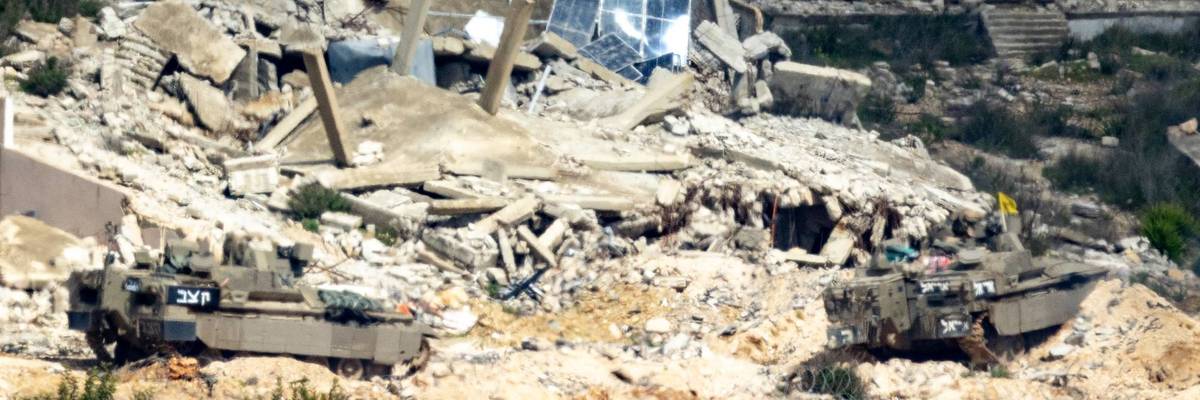
Israeli army vehicles maneuver across the border inside a destroyed Lebanese village as seen from the Upper Galilee in northern Israel on March 16, 2026.
"There is no clear exit strategy for this war. While in theory Israel is trying to coerce Lebanon into disarming Hezbollah, it is unlikely that can happen," said one analyst.
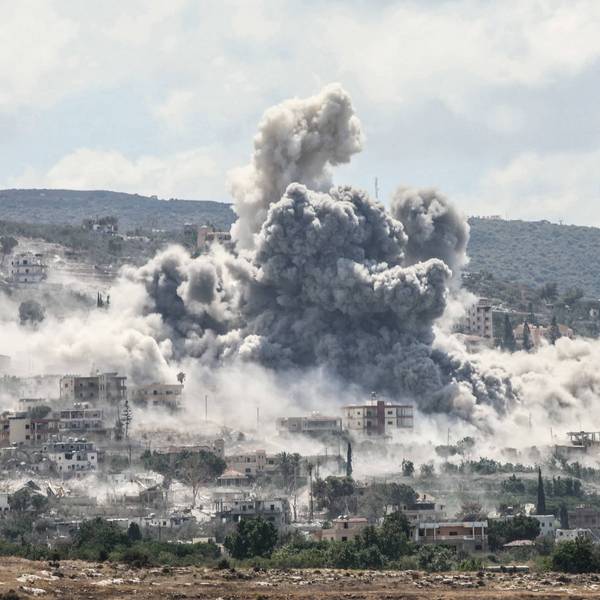
More than 800,000 Lebanese people who have been forced from their homes in southern Lebanon in the last two weeks have little hope of returning soon as the Israeli government on Monday announced its military had begun "limited and targeted ground operations" in and around the strategic southern town of Khiam, a stronghold of Hezbollah.
The ground attacks represent a significant expansion of the Israel Defense Forces' ground operations. On March 2, when Hezbollah fired rockets into Israel in retaliation for the US and Israel's killing of Iran's supreme leader, Ayatollah Ali Khamenei, Israel began sending troops into Lebanon to bolster the presence the IDF has had there in five areas since a 2024 ceasefire.
Until now, ground forces have conducted "limited incursions," Axios reported.
Israel has also launched airstrikes in Lebanon, killing at least 850 people—including 107 children and 66 women—since it was joined by the US late last month in abruptly ending diplomatic negotiations and attacking Iran.
The Times of Israel reported that the IDF carried out "massive airstrikes and artillery shelling 'to remove threats'" over the weekend before the 91st "Galilee" Regional Division began raiding the eastern section of southern Lebanon in attacks that the military said killed several Hezbollah operatives.
Israel conducted raids on towns including Burj Qalawiya, Sultyaniya, Chaqra, Qantara, and as-Sawana on Monday, according to Al Jazeera Arabic, with the military saying the 91st Division had "begun limited and targeted ground operations against key Hezbollah strongholds in southern Lebanon."
A major target of the ramped up ground attacks was Khiam, a Hezbollah stronghold that lies at a strategic junction of roads leading to the eastern and western sections of southern Lebanon.
"What Israel has been trying to do is really cut the supply lines and the difficult capabilities of Hezbollah, so it’s unable to bring in more weapons and fighters to areas south of the Litani River," reported Zeina Khodr of Al Jazeera.
Israeli Defense Minister Israel Katz said that due to what the IDF claimed will be "limited and targeted ground operations," close to a million people who have fled their homes in southern Lebanon "will not return to their homes south of the Litani River until the security of the residents of [northern Israel] is guaranteed.”
While claiming the operation in southern Lebanon will be "limited," Katz also said the operation is intended to resemble Israel's assault on Gaza, which has continued despite a ceasefire that was reached last October, has killed more than 75,000 Palestinians, and has been called a genocide by leading human rights groups and scholars.
Dozens of healthcare workers have been killed in Israeli strikes since the IDF began attacking Lebanon earlier this month; in Gaza, more than 1,500 doctors, nurses, and medics have been killed in October 2023. One attack that killed two paramedics this week in the southern village of Kfarsir was reportedly a "double-tap" strike in which first responders were killed when they arrived to help victims of an initial strike on a building.
The charity group Save the Children on Monday described children "clutching beloved pets and toys as they flee their homes in Lebanon due to the escalating conflict," and said nearly 300,000 children are among those who have been forcibly displaced.
More than 130,000 people are sheltering in overcrowded schools that have been repurposed as refugee shelters, said the group, and families have had to leave their homes without time to gather crucial documents, clothes, or medications.
“Many families were forced to flee in the middle of the night with nothing, and children miss their homes, their villages, their friends, and their schools," said Nora Ingdal, country director for Save the Children Lebanon. "I met a child who told me, ‘I'm not able to play here and I just want to go back to my village as soon as possible.’ One child I met clutched his blue toy car, as it was the only thing he had managed to bring from home."
"Hostilities must end and children must be protected at all costs," said Ingdal. "We know children are always the most impacted in any conflict, and the psychological impacts last long after any conflict ends."
The IDF is reportedly calling up 450,000 reservists to carry out the ground invasion, and the Israeli newspaper Yedioth Ahronoth reported that a senior Northern Command official told reservists in a briefing that the operation could continue "until Shavuot," a Jewish holiday falling between May 21-23.
"We will stay as long as necessary," the official said.
Lebanese security sources told Reuters Monday that the IDF had effectively taken control of Khiam and were advancing west toward the Litani River, which could cut off parts of southern Lebanon from the rest of the country.
Katz has also threatened to seize territory in the southern area in an effort to uproot Hezbollah.
Geopolitical analyst Shaiel Ben-Ephraim said Israel appears to be using "coercive diplomacy" and expressing a willingness to hold direct talks with Lebanon in the coming days.
"Israel is applying the Daheyia Doctrine, which uses overwhelming, disproportionate force against civilian infrastructure in areas controlled by Hezbollah to deter future attacks," said Ben-Ephraim. "However, they plan to use this increasingly against Lebanese infrastructure to coerce Lebanon into a deal."
"There is no clear exit strategy for this war. While in theory Israel is trying to coerce Lebanon into disarming Hezbollah, it is unlikely that can happen," he said.
US Sen. Chris Murphy (D-Conn.) emphasized that the expanded ground operation in Lebanon is one of several crises unfolding as a result of President Donald Trump's decision to launch attacks against Iran with Israel.
"A broader, regional war is breaking out," said Murphy. "Trump has no endgame. Iran and its proxies can create chaos indefinitely."
"All of this was totally foreseeable," he added. "Frankly, it’s why previous presidents weren’t so stupid to start a war like this. Trump has lost control of the war. His best course now is to cut his losses and end it. That’s the only way to prevent an even bigger disaster."
Dear Common Dreams reader, It’s been nearly 30 years since I co-founded Common Dreams with my late wife, Lina Newhouser. We had the radical notion that journalism should serve the public good, not corporate profits. It was clear to us from the outset what it would take to build such a project. No paid advertisements. No corporate sponsors. No millionaire publisher telling us what to think or do. Many people said we wouldn't last a year, but we proved those doubters wrong. Together with a tremendous team of journalists and dedicated staff, we built an independent media outlet free from the constraints of profits and corporate control. Our mission has always been simple: To inform. To inspire. To ignite change for the common good. Building Common Dreams was not easy. Our survival was never guaranteed. When you take on the most powerful forces—Wall Street greed, fossil fuel industry destruction, Big Tech lobbyists, and uber-rich oligarchs who have spent billions upon billions rigging the economy and democracy in their favor—the only bulwark you have is supporters who believe in your work. But here’s the urgent message from me today. It's never been this bad out there. And it's never been this hard to keep us going. At the very moment Common Dreams is most needed, the threats we face are intensifying. We need your support now more than ever. We don't accept corporate advertising and never will. We don't have a paywall because we don't think people should be blocked from critical news based on their ability to pay. Everything we do is funded by the donations of readers like you. When everyone does the little they can afford, we are strong. But if that support retreats or dries up, so do we. Will you donate now to make sure Common Dreams not only survives but thrives? —Craig Brown, Co-founder |
More than 800,000 Lebanese people who have been forced from their homes in southern Lebanon in the last two weeks have little hope of returning soon as the Israeli government on Monday announced its military had begun "limited and targeted ground operations" in and around the strategic southern town of Khiam, a stronghold of Hezbollah.
The ground attacks represent a significant expansion of the Israel Defense Forces' ground operations. On March 2, when Hezbollah fired rockets into Israel in retaliation for the US and Israel's killing of Iran's supreme leader, Ayatollah Ali Khamenei, Israel began sending troops into Lebanon to bolster the presence the IDF has had there in five areas since a 2024 ceasefire.
Until now, ground forces have conducted "limited incursions," Axios reported.
Israel has also launched airstrikes in Lebanon, killing at least 850 people—including 107 children and 66 women—since it was joined by the US late last month in abruptly ending diplomatic negotiations and attacking Iran.
The Times of Israel reported that the IDF carried out "massive airstrikes and artillery shelling 'to remove threats'" over the weekend before the 91st "Galilee" Regional Division began raiding the eastern section of southern Lebanon in attacks that the military said killed several Hezbollah operatives.
Israel conducted raids on towns including Burj Qalawiya, Sultyaniya, Chaqra, Qantara, and as-Sawana on Monday, according to Al Jazeera Arabic, with the military saying the 91st Division had "begun limited and targeted ground operations against key Hezbollah strongholds in southern Lebanon."
A major target of the ramped up ground attacks was Khiam, a Hezbollah stronghold that lies at a strategic junction of roads leading to the eastern and western sections of southern Lebanon.
"What Israel has been trying to do is really cut the supply lines and the difficult capabilities of Hezbollah, so it’s unable to bring in more weapons and fighters to areas south of the Litani River," reported Zeina Khodr of Al Jazeera.
Israeli Defense Minister Israel Katz said that due to what the IDF claimed will be "limited and targeted ground operations," close to a million people who have fled their homes in southern Lebanon "will not return to their homes south of the Litani River until the security of the residents of [northern Israel] is guaranteed.”
While claiming the operation in southern Lebanon will be "limited," Katz also said the operation is intended to resemble Israel's assault on Gaza, which has continued despite a ceasefire that was reached last October, has killed more than 75,000 Palestinians, and has been called a genocide by leading human rights groups and scholars.
Dozens of healthcare workers have been killed in Israeli strikes since the IDF began attacking Lebanon earlier this month; in Gaza, more than 1,500 doctors, nurses, and medics have been killed in October 2023. One attack that killed two paramedics this week in the southern village of Kfarsir was reportedly a "double-tap" strike in which first responders were killed when they arrived to help victims of an initial strike on a building.
The charity group Save the Children on Monday described children "clutching beloved pets and toys as they flee their homes in Lebanon due to the escalating conflict," and said nearly 300,000 children are among those who have been forcibly displaced.
More than 130,000 people are sheltering in overcrowded schools that have been repurposed as refugee shelters, said the group, and families have had to leave their homes without time to gather crucial documents, clothes, or medications.
“Many families were forced to flee in the middle of the night with nothing, and children miss their homes, their villages, their friends, and their schools," said Nora Ingdal, country director for Save the Children Lebanon. "I met a child who told me, ‘I'm not able to play here and I just want to go back to my village as soon as possible.’ One child I met clutched his blue toy car, as it was the only thing he had managed to bring from home."
"Hostilities must end and children must be protected at all costs," said Ingdal. "We know children are always the most impacted in any conflict, and the psychological impacts last long after any conflict ends."
The IDF is reportedly calling up 450,000 reservists to carry out the ground invasion, and the Israeli newspaper Yedioth Ahronoth reported that a senior Northern Command official told reservists in a briefing that the operation could continue "until Shavuot," a Jewish holiday falling between May 21-23.
"We will stay as long as necessary," the official said.
Lebanese security sources told Reuters Monday that the IDF had effectively taken control of Khiam and were advancing west toward the Litani River, which could cut off parts of southern Lebanon from the rest of the country.
Katz has also threatened to seize territory in the southern area in an effort to uproot Hezbollah.
Geopolitical analyst Shaiel Ben-Ephraim said Israel appears to be using "coercive diplomacy" and expressing a willingness to hold direct talks with Lebanon in the coming days.
"Israel is applying the Daheyia Doctrine, which uses overwhelming, disproportionate force against civilian infrastructure in areas controlled by Hezbollah to deter future attacks," said Ben-Ephraim. "However, they plan to use this increasingly against Lebanese infrastructure to coerce Lebanon into a deal."
"There is no clear exit strategy for this war. While in theory Israel is trying to coerce Lebanon into disarming Hezbollah, it is unlikely that can happen," he said.
US Sen. Chris Murphy (D-Conn.) emphasized that the expanded ground operation in Lebanon is one of several crises unfolding as a result of President Donald Trump's decision to launch attacks against Iran with Israel.
"A broader, regional war is breaking out," said Murphy. "Trump has no endgame. Iran and its proxies can create chaos indefinitely."
"All of this was totally foreseeable," he added. "Frankly, it’s why previous presidents weren’t so stupid to start a war like this. Trump has lost control of the war. His best course now is to cut his losses and end it. That’s the only way to prevent an even bigger disaster."
More than 800,000 Lebanese people who have been forced from their homes in southern Lebanon in the last two weeks have little hope of returning soon as the Israeli government on Monday announced its military had begun "limited and targeted ground operations" in and around the strategic southern town of Khiam, a stronghold of Hezbollah.
The ground attacks represent a significant expansion of the Israel Defense Forces' ground operations. On March 2, when Hezbollah fired rockets into Israel in retaliation for the US and Israel's killing of Iran's supreme leader, Ayatollah Ali Khamenei, Israel began sending troops into Lebanon to bolster the presence the IDF has had there in five areas since a 2024 ceasefire.
Until now, ground forces have conducted "limited incursions," Axios reported.
Israel has also launched airstrikes in Lebanon, killing at least 850 people—including 107 children and 66 women—since it was joined by the US late last month in abruptly ending diplomatic negotiations and attacking Iran.
The Times of Israel reported that the IDF carried out "massive airstrikes and artillery shelling 'to remove threats'" over the weekend before the 91st "Galilee" Regional Division began raiding the eastern section of southern Lebanon in attacks that the military said killed several Hezbollah operatives.
Israel conducted raids on towns including Burj Qalawiya, Sultyaniya, Chaqra, Qantara, and as-Sawana on Monday, according to Al Jazeera Arabic, with the military saying the 91st Division had "begun limited and targeted ground operations against key Hezbollah strongholds in southern Lebanon."
A major target of the ramped up ground attacks was Khiam, a Hezbollah stronghold that lies at a strategic junction of roads leading to the eastern and western sections of southern Lebanon.
"What Israel has been trying to do is really cut the supply lines and the difficult capabilities of Hezbollah, so it’s unable to bring in more weapons and fighters to areas south of the Litani River," reported Zeina Khodr of Al Jazeera.
Israeli Defense Minister Israel Katz said that due to what the IDF claimed will be "limited and targeted ground operations," close to a million people who have fled their homes in southern Lebanon "will not return to their homes south of the Litani River until the security of the residents of [northern Israel] is guaranteed.”
While claiming the operation in southern Lebanon will be "limited," Katz also said the operation is intended to resemble Israel's assault on Gaza, which has continued despite a ceasefire that was reached last October, has killed more than 75,000 Palestinians, and has been called a genocide by leading human rights groups and scholars.
Dozens of healthcare workers have been killed in Israeli strikes since the IDF began attacking Lebanon earlier this month; in Gaza, more than 1,500 doctors, nurses, and medics have been killed in October 2023. One attack that killed two paramedics this week in the southern village of Kfarsir was reportedly a "double-tap" strike in which first responders were killed when they arrived to help victims of an initial strike on a building.
The charity group Save the Children on Monday described children "clutching beloved pets and toys as they flee their homes in Lebanon due to the escalating conflict," and said nearly 300,000 children are among those who have been forcibly displaced.
More than 130,000 people are sheltering in overcrowded schools that have been repurposed as refugee shelters, said the group, and families have had to leave their homes without time to gather crucial documents, clothes, or medications.
“Many families were forced to flee in the middle of the night with nothing, and children miss their homes, their villages, their friends, and their schools," said Nora Ingdal, country director for Save the Children Lebanon. "I met a child who told me, ‘I'm not able to play here and I just want to go back to my village as soon as possible.’ One child I met clutched his blue toy car, as it was the only thing he had managed to bring from home."
"Hostilities must end and children must be protected at all costs," said Ingdal. "We know children are always the most impacted in any conflict, and the psychological impacts last long after any conflict ends."
The IDF is reportedly calling up 450,000 reservists to carry out the ground invasion, and the Israeli newspaper Yedioth Ahronoth reported that a senior Northern Command official told reservists in a briefing that the operation could continue "until Shavuot," a Jewish holiday falling between May 21-23.
"We will stay as long as necessary," the official said.
Lebanese security sources told Reuters Monday that the IDF had effectively taken control of Khiam and were advancing west toward the Litani River, which could cut off parts of southern Lebanon from the rest of the country.
Katz has also threatened to seize territory in the southern area in an effort to uproot Hezbollah.
Geopolitical analyst Shaiel Ben-Ephraim said Israel appears to be using "coercive diplomacy" and expressing a willingness to hold direct talks with Lebanon in the coming days.
"Israel is applying the Daheyia Doctrine, which uses overwhelming, disproportionate force against civilian infrastructure in areas controlled by Hezbollah to deter future attacks," said Ben-Ephraim. "However, they plan to use this increasingly against Lebanese infrastructure to coerce Lebanon into a deal."
"There is no clear exit strategy for this war. While in theory Israel is trying to coerce Lebanon into disarming Hezbollah, it is unlikely that can happen," he said.
US Sen. Chris Murphy (D-Conn.) emphasized that the expanded ground operation in Lebanon is one of several crises unfolding as a result of President Donald Trump's decision to launch attacks against Iran with Israel.
"A broader, regional war is breaking out," said Murphy. "Trump has no endgame. Iran and its proxies can create chaos indefinitely."
"All of this was totally foreseeable," he added. "Frankly, it’s why previous presidents weren’t so stupid to start a war like this. Trump has lost control of the war. His best course now is to cut his losses and end it. That’s the only way to prevent an even bigger disaster."