5
#000000
#FFFFFF
To donate by check, phone, or other method, see our More Ways to Give page.
Daily news & progressive opinion—funded by the people, not the corporations—delivered straight to your inbox.
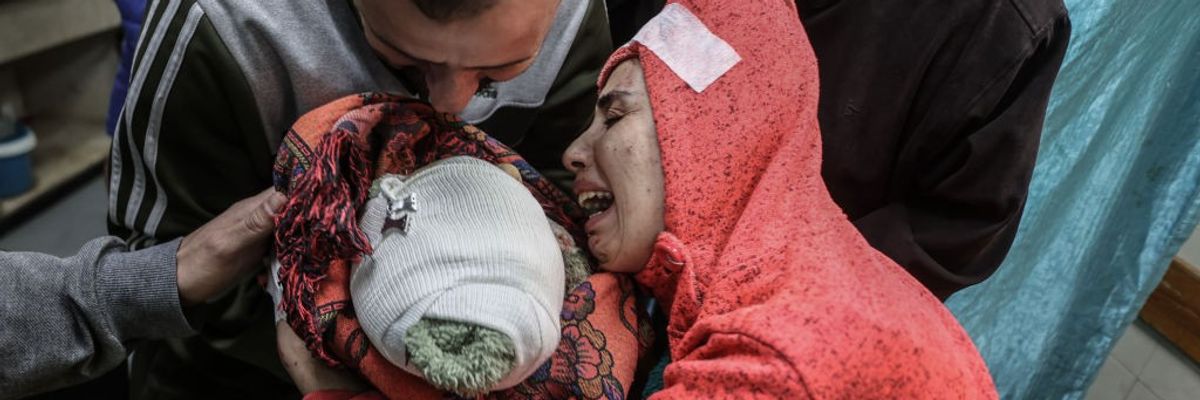
A mother mourns after her child was killed by an Israeli airstrike in Deir al-Balah, Gaza on January 9, 2025.
The peer-reviewed analysis estimates that Israel's assault on Gaza killed 64,260 people between October 7, 2023 and June 30, 2024—a figure significantly higher than the one reported by the enclave's health ministry.
A peer-reviewed analysis published in The Lancet on Thursday found that the official Gaza death toll reported by the enclave's Ministry of Health between October 7, 2023 and June 30, 2024 was likely a 41% undercount, a finding that underscores the devastation wrought by Israel's assault on the Palestinian territory and the difficulties of collecting accurate data amid relentless bombing.
During the period examined by the new study, Gaza's health ministry (MoH) reported that 37,877 people had been killed in Israeli attacks. But the Lancet analysis estimates that the death toll during that period was 64,260, with women, children, and the elderly accounting for nearly 60% of the deaths for which details were available.
That count only includes "deaths due to traumatic injury," leaving out deaths from starvation, cold, and disease.
To reach their estimate, the authors of the new study "composed three lists from successive MoH-collected hospital morgue data, an MoH online survey, and obituaries published on public social media pages" and "manually scraped information from open-source social media platforms, including specific obituary pages for Gaza shaheed, martyrs of Gaza, and The Palestinian Information Center to create our third capture-recapture list."
"These pages are widely used obituary spaces where relatives and friends inform their networks about deaths, offer condolences and prayers, and honor people known as martyrs (those killed in war)," the authors write. "The platforms span multiple social media channels, including X (formerly Twitter), Instagram, Facebook, WhatsApp, and Telegram. Throughout the study period, these pages were updated periodically and consistently, providing a comprehensive source of information on casualties. Obituaries typically included names, age at death, and date and location of death, and were often accompanied by photographs and personal stories. We translated English posts into Arabic to match names across lists and excluded deaths attributed to non-traumatic injuries."
The group of authors—which includes academics from the United Kingdom, the United States, and Japan—said the findings "show an exceptionally high mortality rate in the Gaza Strip during the period studied" and highlight "the urgent need for interventions to prevent further loss of life and illuminate important patterns in the conduct of the war."
Establishing an accurate count of the number of people killed in Israel's 15-month assault on the Gaza Strip, which began in the wake of a deadly Hamas-led attack, has been made extremely difficult by the Israeli military's incessant bombing and destruction of the enclave's medical infrastructure. There are also tens of thousands of people believed to be missing under the ruins of Gaza homes and buildings.
The Lancet study notes that "the escalation of Israeli military ground operations and attacks on healthcare facilities severely disrupted" Gaza officials' data-collection efforts. Prior to October 7, 2023, the MoH "had achieved good accuracy in mortality documentation, with underreporting estimated at 13%," the new analysis notes, and its figures were widely considered reliable.
But since Israel launched its catastrophic response to the Hamas-led attack, U.S. lawmakers and leaders who have backed Israel's assault—including President Joe Biden—have openly cast doubt on the ministry's data. Currently, the MoH estimates that more than 46,000 Palestinians have been killed since October 7, 2023.
Last month, the U.S. Congress approved a sprawling military policy bill that included a provision barring the Pentagon from publicly citing as "authoritative" death toll figures from Gaza's health ministry. Biden signed the measure into law on December 23.
"This is an alarming erasure of the suffering of the Palestinian people, ignoring the human toll of ongoing violence," Rep. Ilhan Omar (D-Minn.), who voted against the legislation, told The Intercept following House passage of the measure.
Dear Common Dreams reader, It’s been nearly 30 years since I co-founded Common Dreams with my late wife, Lina Newhouser. We had the radical notion that journalism should serve the public good, not corporate profits. It was clear to us from the outset what it would take to build such a project. No paid advertisements. No corporate sponsors. No millionaire publisher telling us what to think or do. Many people said we wouldn't last a year, but we proved those doubters wrong. Together with a tremendous team of journalists and dedicated staff, we built an independent media outlet free from the constraints of profits and corporate control. Our mission has always been simple: To inform. To inspire. To ignite change for the common good. Building Common Dreams was not easy. Our survival was never guaranteed. When you take on the most powerful forces—Wall Street greed, fossil fuel industry destruction, Big Tech lobbyists, and uber-rich oligarchs who have spent billions upon billions rigging the economy and democracy in their favor—the only bulwark you have is supporters who believe in your work. But here’s the urgent message from me today. It's never been this bad out there. And it's never been this hard to keep us going. At the very moment Common Dreams is most needed, the threats we face are intensifying. We need your support now more than ever. We don't accept corporate advertising and never will. We don't have a paywall because we don't think people should be blocked from critical news based on their ability to pay. Everything we do is funded by the donations of readers like you. When everyone does the little they can afford, we are strong. But if that support retreats or dries up, so do we. Will you donate now to make sure Common Dreams not only survives but thrives? —Craig Brown, Co-founder |
A peer-reviewed analysis published in The Lancet on Thursday found that the official Gaza death toll reported by the enclave's Ministry of Health between October 7, 2023 and June 30, 2024 was likely a 41% undercount, a finding that underscores the devastation wrought by Israel's assault on the Palestinian territory and the difficulties of collecting accurate data amid relentless bombing.
During the period examined by the new study, Gaza's health ministry (MoH) reported that 37,877 people had been killed in Israeli attacks. But the Lancet analysis estimates that the death toll during that period was 64,260, with women, children, and the elderly accounting for nearly 60% of the deaths for which details were available.
That count only includes "deaths due to traumatic injury," leaving out deaths from starvation, cold, and disease.
To reach their estimate, the authors of the new study "composed three lists from successive MoH-collected hospital morgue data, an MoH online survey, and obituaries published on public social media pages" and "manually scraped information from open-source social media platforms, including specific obituary pages for Gaza shaheed, martyrs of Gaza, and The Palestinian Information Center to create our third capture-recapture list."
"These pages are widely used obituary spaces where relatives and friends inform their networks about deaths, offer condolences and prayers, and honor people known as martyrs (those killed in war)," the authors write. "The platforms span multiple social media channels, including X (formerly Twitter), Instagram, Facebook, WhatsApp, and Telegram. Throughout the study period, these pages were updated periodically and consistently, providing a comprehensive source of information on casualties. Obituaries typically included names, age at death, and date and location of death, and were often accompanied by photographs and personal stories. We translated English posts into Arabic to match names across lists and excluded deaths attributed to non-traumatic injuries."
The group of authors—which includes academics from the United Kingdom, the United States, and Japan—said the findings "show an exceptionally high mortality rate in the Gaza Strip during the period studied" and highlight "the urgent need for interventions to prevent further loss of life and illuminate important patterns in the conduct of the war."
Establishing an accurate count of the number of people killed in Israel's 15-month assault on the Gaza Strip, which began in the wake of a deadly Hamas-led attack, has been made extremely difficult by the Israeli military's incessant bombing and destruction of the enclave's medical infrastructure. There are also tens of thousands of people believed to be missing under the ruins of Gaza homes and buildings.
The Lancet study notes that "the escalation of Israeli military ground operations and attacks on healthcare facilities severely disrupted" Gaza officials' data-collection efforts. Prior to October 7, 2023, the MoH "had achieved good accuracy in mortality documentation, with underreporting estimated at 13%," the new analysis notes, and its figures were widely considered reliable.
But since Israel launched its catastrophic response to the Hamas-led attack, U.S. lawmakers and leaders who have backed Israel's assault—including President Joe Biden—have openly cast doubt on the ministry's data. Currently, the MoH estimates that more than 46,000 Palestinians have been killed since October 7, 2023.
Last month, the U.S. Congress approved a sprawling military policy bill that included a provision barring the Pentagon from publicly citing as "authoritative" death toll figures from Gaza's health ministry. Biden signed the measure into law on December 23.
"This is an alarming erasure of the suffering of the Palestinian people, ignoring the human toll of ongoing violence," Rep. Ilhan Omar (D-Minn.), who voted against the legislation, told The Intercept following House passage of the measure.
A peer-reviewed analysis published in The Lancet on Thursday found that the official Gaza death toll reported by the enclave's Ministry of Health between October 7, 2023 and June 30, 2024 was likely a 41% undercount, a finding that underscores the devastation wrought by Israel's assault on the Palestinian territory and the difficulties of collecting accurate data amid relentless bombing.
During the period examined by the new study, Gaza's health ministry (MoH) reported that 37,877 people had been killed in Israeli attacks. But the Lancet analysis estimates that the death toll during that period was 64,260, with women, children, and the elderly accounting for nearly 60% of the deaths for which details were available.
That count only includes "deaths due to traumatic injury," leaving out deaths from starvation, cold, and disease.
To reach their estimate, the authors of the new study "composed three lists from successive MoH-collected hospital morgue data, an MoH online survey, and obituaries published on public social media pages" and "manually scraped information from open-source social media platforms, including specific obituary pages for Gaza shaheed, martyrs of Gaza, and The Palestinian Information Center to create our third capture-recapture list."
"These pages are widely used obituary spaces where relatives and friends inform their networks about deaths, offer condolences and prayers, and honor people known as martyrs (those killed in war)," the authors write. "The platforms span multiple social media channels, including X (formerly Twitter), Instagram, Facebook, WhatsApp, and Telegram. Throughout the study period, these pages were updated periodically and consistently, providing a comprehensive source of information on casualties. Obituaries typically included names, age at death, and date and location of death, and were often accompanied by photographs and personal stories. We translated English posts into Arabic to match names across lists and excluded deaths attributed to non-traumatic injuries."
The group of authors—which includes academics from the United Kingdom, the United States, and Japan—said the findings "show an exceptionally high mortality rate in the Gaza Strip during the period studied" and highlight "the urgent need for interventions to prevent further loss of life and illuminate important patterns in the conduct of the war."
Establishing an accurate count of the number of people killed in Israel's 15-month assault on the Gaza Strip, which began in the wake of a deadly Hamas-led attack, has been made extremely difficult by the Israeli military's incessant bombing and destruction of the enclave's medical infrastructure. There are also tens of thousands of people believed to be missing under the ruins of Gaza homes and buildings.
The Lancet study notes that "the escalation of Israeli military ground operations and attacks on healthcare facilities severely disrupted" Gaza officials' data-collection efforts. Prior to October 7, 2023, the MoH "had achieved good accuracy in mortality documentation, with underreporting estimated at 13%," the new analysis notes, and its figures were widely considered reliable.
But since Israel launched its catastrophic response to the Hamas-led attack, U.S. lawmakers and leaders who have backed Israel's assault—including President Joe Biden—have openly cast doubt on the ministry's data. Currently, the MoH estimates that more than 46,000 Palestinians have been killed since October 7, 2023.
Last month, the U.S. Congress approved a sprawling military policy bill that included a provision barring the Pentagon from publicly citing as "authoritative" death toll figures from Gaza's health ministry. Biden signed the measure into law on December 23.
"This is an alarming erasure of the suffering of the Palestinian people, ignoring the human toll of ongoing violence," Rep. Ilhan Omar (D-Minn.), who voted against the legislation, told The Intercept following House passage of the measure.