SUBSCRIBE TO OUR FREE NEWSLETTER
Daily news & progressive opinion—funded by the people, not the corporations—delivered straight to your inbox.
5
#000000
#FFFFFF
To donate by check, phone, or other method, see our More Ways to Give page.
Daily news & progressive opinion—funded by the people, not the corporations—delivered straight to your inbox.
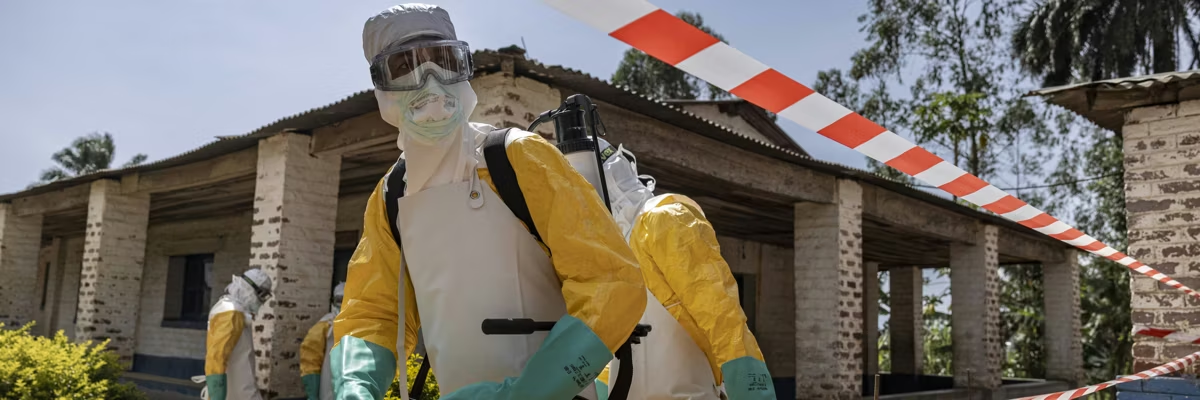
A member of the Médecins Sans Frontières (MSF) Ebola response team disinfects a restricted area outside the General Referral Hospital of Mongbwalu during outbreak preparedness and infection prevention activities on May 26, 2026 in Mongbwalu, Democratic Republic of Congo.
Kenya's largest medical professionals union, which welcomed the ruling, argued that if setting up an Ebola quarantine facility "is too dangerous for America, it is too dangerous for Kenya."
A day after US officials said Kenya had approved a request to open a quarantine center for Americans exposed to a rare strain of the Ebola virus, a court in the East African nation on Friday temporarily blocked the plan amid a growing outbreak in neighboring Uganda and the Democratic Republic of Congo.
The High Court prohibited the Kenyan government from establishing or operating any Ebola exposure, quarantine, isolation, or treatment facility in the country under any agreement with the United States or any other foreign government or agency.
The court also blocked Kenya's government from allowing anyone infected with or exposed to Ebola into the country pending the outcome of the case, which was filed by the Katiba Institute, a civil rights group.
“At its core, the case is about preserving constitutional accountability, protecting public health, and ensuring that no government may place expediency above the lives and safety of the people of Kenya,” Katiba Institute executive director Nora Mbagathi said Thursday.
A 50-bed Ebola quarantine center was set to open Friday at Laikipia Air Base in Nanyuki, located approximately 125 miles north of Nairobi. The facility would have been operated by members of the US Public Health Service, a uniformed branch of the Department of Health and Human Services.
US Secretary of State Marco Rubio said Thursday during a Cabinet meeting that “we cannot and will not allow any cases of Ebola to enter the United States."
However, US public health officials strongly criticized the plan to quarantine Americans in Kenya instead of repatriating them, with one emergency physician accusing the Trump administration of “a dramatic abdication of what we owe our own."
Elected leaders in Laikipia County welcomed the High Court's ruling. They had opposed the US quarantine center, and had asked in a joint statement prior to the decision, "Why Laikipia?"
"What does the US government know about this that they are not accepting their own affected citizens into their soil but are ready to have them elsewhere?" the officials added.
The Kenya Medical Practitioners, Pharmacists, and Dentists Union (KMPDU), which had strongly opposed the quarantine center and had threatened to strike, also welcomed the High Court ruling.
"We are utterly disgusted by the government’s apparent willingness to trade national biosecurity and the lives of its citizens for foreign aid," KMPDU secretary general Davji Bhimji Attelah said in a statement Thursday, referring to the $13.5 million the Trump administration pledged for Ebola preparedness in Kenya, part of a broader $125 million US commitment toward fighting the disease.
Kenyan healthcare workers are pushing back hard against reported plans for the U.S. to establish Ebola quarantine/treatment facilities in Kenya for exposed American personnel during the ongoing Bundibugyo Ebola outbreak in Central/East Africa.
[image or embed]
— BK. Titanji (@boghuma.bsky.social) May 28, 2026 at 11:31 AM
"We will not sit back and watch Kenya be treated as a containment colony for a lethal pathogen that we did not generate," Attelah added. “We will not tolerate an apartheid healthcare model on Kenyan soil. If it is too dangerous for America, it is too dangerous for Kenya."
Critics say President Donald Trump’s ideologically driven decision to withdraw the US from the World Health Organization (WHO), his administration’s dismantling of the US Agency for International Development, and reduced funding for the US Centers for Disease Control and Prevention’s global public health efforts have adversely affected the response to the current Ebola epidemic, compared with 2014 and 2019 outbreaks.
The WHO said Friday that there were a total of 906 suspected Ebola cases and 223 suspected deaths reported in the Democratic Republic of the Congo as of Wednesday, and 125 confirmed cases in the DRC and 9 in Uganda, with 18 deaths among the confirmed cases in both countries.
Ebola—which typically kills between 25% and 90% of infected people, depending upon the strain of the virus and quality of available medical care—causes widespread and often catastrophic damage to the body’s blood vessels, immune system, and organs. The virus is transmitted to people from wild animals, including fruit bats, porcupines, and non-human primates, and then spreads between humans through direct contact with the blood or bodily fluids of infected people.
Dear Common Dreams reader, It’s been nearly 30 years since I co-founded Common Dreams with my late wife, Lina Newhouser. We had the radical notion that journalism should serve the public good, not corporate profits. It was clear to us from the outset what it would take to build such a project. No paid advertisements. No corporate sponsors. No millionaire publisher telling us what to think or do. Many people said we wouldn't last a year, but we proved those doubters wrong. Together with a tremendous team of journalists and dedicated staff, we built an independent media outlet free from the constraints of profits and corporate control. Our mission has always been simple: To inform. To inspire. To ignite change for the common good. Building Common Dreams was not easy. Our survival was never guaranteed. When you take on the most powerful forces—Wall Street greed, fossil fuel industry destruction, Big Tech lobbyists, and uber-rich oligarchs who have spent billions upon billions rigging the economy and democracy in their favor—the only bulwark you have is supporters who believe in your work. But here’s the urgent message from me today. It's never been this bad out there. And it's never been this hard to keep us going. At the very moment Common Dreams is most needed, the threats we face are intensifying. We need your support now more than ever. We don't accept corporate advertising and never will. We don't have a paywall because we don't think people should be blocked from critical news based on their ability to pay. Everything we do is funded by the donations of readers like you. When everyone does the little they can afford, we are strong. But if that support retreats or dries up, so do we. Will you donate now to make sure Common Dreams not only survives but thrives? —Craig Brown, Co-founder |
A day after US officials said Kenya had approved a request to open a quarantine center for Americans exposed to a rare strain of the Ebola virus, a court in the East African nation on Friday temporarily blocked the plan amid a growing outbreak in neighboring Uganda and the Democratic Republic of Congo.
The High Court prohibited the Kenyan government from establishing or operating any Ebola exposure, quarantine, isolation, or treatment facility in the country under any agreement with the United States or any other foreign government or agency.
The court also blocked Kenya's government from allowing anyone infected with or exposed to Ebola into the country pending the outcome of the case, which was filed by the Katiba Institute, a civil rights group.
“At its core, the case is about preserving constitutional accountability, protecting public health, and ensuring that no government may place expediency above the lives and safety of the people of Kenya,” Katiba Institute executive director Nora Mbagathi said Thursday.
A 50-bed Ebola quarantine center was set to open Friday at Laikipia Air Base in Nanyuki, located approximately 125 miles north of Nairobi. The facility would have been operated by members of the US Public Health Service, a uniformed branch of the Department of Health and Human Services.
US Secretary of State Marco Rubio said Thursday during a Cabinet meeting that “we cannot and will not allow any cases of Ebola to enter the United States."
However, US public health officials strongly criticized the plan to quarantine Americans in Kenya instead of repatriating them, with one emergency physician accusing the Trump administration of “a dramatic abdication of what we owe our own."
Elected leaders in Laikipia County welcomed the High Court's ruling. They had opposed the US quarantine center, and had asked in a joint statement prior to the decision, "Why Laikipia?"
"What does the US government know about this that they are not accepting their own affected citizens into their soil but are ready to have them elsewhere?" the officials added.
The Kenya Medical Practitioners, Pharmacists, and Dentists Union (KMPDU), which had strongly opposed the quarantine center and had threatened to strike, also welcomed the High Court ruling.
"We are utterly disgusted by the government’s apparent willingness to trade national biosecurity and the lives of its citizens for foreign aid," KMPDU secretary general Davji Bhimji Attelah said in a statement Thursday, referring to the $13.5 million the Trump administration pledged for Ebola preparedness in Kenya, part of a broader $125 million US commitment toward fighting the disease.
Kenyan healthcare workers are pushing back hard against reported plans for the U.S. to establish Ebola quarantine/treatment facilities in Kenya for exposed American personnel during the ongoing Bundibugyo Ebola outbreak in Central/East Africa.
[image or embed]
— BK. Titanji (@boghuma.bsky.social) May 28, 2026 at 11:31 AM
"We will not sit back and watch Kenya be treated as a containment colony for a lethal pathogen that we did not generate," Attelah added. “We will not tolerate an apartheid healthcare model on Kenyan soil. If it is too dangerous for America, it is too dangerous for Kenya."
Critics say President Donald Trump’s ideologically driven decision to withdraw the US from the World Health Organization (WHO), his administration’s dismantling of the US Agency for International Development, and reduced funding for the US Centers for Disease Control and Prevention’s global public health efforts have adversely affected the response to the current Ebola epidemic, compared with 2014 and 2019 outbreaks.
The WHO said Friday that there were a total of 906 suspected Ebola cases and 223 suspected deaths reported in the Democratic Republic of the Congo as of Wednesday, and 125 confirmed cases in the DRC and 9 in Uganda, with 18 deaths among the confirmed cases in both countries.
Ebola—which typically kills between 25% and 90% of infected people, depending upon the strain of the virus and quality of available medical care—causes widespread and often catastrophic damage to the body’s blood vessels, immune system, and organs. The virus is transmitted to people from wild animals, including fruit bats, porcupines, and non-human primates, and then spreads between humans through direct contact with the blood or bodily fluids of infected people.
A day after US officials said Kenya had approved a request to open a quarantine center for Americans exposed to a rare strain of the Ebola virus, a court in the East African nation on Friday temporarily blocked the plan amid a growing outbreak in neighboring Uganda and the Democratic Republic of Congo.
The High Court prohibited the Kenyan government from establishing or operating any Ebola exposure, quarantine, isolation, or treatment facility in the country under any agreement with the United States or any other foreign government or agency.
The court also blocked Kenya's government from allowing anyone infected with or exposed to Ebola into the country pending the outcome of the case, which was filed by the Katiba Institute, a civil rights group.
“At its core, the case is about preserving constitutional accountability, protecting public health, and ensuring that no government may place expediency above the lives and safety of the people of Kenya,” Katiba Institute executive director Nora Mbagathi said Thursday.
A 50-bed Ebola quarantine center was set to open Friday at Laikipia Air Base in Nanyuki, located approximately 125 miles north of Nairobi. The facility would have been operated by members of the US Public Health Service, a uniformed branch of the Department of Health and Human Services.
US Secretary of State Marco Rubio said Thursday during a Cabinet meeting that “we cannot and will not allow any cases of Ebola to enter the United States."
However, US public health officials strongly criticized the plan to quarantine Americans in Kenya instead of repatriating them, with one emergency physician accusing the Trump administration of “a dramatic abdication of what we owe our own."
Elected leaders in Laikipia County welcomed the High Court's ruling. They had opposed the US quarantine center, and had asked in a joint statement prior to the decision, "Why Laikipia?"
"What does the US government know about this that they are not accepting their own affected citizens into their soil but are ready to have them elsewhere?" the officials added.
The Kenya Medical Practitioners, Pharmacists, and Dentists Union (KMPDU), which had strongly opposed the quarantine center and had threatened to strike, also welcomed the High Court ruling.
"We are utterly disgusted by the government’s apparent willingness to trade national biosecurity and the lives of its citizens for foreign aid," KMPDU secretary general Davji Bhimji Attelah said in a statement Thursday, referring to the $13.5 million the Trump administration pledged for Ebola preparedness in Kenya, part of a broader $125 million US commitment toward fighting the disease.
Kenyan healthcare workers are pushing back hard against reported plans for the U.S. to establish Ebola quarantine/treatment facilities in Kenya for exposed American personnel during the ongoing Bundibugyo Ebola outbreak in Central/East Africa.
[image or embed]
— BK. Titanji (@boghuma.bsky.social) May 28, 2026 at 11:31 AM
"We will not sit back and watch Kenya be treated as a containment colony for a lethal pathogen that we did not generate," Attelah added. “We will not tolerate an apartheid healthcare model on Kenyan soil. If it is too dangerous for America, it is too dangerous for Kenya."
Critics say President Donald Trump’s ideologically driven decision to withdraw the US from the World Health Organization (WHO), his administration’s dismantling of the US Agency for International Development, and reduced funding for the US Centers for Disease Control and Prevention’s global public health efforts have adversely affected the response to the current Ebola epidemic, compared with 2014 and 2019 outbreaks.
The WHO said Friday that there were a total of 906 suspected Ebola cases and 223 suspected deaths reported in the Democratic Republic of the Congo as of Wednesday, and 125 confirmed cases in the DRC and 9 in Uganda, with 18 deaths among the confirmed cases in both countries.
Ebola—which typically kills between 25% and 90% of infected people, depending upon the strain of the virus and quality of available medical care—causes widespread and often catastrophic damage to the body’s blood vessels, immune system, and organs. The virus is transmitted to people from wild animals, including fruit bats, porcupines, and non-human primates, and then spreads between humans through direct contact with the blood or bodily fluids of infected people.