
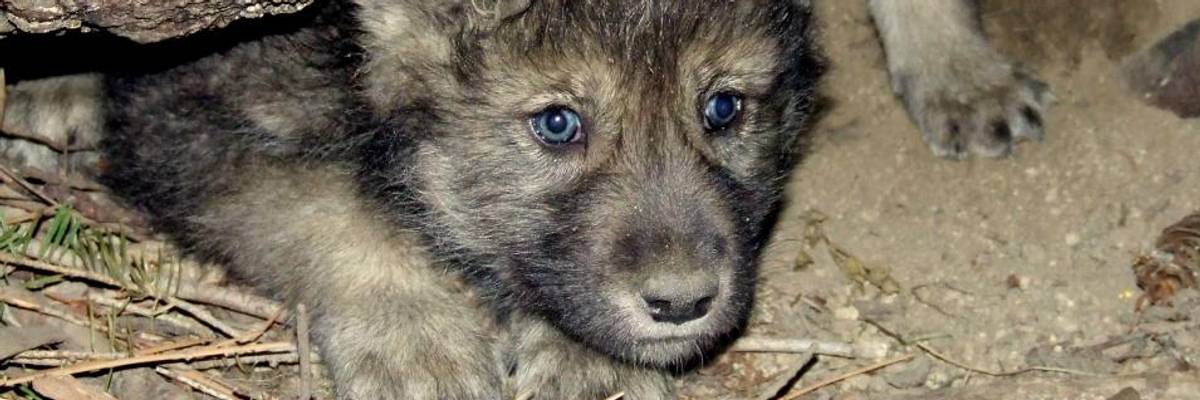
A gray wolf pup emerges from a den.
House GOP Anti-Wildlife 'Extremists' Approve Boebert's Delisting of Gray Wolves
"The inappropriately named 'Trust the Science Act' not only puts endangered gray wolves at risk for extinction, but it completely undermines the purpose of the Endangered Species Act," one wildlife advocate said.
Overriding the opposition of more than 100 environmental groups, the Republican-led House of Representatives passed a bill on Tuesday that would strip gray wolves in the Lower 48 states of their protections under the Endangered Species Act.
The so-called Trust the Science Act, which was introduced by far-right election denier Rep. Lauren Boebert (R-Colo.), passed by a narrow 209-205 margin. It would reimpose a Trump administration decision to delist gray wolves that was later overturned in federal court.
"This move by extremists in Congress to push forward an anti-wolf, anti-science bill is irresponsible and emboldens cruelty towards gray wolves," said Endangered Species Coalition executive director Susan Holmes.
"This is yet another troubling sign that our elected leaders in the House are increasingly choosing to subvert our nation's landmark environmental laws and ignore the biodiversity crisis that threatens wildlife populations around the globe with extinction."
There were once around 2 million gray wolves in North America, but they were nearly hunted to extinction with government support. After the federal government began to protect them in the 1960s, their numbers rebounded to around 6,000, but they only roam through less than 10% of their historic range in the lower 48 states.
Scientists have discovered that wolves are very beneficial for the ecosystems they inhabit; their reintroduction into Yellowstone National Park increased the park's biodiversity by controlling elk and deer that had overgrazed trees, allowing willows and aspens to thrive and attract the song birds and beavers that depend on them.
"The inappropriately named 'Trust the Science Act' not only puts endangered gray wolves at risk for extinction, but it completely undermines the purpose of the Endangered Species Act," Raena Garcia, senior fossil fuels and lands campaigner at Friends of the Earth, said in a statement. "The ESA is essential environmental legislation that needs to be strengthened, not weakened. As a keystone species that plays a vital role in preserving biodiversity, the livelihood of gray wolves can't be dictated by industry-driven politicians."
The Endangered Species Act Coalition and Friends of the Earth Action were two of the more than 100 groups that sent a letter to representatives on Monday urging them to oppose the bill. In the letter, they pointed out that the Trump-era ruling it is based on was overturned because of its faulty science: It based its determination for national wolves on only two populations, it did not define what it meant by a "significant" portion of the species' range, it did not consider what it means for gray wolves to have lost so much of their historic range, and it did not account for the fact that West Coast wolves and northern Rocky Mountain wolves have different ancestries. Despite these flaws with the decision, the bill would also prohibit courts from weighing in a second time.
"The 'Trust the Science Act' undermines the integrity of the ESA by forcing the reinstatement of the Trump administration's scientifically indefensible delisting rule and precluding judicial review, undermining the rule of law that holds government officials accountable in the courts," the conservation groups wrote.
Environmental organizations also argue that the bill would put wolves at even greater risk from human violence. In Wyoming, where wolves are delisted, a man recently injured a young wolf and showed it off at a local bar before killing it. When wolves were delisted during the Trump administration, a hunt reestablished in Wisconsin killed off up to a third of the state's wolves.
"The recent torture and killing of a young gray wolf in Wyoming shows how critical the Endangered Species Act protections are for the survival of this species core to our country's natural heritage," Holmes said.
The bill also comes as the Earth is losing species at such alarming rates that scientists say humans have likely instigated a sixth mass extinction.
"This is yet another troubling sign that our elected leaders in the House are increasingly choosing to subvert our nation's landmark environmental laws and ignore the biodiversity crisis that threatens wildlife populations around the globe with extinction," Robert Dewey, vice president of government relations for Defenders of Wildlife, said in a statement. "Wolves play hugely important roles in maintaining healthy ecosystems and cutting short their recovery will only harm our nation."
"The majority of Americans believe that protecting biodiversity should be a national priority and today their voices were stifled," Dewey continued. "We urge the Senate to take the scientifically sound path forward and not take up this bill."
Whatever the Senate decides, it is unlikely the bill would become law while President Joe Biden is in office. The Executive Office of the President's Office of Budget and Management issued a statement on Monday saying the Biden administration "strongly opposes" the bill, arguing that its passage "would undermine America's proud wildlife conservation traditions and the implementation of one of our nation's bedrock environmental laws."
We are at a crossroads
This country and this world are at a monumental crossroads. In a few short weeks, US voters will have an opportunity to beat back the forces of fascism and confront the billionaires who are rigging the economy, our media system, and our democracy, making it increasingly impossible for ordinary people to get by. We’re not just talking about the election. We’re talking about what must be done once these fascist elements are vanquished from power. We need a bolder set of solutions than what either major party has so far been willing to offer and a working-class movement ready to fight like hell for it. Trump didn't emerge from nowhere. The conditions that fueled MAGA authoritarianism were created by decades of radical neoliberal economic policies and a corrupt political system dominated by corporate interests. They slashed taxes on the super-rich, promising that the benefits would trickle down. They said giveaways to the corporate titans would make life more affordable for the rest of us. It was all bullshit. And when a bitter, betrayed populace searches for someone to blame, right-wing demagogues have little trouble finding scapegoats. People know when they're being lied to, but you won't hear any of this from the corporate media. Only independent journalism—powered and funded by people who believe in building a better world—can deliver truly trustworthy daily news. Our Fall Campaign is underway, and we need your help. To power our newsroom through the rest of the year, we need to raise $125,000 by midnight on October 31. So if you share our vision, please contribute whatever you can to sustain our work. |
Overriding the opposition of more than 100 environmental groups, the Republican-led House of Representatives passed a bill on Tuesday that would strip gray wolves in the Lower 48 states of their protections under the Endangered Species Act.
The so-called Trust the Science Act, which was introduced by far-right election denier Rep. Lauren Boebert (R-Colo.), passed by a narrow 209-205 margin. It would reimpose a Trump administration decision to delist gray wolves that was later overturned in federal court.
"This move by extremists in Congress to push forward an anti-wolf, anti-science bill is irresponsible and emboldens cruelty towards gray wolves," said Endangered Species Coalition executive director Susan Holmes.
"This is yet another troubling sign that our elected leaders in the House are increasingly choosing to subvert our nation's landmark environmental laws and ignore the biodiversity crisis that threatens wildlife populations around the globe with extinction."
There were once around 2 million gray wolves in North America, but they were nearly hunted to extinction with government support. After the federal government began to protect them in the 1960s, their numbers rebounded to around 6,000, but they only roam through less than 10% of their historic range in the lower 48 states.
Scientists have discovered that wolves are very beneficial for the ecosystems they inhabit; their reintroduction into Yellowstone National Park increased the park's biodiversity by controlling elk and deer that had overgrazed trees, allowing willows and aspens to thrive and attract the song birds and beavers that depend on them.
"The inappropriately named 'Trust the Science Act' not only puts endangered gray wolves at risk for extinction, but it completely undermines the purpose of the Endangered Species Act," Raena Garcia, senior fossil fuels and lands campaigner at Friends of the Earth, said in a statement. "The ESA is essential environmental legislation that needs to be strengthened, not weakened. As a keystone species that plays a vital role in preserving biodiversity, the livelihood of gray wolves can't be dictated by industry-driven politicians."
The Endangered Species Act Coalition and Friends of the Earth Action were two of the more than 100 groups that sent a letter to representatives on Monday urging them to oppose the bill. In the letter, they pointed out that the Trump-era ruling it is based on was overturned because of its faulty science: It based its determination for national wolves on only two populations, it did not define what it meant by a "significant" portion of the species' range, it did not consider what it means for gray wolves to have lost so much of their historic range, and it did not account for the fact that West Coast wolves and northern Rocky Mountain wolves have different ancestries. Despite these flaws with the decision, the bill would also prohibit courts from weighing in a second time.
"The 'Trust the Science Act' undermines the integrity of the ESA by forcing the reinstatement of the Trump administration's scientifically indefensible delisting rule and precluding judicial review, undermining the rule of law that holds government officials accountable in the courts," the conservation groups wrote.
Environmental organizations also argue that the bill would put wolves at even greater risk from human violence. In Wyoming, where wolves are delisted, a man recently injured a young wolf and showed it off at a local bar before killing it. When wolves were delisted during the Trump administration, a hunt reestablished in Wisconsin killed off up to a third of the state's wolves.
"The recent torture and killing of a young gray wolf in Wyoming shows how critical the Endangered Species Act protections are for the survival of this species core to our country's natural heritage," Holmes said.
The bill also comes as the Earth is losing species at such alarming rates that scientists say humans have likely instigated a sixth mass extinction.
"This is yet another troubling sign that our elected leaders in the House are increasingly choosing to subvert our nation's landmark environmental laws and ignore the biodiversity crisis that threatens wildlife populations around the globe with extinction," Robert Dewey, vice president of government relations for Defenders of Wildlife, said in a statement. "Wolves play hugely important roles in maintaining healthy ecosystems and cutting short their recovery will only harm our nation."
"The majority of Americans believe that protecting biodiversity should be a national priority and today their voices were stifled," Dewey continued. "We urge the Senate to take the scientifically sound path forward and not take up this bill."
Whatever the Senate decides, it is unlikely the bill would become law while President Joe Biden is in office. The Executive Office of the President's Office of Budget and Management issued a statement on Monday saying the Biden administration "strongly opposes" the bill, arguing that its passage "would undermine America's proud wildlife conservation traditions and the implementation of one of our nation's bedrock environmental laws."
- Idaho Lawmakers Green-Light Legislation to 'Wipe Out' Wolves ›
- Study Helps Explain How Wolf Removal Can 'Unravel' Key Ecological Systems | Common Dreams ›
- Opinion | Lead Ammo Harms Wildlife and Undermines the Mission of Our National Parks | Common Dreams ›
- Opinion | We Know What’s Behind Biodiversity Loss—It’s Time to Actually Tackle It | Common Dreams ›
- Judge Rules Rocky Mountain Wolves Wrongly Denied Endangered Species Protections | Common Dreams ›
Overriding the opposition of more than 100 environmental groups, the Republican-led House of Representatives passed a bill on Tuesday that would strip gray wolves in the Lower 48 states of their protections under the Endangered Species Act.
The so-called Trust the Science Act, which was introduced by far-right election denier Rep. Lauren Boebert (R-Colo.), passed by a narrow 209-205 margin. It would reimpose a Trump administration decision to delist gray wolves that was later overturned in federal court.
"This move by extremists in Congress to push forward an anti-wolf, anti-science bill is irresponsible and emboldens cruelty towards gray wolves," said Endangered Species Coalition executive director Susan Holmes.
"This is yet another troubling sign that our elected leaders in the House are increasingly choosing to subvert our nation's landmark environmental laws and ignore the biodiversity crisis that threatens wildlife populations around the globe with extinction."
There were once around 2 million gray wolves in North America, but they were nearly hunted to extinction with government support. After the federal government began to protect them in the 1960s, their numbers rebounded to around 6,000, but they only roam through less than 10% of their historic range in the lower 48 states.
Scientists have discovered that wolves are very beneficial for the ecosystems they inhabit; their reintroduction into Yellowstone National Park increased the park's biodiversity by controlling elk and deer that had overgrazed trees, allowing willows and aspens to thrive and attract the song birds and beavers that depend on them.
"The inappropriately named 'Trust the Science Act' not only puts endangered gray wolves at risk for extinction, but it completely undermines the purpose of the Endangered Species Act," Raena Garcia, senior fossil fuels and lands campaigner at Friends of the Earth, said in a statement. "The ESA is essential environmental legislation that needs to be strengthened, not weakened. As a keystone species that plays a vital role in preserving biodiversity, the livelihood of gray wolves can't be dictated by industry-driven politicians."
The Endangered Species Act Coalition and Friends of the Earth Action were two of the more than 100 groups that sent a letter to representatives on Monday urging them to oppose the bill. In the letter, they pointed out that the Trump-era ruling it is based on was overturned because of its faulty science: It based its determination for national wolves on only two populations, it did not define what it meant by a "significant" portion of the species' range, it did not consider what it means for gray wolves to have lost so much of their historic range, and it did not account for the fact that West Coast wolves and northern Rocky Mountain wolves have different ancestries. Despite these flaws with the decision, the bill would also prohibit courts from weighing in a second time.
"The 'Trust the Science Act' undermines the integrity of the ESA by forcing the reinstatement of the Trump administration's scientifically indefensible delisting rule and precluding judicial review, undermining the rule of law that holds government officials accountable in the courts," the conservation groups wrote.
Environmental organizations also argue that the bill would put wolves at even greater risk from human violence. In Wyoming, where wolves are delisted, a man recently injured a young wolf and showed it off at a local bar before killing it. When wolves were delisted during the Trump administration, a hunt reestablished in Wisconsin killed off up to a third of the state's wolves.
"The recent torture and killing of a young gray wolf in Wyoming shows how critical the Endangered Species Act protections are for the survival of this species core to our country's natural heritage," Holmes said.
The bill also comes as the Earth is losing species at such alarming rates that scientists say humans have likely instigated a sixth mass extinction.
"This is yet another troubling sign that our elected leaders in the House are increasingly choosing to subvert our nation's landmark environmental laws and ignore the biodiversity crisis that threatens wildlife populations around the globe with extinction," Robert Dewey, vice president of government relations for Defenders of Wildlife, said in a statement. "Wolves play hugely important roles in maintaining healthy ecosystems and cutting short their recovery will only harm our nation."
"The majority of Americans believe that protecting biodiversity should be a national priority and today their voices were stifled," Dewey continued. "We urge the Senate to take the scientifically sound path forward and not take up this bill."
Whatever the Senate decides, it is unlikely the bill would become law while President Joe Biden is in office. The Executive Office of the President's Office of Budget and Management issued a statement on Monday saying the Biden administration "strongly opposes" the bill, arguing that its passage "would undermine America's proud wildlife conservation traditions and the implementation of one of our nation's bedrock environmental laws."
- Idaho Lawmakers Green-Light Legislation to 'Wipe Out' Wolves ›
- Study Helps Explain How Wolf Removal Can 'Unravel' Key Ecological Systems | Common Dreams ›
- Opinion | Lead Ammo Harms Wildlife and Undermines the Mission of Our National Parks | Common Dreams ›
- Opinion | We Know What’s Behind Biodiversity Loss—It’s Time to Actually Tackle It | Common Dreams ›
- Judge Rules Rocky Mountain Wolves Wrongly Denied Endangered Species Protections | Common Dreams ›