SUBSCRIBE TO OUR FREE NEWSLETTER
Daily news & progressive opinion—funded by the people, not the corporations—delivered straight to your inbox.
5
#000000
#FFFFFF
To donate by check, phone, or other method, see our More Ways to Give page.
Daily news & progressive opinion—funded by the people, not the corporations—delivered straight to your inbox.
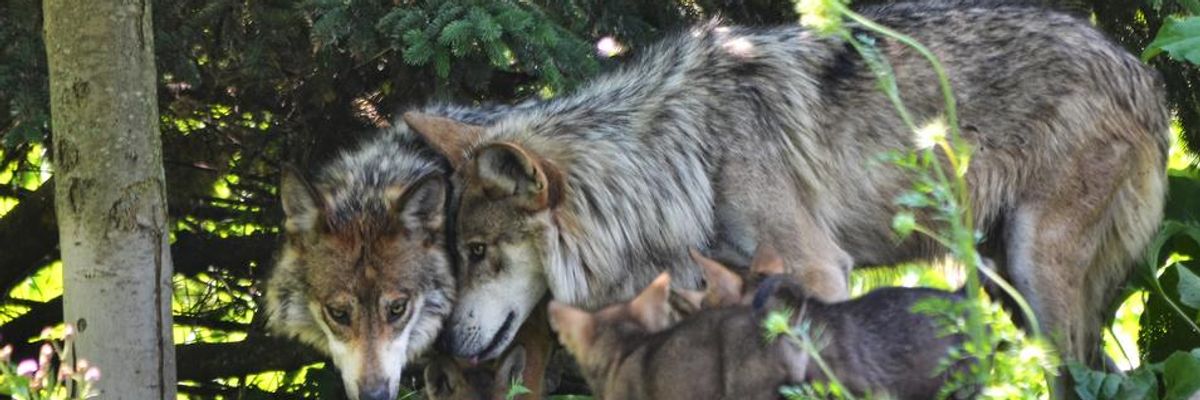
A family of gray wolves tends to their pups. After 45 years, gray wolves were delisted from the Endangered Species Act by the Trump administration on January 4, 2021. (Photo: Chad Horwedel/Flickr/cc)
Wildlife advocates on Monday accused the Trump administration of "willful ignorance" after the U.S. Fish and Wildlife Service delisted gray wolves from the Endangered Species Act after 45 years of protection, even though experts say the animals are far from out of the proverbial woods.
"Even with Trump's days in office dwindling, the long-term impact of illegitimate decisions like the wolf delisting will take years to correct."
--Lindsay Larris,
WildEarth Guardians
USFWS announced the rule change--one of over 100 regulatory rollbacks recently pushed through by the Trump administration--in October. The move will allow state authorities to treat the canines as predators and kill or protect them according to their respective laws.
In South Dakota, for example, hunters, trappers, landowners, and livestock producers are now permitted to kill gray wolves after obtaining the necessary paperwork, which includes a predator/varmint, furbearer, or hunting license. Landowners on their own property and minors under the age of 16 are exempt from licensing requirements.
In neighboring Minnesota, gray wolves will retain a higher level of protection in the northern part of the state--owners of livestock and other animals can kill wolves that pose an "immediate threat"--while in the southern two-thirds of the state people can shoot wolves that they believe pose any threat to livestock, as long as they surrender the carcass.
In Oregon, on the other hand, "wolves remain protected throughout the state," according to the Oregon Department of Fish and Wildlife. "Hunting and trapping of wolves remains prohibited statewide."
Last September, Common Dreams reported that an analysis of deregulation in some Western states revealed that a record-breaking 570 wolves, including dozens of pups, were brutally killed in Idaho over a recent one-year period.
"Tragically, we know how this will play out when states 'manage' wolves, as we have seen in the northern Rocky Mountain region in which they were previously delisted," Samantha Bruegger, wildlife coexistence campaigner for WildEarth Guardians, said in reaction to Monday's delisting.
Bruegger cited the Idaho killings, as well as the situation in Washington, where last year "the state slaughtered an entire pack of wolves due to supposed conflicts with ranching interests," as proof that "without federal protections, wolves are vulnerable to the whims and politics of state management."
Monday's delisting comes despite the enduring precarity of wolf populations throughout much of the country. According to the most recent USFWS data, there are only 108 wolves in Washington state, 158 in Oregon, and 15 in California, while wolves are "functionally extinct" in Nevada, Utah, and Colorado.
"These meager numbers lay the groundwork for a legal challenge planned by WildEarth Guardians with a coalition of conservation groups to be filed later this month," said Bruegger.
Lindsay Larris, wildlife program director at WildEarth Guardians, said in a statement that "the delisting of gray wolves is the latest causality of the Trump administration's willful ignorance of the biodiversity crisis and scientific facts."
"Even with [President Donald] Trump's days in office dwindling, the long-term impact of illegitimate decisions like the wolf delisting will take years to correct," Larris added. "Guardians is committed to challenging this decision in court, while working across political channels to ensure wolves receive as much protection as possible at the state level in the interim."
Dear Common Dreams reader, It’s been nearly 30 years since I co-founded Common Dreams with my late wife, Lina Newhouser. We had the radical notion that journalism should serve the public good, not corporate profits. It was clear to us from the outset what it would take to build such a project. No paid advertisements. No corporate sponsors. No millionaire publisher telling us what to think or do. Many people said we wouldn't last a year, but we proved those doubters wrong. Together with a tremendous team of journalists and dedicated staff, we built an independent media outlet free from the constraints of profits and corporate control. Our mission has always been simple: To inform. To inspire. To ignite change for the common good. Building Common Dreams was not easy. Our survival was never guaranteed. When you take on the most powerful forces—Wall Street greed, fossil fuel industry destruction, Big Tech lobbyists, and uber-rich oligarchs who have spent billions upon billions rigging the economy and democracy in their favor—the only bulwark you have is supporters who believe in your work. But here’s the urgent message from me today. It's never been this bad out there. And it's never been this hard to keep us going. At the very moment Common Dreams is most needed, the threats we face are intensifying. We need your support now more than ever. We don't accept corporate advertising and never will. We don't have a paywall because we don't think people should be blocked from critical news based on their ability to pay. Everything we do is funded by the donations of readers like you. When everyone does the little they can afford, we are strong. But if that support retreats or dries up, so do we. Will you donate now to make sure Common Dreams not only survives but thrives? —Craig Brown, Co-founder |
Wildlife advocates on Monday accused the Trump administration of "willful ignorance" after the U.S. Fish and Wildlife Service delisted gray wolves from the Endangered Species Act after 45 years of protection, even though experts say the animals are far from out of the proverbial woods.
"Even with Trump's days in office dwindling, the long-term impact of illegitimate decisions like the wolf delisting will take years to correct."
--Lindsay Larris,
WildEarth Guardians
USFWS announced the rule change--one of over 100 regulatory rollbacks recently pushed through by the Trump administration--in October. The move will allow state authorities to treat the canines as predators and kill or protect them according to their respective laws.
In South Dakota, for example, hunters, trappers, landowners, and livestock producers are now permitted to kill gray wolves after obtaining the necessary paperwork, which includes a predator/varmint, furbearer, or hunting license. Landowners on their own property and minors under the age of 16 are exempt from licensing requirements.
In neighboring Minnesota, gray wolves will retain a higher level of protection in the northern part of the state--owners of livestock and other animals can kill wolves that pose an "immediate threat"--while in the southern two-thirds of the state people can shoot wolves that they believe pose any threat to livestock, as long as they surrender the carcass.
In Oregon, on the other hand, "wolves remain protected throughout the state," according to the Oregon Department of Fish and Wildlife. "Hunting and trapping of wolves remains prohibited statewide."
Last September, Common Dreams reported that an analysis of deregulation in some Western states revealed that a record-breaking 570 wolves, including dozens of pups, were brutally killed in Idaho over a recent one-year period.
"Tragically, we know how this will play out when states 'manage' wolves, as we have seen in the northern Rocky Mountain region in which they were previously delisted," Samantha Bruegger, wildlife coexistence campaigner for WildEarth Guardians, said in reaction to Monday's delisting.
Bruegger cited the Idaho killings, as well as the situation in Washington, where last year "the state slaughtered an entire pack of wolves due to supposed conflicts with ranching interests," as proof that "without federal protections, wolves are vulnerable to the whims and politics of state management."
Monday's delisting comes despite the enduring precarity of wolf populations throughout much of the country. According to the most recent USFWS data, there are only 108 wolves in Washington state, 158 in Oregon, and 15 in California, while wolves are "functionally extinct" in Nevada, Utah, and Colorado.
"These meager numbers lay the groundwork for a legal challenge planned by WildEarth Guardians with a coalition of conservation groups to be filed later this month," said Bruegger.
Lindsay Larris, wildlife program director at WildEarth Guardians, said in a statement that "the delisting of gray wolves is the latest causality of the Trump administration's willful ignorance of the biodiversity crisis and scientific facts."
"Even with [President Donald] Trump's days in office dwindling, the long-term impact of illegitimate decisions like the wolf delisting will take years to correct," Larris added. "Guardians is committed to challenging this decision in court, while working across political channels to ensure wolves receive as much protection as possible at the state level in the interim."
Wildlife advocates on Monday accused the Trump administration of "willful ignorance" after the U.S. Fish and Wildlife Service delisted gray wolves from the Endangered Species Act after 45 years of protection, even though experts say the animals are far from out of the proverbial woods.
"Even with Trump's days in office dwindling, the long-term impact of illegitimate decisions like the wolf delisting will take years to correct."
--Lindsay Larris,
WildEarth Guardians
USFWS announced the rule change--one of over 100 regulatory rollbacks recently pushed through by the Trump administration--in October. The move will allow state authorities to treat the canines as predators and kill or protect them according to their respective laws.
In South Dakota, for example, hunters, trappers, landowners, and livestock producers are now permitted to kill gray wolves after obtaining the necessary paperwork, which includes a predator/varmint, furbearer, or hunting license. Landowners on their own property and minors under the age of 16 are exempt from licensing requirements.
In neighboring Minnesota, gray wolves will retain a higher level of protection in the northern part of the state--owners of livestock and other animals can kill wolves that pose an "immediate threat"--while in the southern two-thirds of the state people can shoot wolves that they believe pose any threat to livestock, as long as they surrender the carcass.
In Oregon, on the other hand, "wolves remain protected throughout the state," according to the Oregon Department of Fish and Wildlife. "Hunting and trapping of wolves remains prohibited statewide."
Last September, Common Dreams reported that an analysis of deregulation in some Western states revealed that a record-breaking 570 wolves, including dozens of pups, were brutally killed in Idaho over a recent one-year period.
"Tragically, we know how this will play out when states 'manage' wolves, as we have seen in the northern Rocky Mountain region in which they were previously delisted," Samantha Bruegger, wildlife coexistence campaigner for WildEarth Guardians, said in reaction to Monday's delisting.
Bruegger cited the Idaho killings, as well as the situation in Washington, where last year "the state slaughtered an entire pack of wolves due to supposed conflicts with ranching interests," as proof that "without federal protections, wolves are vulnerable to the whims and politics of state management."
Monday's delisting comes despite the enduring precarity of wolf populations throughout much of the country. According to the most recent USFWS data, there are only 108 wolves in Washington state, 158 in Oregon, and 15 in California, while wolves are "functionally extinct" in Nevada, Utah, and Colorado.
"These meager numbers lay the groundwork for a legal challenge planned by WildEarth Guardians with a coalition of conservation groups to be filed later this month," said Bruegger.
Lindsay Larris, wildlife program director at WildEarth Guardians, said in a statement that "the delisting of gray wolves is the latest causality of the Trump administration's willful ignorance of the biodiversity crisis and scientific facts."
"Even with [President Donald] Trump's days in office dwindling, the long-term impact of illegitimate decisions like the wolf delisting will take years to correct," Larris added. "Guardians is committed to challenging this decision in court, while working across political channels to ensure wolves receive as much protection as possible at the state level in the interim."