SUBSCRIBE TO OUR FREE NEWSLETTER
Daily news & progressive opinion—funded by the people, not the corporations—delivered straight to your inbox.
5
#000000
#FFFFFF
To donate by check, phone, or other method, see our More Ways to Give page.
Daily news & progressive opinion—funded by the people, not the corporations—delivered straight to your inbox.
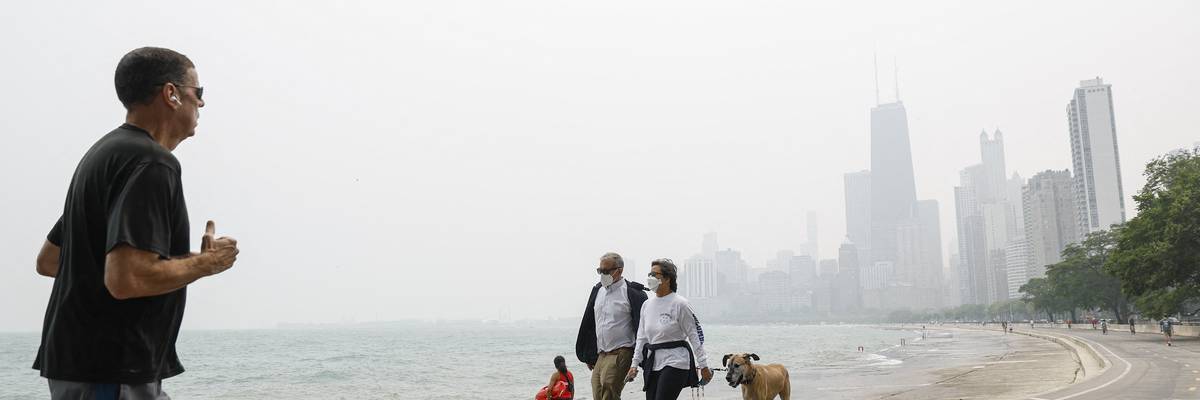
People walk and jog along the shoreline of Lake Michigan with heavy smoke from the Canadian wildfires in the background on June 27, 2023, in Chicago.
"We can't afford to wait. Climate action now."
More than 120 million people across the U.S.—over a third of the country's population—were living under air quality alerts as of late Wednesday as smoke from hundreds of out-of-control Canadian wildfires blanketed much of the Northeast and the Midwest, temporarily leaving Detroit and Chicago with the most polluted air in the world.
Michigan's air quality alert was extended through Thursday "as weather forecasters expected low-level winds to change direction, potentially resulting in more smoke and reduced visibility as a result of the Canadian wildfires," the Detroit Free Press noted Wednesday.
Residents of Michigan and other U.S. states reported smelling burning plastic, prompting toxicologists at Michigan's Department of Environment, Great Lakes, and Energy to observe that "wood fires emit a lot of volatile organic compounds (VOCs)," most of which "are noticeable to our noses as the familiar 'campfire' smell, but they break down quickly when exposed to UV radiation from sunlight."
"Other VOCs like benzene, formaldehyde, and acrolein are also released and they outlast the 'campfire' VOCs," the state officials said. "It's these chemical compounds that you're smelling as the smoke wafts around for a few days and settles to the ground and reaches your nose."
Dr. Glen Clark, emergency center chief at Corewell Health's Beaumont Hospital in Grosse Pointe, Michigan, said in a statement to the Free Press that his medical center has seen "a significant increase in respiratory complaints" over the past week.
"We've seen both asthma and COPD patients, who have been well controlled, presenting with exacerbations requiring an increase in use of asthma medications, including rescue inhalers," said Clark. "Even otherwise healthy individuals have come in complaining of chest tightness."
As of Thursday morning, the Swiss firm IQAir ranked Chicago and Detroit as the cities with the worst air quality in the world. Minneapolis briefly cracked the top five the previous day.
CNN reported Wednesday that "Chicago asked all residents—especially those with heart or lung disease, older adults, pregnant people, and young children—to avoid outdoor activities and protect themselves from exposure."
"Chicago Public Schools and camps are also moving activities indoors, city officials said in a news release," the outlet added. "About 11 miles away, Evanston, Illinois closed all swimming beaches and canceled a concert Tuesday due to the poor air quality, the city said on Facebook, asking residents to limit outdoor exposure through Wednesday."
As air quality deteriorated across Northeast and the Midwest, the U.S. South and Southwest experienced scorching temperatures, with at least nine people dying of heat-related causes in Texas.
"This is what we've been warning about... more extreme heat linked to the climate crisis," the youth-led Sunrise Movement tweeted Wednesday.
"We need to declare a climate emergency," the group added, reiterating a longstanding demand that President Joe Biden has thus far rejected.
Late Wednesday afternoon, the National Weather Service (NWS) wrote on social media that "dangerous heat persists for much of the southern U.S.," where tens of millions of people are living under heat advisories.
"Heat is the leading cause of weather-related fatalities each year," the agency stressed. "Take it seriously."
The Washington Post reported that "much of the United States felt like a blazing inferno on Wednesday, as record heat attacked the South like a blowtorch, thick smoke from Canadian wildfires blanketed the Great Lakes region, and triple-digit temperatures threatened to wallop California for the first time this year."
"Scientists said climate change helped shape the weather conditions that were causing misery and putting lives at risk from Mexico to Canada," the Post added. "There was no disputing the impact: If it wasn't way too smoky, it was way too hot."
"Texas is seeing a heatwave so deadly that the state is breaking all-time records for energy usage," the Institute for Policy Studies wrote Wednesday. "Detroit, Chicago, and Minneapolis are among the four cities with the worst air quality in the world due to [Canada wildfire] smoke. "We can't afford to wait. Climate action now."
Dear Common Dreams reader, It’s been nearly 30 years since I co-founded Common Dreams with my late wife, Lina Newhouser. We had the radical notion that journalism should serve the public good, not corporate profits. It was clear to us from the outset what it would take to build such a project. No paid advertisements. No corporate sponsors. No millionaire publisher telling us what to think or do. Many people said we wouldn't last a year, but we proved those doubters wrong. Together with a tremendous team of journalists and dedicated staff, we built an independent media outlet free from the constraints of profits and corporate control. Our mission has always been simple: To inform. To inspire. To ignite change for the common good. Building Common Dreams was not easy. Our survival was never guaranteed. When you take on the most powerful forces—Wall Street greed, fossil fuel industry destruction, Big Tech lobbyists, and uber-rich oligarchs who have spent billions upon billions rigging the economy and democracy in their favor—the only bulwark you have is supporters who believe in your work. But here’s the urgent message from me today. It's never been this bad out there. And it's never been this hard to keep us going. At the very moment Common Dreams is most needed, the threats we face are intensifying. We need your support now more than ever. We don't accept corporate advertising and never will. We don't have a paywall because we don't think people should be blocked from critical news based on their ability to pay. Everything we do is funded by the donations of readers like you. When everyone does the little they can afford, we are strong. But if that support retreats or dries up, so do we. Will you donate now to make sure Common Dreams not only survives but thrives? —Craig Brown, Co-founder |
More than 120 million people across the U.S.—over a third of the country's population—were living under air quality alerts as of late Wednesday as smoke from hundreds of out-of-control Canadian wildfires blanketed much of the Northeast and the Midwest, temporarily leaving Detroit and Chicago with the most polluted air in the world.
Michigan's air quality alert was extended through Thursday "as weather forecasters expected low-level winds to change direction, potentially resulting in more smoke and reduced visibility as a result of the Canadian wildfires," the Detroit Free Press noted Wednesday.
Residents of Michigan and other U.S. states reported smelling burning plastic, prompting toxicologists at Michigan's Department of Environment, Great Lakes, and Energy to observe that "wood fires emit a lot of volatile organic compounds (VOCs)," most of which "are noticeable to our noses as the familiar 'campfire' smell, but they break down quickly when exposed to UV radiation from sunlight."
"Other VOCs like benzene, formaldehyde, and acrolein are also released and they outlast the 'campfire' VOCs," the state officials said. "It's these chemical compounds that you're smelling as the smoke wafts around for a few days and settles to the ground and reaches your nose."
Dr. Glen Clark, emergency center chief at Corewell Health's Beaumont Hospital in Grosse Pointe, Michigan, said in a statement to the Free Press that his medical center has seen "a significant increase in respiratory complaints" over the past week.
"We've seen both asthma and COPD patients, who have been well controlled, presenting with exacerbations requiring an increase in use of asthma medications, including rescue inhalers," said Clark. "Even otherwise healthy individuals have come in complaining of chest tightness."
As of Thursday morning, the Swiss firm IQAir ranked Chicago and Detroit as the cities with the worst air quality in the world. Minneapolis briefly cracked the top five the previous day.
CNN reported Wednesday that "Chicago asked all residents—especially those with heart or lung disease, older adults, pregnant people, and young children—to avoid outdoor activities and protect themselves from exposure."
"Chicago Public Schools and camps are also moving activities indoors, city officials said in a news release," the outlet added. "About 11 miles away, Evanston, Illinois closed all swimming beaches and canceled a concert Tuesday due to the poor air quality, the city said on Facebook, asking residents to limit outdoor exposure through Wednesday."
As air quality deteriorated across Northeast and the Midwest, the U.S. South and Southwest experienced scorching temperatures, with at least nine people dying of heat-related causes in Texas.
"This is what we've been warning about... more extreme heat linked to the climate crisis," the youth-led Sunrise Movement tweeted Wednesday.
"We need to declare a climate emergency," the group added, reiterating a longstanding demand that President Joe Biden has thus far rejected.
Late Wednesday afternoon, the National Weather Service (NWS) wrote on social media that "dangerous heat persists for much of the southern U.S.," where tens of millions of people are living under heat advisories.
"Heat is the leading cause of weather-related fatalities each year," the agency stressed. "Take it seriously."
The Washington Post reported that "much of the United States felt like a blazing inferno on Wednesday, as record heat attacked the South like a blowtorch, thick smoke from Canadian wildfires blanketed the Great Lakes region, and triple-digit temperatures threatened to wallop California for the first time this year."
"Scientists said climate change helped shape the weather conditions that were causing misery and putting lives at risk from Mexico to Canada," the Post added. "There was no disputing the impact: If it wasn't way too smoky, it was way too hot."
"Texas is seeing a heatwave so deadly that the state is breaking all-time records for energy usage," the Institute for Policy Studies wrote Wednesday. "Detroit, Chicago, and Minneapolis are among the four cities with the worst air quality in the world due to [Canada wildfire] smoke. "We can't afford to wait. Climate action now."
More than 120 million people across the U.S.—over a third of the country's population—were living under air quality alerts as of late Wednesday as smoke from hundreds of out-of-control Canadian wildfires blanketed much of the Northeast and the Midwest, temporarily leaving Detroit and Chicago with the most polluted air in the world.
Michigan's air quality alert was extended through Thursday "as weather forecasters expected low-level winds to change direction, potentially resulting in more smoke and reduced visibility as a result of the Canadian wildfires," the Detroit Free Press noted Wednesday.
Residents of Michigan and other U.S. states reported smelling burning plastic, prompting toxicologists at Michigan's Department of Environment, Great Lakes, and Energy to observe that "wood fires emit a lot of volatile organic compounds (VOCs)," most of which "are noticeable to our noses as the familiar 'campfire' smell, but they break down quickly when exposed to UV radiation from sunlight."
"Other VOCs like benzene, formaldehyde, and acrolein are also released and they outlast the 'campfire' VOCs," the state officials said. "It's these chemical compounds that you're smelling as the smoke wafts around for a few days and settles to the ground and reaches your nose."
Dr. Glen Clark, emergency center chief at Corewell Health's Beaumont Hospital in Grosse Pointe, Michigan, said in a statement to the Free Press that his medical center has seen "a significant increase in respiratory complaints" over the past week.
"We've seen both asthma and COPD patients, who have been well controlled, presenting with exacerbations requiring an increase in use of asthma medications, including rescue inhalers," said Clark. "Even otherwise healthy individuals have come in complaining of chest tightness."
As of Thursday morning, the Swiss firm IQAir ranked Chicago and Detroit as the cities with the worst air quality in the world. Minneapolis briefly cracked the top five the previous day.
CNN reported Wednesday that "Chicago asked all residents—especially those with heart or lung disease, older adults, pregnant people, and young children—to avoid outdoor activities and protect themselves from exposure."
"Chicago Public Schools and camps are also moving activities indoors, city officials said in a news release," the outlet added. "About 11 miles away, Evanston, Illinois closed all swimming beaches and canceled a concert Tuesday due to the poor air quality, the city said on Facebook, asking residents to limit outdoor exposure through Wednesday."
As air quality deteriorated across Northeast and the Midwest, the U.S. South and Southwest experienced scorching temperatures, with at least nine people dying of heat-related causes in Texas.
"This is what we've been warning about... more extreme heat linked to the climate crisis," the youth-led Sunrise Movement tweeted Wednesday.
"We need to declare a climate emergency," the group added, reiterating a longstanding demand that President Joe Biden has thus far rejected.
Late Wednesday afternoon, the National Weather Service (NWS) wrote on social media that "dangerous heat persists for much of the southern U.S.," where tens of millions of people are living under heat advisories.
"Heat is the leading cause of weather-related fatalities each year," the agency stressed. "Take it seriously."
The Washington Post reported that "much of the United States felt like a blazing inferno on Wednesday, as record heat attacked the South like a blowtorch, thick smoke from Canadian wildfires blanketed the Great Lakes region, and triple-digit temperatures threatened to wallop California for the first time this year."
"Scientists said climate change helped shape the weather conditions that were causing misery and putting lives at risk from Mexico to Canada," the Post added. "There was no disputing the impact: If it wasn't way too smoky, it was way too hot."
"Texas is seeing a heatwave so deadly that the state is breaking all-time records for energy usage," the Institute for Policy Studies wrote Wednesday. "Detroit, Chicago, and Minneapolis are among the four cities with the worst air quality in the world due to [Canada wildfire] smoke. "We can't afford to wait. Climate action now."