5
#000000
#FFFFFF
To donate by check, phone, or other method, see our More Ways to Give page.
Daily news & progressive opinion—funded by the people, not the corporations—delivered straight to your inbox.
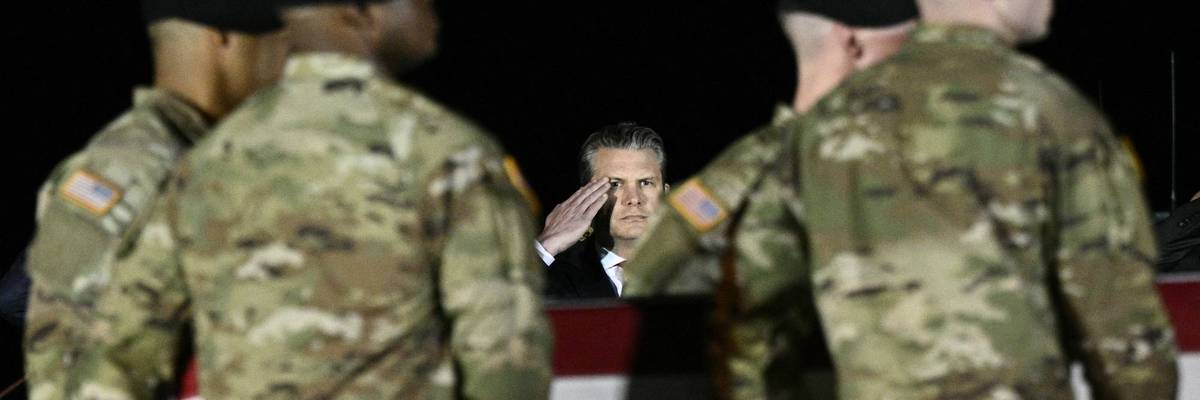
Pentagon Secretary Pete Hegseth salutes as members of a US Army team carry a flagged-draped transfer case containing the remains of American troops killed during the Iran war on March 9, 2026.
"Looking to the invasion of Iraq in 2003, a similar invasion of Iran, given its population size, would require as many as 1.6 million troops," warned one analyst.
The Trump administration is reportedly considering several options for a massive escalation of its unlawful war on Iran, heightening fears that US troops—possibly as early as Friday or the weekend—could be hurled into a deadly quagmire with no clear objective, legal rationale, or exit strategy.
Axios reported that among the options the Pentagon is considering are "invading or blockading" Kharg Island—Iran's primary oil export hub—and sending American forces "deep inside the interior of Iran" in an effort to seize the country's enriched uranium. The reporting indicates that the administration views the options as a "final blow" against Iran, despite US President Donald Trump's public claim that the war has already been won decisively.
The new reporting marked just the latest signal that the Trump administration could be readying a ground invasion, which—like the ongoing bombing campaign across Iran—has not been approved by the US Congress and would be deeply unpopular with the American public. The US and Iran have both put forth demands for a diplomatic resolution, but Iranian officials have said there are no active negotiations with the Trump administration, contrary to the president's claim earlier this week.
Brandan Buck, a research fellow at the libertarian Cato Institute who has criticized the war from the start, warned in a recent blog post that "any serious American invasion of Iran would likely rival or exceed the scale of Vietnam or the 1991 Gulf War, making it the largest US military undertaking since the Second World War."
"Looking to the invasion of Iraq in 2003, a similar invasion of Iran, given its population size, would require as many as 1.6 million troops," Buck noted. "Trump’s ill-considered decision to launch the war, coupled with his vague-but-ambitious goals, has made this impossible scenario a military possibility. Given the horrific costs such an invasion would entail, however, Trump should choose a different path: declare 'victory' and de-escalate."
Fears of an imminent ground invasion have spread to Republicans who were otherwise supportive of the Trump administration's decision to attack Iran. Rep. Nancy Mace (R-SC), who earlier this month voted against a resolution that aimed to stop the war, wrote on social media Wednesday afternoon that she "will not support troops on the ground in Iran."
Mace's post came shortly after she left a closed-door House Armed Services Committee briefing on Iran. The Republican lawmaker said she was "even more" opposed to a ground invasion following Wednesday's briefing.
"The justifications presented to the American public for the war in Iran were not the same military objectives we were briefed on today in the House Armed Services Committee," Mace wrote in a separate post on Wednesday. "This gap is deeply troubling. The longer this war continues, the faster it will lose the support of Congress and the American people."
Rep. Mike Rogers (R-Ala.), who celebrated the US-Israeli bombing of Iran when it kicked off last month, told reporters following Wednesday's briefing—nearly a month into the war—that "we want to know more about what’s going on, what the options are, and why they’re being considered."
"Trump has a well-documented pattern of escalating on Friday night, after the markets close."
House Democratic leaders, meanwhile, faced backlash for reportedly deciding to punt a vote on an Iran war powers resolution until at least mid-April, even amid mounting evidence that the Trump administration is barreling headlong toward an illegal and potentially catastrophic ground assault.
"Congress is in session until Friday, after which they will go on a two-week recess," noted Nathan Thompson, senior policy adviser at Just Foreign Policy. "Trump has a well-documented pattern of escalating on Friday night, after the markets close. If House Democrats and [the House Foreign Affairs Committee] wait until after the recess, the damage could be done."
The Pentagon earlier this week ordered roughly 2,000 soldiers from the Army's 82nd Airborne Division to head to the Middle East. According to the US Central Command, more than 50,000 American troops are currently involved in the war on Iran.
During a briefing on Wednesday, a reporter noted to White House Press Secretary Karoline Leavitt that the 82nd Airborne Division is "typically deployed at the beginning of conflicts."
"Does the White House consider this conflict as wrapping up, or is it changing shape?" the reporter asked.
Leavitt responded that "the president likes to maintain options at his disposal."
Drop Site's Ryan Grim, citing an unnamed source, reported Thursday that "Naval Special Warfare teams were also given deployment orders yesterday, as well as a bunch of Tier 1 operators."
Taken together, Grim argued, recent developments suggest that "all the pieces are in place for a ground operation within a day."
Dear Common Dreams reader, The U.S. is on a fast track to authoritarianism like nothing I've ever seen. Meanwhile, corporate news outlets are utterly capitulating to Trump, twisting their coverage to avoid drawing his ire while lining up to stuff cash in his pockets. That's why I believe that Common Dreams is doing the best and most consequential reporting that we've ever done. Our small but mighty team is a progressive reporting powerhouse, covering the news every day that the corporate media never will. Our mission has always been simple: To inform. To inspire. And to ignite change for the common good. Now here's the key piece that I want all our readers to understand: None of this would be possible without your financial support. That's not just some fundraising cliche. It's the absolute and literal truth. We don't accept corporate advertising and never will. We don't have a paywall because we don't think people should be blocked from critical news based on their ability to pay. Everything we do is funded by the donations of readers like you. Will you donate now to help power the nonprofit, independent reporting of Common Dreams? Thank you for being a vital member of our community. Together, we can keep independent journalism alive when it’s needed most. - Craig Brown, Co-founder |
The Trump administration is reportedly considering several options for a massive escalation of its unlawful war on Iran, heightening fears that US troops—possibly as early as Friday or the weekend—could be hurled into a deadly quagmire with no clear objective, legal rationale, or exit strategy.
Axios reported that among the options the Pentagon is considering are "invading or blockading" Kharg Island—Iran's primary oil export hub—and sending American forces "deep inside the interior of Iran" in an effort to seize the country's enriched uranium. The reporting indicates that the administration views the options as a "final blow" against Iran, despite US President Donald Trump's public claim that the war has already been won decisively.
The new reporting marked just the latest signal that the Trump administration could be readying a ground invasion, which—like the ongoing bombing campaign across Iran—has not been approved by the US Congress and would be deeply unpopular with the American public. The US and Iran have both put forth demands for a diplomatic resolution, but Iranian officials have said there are no active negotiations with the Trump administration, contrary to the president's claim earlier this week.
Brandan Buck, a research fellow at the libertarian Cato Institute who has criticized the war from the start, warned in a recent blog post that "any serious American invasion of Iran would likely rival or exceed the scale of Vietnam or the 1991 Gulf War, making it the largest US military undertaking since the Second World War."
"Looking to the invasion of Iraq in 2003, a similar invasion of Iran, given its population size, would require as many as 1.6 million troops," Buck noted. "Trump’s ill-considered decision to launch the war, coupled with his vague-but-ambitious goals, has made this impossible scenario a military possibility. Given the horrific costs such an invasion would entail, however, Trump should choose a different path: declare 'victory' and de-escalate."
Fears of an imminent ground invasion have spread to Republicans who were otherwise supportive of the Trump administration's decision to attack Iran. Rep. Nancy Mace (R-SC), who earlier this month voted against a resolution that aimed to stop the war, wrote on social media Wednesday afternoon that she "will not support troops on the ground in Iran."
Mace's post came shortly after she left a closed-door House Armed Services Committee briefing on Iran. The Republican lawmaker said she was "even more" opposed to a ground invasion following Wednesday's briefing.
"The justifications presented to the American public for the war in Iran were not the same military objectives we were briefed on today in the House Armed Services Committee," Mace wrote in a separate post on Wednesday. "This gap is deeply troubling. The longer this war continues, the faster it will lose the support of Congress and the American people."
Rep. Mike Rogers (R-Ala.), who celebrated the US-Israeli bombing of Iran when it kicked off last month, told reporters following Wednesday's briefing—nearly a month into the war—that "we want to know more about what’s going on, what the options are, and why they’re being considered."
"Trump has a well-documented pattern of escalating on Friday night, after the markets close."
House Democratic leaders, meanwhile, faced backlash for reportedly deciding to punt a vote on an Iran war powers resolution until at least mid-April, even amid mounting evidence that the Trump administration is barreling headlong toward an illegal and potentially catastrophic ground assault.
"Congress is in session until Friday, after which they will go on a two-week recess," noted Nathan Thompson, senior policy adviser at Just Foreign Policy. "Trump has a well-documented pattern of escalating on Friday night, after the markets close. If House Democrats and [the House Foreign Affairs Committee] wait until after the recess, the damage could be done."
The Pentagon earlier this week ordered roughly 2,000 soldiers from the Army's 82nd Airborne Division to head to the Middle East. According to the US Central Command, more than 50,000 American troops are currently involved in the war on Iran.
During a briefing on Wednesday, a reporter noted to White House Press Secretary Karoline Leavitt that the 82nd Airborne Division is "typically deployed at the beginning of conflicts."
"Does the White House consider this conflict as wrapping up, or is it changing shape?" the reporter asked.
Leavitt responded that "the president likes to maintain options at his disposal."
Drop Site's Ryan Grim, citing an unnamed source, reported Thursday that "Naval Special Warfare teams were also given deployment orders yesterday, as well as a bunch of Tier 1 operators."
Taken together, Grim argued, recent developments suggest that "all the pieces are in place for a ground operation within a day."
The Trump administration is reportedly considering several options for a massive escalation of its unlawful war on Iran, heightening fears that US troops—possibly as early as Friday or the weekend—could be hurled into a deadly quagmire with no clear objective, legal rationale, or exit strategy.
Axios reported that among the options the Pentagon is considering are "invading or blockading" Kharg Island—Iran's primary oil export hub—and sending American forces "deep inside the interior of Iran" in an effort to seize the country's enriched uranium. The reporting indicates that the administration views the options as a "final blow" against Iran, despite US President Donald Trump's public claim that the war has already been won decisively.
The new reporting marked just the latest signal that the Trump administration could be readying a ground invasion, which—like the ongoing bombing campaign across Iran—has not been approved by the US Congress and would be deeply unpopular with the American public. The US and Iran have both put forth demands for a diplomatic resolution, but Iranian officials have said there are no active negotiations with the Trump administration, contrary to the president's claim earlier this week.
Brandan Buck, a research fellow at the libertarian Cato Institute who has criticized the war from the start, warned in a recent blog post that "any serious American invasion of Iran would likely rival or exceed the scale of Vietnam or the 1991 Gulf War, making it the largest US military undertaking since the Second World War."
"Looking to the invasion of Iraq in 2003, a similar invasion of Iran, given its population size, would require as many as 1.6 million troops," Buck noted. "Trump’s ill-considered decision to launch the war, coupled with his vague-but-ambitious goals, has made this impossible scenario a military possibility. Given the horrific costs such an invasion would entail, however, Trump should choose a different path: declare 'victory' and de-escalate."
Fears of an imminent ground invasion have spread to Republicans who were otherwise supportive of the Trump administration's decision to attack Iran. Rep. Nancy Mace (R-SC), who earlier this month voted against a resolution that aimed to stop the war, wrote on social media Wednesday afternoon that she "will not support troops on the ground in Iran."
Mace's post came shortly after she left a closed-door House Armed Services Committee briefing on Iran. The Republican lawmaker said she was "even more" opposed to a ground invasion following Wednesday's briefing.
"The justifications presented to the American public for the war in Iran were not the same military objectives we were briefed on today in the House Armed Services Committee," Mace wrote in a separate post on Wednesday. "This gap is deeply troubling. The longer this war continues, the faster it will lose the support of Congress and the American people."
Rep. Mike Rogers (R-Ala.), who celebrated the US-Israeli bombing of Iran when it kicked off last month, told reporters following Wednesday's briefing—nearly a month into the war—that "we want to know more about what’s going on, what the options are, and why they’re being considered."
"Trump has a well-documented pattern of escalating on Friday night, after the markets close."
House Democratic leaders, meanwhile, faced backlash for reportedly deciding to punt a vote on an Iran war powers resolution until at least mid-April, even amid mounting evidence that the Trump administration is barreling headlong toward an illegal and potentially catastrophic ground assault.
"Congress is in session until Friday, after which they will go on a two-week recess," noted Nathan Thompson, senior policy adviser at Just Foreign Policy. "Trump has a well-documented pattern of escalating on Friday night, after the markets close. If House Democrats and [the House Foreign Affairs Committee] wait until after the recess, the damage could be done."
The Pentagon earlier this week ordered roughly 2,000 soldiers from the Army's 82nd Airborne Division to head to the Middle East. According to the US Central Command, more than 50,000 American troops are currently involved in the war on Iran.
During a briefing on Wednesday, a reporter noted to White House Press Secretary Karoline Leavitt that the 82nd Airborne Division is "typically deployed at the beginning of conflicts."
"Does the White House consider this conflict as wrapping up, or is it changing shape?" the reporter asked.
Leavitt responded that "the president likes to maintain options at his disposal."
Drop Site's Ryan Grim, citing an unnamed source, reported Thursday that "Naval Special Warfare teams were also given deployment orders yesterday, as well as a bunch of Tier 1 operators."
Taken together, Grim argued, recent developments suggest that "all the pieces are in place for a ground operation within a day."